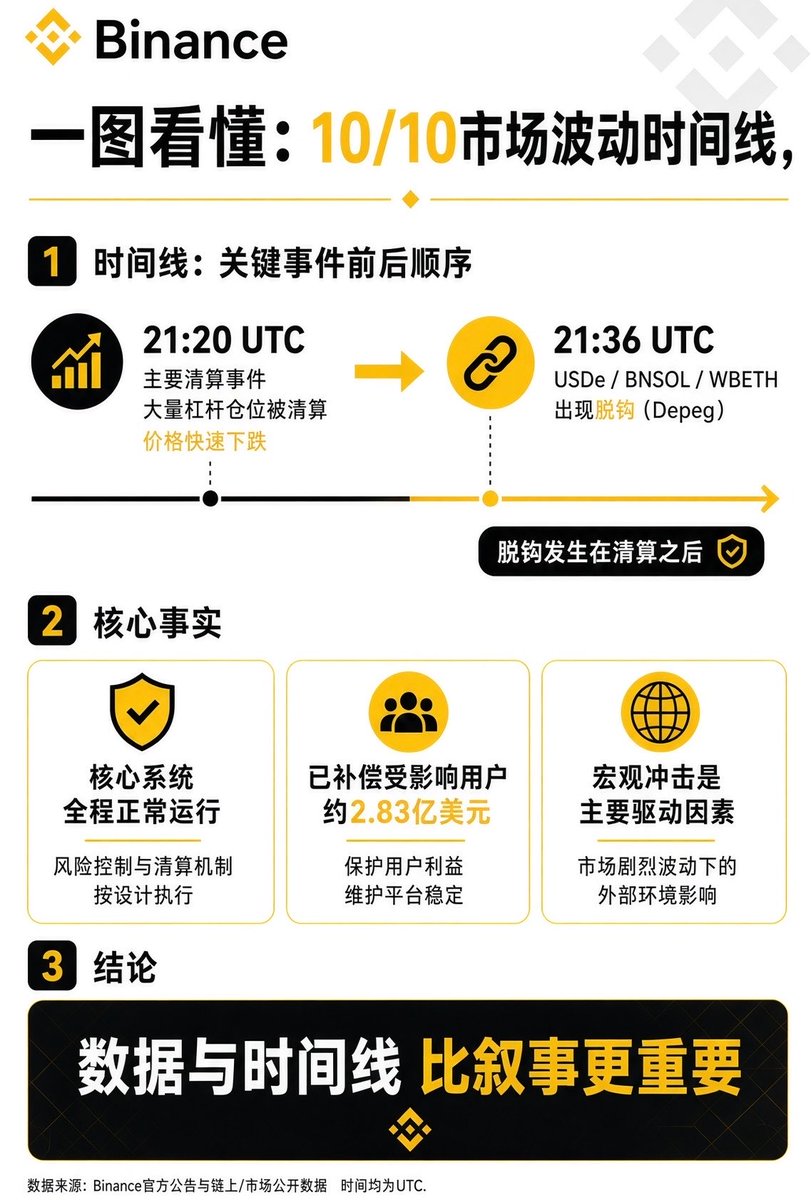
I also saw someone blaming Binance @ Binance's USDe campaign for the 10/10 collapse, saying that 'irresponsible marketing leads to leverage cycles'. The most severe market downturn and large-scale liquidation occurred around 21:20 on October 10th. Assets such as USDe, BNSOL, and WBETH showed a significant decoupling on Binance after 21:36. That is to say, price smashing comes first, liquidation comes first, decoupling is the result of later, not the reason. Binance officials have also made it clear that the core matchmaking engine and API are functioning normally throughout the entire process, and there have been no website crashes. In response to users who were liquidated due to the decoupling of these assets, the platform completed approximately $283 million in compensation within 24 hours, not just saying 'take responsibility'. Everyone knows that high leverage can amplify volatility in extreme market conditions. But simplifying a macro shock (which happened to coincide with tariff news) directly to 'a certain exchange pushed a product', and ignoring the timeline, is a bit selective narrative. Some people in the industry (including Dragonfly) have publicly questioned this causal sequence. As for the EU MiCA matter, the platform has been saying that it is promoting compliance and applying for authorization. This process is already not fast, and we cannot simply say "intentionally violating regulations" just because we don't have a license. Rules are rules, but it is also quite common to take the failure of competitors to win cards as proof of one's compliance. Saying these is not to protect anyone, but to believe that as industry practitioners, we should at least present publicly available timelines and compensation figures for fans to judge for themselves, rather than following emotions. The market is already difficult enough. Less mutual blame and more real data are more useful for users.