
From Nvidia defining GPUs as collateralizable infrastructure assets, to CME and ICE building pricing infrastructures like computing power futures, and then to the complete derivatives industry chain of OTC swaps, on-chain bulk trading, and prediction market forward curves, computing power is gradually being transformed into a financial asset that can be priced, traded, and collateralized.
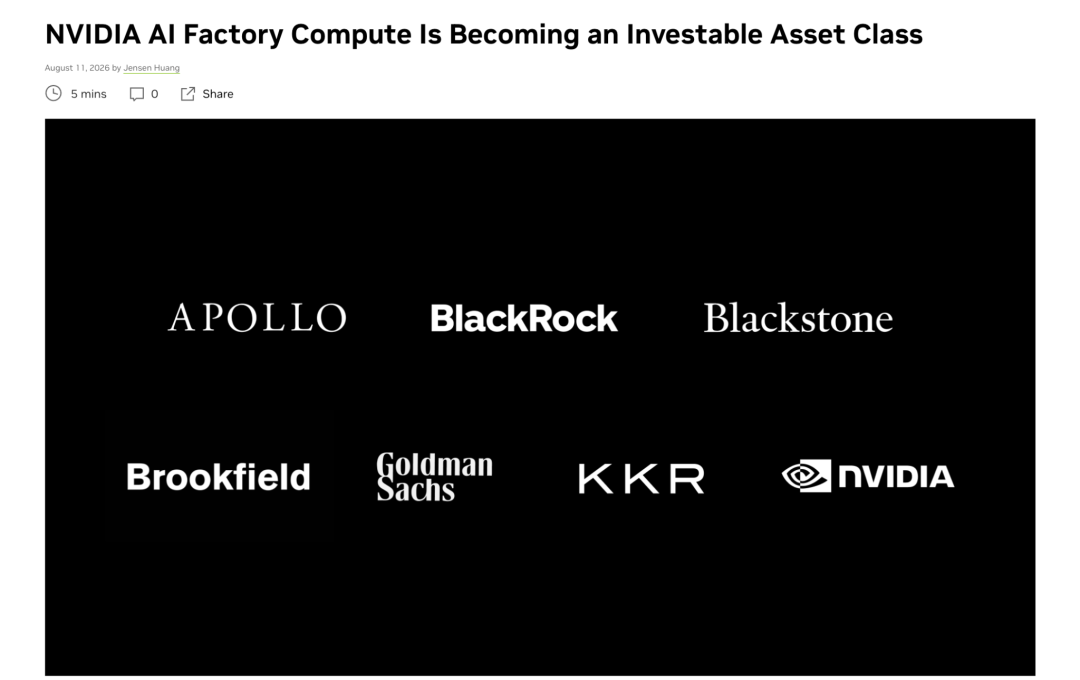
On August 10, 2026, Nvidia announced the signing of a memorandum of cooperation with six top global asset management institutions—Apollo, BlackRock, Blackstone, Brookfield, Goldman Sachs, and KKR—with the goal of mobilizing over $500 billion in third-party capital to define GPUs as a collateralizable and investable infrastructure asset.
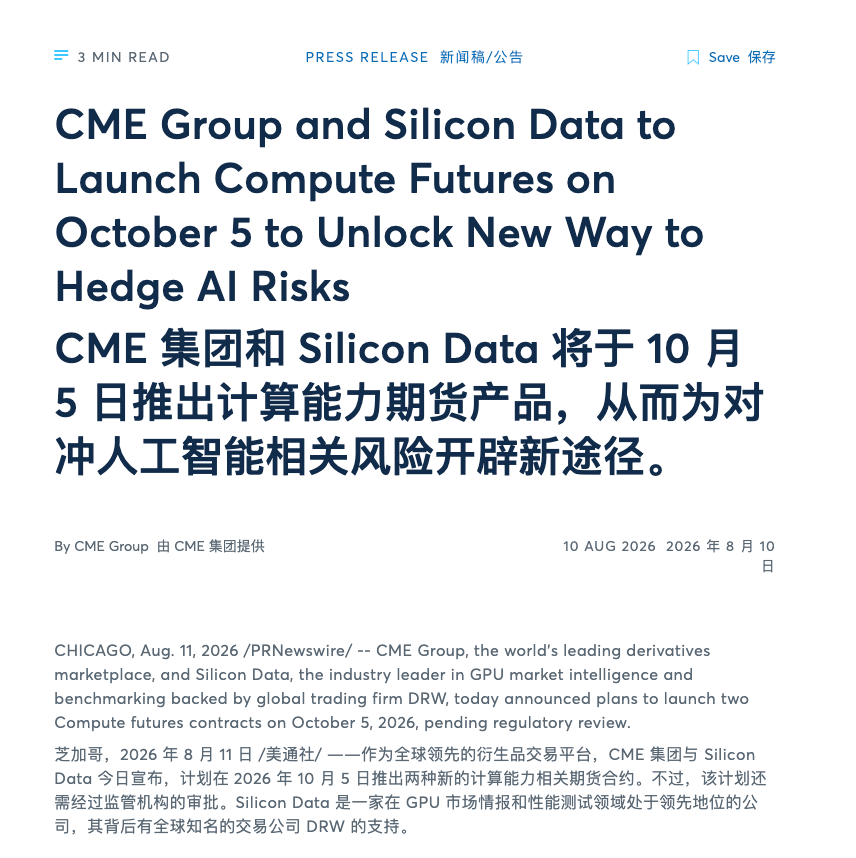
The next day, on August 11, 2026, the Chicago Mercantile Exchange Group (CME Group) announced that it would launch the world's first futures contracts linked to GPU computing power rental on October 5.
Not long before this, across the Pacific, the Shanghai municipal government had released documents on June 2 that explicitly stated to prepare well for the research and development of computing power futures; even earlier, the spot trading on the Shanghai computing power trading platform had actually been operational since 2023.
If we align these three news lines side by side, a common signal emerges: computing power is transforming from an IT resource used through leasing into a financial asset that can be priced, traded, hedged, and collateralized in the public market. Moreover, this transformation is happening almost simultaneously around the globe: forwards have been completed, futures are queuing for listing, indices have already appeared on Bloomberg terminals, and the term “computing power futures” has also appeared for the first time in Chinese government documents.
Based on this, this article clarifies the rapidly growing industry chain:
- How are GPUs being transformed into financial assets step by step?
- Who is trading them, and where are they being traded?
- When computing power truly becomes a commodity like oil, will it spawn a new currency narrative like the petrodollar from half a century ago, namely “computing power dollar”?
1. Starting Point: How are GPUs being transformed into collateral?
1.1 Jensen Huang's Ambition: Attempting to Redefine GPU
To understand why the computing power derivatives market exploded in 2026, we must return to a fundamental action: Nvidia attempted to redefine what a GPU is.
On August 10, 2026, Nvidia's official press release announced that it had signed a memorandum of cooperation with six institutions—Apollo Global Management, BlackRock, Blackstone, Brookfield, Goldman Sachs, and KKR—to jointly build an independent "computing power financing platform," aiming to mobilize over $500 billion in third-party capital for the construction of AI data centers, chip factories, and supporting power facilities in the future.
The core of this announcement is, in fact, a taxonomic shift proposed by Jensen Huang: GPUs should no longer be viewed as technology hardware that depreciates quickly, but should be seen as investable infrastructure assets.
In this context, GPUs possess long-term, predictable cash flows similar to commercial real estate and toll roads. Huang's reasoning is that Nvidia's computing power assets are widely adopted by almost all cloud service providers, can circulate (fungible) among different customers, and can continuously enhance performance through the CUDA software ecosystem, thus extending their effective lifespan.
"This is truly the first time technology chips have become an investable asset class."
——Jensen Huang, August 10, 2026
The legitimacy of this argument hinges on a core question: Can the economic lifespan of GPUs match the duration required by traditional mortgages?
Traditional collateral—commercial real estate, cargo vessels—is accepted by banks because they have decades-long mature secondary markets with relatively stable price fluctuations. In contrast, the value curve of GPUs is entirely different, determined by the pace of chip iterations rather than physical wear.
According to data from industry research firm Silicon Data and GPU trading platform GPUSmith, the H100, which was priced at about $40,000 at the end of 2023, had already seen its price in the second-hand market drop to the range of $12,000 to $22,000 by mid-2026, with some auction prices falling as low as $8,200. This cliff-like and nonlinear value reset is the biggest technical challenge of this GPU assetization experiment.
1.2 A Guarantee Clause Not Yet Fully Defined
To alleviate creditors' concerns, Nvidia proposed a key clause: it is willing to provide a maximum 25% residual value support for certain financing transactions, meaning that if the actual residual value of the chip is lower than expected at the loan's maturity, Nvidia will cover up to 25% of the difference, with the exact ratio assessed on a case-by-case basis.
There is a detail worth noting: According to a line-by-line verification by financial analysis platform Electron Economics, the original announcement on August 10 did not mention the terms "residual value" or "backstop," but stated rather that it would collaborate with the six institutions to establish a large-scale special fund pool with attractive interest rates for clients, and it was clearly noted that the cooperation is still subject to the signing of a final agreement. The specific mention of a “maximum 25% residual value” support mechanism was a supplemental explanation by Huang in interviews and articles the next day.
This sequence, combined with the credit market's response, is worth examining side by side:
- According to ICE Data Services, Nvidia's five-year credit default swap (CDS) spread rose in July due to reports of circular trading, surging by 14 basis points in a single day on July 27, once reaching 82 basis points (it later pulled back), marking the largest single-day intra-day increase since this contract began active trading in November 2025;
- Investing.com analyzed that on the day the financing plan was announced, August 10, the spread rose to about 77.5 basis points. The guarantee clause did not noticeably cool market sentiment.
The aforementioned credit market pricing reflects, to some extent, the position this mechanism is currently in: it is still being continuously tested by the market and has not yet been fully defined.
2. A Measuring Stick for Collateral: Entry of Exchanges
2.1 Why Assetization Cannot Be Without Futures
For an asset to truly become a qualified collateral acceptable on a bank's balance sheet, it usually needs to satisfy three conditions: relative value stability, existence of a mature secondary market, and availability of an authoritative and reliable pricing benchmark. A single physical GPU is difficult to meet all three criteria simultaneously, which is why established exchanges like CME and ICE entered the market intensively in the first half of 2026—they aim to establish a recognized pricing benchmark for this emerging asset category.
On May 12, 2026, CME Group and GPU market data company Silicon Data jointly announced plans to launch the first batch of computing power futures contracts within the year. On August 11, both parties further clarified that they would launch two futures contracts on October 5—Silicon Data H100 Rental Index Futures and Silicon Data B200 Rental Index Futures, which will track the hourly rental price indices of the H100 and next-generation Blackwell B200 chips. If launched smoothly, they will be listed on the New York Mercantile Exchange (NYMEX). CME's global head of energy and environmental products, Pete Keavey, likened it to crude oil futures: "Computing power has become the currency of the AI era. Just as oil powered the economy of the 20th century and evolved from spot trading to a global derivatives market, our futures contracts will transform computing power into a standardized, tradable commodity."
Only a week later, on May 19, 2026, CME’s rival Intercontinental Exchange (ICE) announced it would collaborate with another computing power data provider, Ornn, to launch GPU computing power futures contracts based on the Ornn Computing Price Index (OCPI), covering enterprise-level H100 and H200 down to consumer-grade graphics card RTX 5090. The nearly simultaneous entry of these two exchanges indicates that the race for pricing power is happening at a pace tighter than anticipated.
2.2 Contract Design: Two Different Paths
From a contract design perspective, global computing power futures currently mainly differentiate into two paths:
- One is the computing power leasing path, which uses the GPU hourly rental price index as the underlying asset, essentially pricing from the supply side, at the hardware level;
- The other is the Token path, which is anchored to the demand side of computing power, pricing according to the actual number of tokens consumed by large models, closely related to the real cost experiences of downstream AI application developers and end users.
CME and ICE both follow the first path, while reports from financial media indicate that the Shanghai Futures Exchange in China is currently developing futures schemes based on the latter path, specifically AI Token futures, which is a different technical route from that being pursued in the U.S., marking a significant point of divergence worth ongoing attention. 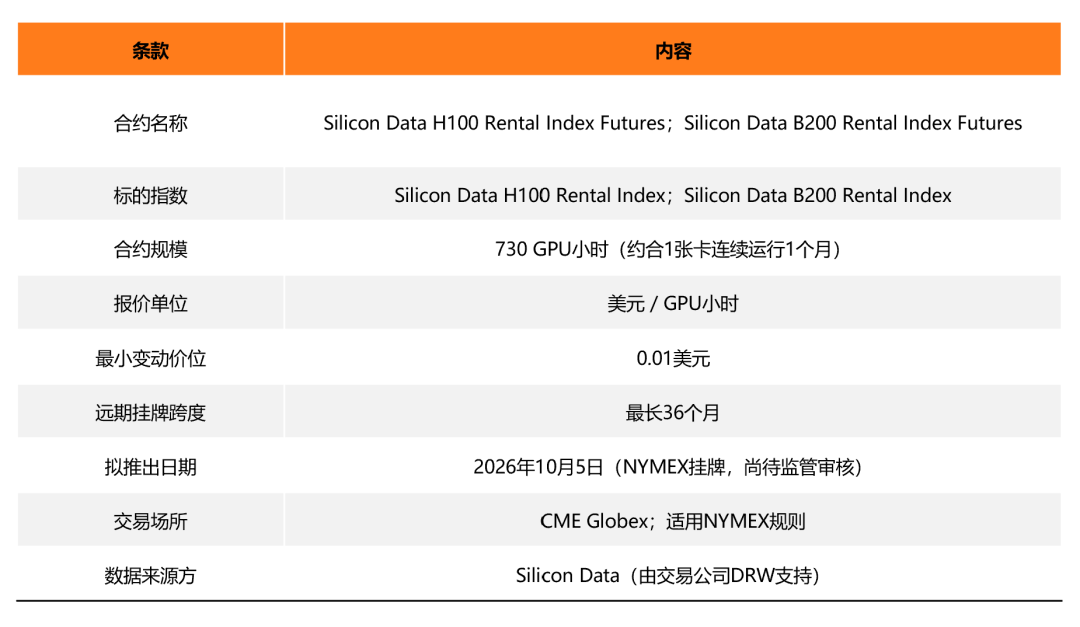
It is worth noting that the claim of CME being the world's first computing power futures requires a qualifier: it is the first computing power futures to enter the regulated mainstream exchange track; the world's first computing power derivatives have already completed several transactions before it officially listed in the OTC market and prediction market platforms.
3. Beyond the Exchanges: An Industry Chain Connected to On-chain Finance
Before the standardized futures contracts on the exchange officially list, the computing power derivatives market has actually run the full industry chain—from OTC forwards to on-chain bulk trading, and to the forward curves in prediction markets—each link has already recorded real transactions, not just in the planning stage.
3.1 No Index, No Derivatives
All derivative transactions to be analyzed below—whether it’s the FalconX OTC swap, Polymarket’s on-chain transaction, or the upcoming futures from CME and ICE—ultimately rely on the same thing: a credible price index.
No index, no pricing benchmark; without a pricing benchmark, there is no space for standardized derivatives to exist.
Currently, two index routes are running parallel in the market:
- Ornn Computing Price Index (OCPI): released by computing power company Ornn, the most notable feature is that it is the world’s first computing index built solely based on real transaction records, rather than quotes or advertised prices. As of April 2026, OCPI is already online on Bloomberg terminals, covering models such as H100, H200, A100, B200, and RTX 5090, serving as the settlement benchmark for ICE’s computing power futures;
- Silicon Data Index: provides index benchmarks for CME’s computing power futures, tracking the rental prices of GPU chips daily. CME currently plans to launch two independent contracts: H100 Rental Index Futures and B200 Rental Index Futures, both priced based on the corresponding hour rental prices of the GPU models, without converting different models into a standardized computing unit.
With price indices like WTI crude oil and Brent crude oil established, computing power truly has the fundamental conditions to become a commodity.
3.2 OTC Swaps: FalconX's First Transaction
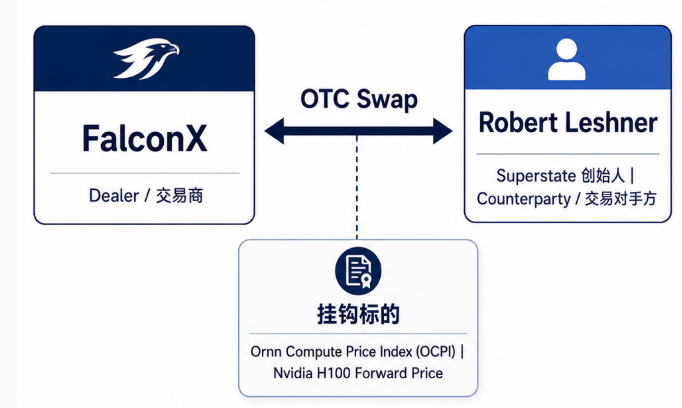
On May 27, 2026, digital asset broker FalconX announced it had completed the world’s first OTC computing power forward price swap transaction. The counterparty was Robert Leshner, founder of the digital asset platform Superstate, with the underlying tied to the forward price of H100 in the Ornn Computing Price Index (OCPI); FalconX acted as the dealer.
Ornn's CEO Kush Bavaria described it as transforming a volatile, unpredictable market into a measurable, tradable, and hedged commodity.
The transaction amount itself was not large, but it proved one thing: while the exchange futures are still awaiting approval, institutional investors are already starting to position themselves for computing price risk management through OTC derivatives.
3.3 Polymarket: On-chain Institutional-Level Bulk Trading
Days later, on June 2, 2026, the prediction market platform Polymarket also announced it had completed its first institutional-level on-chain bulk trade.
The trading parties were FalconX and AI risk clearinghouse startup AneraLabs, with the settlement based on Ornn's OCPI index, and the transaction amount reaching six figures in USD, recorded on the Polygon blockchain.
This risk transaction was structured as a prediction market position on Polymarket, which simultaneously provides a trading venue and on-chain settlement mechanism.
According to CNBC, this was also the prediction market industry's first institutional bulk trade explicitly linked to computing power prices (the H100 OCPI index)—a month prior, Kalshi had completed its first institutional bulk trade, but the underlying was California carbon emissions allowance auction prices. Analyzing both events together indicates that prediction market platforms are increasingly complementing institutional-level trading capabilities, with computing power being one specific commodity.
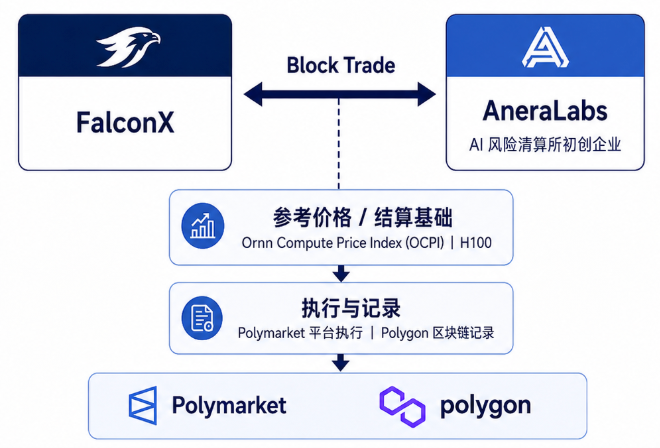
Compared to traditional OTC swaps, this transaction had an added layer of on-chain execution and settlement infrastructure: after bilateral negotiations between FalconX and AneraLabs, the transaction was executed through Polymarket's international platform and ultimately recorded on the Polygon blockchain, rather than relying entirely on the back-office clearing system of traditional financial institutions.
There is an easily overlooked distinction here: Polymarket effectively operates two independent platforms.
- One is the international site where this computing power trade took place, which is based on Polygon, settles in USDC, does not require identity verification, and geo-blocks U.S. users;
- The other is Polymarket US, launched at the end of 2025, run by the acquired QCX entity, regulated by the CFTC, settled in USD, and requiring complete identity verification.
This GPU computing trade took place on the former, which is not within the CFTC’s regulatory framework, marking a substantial difference from the next section discussing Kalshi.
3.4 Kalshi: From Prediction Market to Forward Curve
On July 14, 2026, the CFTC-regulated prediction market platform Kalshi launched the AI computing power forward curve.
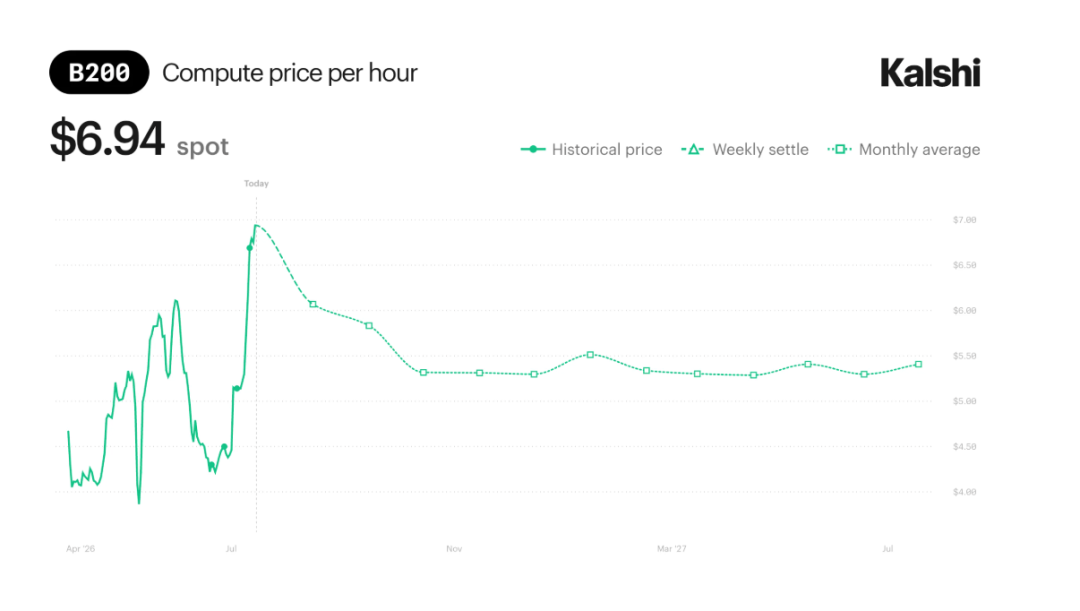
According to Kalshi's official press release, this curve currently covers the Nvidia B200, H200, and A100 chips; while the broader contracts related to computing power on the Kalshi platform also include H100 and RTX 5090.
Kalshi's Chief Risk Officer previously worked at CME Group for about 16 years. In an interview with Bloomberg, he stated that Kalshi is using prediction markets to build a forward curve for GPU computing power, viewing it as the foundation for the future development of futures, options, and other products; he also pointed out that just in 2026 alone, capital expenditure commitments from ultra-large cloud service providers have already reached around $500 billion to $600 billion.
It is important to clarify a detail: Kalshi officially stated that the forward curve itself is not a tradable asset but a reference price for pricing in OTC swaps and structured products; the truly tradable asset is the underlying prediction market contracts on the Kalshi exchange itself.
The data sources for this curve are also not completely independent of the Ornn system—some of Kalshi's computing power contracts are also settled based on real-time pricing data provided by Ornn. This indicates that although there are a multitude of participants in this industry chain, the underlying price index suppliers are actually highly concentrated in Ornn and Silicon Data.
3.5 Summary Comparison: Four Transactions, Four Roles
These four transactions are all computing power derivatives, yet they have different positioning.
- FalconX’s OTC swap and Polymarket’s on-chain bulk trade both adopted a form of negotiated trading between institutions, but their participant structures are not the same: the former had FalconX as the dealer and Robert Leshner as the counterparty, with FalconX effectively acting as the market maker to complete a hedging transaction for Leshner; the latter involved FalconX and AneraLabs mutually acting as counterparties, while Polymarket provides on-chain trading infrastructure (the execution function) and settles through Polygon.
- Kalshi's forward curve is entirely different—it is not a contract but a reference price retroactively derived from a large number of real small prediction contracts on the platform; what can actually be bought and sold are those underlying contracts themselves, and the curve merely stitches their prices into a line.
- The futures from CME and ICE are closest to traditional commodity futures, with standardized terms, exchange listing, and centralized clearing, having a similar structure to crude oil futures.
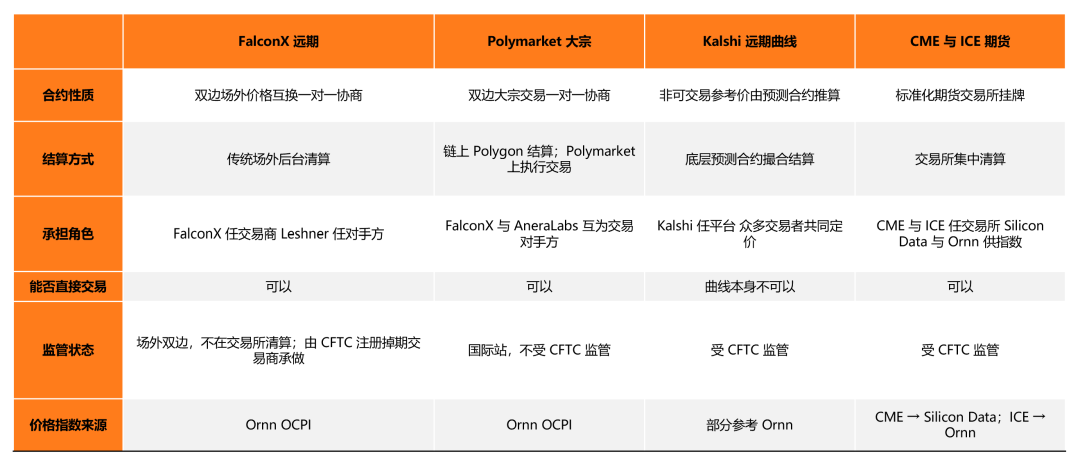
Looking at the above content together, it illustrates a clear division of labor within the industry chain: OTC forwards catch the risk management demands during the gap before exchange approval, the prediction market explores a market-recognized price level through high-frequency small trades, and exchange futures standardize this price into contracts that anyone can trade.
4. On the Chinese Side: An Earlier Spot, A Slower Futures
4.1 Shanghai: From Pilot Operation to Being Written into Government Documents
Few have noticed that China actually started its infrastructure construction for computing power spot trading even earlier than this whole wave of U.S. futures fervor, with several lines being developed simultaneously.
On the platform level, Shanghai is leading the way. The Shanghai computing power trading platform went live in a pilot operation in April 2023, launched version 2.0 in December of the same year, and upgraded to the China Computing Power Platform (Shanghai) in May 2025. However, this is just a local node, as national-level expansion has gradually begun: the national computing power platform, led by the China Academy of Information and Communications Technology, fully interconnected at the Chinese Computing Power Conference in August 2025, with ten provincial platforms including Shanxi, Liaoning, Shanghai, Jiangsu, Zhejiang, Shandong, Henan, Qinghai, Ningxia, and Xinjiang connecting.
On the pricing benchmark level, the China Securities Index Company released the China Securities Intelligent Computing Power Supply Index Series on December 24, 2025, comprising 16 indices, covering 1 overall index, 7 regional indices, and 8 national computing power hub node indices.
On the national policy level, the shift occurred even later and more clearly in two steps. In April 2026, the Ministry of Industry and Information Technology first proposed exploring innovative businesses such as computing power banks and computing power supermarkets, indicating a loosening of concepts.
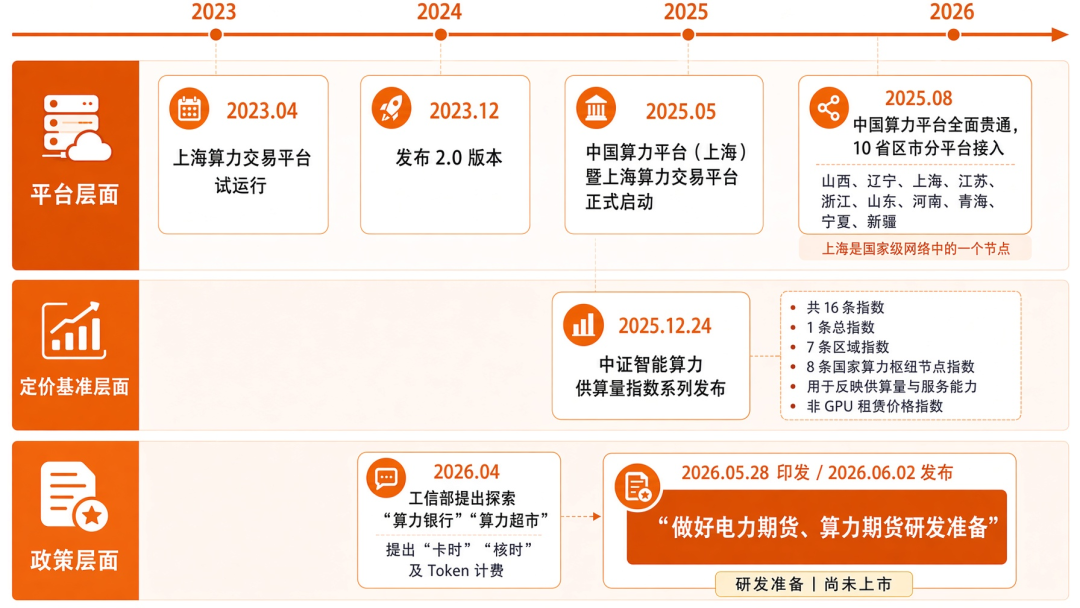
The real breakthrough occurred at the end of May: on May 28, the Shanghai Municipal Government's General Office issued “Several Opinions on Deepening the Construction of Shanghai's Global Asset Management Center,” which was publicly released on June 2, explicitly stating to prepare for the research and development of electricity futures and computing power futures. —Thus, the term “computing power futures” officially appeared for the first time in a public document from a provincial government in China.
Prepare well for the R&D of electricity futures and computing power futures, and develop more new futures varieties representing the direction of new productive forces. —Shanghai Municipal Government “Several Opinions on Deepening the Construction of Shanghai's Global Asset Management Center,” June 2, 2026
Interestingly, this document uses the term “R&D preparation” rather than “upcoming listing.” This contrasts with the specific listing date of October 5 proposed by CME, showing a noticeably more cautious and earlier rhythm. The Shanghai document also proposed a larger goal: striving for Shanghai’s asset management scale to reach 55 trillion yuan by 2030, accounting for one-third of the national total.
4.2 A Technology Route Fork Previously Unmentioned
According to exclusive reports by Reuters, the Shanghai Futures Exchange is designing a futures scheme linked to AI Tokens, with the underlying being the smallest unit of Token processed by large models for pricing AI services, which is completely different from the GPU hourly rental model adopted by CME and ICE. The report also mentions that this research is still in the early stages: it has not disclosed whether it will be priced according to the number of Tokens or the unit Token price, and the regulatory approval timeline is also not yet determined.
Even so, the two routes for computing power futures in China and the U.S. have diverged right from their design starting points: the U.S. anchors its focus on the rental costs on the hardware supply side, while China explores pricing methods related to the demand side and Token consumption.
This divergence is not difficult to understand—CME and ICE mainly serve data center operators and cloud service providers who are concerned about how much the hourly rental price of one card is; Token pricing is closer to the real cost experiences of downstream AI application developers, who care about how many Tokens are consumed to complete a task and how much money is spent.
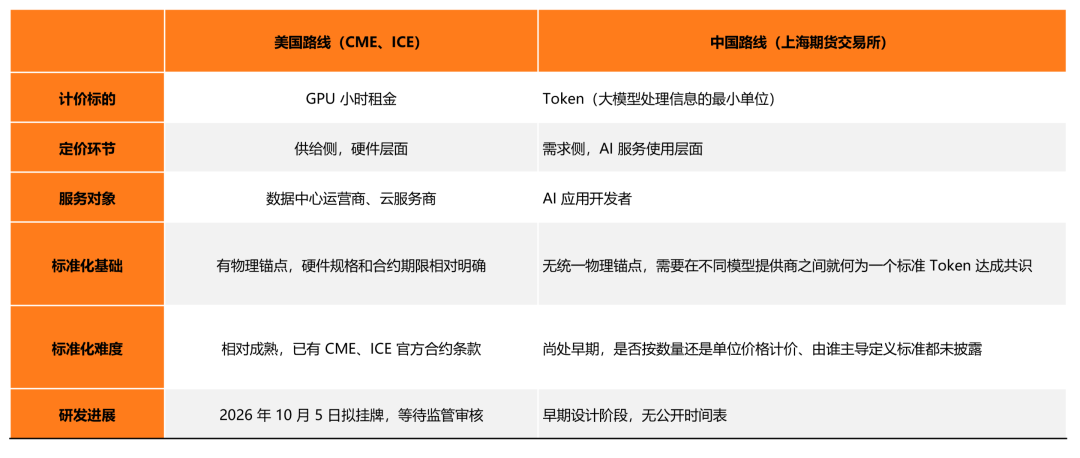
The question of which route is superior has yet to be determined, but if China successfully takes the Token futures route, it will correspond to a downstream application market that is much larger than the rental hours of selling cards, and has considerable potential for product performance (such as transferability, convenience, etc.), albeit with significant challenges in standardization.
5. Computing Power Dollar: A Concept Under Discussion but Not Yet Established
As computing power truly begins to be priced, traded, and collateralized like oil, a question naturally arises: oil trade is unified in USD for settlement, giving rise to a petrodollar system that has lasted for half a century; will computing power follow the same path?
5.1 The Proposal of the “Computing Power Dollar” Concept
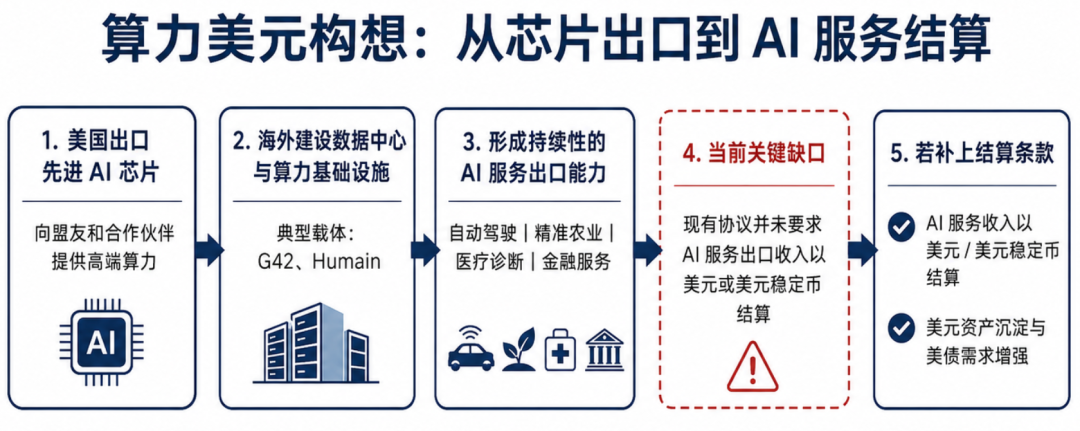
This analogy is not an original idea of this article. Over the past six months, several institutional research bodies have proposed similar frameworks, one of the more influential articles being a commentary by Navin Girishankar, head of the Economic Security and Technology Department at the Center for Strategic and International Studies (CSIS), published on December 8, 2025, titled “Turning the AI Revolution into Dollar Dominance.”
The core idea of the article is that the U.S. is exporting advanced AI chips to its allies and partners, helping these countries build computing power infrastructure, and that this computing power will continuously produce AI services in the future for export worldwide. Whosoever controls the settlement currency for these AI service export revenues replicates the position of the petrodollar of yesteryear. (Note: This is a commentary representing the author's personal views; CSIS officially states that its research is nonpartisan and does not represent the organization's position, nor is it U.S. government policy.)
5.2 The Core Flaw of the Concept: Computing Power Has Yet to Establish a Strong Link with the Dollar
The largest flaw in this concept, as pointed out by the author himself, is that these chip export agreements do not require recipient countries to settle their AI service export revenues in dollars at all.
He provided a calculation logic: a country might spend $10 billion to build data center infrastructure once, but these chips could generate $50 billion to $100 billion in annual AI service export revenues afterwards, yet there is currently no constraint on what currency this sustained, long-term revenue will be settled in—while the petrodollar relies on implicit pricing agreements, the computing power dollar hasn’t even taken that first step.
To fill this gap, the author proposed three policy recommendations:
- Link chip export licenses with commitments to settle in dollars or dollar stablecoins;
- Sign the GENIUS Act established in July 2025 as a means of payment settlement using dollar stablecoins;
- Provide an economic security umbrella, as a contemporary version of the Cold War defense umbrella.
Based on this, the more accurate positioning for the computing power dollar at the moment is as a policy initiative articulated in a think tank commentary, rather than a fully established, operational currency system.
5.3 Historical Reference: The Cycle from Proposal to Verification of a New Narrative
A new asset narrative typically requires a complete cycle from proposal to true market validation. The two bubbles around 2000 can serve as a reference. One was the more familiar internet stock bubble; the other was the telecom equipment bubble, which structurally resembles the current computing power narrative—Cisco, Lucent, Nortel Networks, and other equipment vendors provided large-scale vendor credit to financially strapped telecom operators and internet service providers to help clients purchase equipment, forming a self-reinforcing loop where loans drove procurement, pushing up stock prices.
The entire industry expanded to over $1.5 trillion before the bubble burst, with accumulated debt around $1 trillion, leading to over $500 billion spent on laying fiber optic and other infrastructure. For example, Nortel Networks completed $19.7 billion in acquisitions almost entirely through stock payments in just 2000.
Interestingly, there were also attempts back then to make bandwidth a tradable commodity, which ultimately failed. The well-known Enron completed its first bandwidth transaction in December 1999, with the underlying being a monthly incremental contract from New York to Los Angeles on the Global Crossing network, explicitly stating its intention to price this contract as a benchmark and proposing a series of subsequent expansion plans. This is the same methodology being employed today by Ornn and Silicon Data for indices, and CME for standardized contracts.
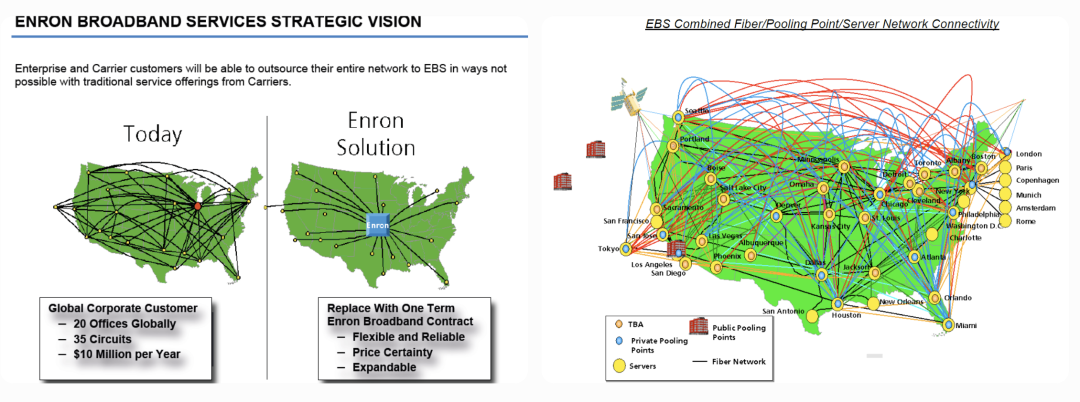
The outcome was: The bandwidth market collapsed before it could form sufficient liquidity; after Enron's bankruptcy in 2001, following companies like Williams, Dynegy, and El Paso also shut down their bandwidth trading departments, and independent bandwidth trading platforms like RateXchange exited the market directly.
Looking at these two bubbles together illustrates a common point: telling the story early does not mean the demand is fake. Internet traffic indeed continued to grow as anticipated, and overbuilding of fiber contributed to faster declines in costs for broadband, video, and cloud computing; the bubble burst punishes leverage and stock prices that run ahead of real demand, not the direction itself. The current signals of AI computing power demand are similarly strong, but whether this translates into sustainable profitability remains unknown. Additionally, historical regulatory reforms typically occur after a bubble bursts, whereas institutions like the U.S. CFTC and the Bank of England are now intervening to observe in advance, which is a significant difference from the regulatory vacuum of 20 years ago.
6. Conclusion: The Road Ahead is Long
While the fast-paced development of computing power trading and related industry chains does not guarantee success, the progress of forwards being completed, indices being listed, and futures queuing for launch creates an illusion that the assetization of computing power is a foregone conclusion. However, what truly determines whether this system can stand is whether demand can support leverage, whether regulation can keep up with innovation, and whether different paths can eventually converge into a standard. These three cuestiones have yet to be answered.
Will the assetization of computing power repeat the internet financial bubble of 2000? This depends on a few variables that remain unclear: whether the residual value assumptions of GPUs can withstand the impact of each new generation of chips, whether the computing power dollar can truly be written into agreement terms, and whether China’s Token futures and America’s GPU hourly futures will eventually adhere to the same set of standards.
Computing power is being transformed into a financial asset, and this direction is likely irreversible. As for who will ultimately price this new system, which currency will be used for settlement, and in what standard it will operate, the answers are still on the way.
This is a new story.
Disclaimer: This article represents only the personal views of the author and does not represent the position and views of this platform. This article is for information sharing only and does not constitute any investment advice to anyone. Any disputes between users and authors are unrelated to this platform. If the articles or images on the webpage involve infringement, please provide relevant proof of rights and identity documents and send an email to support@aicoin.com. The relevant staff of this platform will conduct an investigation.