Loading...
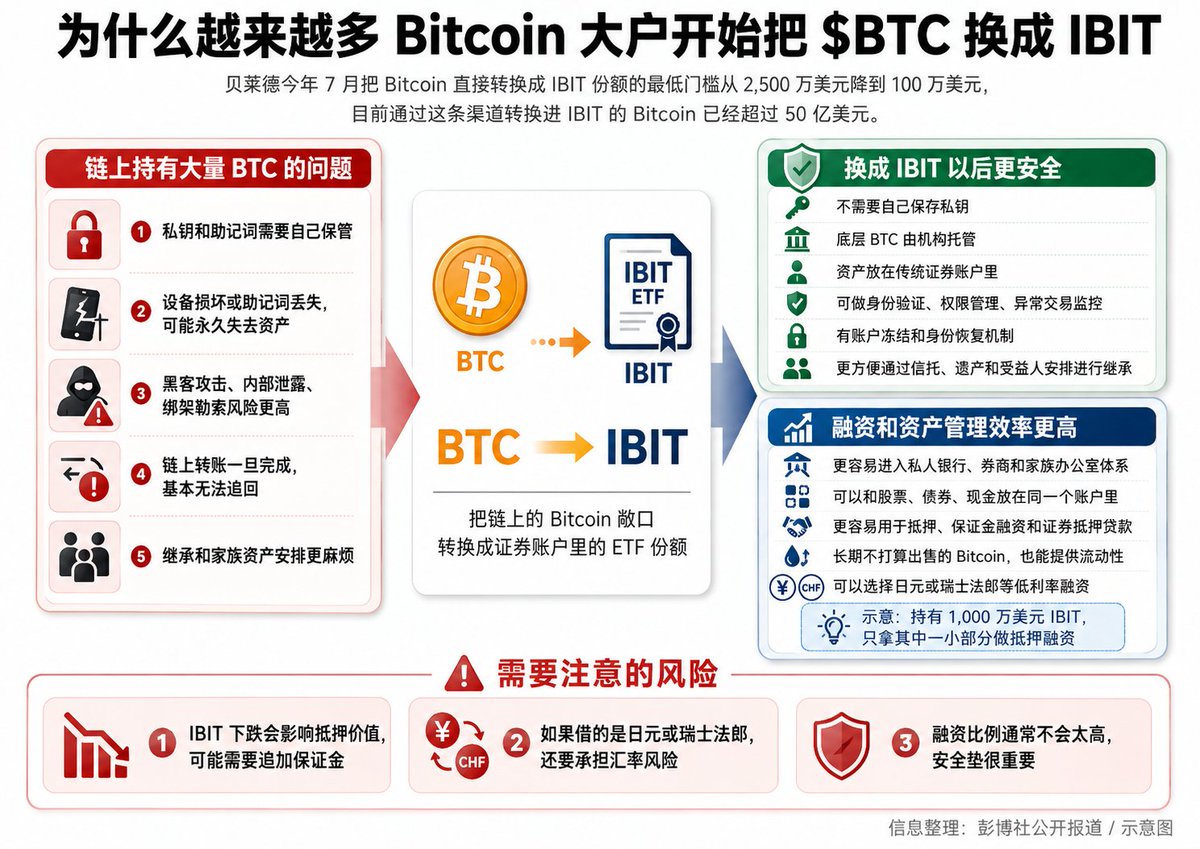
Why are more and more Bitcoin whales converting bitcoin:native into IBIT? In July this year, BlackRock lowered the minimum threshold for converting Bitcoin directly into IBIT shares from $25 million to $1 million. According to Bloomberg, over $5 billion worth of Bitcoin has already been converted into IBIT through this channel. For investors holding large amounts of BTC, the most important thing is reducing custody risks. If you have tens of thousands or even hundreds of thousands of dollars in BTC, it’s relatively easy to manage with a hardware wallet. But when it comes to millions or even tens of millions of dollars, the private key and seed phrase themselves become risks. Device damage, lost seed phrases, hacking, insider leaks, kidnapping, or extortion—any one of these issues could result in the total loss of assets. And once an on-chain transaction is completed, it’s nearly impossible to reverse. By converting to IBIT, investors no longer need to store private keys themselves. The underlying BTC is held in institutional custody, while their assets are stored in a securities account. Securities accounts offer identity verification, permission management, abnormal transaction monitoring, and mechanisms for account freezing and identity recovery. If you forget your password, you can verify your identity to reset it. If you lose your phone, you can log in again. Even in the event of an accident, assets can be inherited through trusts, estates, or beneficiary arrangements. So for investors with significant asset sizes, converting to IBIT can indeed mitigate many security risks. Another factor is financing and asset management efficiency. On-chain BTC is difficult to directly integrate into traditional private banks, family offices, or securities portfolios for loans or financing. But IBIT is a standard security, which can be held in the same account as stocks, bonds, and cash. It’s also easier to use for collateral, financing, margin trading, and family wealth management. This is crucial for many investors. They can leverage Bitcoin they don’t plan to sell anytime soon for financing. For example, if you hold $10 million worth of IBIT, you can use a small portion as collateral for a loan, choosing currencies with relatively low interest rates like the Japanese yen or Swiss franc. The financing cost could be significantly lower than borrowing directly in USD. The funds obtained can then be used for other investments or to provide liquidity. Depending on the loan terms, you could even allocate the funds to assets like U.S. Treasury bonds, VOO, or QQQ, effectively adding an annual yield to your BTC. Of course, converting to IBIT isn’t necessarily the best choice for everyone. But for many investors who don’t engage in DeFi and prefer traditional approaches, storing IBIT is indeed simpler. @Gate Crypto, U.S. stocks, Hong Kong stocks, Korean stocks, gold, CFDs, prediction markets—all-in-one trading platform.