
How a DAO Efficiently Participates in the Equity Structure of Leading Global Humanoid Robotics Companies
The humanoid robotics industry has transitioned from the conceptual phase to actual deployment.
By 2025 alone, this field has attracted nearly $14 billion in financing. Leading companies such as Figure AI, Apptronik, 1X Technologies, NEURA Robotics, and Agility Robotics currently have a combined valuation exceeding $85 billion. Despite the rapid growth of the industry, entry into this market is still limited to private equity markets, and participants are primarily confined to institutional capital.
XMAQUINA is designed precisely to address this structural gap.
This DAO has established verified equity positions in five private humanoid robotics companies and governs these positions entirely on-chain. The DEUS token serves as the coordinating layer that supports the operation of this system.
This article aims to introduce the specific operational logic and significance of this system.
XMAQUINA Overview
XMAQUINA is a governance-centric capital allocation layer focused on the humanoid robotics sector.
It is responsible for sourcing, acquiring, and managing equity positions in humanoid robotics companies while building infrastructure that allows these positions to be accessed and have liquidity on-chain. The humanoid robotics sector has long been a relatively closed market, and XMAQUINA introduces a structured access mechanism to it.
The entire ecosystem consists of four interrelated integrated layers:
- The DAO governs the treasury and capital allocation decisions through on-chain voting. No funds will be deployed without explicit approval from token holders.
- The Robotics Capital Markets Protocol acts as the robot capital market protocol, dedicated to providing liquidity infrastructure that transforms equity positions into tradable markets on-chain.
- The DEUS token functions as a coordinating asset between governance and liquidity.
- DEUS Labs aims to incubate new projects aligned with humanoid robotics investment logic, securing their equity early in the establishment phase and extending the ecosystem beyond external capital allocation.
This structure integrates capital formation, governance, and liquidity into a unified system.
Core Issues
The private robotics market remains structurally difficult to enter.
Participation in such markets typically requires investors to qualify as accredited investors, incurs high transaction costs, and relies heavily on slow and opaque secondary markets, with settlements that may take weeks, often restricted by network relationships.
This creates a serious disconnect between value creation and opportunities for participation.
Entering Robotics Capital Markets Protocol
The Robotics Capital Markets Protocol, as the robot capital market protocol, transforms robot equity that lacks liquidity in traditional markets into an accessible on-chain market.
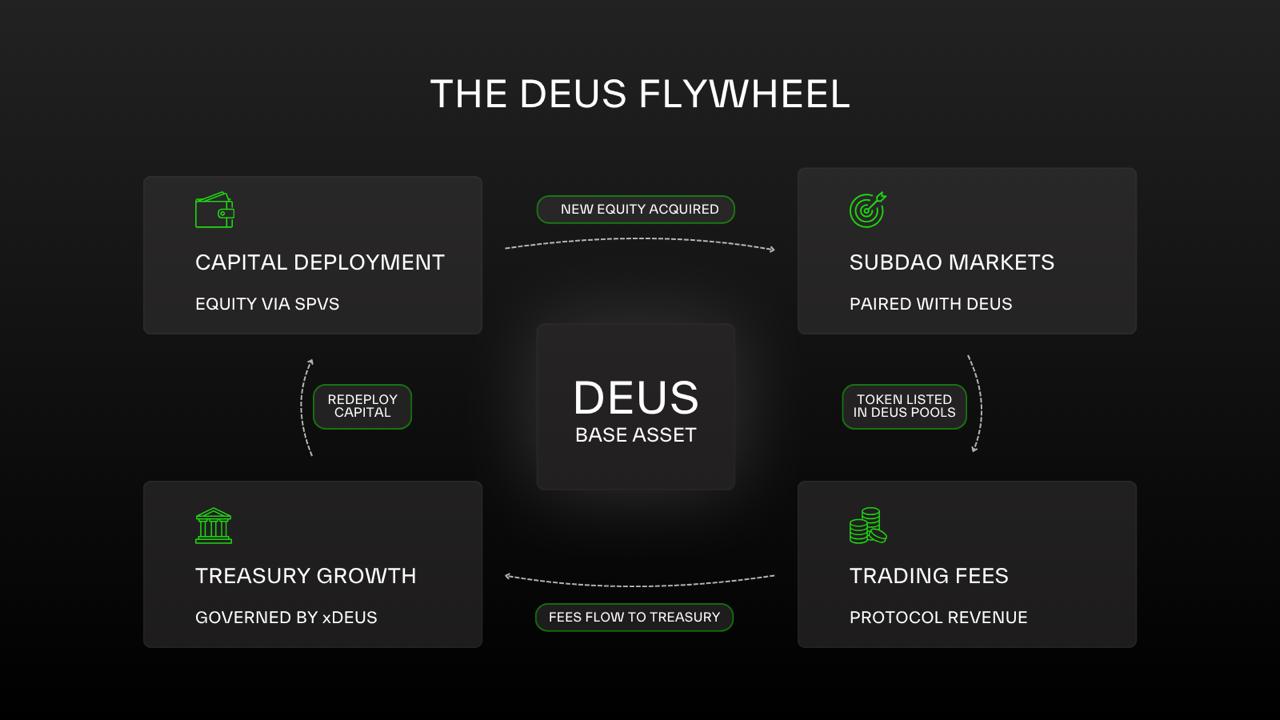
Each equity position acquired by the DAO is held through a Special Purpose Vehicle (SPV) and represented by a dedicated SubDAO token. These tokens will be paired with the DEUS token and opened for trading on-chain, allowing private humanoid robotics companies to achieve continuous market access.
The system has a clear operational process:
- The DAO identifies and invests in projects;
- The corresponding equity is held by the SPV;
- Related SubDAO tokens are issued and injected into the DEUS liquidity pool;
- Fees generated from trading activities flow back to the DAO treasury.
The DEUS token acts as the foundational asset for all markets. As new equity positions are continuously added, trading activities will increase, producing more fees, expanding the treasury, and supporting further capital allocation.
This creates a self-reinforcing cycle among capital deployment, liquidity, and treasury growth.
The protocol captures value when projects launch and accumulates value through ongoing trading, while governance mechanisms will determine how this capital is allocated throughout the ecosystem.
Portfolio
Real Equity from Private Robotics Companies
XMAQUINA holds direct equity through specially established SPVs, rather than synthetic asset mappings or derivatives.
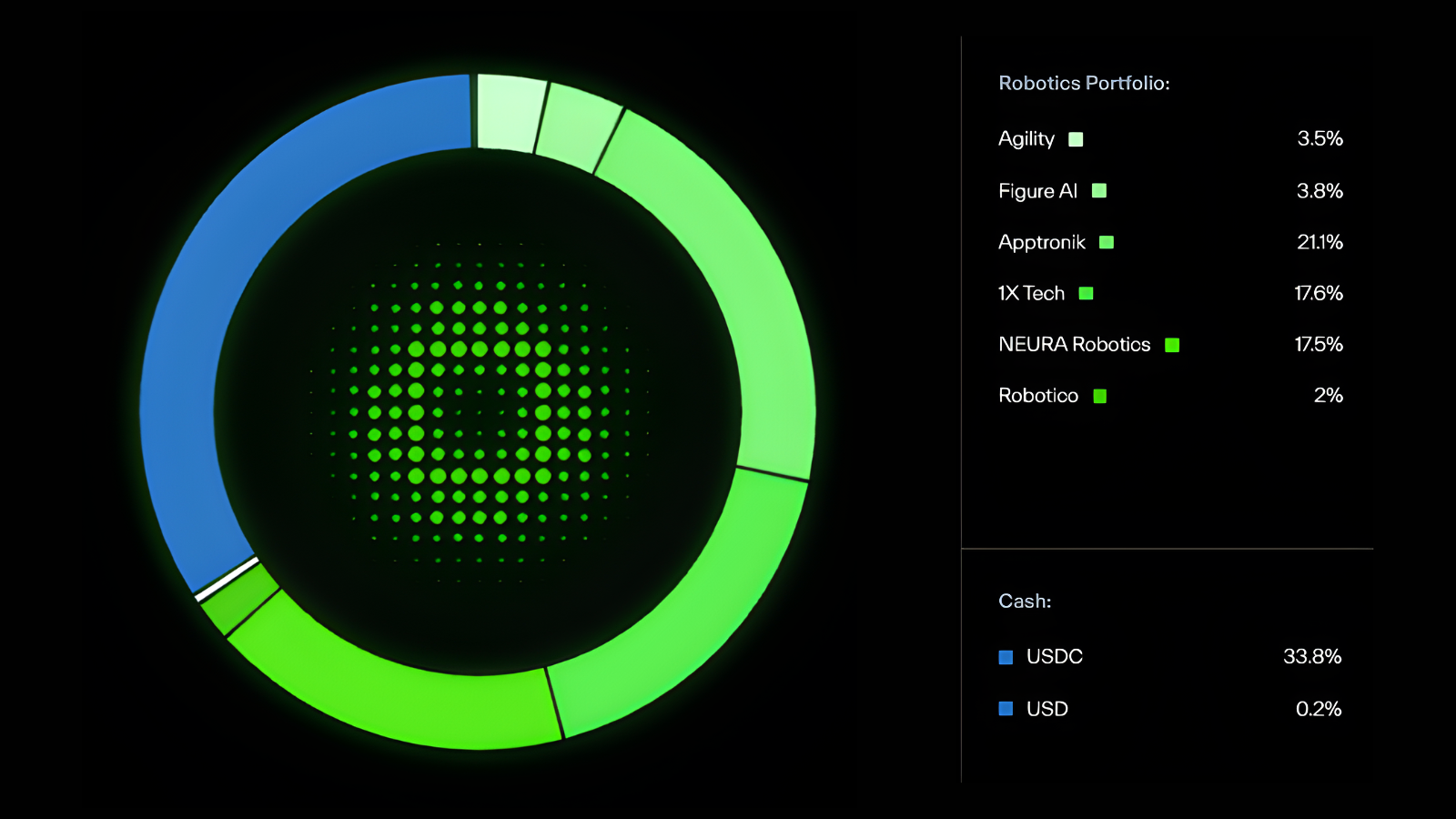
The current portfolio includes seven investments in six companies, allowing investors to gain exposure before these leading humanoid robotics companies enter the public market.
Apptronik
Total financing reached $935 million, with a valuation of $5.5 billion.
This position of the DAO has increased by 103% at the preferred stock level.
The company is developing a humanoid robot platform, Apollo, for manufacturing and logistics scenarios and is currently conducting pilot collaborations with multiple industrial partners.
1X Technologies
So far raised $136.5 million.
This position of the DAO has increased by 119%.
The company focuses on consumer humanoid robots and has begun early deployments in residential environments.
NEURA Robotics
Currently raising funds at a $4.3 billion valuation.
This position of the DAO is currently valued at cost.
The company is building cognitive robotic systems while concurrently developing a shared intelligence layer.
Figure AI
Financing has exceeded $1 billion, with a valuation of $39 billion.
The DAO holds its common stock.
Its humanoid robotic system is already operational in industrial environments and is in regular daily use.
Agility Robotics
Raised about $680 million, with a valuation of $1.8 billion.
The DAO holds its preferred stock.
Its Digit robot is one of the first humanoid robots authorized for deployment in commercial workplaces.
The XMAQUINA portfolio continues to expand, and all allocations and performance data will be transparently disclosed through the DAO portal.
DEUS Token
Functions in the XMAQUINA Ecosystem
The DEUS token is not a passive asset.
It serves as a coordinating layer across governance, capital deployment, and liquidity infrastructure, manifesting its functionality across five core dimensions.
1. Treasury Exposure
The DEUS token represents governance rights over a treasury that holds equity in humanoid robotics companies.
Such opportunities are typically only available to institutional capital. Through the DAO, this exposure is organized collectively, with investment opportunities emerging from publicly formed capital and regulated allocations.
2. Governance
DEUS token holders can directly participate in all capital allocation decisions, including:
- Treasury fund deployment
- Portfolio construction
- Protocol parameter adjustments
- Decisions on ecosystem expansion
Governance is executed through xDEUS, with voting rights enhanced by long-term consistency. This ensures that decision-making power is held by long-term participants rather than short-term players.
3. Value Distribution
All value generated within the ecosystem is governed by DEUS token holders, including:
- Transaction fees from the RCM Protocol
- Returns from equity positions
- Outcomes from DAO-incubated projects
Related distribution decisions are made on-chain, which can take forms such as:
- Reinvestment
- Buybacks
- Incentive mechanisms
There are no automatic distribution mechanisms; all value flows must be decided through governance.
4. RCM Protocol Integration
Each SubDAO token within the Robotics Capital Markets Protocol will form a trading pair with the DEUS token.
This makes the DEUS token the foundational asset for liquidity in all markets. As new equity positions are introduced and more new markets are created, the DEUS token's core position in trading activities will continue to strengthen.
Fees generated from these markets will flow back to the treasury, thereby reinforcing the capital base governed by DEUS token holders.
5. DAO Incubation
Through DEUS Labs, the role of DEUS tokens extends beyond external capital allocation.
Incubation projects like Robotico are introducing new infrastructure within the humanoid robotics ecosystem. The DAO holds equity in these projects from the inception, extending its exposure to data, analysis, and coordination layers around core asset classes.
This provides an additional pathway for long-term value creation aligned with the overall robotics investment logic.
DEUS Flywheel
The DEUS token represents governance rights over a treasury that holds real equity in leading humanoid robotics companies.
The value of the DEUS token is structurally tied to the expansion of the Robotics Capital Markets Protocol:
As trading activities increase, fees will accumulate at the treasury layer; the growth of the treasury will support further capital deployment, expanding the number of markets and reinforcing this cycle.
This system connects capital formation, liquidity, and governance into a unified positive feedback loop, where each layer amplifies the effects of the next layer.
Conclusion
Humanoid robots are entering a phase of real-world deployment, with capital and capabilities concentrating among a few leading companies.
Until now, access to this vertical sector has primarily been limited to private capital.
XMAQUINA proposes an alternative model.
It integrates capital formation, governance, and liquidity into a unified system, allowing participation to be organized on-chain, with configuration decisions made collectively.
Its aim is not only to gain exposure to the robotics sector but also to build a complete set of infrastructure that allows this exposure to be accessed, priced, and allocated.
As the market matures, advantages will shift from isolated individual positions to mechanisms that can coordinate capital and liquidity across the entire ecosystem.
How to Trade DEUS Token
At the TGE, the DEUS token was launched simultaneously on multiple on-chain trading platforms and centralized exchanges.
On Base, the DEUS token can be traded through Aerodrome and Virtuals Protocol, providing access for Base ecosystem users.
Meanwhile, the DEUS token has also launched on Solana through Sunrise DeFi, and as part of its cross-chain deployment, liquidity has been configured on Solana's DEX.
As for the centralized exchange market, real-time trading pairs can be viewed on the following platforms:
Resource Links
- Official Website: https://www.xmaquina.io/
- Documentation: https://docs.xmaquina.io/
- X: https://x.com/xmaquina
- Discord: https://discord.gg/xmaquina
Disclaimer: This article represents only the personal views of the author and does not represent the position and views of this platform. This article is for information sharing only and does not constitute any investment advice to anyone. Any disputes between users and authors are unrelated to this platform. If the articles or images on the webpage involve infringement, please provide relevant proof of rights and identity documents and send an email to support@aicoin.com. The relevant staff of this platform will conduct an investigation.