

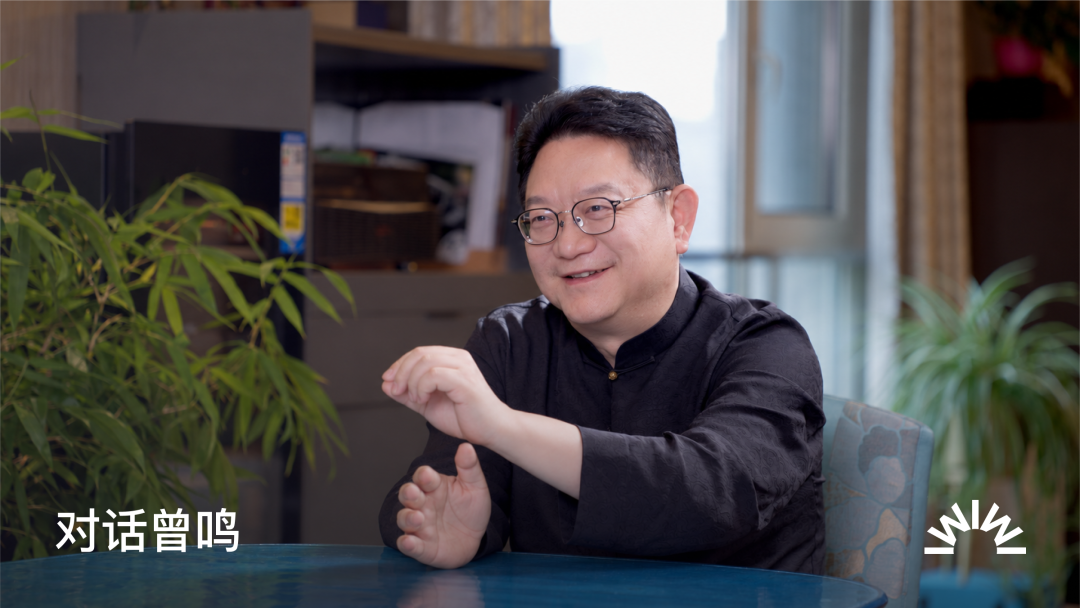

Interview: Zhang Xiaojun x Zeng Ming
Professor Zeng Ming was once the chief strategist of Alibaba Group and also participated in the establishment of two business schools (Yangtze Business School and Lakeside), but he is more familiar to many as a researcher who has deeply contemplated corporate strategy. Many entrepreneurs and business executives have been inspired by him.
As a researcher who has observed the entire cycle of the Internet, today we discussed his comprehensive thoughts on the new era of AI and its new paradigm, comparing it with key historical turning points—after our discussion, I gained a broader perspective.
Regarding the industrial development of AI, Professor Zeng has offered many "non-consensus judgments." We have summarized his 11 viewpoints:
Viewpoint 1: There is still a transitional phase between native applications and the maturity of infrastructure;
Viewpoint 2: Two years ago, I thought AI had reached the Yahoo phase; now it seems the industrialization has not yet reached the browser phase;
Viewpoint 3: Anthropic and OpenAI are unlikely to be the major players or winners in the native application stage;
Viewpoint 4: In public infrastructure, only one business model is valid, called oligopoly with strong government regulation;
Viewpoint 5: Old platforms are unlikely to evolve into new platforms;
Viewpoint 6: Jobs have disappeared, hierarchies have vanished, and companies will eventually face extinction; new forms of organization will arise;
Viewpoint 7: Altruism, empathy, and a shrinking self are probably essential elements for achieving excellence;
Viewpoint 8: The strategic generation system: essentially a small model trained by humans and AI together;
Viewpoint 9: A better analogy for robots is the development of electrical appliances;
Viewpoint 10: In the face of a massive wave, no one is safe; those who feel safe are the most unsafe;
- Viewpoint 11: In the age of AI, the difference between people lies in creativity, which is the ability to create something from nothing.
Below is a condensed version of the text; for full content, please watch our podcast:)
The complete podcast video has been released on all platforms including Xiaoyuzhou,Bilibili, Xiaohongshu, Video Number, Weibo, etc.
Viewpoint 1
“There is still a transitional phase between native applications and the maturity of infrastructure”
Zhang Xiaojun: Professor Zeng, as someone who has been formulating strategies for a long time, do you also feel confused in the face of the significant uncertainty of the AI era? What are your true feelings?
Zeng Ming: I am indeed very confused. You know there will definitely be many new things, but you don't know which ones are fleeting small waves and which represent the great tides of the future; what will change, what will not change—these are very perplexing.
This is why I wrote this book "Intelligence: The Essence of Business, Organization, and Strategy in the AI Era." A few years ago, I was pondering this issue, but I quickly negated my original thoughts. However, by the first half of this year, the situation became clear: some trend signals began to converge and show similar patterns. I saw a possible framework that could explain many current issues and even predict the next steps for development. I was less anxious.
What truly brought the framework to light was that I roughly understood which development stage AI industrialization had entered, as well as the different operational laws of each stage. Once I saw clearly, it gave me a distinct guiding significance for the next three to five years.
Zhang Xiaojun: At what stage is artificial intelligence industrialization today? How do you categorize the entire cycle completely?
Zeng Ming: I have conducted relatively systematic research. I have looked at the history from the PC Internet to the mobile Internet and then to cloud computing, as well as the first, second, and third industrial revolutions. Generally speaking, the emergence of new technology—I am referring to huge, general-purpose disruptive innovations—will go through three stages, which is quite interesting:
In the first stage, the technology is gradually accepted by society and becomes the infrastructure of that society;
In the second stage, a large number of new applications emerge based on this infrastructure, entering an era of flourishing diversity;
In the third stage, when these massive applications appear, people realize they need some more fundamental methods to operate in the new world, which I call the "native application stage."
Zhang Xiaojun: For example, in the case of the mobile Internet, during the birth of Douyin and Pinduoduo, it belongs to the native application stage.
Zeng Ming: Yes. Early on, for example, today young people rarely hear about BlackBerry phones, but BlackBerry was the first phone called a smartphone and dominated for a long time, with a very high market penetration. As late as 2010, it still had over forty percent of the U.S. smartphone market share, while the iPhone only had a bit over twenty percent. It wasn't until after the iPhone 4 that the iPhone began to lead. After the iPhone came the App Store, and after the App Store, a new generation of native applications appeared.
At that time, I invested in the Internet and mobile Internet, including Moji Weather and many other applications that quickly surpassed a hundred million daily active users, but I soon discovered: they did not represent the future. The applications that truly address core needs are the ones that are the native applications.
Zhang Xiaojun: Why must there be a period of explosive application proliferation before reaching the native application stage? Why aren't native applications born in the second stage?
Zeng Ming: Because the proliferation of applications provides direction for the next stage of technological development. Once the technology becomes infrastructure, it does not stagnate; it seeks a new direction for growth, but the exact direction is unclear.
As I just mentioned about Bytedance, it first created Toutiao (Today's Headlines) and even before that, it made a series of small products like Neihan Duanzi. This is because at the early stage of technology, you don't know what will work; you must constantly try. In the first stage, when textual content had matured, Toutiao emerged. Toutiao then explored recommendation algorithms—a type of innovation that is both a technical and a business model. Subsequently, with the development of bandwidth and computing power, short videos emerged. This new form of presentation combined with the underlying technology of recommendation algorithms led to the phenomenon of the TikTok native application, which truly became a national-level product.
There is still a transitional phase between native applications and the maturity of infrastructure.
Zhang Xiaojun: Can the second stage be called a transitional phase? Many entrepreneurs in the middle might feel disheartened upon hearing this.
Zeng Ming: So I hesitate. The second stage itself is very exciting and valuable. I call native applications the third stage to tell everyone: the second stage is likely to last for another three to five years and can be a highly exciting time. You cannot skip over this stage. Without the accumulation of the second stage, you cannot reach the third stage.
Based on the accumulation of the first stage, what needs to be done now is what the second stage requires: to unleash a proliferation of applications.
Zhang Xiaojun: Where are we in the AI industrialization cycle today? Has the first stage already ended?
Zeng Ming: 2026 is a landmark stage where the first phase is basically completed. The core reason is that at the beginning of this year, broad consensus formed around the term "token." For two to three months, relevant discussions were very dense. Huang Renxun mentioned at the NVIDIA GTC conference that NVIDIA's future is a token factory; Sam Altman also quickly expressed that OpenAI's core is selling tokens.
Why are tokens important? Because when a technology has standard measures, it can be scaled and standardized for use. Today, we talk about a kilowatt-hour, a ton of water, a gigabyte of data. These units of measurement allow us to use what was once cutting-edge technology very simply. Now everyone knows: I can call a certain number of tokens to complete a certain amount of work, knowing how much it will cost. At this point, intelligence starts becoming the infrastructure of society.
This means the first stage is coming to an end, and it also means it is starting to mature. It will undoubtedly continue to develop: services will improve, intelligence will grow stronger, and costs will decrease. But it has already formed a matching business model and has become a new concept that everyone can understand and accept. This phase has matured.
Zhang Xiaojun: So, have we entered the second stage?
Zeng Ming: What is interesting this year is that it marks the basically completed first stage, as well as the opening of the second stage.
Before and after this year's Spring Festival, something particularly exciting happened: OpenClaw, which everyone refers to as "lobster." Many people didn't sleep well during the Spring Festival, and they were crazily researching and using these things every day. "Lobster" made everyone see the potential of an Agent that can independently complete tasks. The reason for everyone's enthusiasm is that they see this possibility.
So I believe AI is entering the second stage—the Agent stage. An agent is the new application of the AI era.
Viewpoint 2
“Two years ago, I thought AI had reached the Yahoo phase; now it seems that industrialization has not yet reached thebrowser phase”
Zhang Xiaojun: This analogy may seem a bit naive, but we still want to try: If we compare today with the development stages of the internet or mobile internet, which year does it roughly correspond to?
Zeng Ming: This is a question I have pondered for two or three years. Two years ago, I gave a speech titled "Let’s Embrace Yahoo." At that time, my judgment was that Yahoo was coming soon. But by early this year, I found myself tangled: it seems that industrialization has not yet reached the browser phase.
Zhang Xiaojun: So, your judgment has shifted earlier.
Zeng Ming: Yes. Seeing these things like OpenClaw emerged, my first reaction was: we are still waiting for a browser to appear. It’s not about what happens when the browser comes out; it's that the browser itself hasn’t even appeared yet.
Because what emerged simultaneously with agents are skills. Let’s think about it: what is the essence of an agent? It is actually about sharing capabilities. We encapsulate the capabilities we understand and share. OpenClaw provided a framework and idea: capabilities can be encapsulated and called like this.
I suddenly recalled what I was most enthusiastic about in 1992: building websites. Everyone was figuring out how to build websites, and the purpose of building websites was to share information.
Therefore, this round of AI innovation is taking us from the information age into the capability age. A massive amount of information and knowledge has already been processed and digitized; today, people no longer need to search for information everywhere like in the past, but directly ask ChatGPT for answers. The great achievements of large models today exist precisely because of the website-building movement around 1992, which allowed people to place information on the Internet and complete the process of digitizing information.
So the key to making the analogy is not to be constrained by the technical manifestations, but to understand the underlying abstract structure and operational laws behind it. When I thought: in an era, everyone was building websites and sharing information; and today, everyone is building agents and sharing capabilities—I felt that this structure matched.
Why is the browser important? The browser accomplished two core functions. First, it established an incredibly simple, unified way to build websites through a complete set of standards like HTML. Thus, building a website was no longer a professional task only for specialized engineers; anyone with information could build a website. It greatly lowered the barriers to creation and development. Second, it reduced the barrier to browsing websites to almost zero. Users only need to click to complete information browsing. Suddenly, the user end exploded, and the supply side also exploded, with countless websites emerging every day.
However, when there were too many websites, everyone didn’t know what to look at. At this point, Yahoo appeared. Yahoo was initially a directory: among the hundred new websites that appeared that day, it told you which were the most interesting. Later, when websites became ten thousand, it informed you what the top ten were and further classified them: entertainment, news, stocks...
Zhang Xiaojun: Yahoo, in essence, is structuring information. It is decreasing entropy rather than increasing it.
Zeng Ming: While entropy increases, there must also be entropy reduction to relieve everyone's cognitive stress. Today we are in a process of increasing entropy: various skills are exploding.
Zhang Xiaojun: Who might do the "entropy reduction" in this case? Do you see a precursor to an AI era Yahoo?
Zeng Ming: I don’t see a precursor to Yahoo at all. That's why I say not even the browser has appeared yet. If I were to guess, I think the next biggest opportunity is something like a browser. It will standardize the agents while allowing users to call agents in a very simple way. Then, a massive number of agents will explode. This could be one of the most exciting things in the next two years.
Zhang Xiaojun: Hypothetically, what form could such a product take? What are its prerequisites?
Zeng Ming: We can summarize abstract laws, but we definitely can't deduce the specific product forms. This is precisely the place where everyone needs to create.
Zhang Xiaojun: From Yahoo to Google, there were still a few years in between. Since you haven’t seen this era's Yahoo, you probably won't see Google's either?
Zeng Ming: This is a question I cannot answer right now. I am not sure whether there will definitely be a huge gap between this era's company and the next. After all, Yahoo did not last. I can't see it clearly yet, and I feel it is too early to discuss it. Let's wait for Yahoo to appear first, let it shine for three years, and then we can see who will challenge it.
Yahoo was founded in 1995 and was very brilliant by around 2000. After Google was established, at first, it only provided To B services to Yahoo, offering algorithm support, almost like a "little brother" to Yahoo.
In this sense, Yahoo nurtured Google.
Viewpoint 3
“Anthropic and OpenAI are unlikely to be major players or winners in the native application stage”
Zhang Xiaojun: The most critical variable in this era is the model. How do you understand the model? What is the essence of the model? What can it be compared with in history?
Zeng Ming: There are many analogies. People say data is the new oil, and the model is a refinery.
From the perspective of broadly providing infrastructure, it resembles another now-defunct company—America Online (AOL). It was an internet service provider, allowing everyone to connect to the internet, which itself was a massive achievement. Today, large models enable everyone to access intelligence easily. From this perspective, it is also an infrastructure provider.
Zhang Xiaojun: Do you think companies like OpenAI, Anthropic, DeepSeek, and Kimi are just infrastructure providers?
Zeng Ming: To put it bluntly, model companies are AI cloud companies—the future AI cloud companies.
This is also why the competition between these large model companies and several cloud vendors has become very interesting and complex in the U.S. cloud providers feel they have invested too much and received too little; model companies likely believe they will have to build their own cloud services in the future, like OpenAI.
Between these two ecosystems, some collisions and re-integrations may occur, ultimately resulting in a few relatively stable AI cloud companies. I believe this trend is certain.
Zhang Xiaojun: Is there a chance for large model companies to leap from infrastructure providers to successful application companies?
Zeng Ming: This is an open question. If I had to give a subjective conclusion, the probability won’t be too high.
Zhang Xiaojun: Why?
Zeng Ming: There are no historical precedents.
Zhang Xiaojun: Codex is doing great now, and Claude Code is also doing well; they are successful to C applications.
Zeng Ming: No, this is a foundational extension of large models. Coding must become a part of basic intelligence. Without coding, we wouldn’t even be able to talk about calling APIs or whether tokens would exist. It is because coding capabilities have made tokens valuable, due to the breakthroughs in intelligence and reasoning abilities.
Zhang Xiaojun: But you see, companies like Anthropic were established only five years ago, and in such a short time, they are already valued at around a trillion dollars, which is very rare in human history. How do you explain this phenomenon?
Zeng Ming: This description itself is an illusion and misunderstanding. Young people are prone to think that in each era, "this time is different." This is a typical "this time is different" case.
I have checked into this matter. Returning to what we just mentioned, Yahoo was founded in 1995 and reached a valuation of 120 billion dollars in 2000, within five years. What does that correspond to? When you factor in inflation and the rise of the NASDAQ index, achieving a valuation of 100 billion dollars at that time, with an approximate 8% annual return, corresponds to a company worth one trillion dollars today.
So in 2000, achieving a 100 billion dollar valuation in just five years had a shock on everyone that was no less intense than Anthropic’s today. It was equally intense.
The AOL company I just mentioned, which later faded away, started providing services in 1988, and at its peak in 2000, it was valued at 220 billion dollars, higher than Yahoo, making it the highest valued company at that time. When it later acquired traditional media and Warner Bros, reaching over 300 billion dollars, that was also a terrifying figure.
Google was founded in 1998 and achieved a 100 billion dollar valuation by 2005. Blackberry at its peak was one of the fastest hardware manufacturers to reach a 100 billion dollar valuation.
So when a technology has such a strong impact, the first wave of successful companies will have tremendous value.
I think, whether it be Anthropic or OpenAI, they are remarkable, both in terms of technological breakthroughs and business achievements. However, such precedents have occurred in history and similar stages before. But they may not necessarily survive to the end. They can likely continue to thrive, but they are unlikely to be major players or big winners in the native application stage.
Even if we return to the analogy of oil, refineries and chemical factories are two different types of companies. Chemical companies offer far more value than purely refining companies. Chemicals represent applications, while refining is merely basic, extracting oil and turning it into essential products.
Another analogy is cars. Cars certainly cannot run without oil, but oil companies cannot make cars. You’ve never heard of a car company that transformed from an oil company.
Zhang Xiaojun: I happened to read a quote from Dr. Lu Qi in 2024, where he said that AGI companies like OpenAI will definitely be larger than Google in the future, it’s just a question of whether they will be five times bigger or ten times bigger.
Based on your earlier reasoning, I understand that you not only don’t consider "OpenAI to be the Google of the AI era," but you even feel they might just be historical passersby who might disappear. Is that your perspective?
Zeng Ming: That is indeed my perspective.
I believe there will definitely be a 10 trillion dollar company in the future, but it may not be among the current frontrunners.
I understand that Dr. Lu Qi means there will be an "AI era Google company," which is likely to be ten times bigger than the current Google.
Zhang Xiaojun: No, he is specifically referring to OpenAI.
Zeng Ming: I understand. But at that time, everyone likely only thought OpenAI represents the future.
As a researcher of business history, I study the dynamics of the business world. The theoretical framework I can see tells me: companies in the first stage find it difficult to survive to the second stage; companies in the second stage struggle to reach the third stage.
Zhang Xiaojun: Why is that?
Zeng Ming: Logically, if they appear in the market so early, being sensitive to the most cutting-edge information, why can’t they pivot in time? For instance, I can immediately transform from being an infrastructure company to an Agent-focused company, this transition seems seamless.
Zeng Ming: I doubt that’s smooth. Because the core of technology in the first stage is "usable," it has many original technological innovations. The hallmark of the beginning of the second stage is that the development of technologies from the first stage gradually slows down before it can become a technology that can be queried widely—so I don't need to reinvent the wheel. But applications in the second stage require strong insights. They require innovative products, strong empathy for ordinary users, and a batch of new application technologies.
Disclaimer: This article represents only the personal views of the author and does not represent the position and views of this platform. This article is for information sharing only and does not constitute any investment advice to anyone. Any disputes between users and authors are unrelated to this platform. If the articles or images on the webpage involve infringement, please provide relevant proof of rights and identity documents and send an email to support@aicoin.com. The relevant staff of this platform will conduct an investigation.