Author: Deep Tide TechFlow
As the year comes to an end, it is expected that major institutions will release their 2026 crypto predictions and outlooks over the next month.
However, before looking at new predictions, it might be worthwhile to review what these institutions said last year; after all, anyone can make predictions, but accuracy is the real skill.
Looking back at the end of 2024, market sentiment was high, with BTC just breaking through $100,000, and predictions were generally optimistic:
For example, BTC was expected to hit $200,000, the stablecoin market was predicted to double, AI agents were set to ignite on-chain activities, and crypto unicorns were expected to flock to IPOs… Now, a year later, have those predictions come true?
We have sifted through various prediction reports from last year to highlight a few typical institutions and individuals' viewpoints to see who had a higher prediction accuracy rate.
1. VanEck: 10% accuracy, only correctly predicted the establishment of Bitcoin strategic reserves
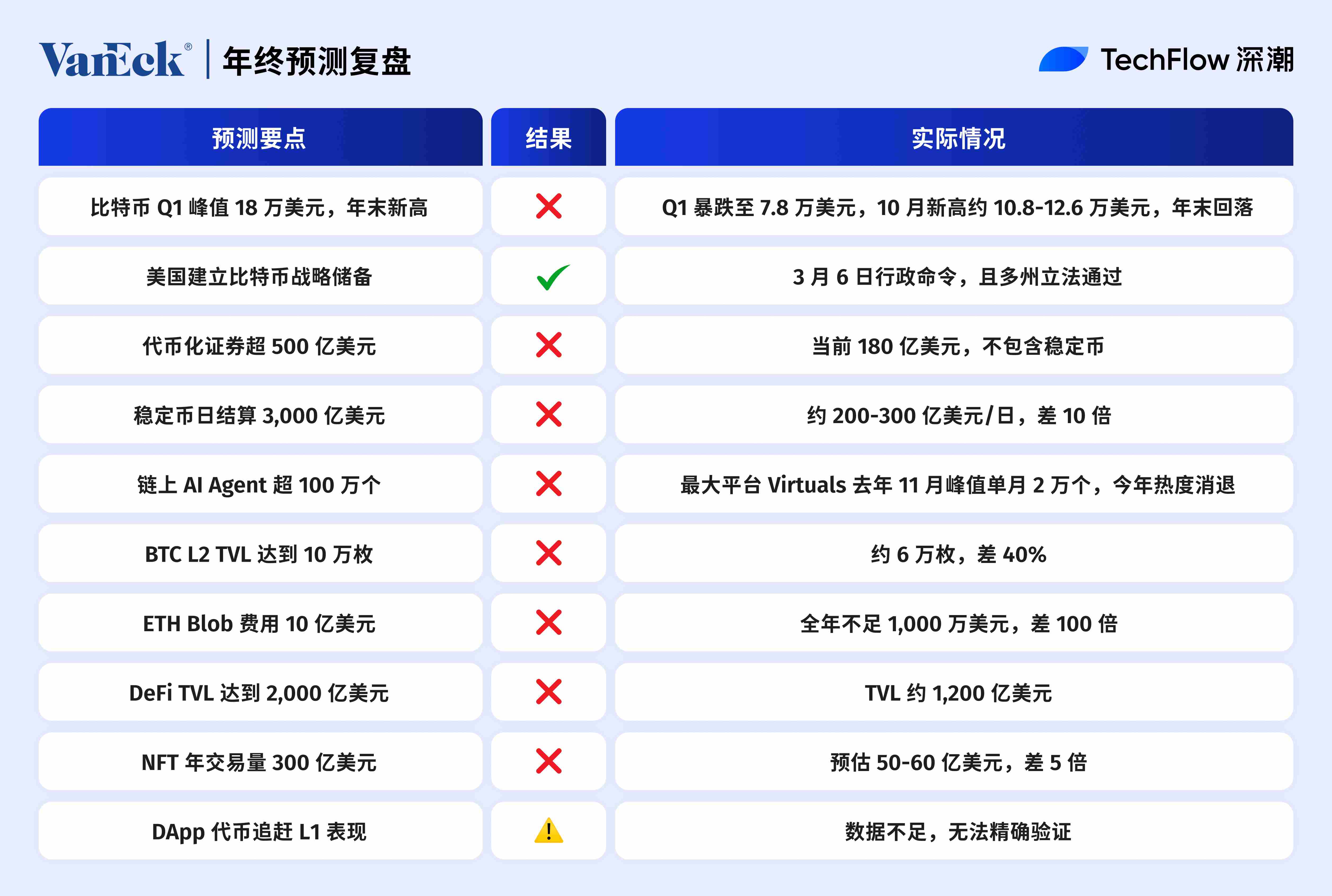
VanEck provided 10 predictions for the end of 2024, with the only accurate one being the Bitcoin strategic reserve.
The other 9 were all incorrect, and most were not minor deviations but rather orders of magnitude errors, such as predicting that crypto would peak in Q1 with Bitcoin reaching $180k and setting new highs by year-end; in reality, the timing and price targets were completely opposite.
Additionally, their market size predictions were overly optimistic. They predicted tokenized securities at $50 billion, while the actual figure was around $30-35 billion; DeFi TVL was predicted at $200 billion, but the actual was about $120-130 billion; NFT trading volume was forecasted at $30 billion, while the actual estimate was $5-6.5 billion.
Overall, VanEck's judgment on policy direction was quite accurate, but they systematically overestimated the on-chain economic scale.
2. Bitwise: 50% accuracy, correct on the general direction but wrong on price predictions
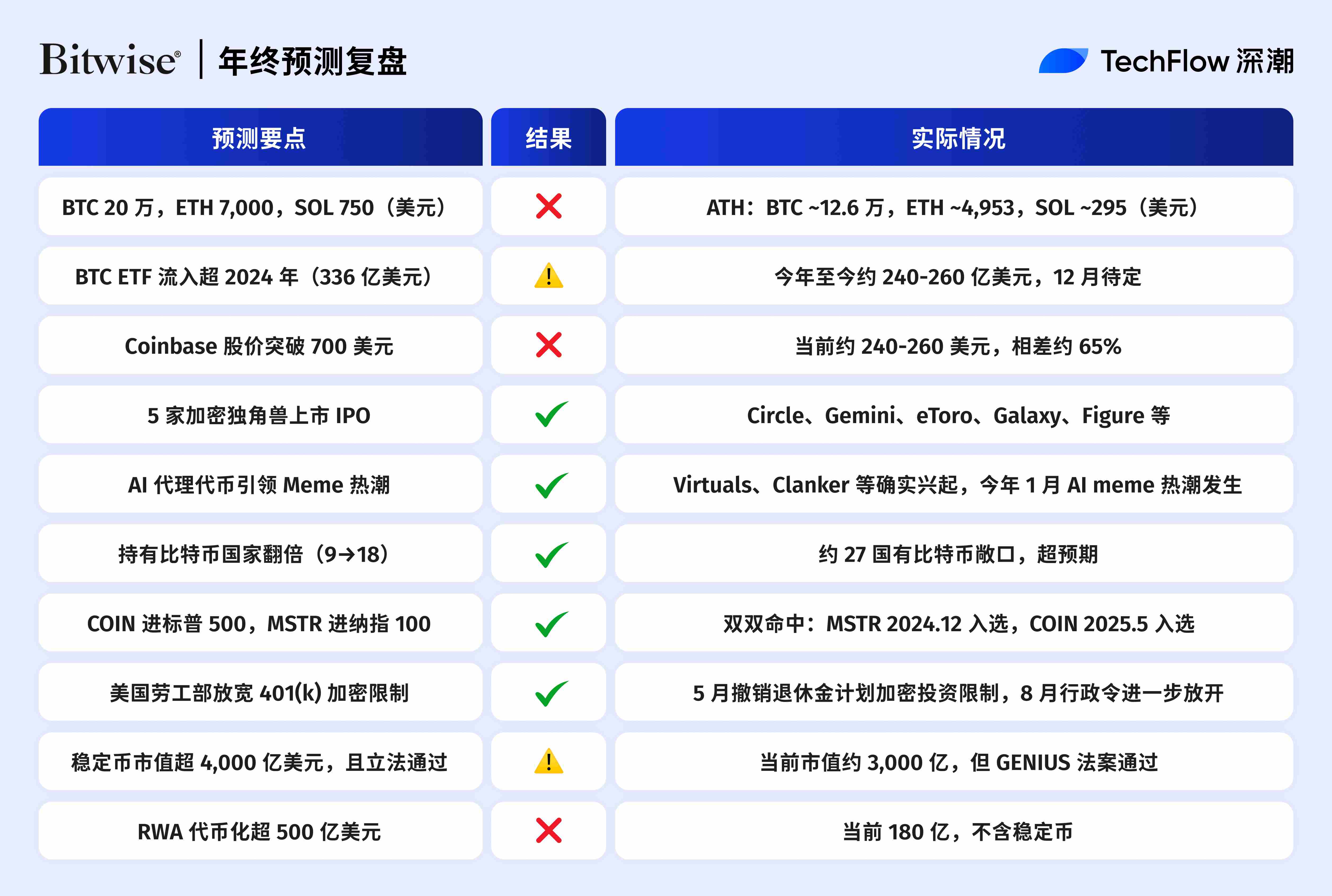
Bitwise made 10 predictions, hitting 5, mainly focused on regulation and institutional adoption; their price and scale predictions were also systematically overestimated.
They accurately predicted policy and institutional adoption. Coinbase and MicroStrategy entering the U.S. stock index came true; the year of crypto IPOs was realized, with several crypto companies going public; the number of countries holding BTC increased from 9 to nearly 30.
However, all price targets were missed: the predicted prices for BTC, ETH, and SOL were far above the actual performance of these tokens this year. Coinbase's stock price was predicted at $250, which was 65% off the $700 target. The estimated $50 billion for RWA tokenization was clearly also an overestimate.
Overall, Bitwise has a keen sense of policy and accurately grasped the rhythm of regulatory shifts and institutional adoption.
3. Coinbase: Nearly 100% accuracy, only discusses direction, not price
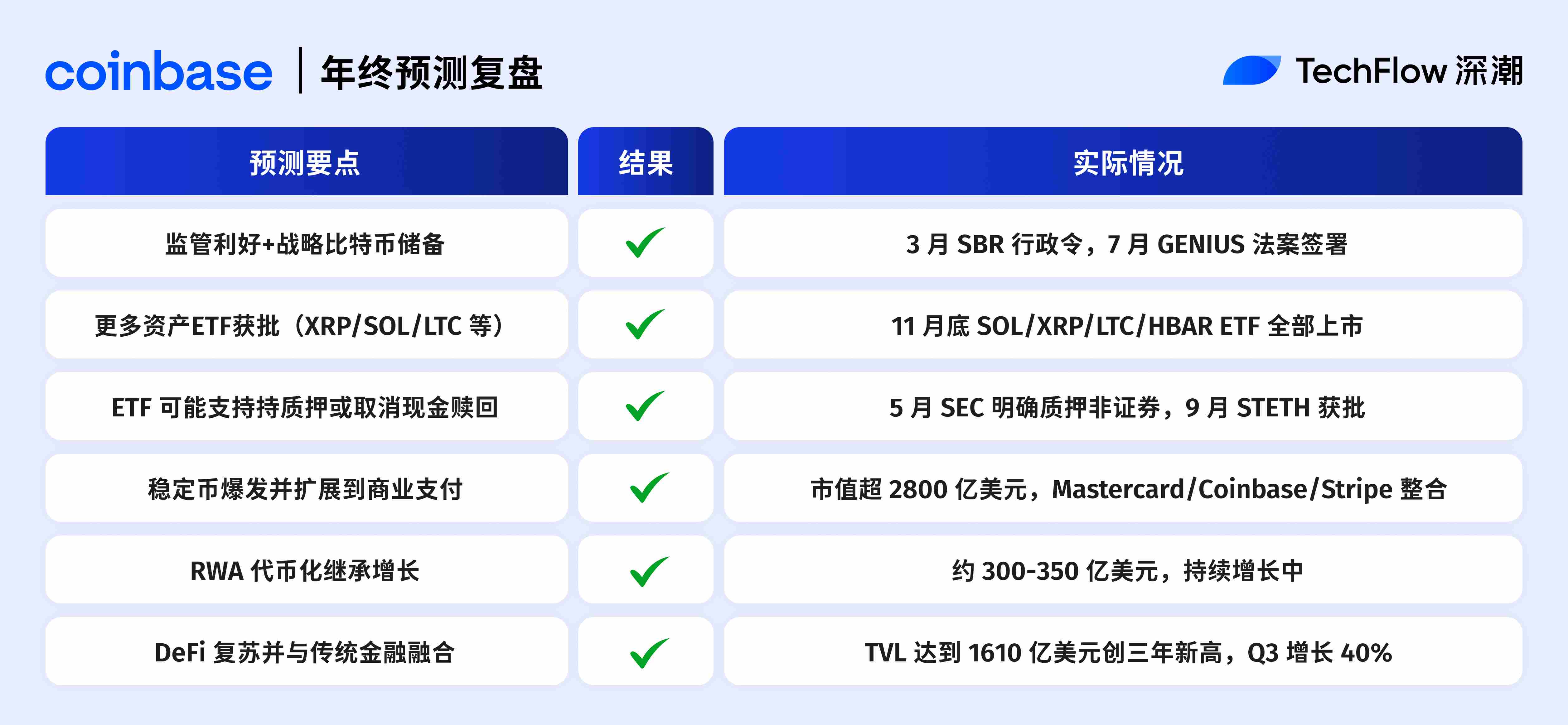
Coinbase's predictions are divided into "macro" and "disruptive" categories, mostly directional judgments rather than precise numbers, representing trend foresight.
Some core verifiable predictions are as follows:
Other predictions were generally correct in direction but difficult to quantify:
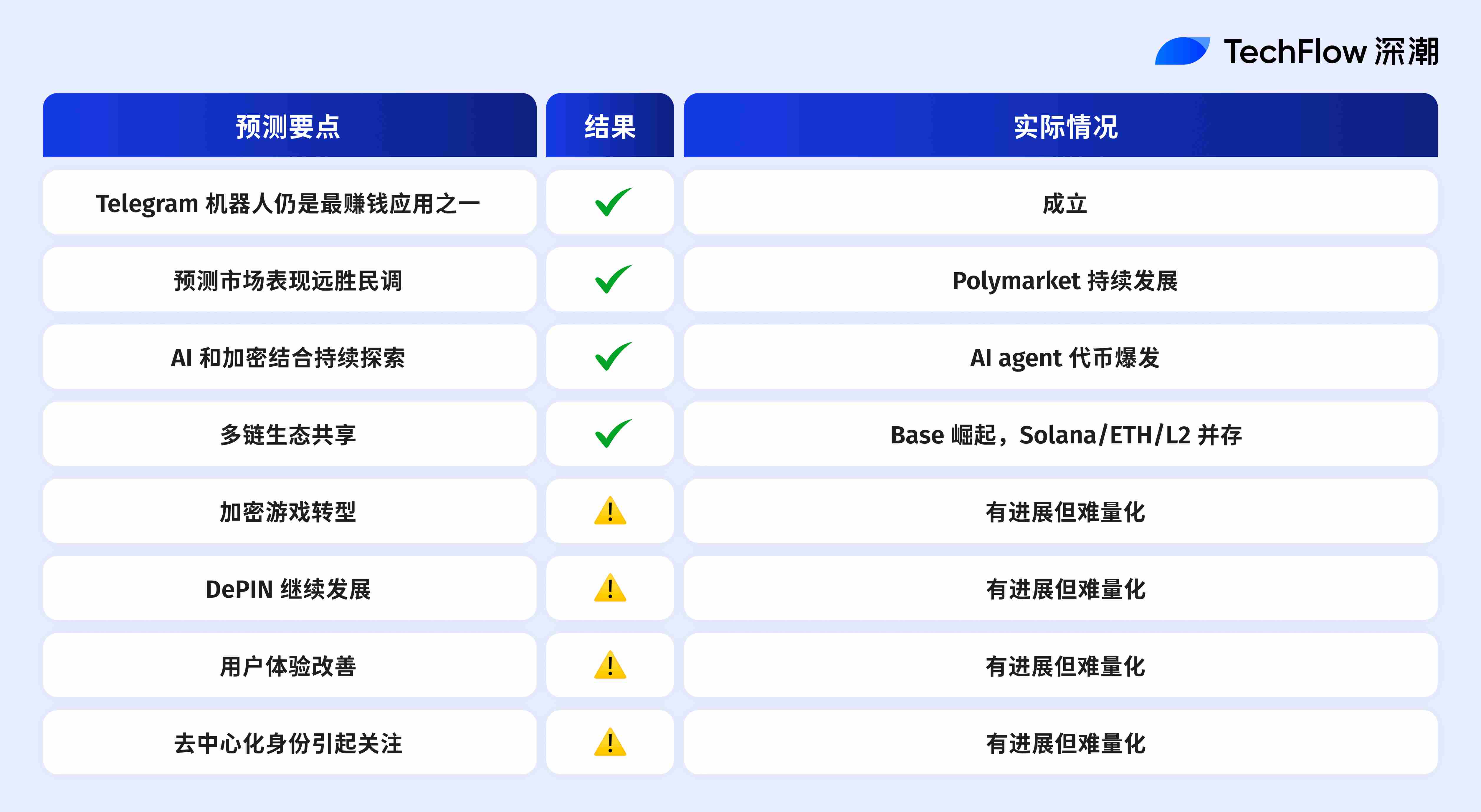
You can see that this company’s predictions clearly avoided specific price targets, focusing on policy turning points and industry trends. The result is that all core directional predictions were accurate.
The regulatory shift was fully validated: the prediction of "the most crypto-friendly Congress in history" bringing benefits and more asset ETFs being approved was indeed the case.
The general direction for stablecoins and DeFi was correct: they predicted stablecoins would "experience explosive growth and expand into commercial payments," which indeed happened this year with Mastercard announcing support for USDC/PYUSD/USDG in June, and Coinbase's own payment platform integrating with Shopify, while Stripe launched USDC subscription payments;
They also predicted a DeFi recovery, with the reality being that DeFi TVL reached $120 billion, close to a three-year high since May 2022.
This strategy of "only discussing direction, not specific points" may lack sensationalism, but in hindsight, it is the most robust and least likely to be contradicted.
4. Galaxy Research: 26% accuracy, nearly all data-related predictions were wrong
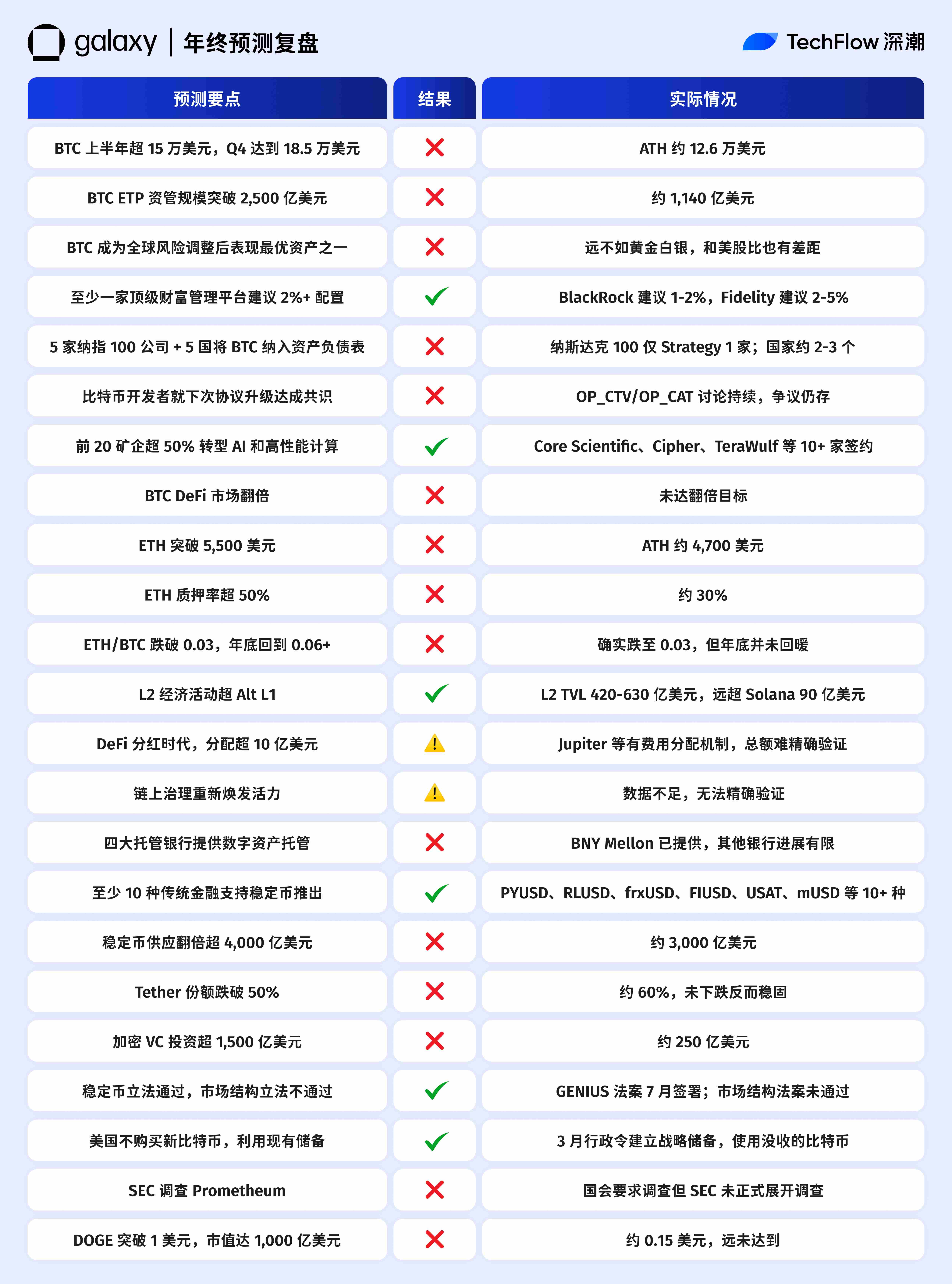
Galaxy's researchers made a total of 23 predictions, the most quantifiable and numerous among all institutions.
Looking back, the policy prediction team performed excellently (100% accuracy), but price and market size predictions were almost all wrong. In particular, the prediction that DOGE would break $1 now seems overly optimistic.
Additionally, Galaxy's predictions on ecological development were quite good. For example, they predicted that most mining companies would transition to AI and high-performance computing, which indeed became a significant trend in this year's AI boom.
When the number of predictions is high and the granularity is fine, even professional research institutions may not get everything right; the market did not move as everyone expected.
5. Hashkey: 70% accuracy, price predictions were overly optimistic
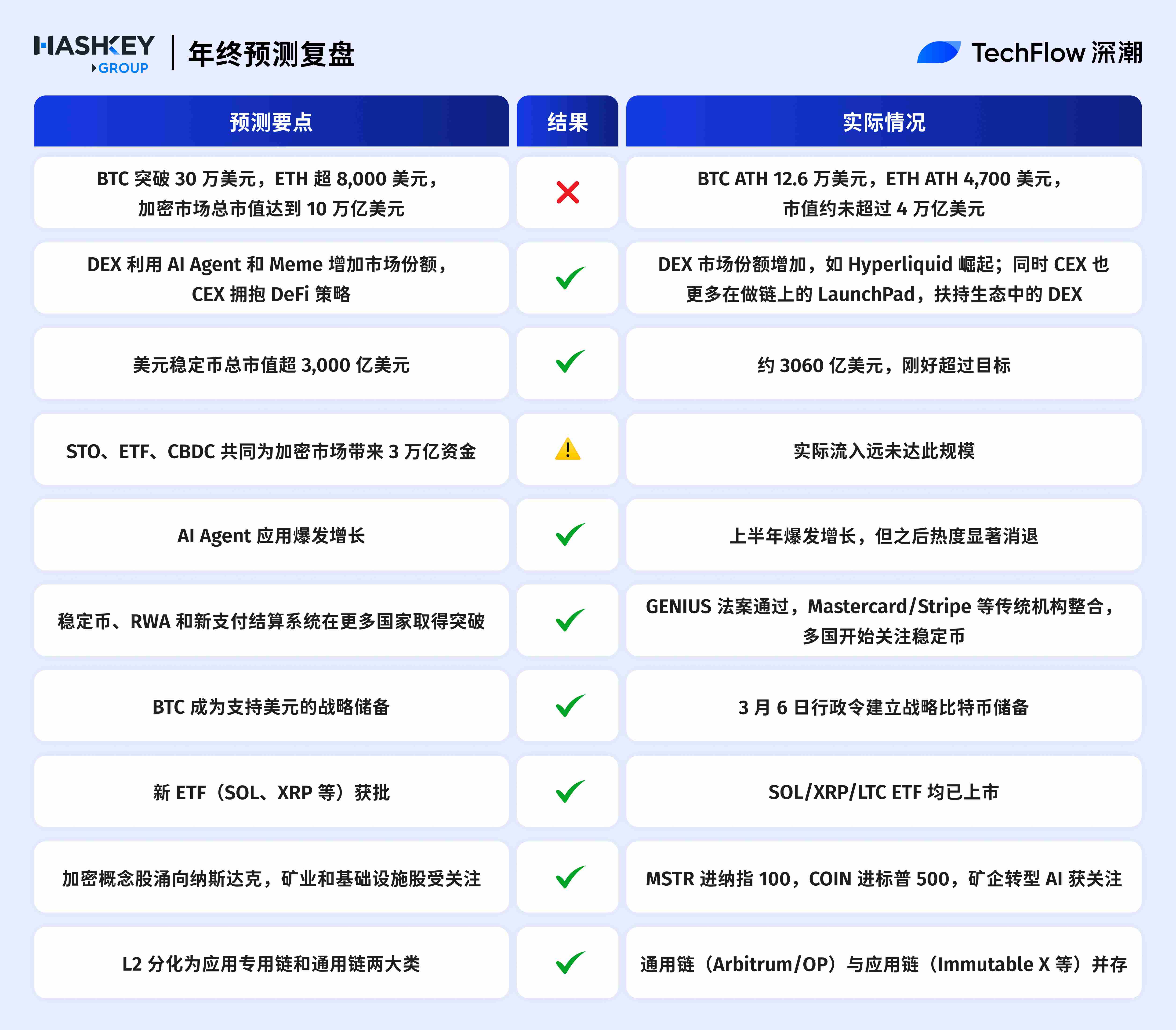
Overall, HashKey's predictions were accurate regarding regulatory compliance progress (ETF, stablecoin legislation) and ecological structural changes (rise of DEX, L2 differentiation), but they remained overly optimistic about price cycles.
Interestingly, this prediction also reflected the sentiment of the crypto community at the time.
After HashKey Group released its top 10 market predictions for 2025, nearly 50,000 community users voted on the sixteen popular predictions summarized by HashKey researchers, analysts, and traders;
The results showed that 50% of voters were optimistic about the prediction that "Bitcoin will break $300,000, Ethereum will exceed $8,000, and the total market cap of crypto will reach $10 trillion."
Ironically, the prediction with the highest voting probability now seems the least likely to be realized by the end of this year.
6. Delphi Digital: 40% accuracy, consumer-level DeFi predictions are the highlight
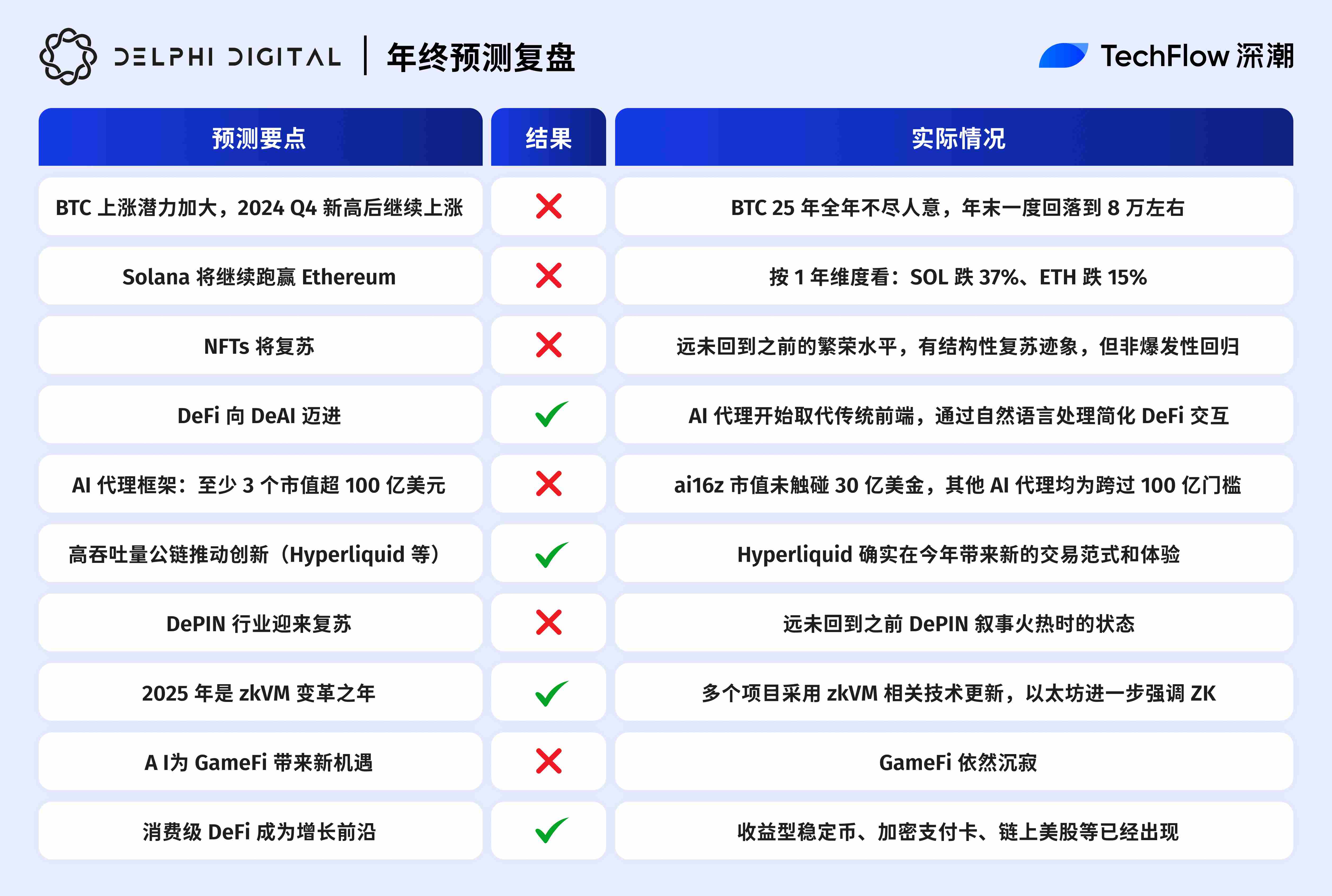
Delphi Digital's predictions regarding technological infrastructure and consumer-level applications were relatively accurate; their prediction for consumer-level applications was:
"2025 will be a significant development node for consumer-level DeFi, with more and more crypto users fully embracing on-chain financial services."
This year, we indeed saw the emergence of various U cards and tokenization of U.S. stocks, and traditional financial applications like Robinhood are gradually embracing on-chain solutions.
7. Messari: 55% accuracy, did not involve specific price points
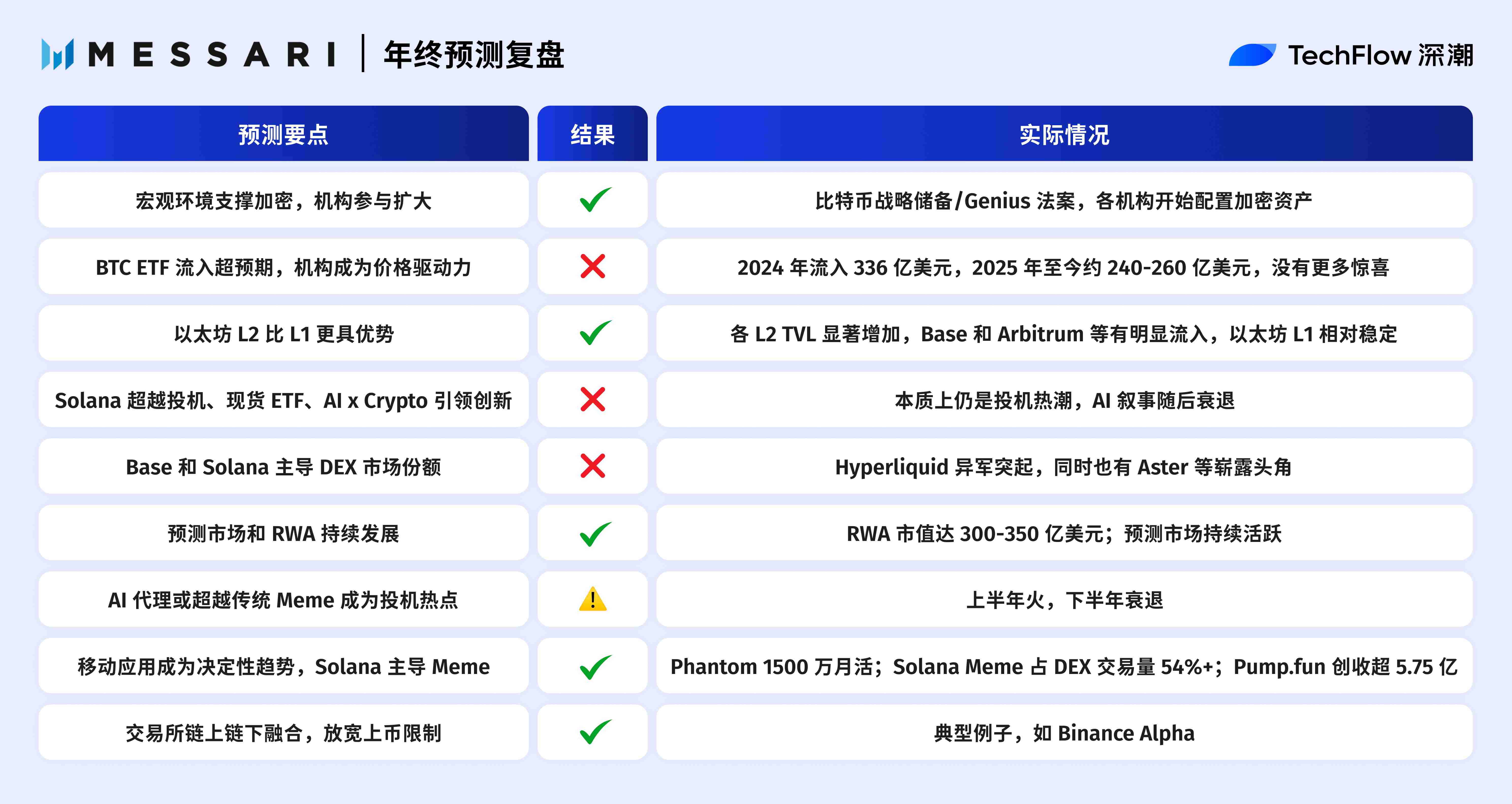
Although Messari is a data analysis platform, its predictions lean towards "trend direction" rather than "specific numbers," and looking back, their judgments on major trends were relatively accurate.
8. Framework Co-founder: 25% accuracy, gave more confidence to invested projects
Next, we also selected some representative individual predictions from last year to see how they turned out.
First is the prediction from Framework co-founder Vance Spencer, from which we selected the parts related to crypto:
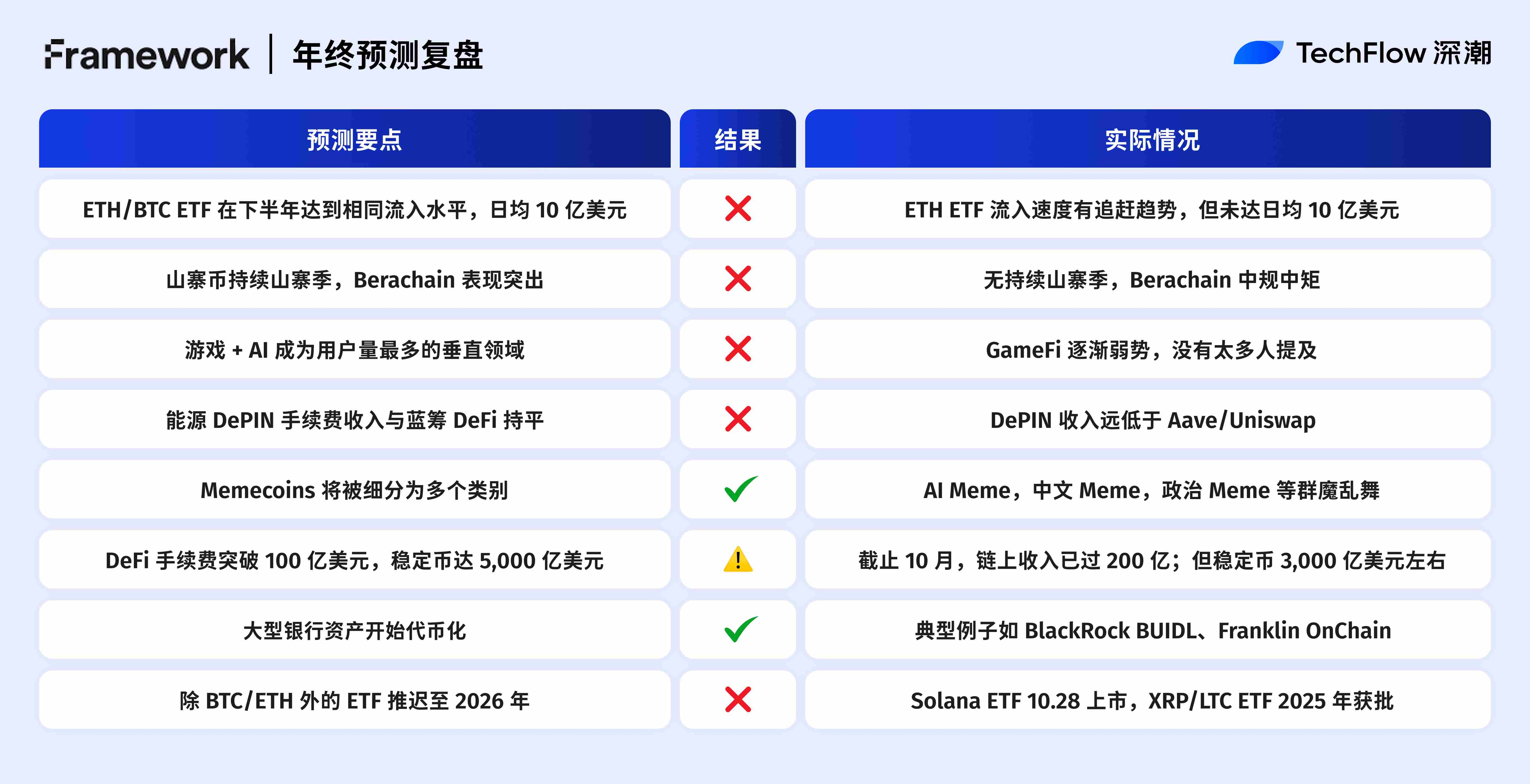
Clearly, Vance had high expectations for the projects he invested in, such as Glow, Daylight, and Berachain, which represent the energy and public chain sectors.
Additionally, some quantitative targets were overly aggressive, such as an average daily inflow of $1 billion into ETH ETFs.
9. Blockworks Co-founder: 48% accuracy, the most predictions made
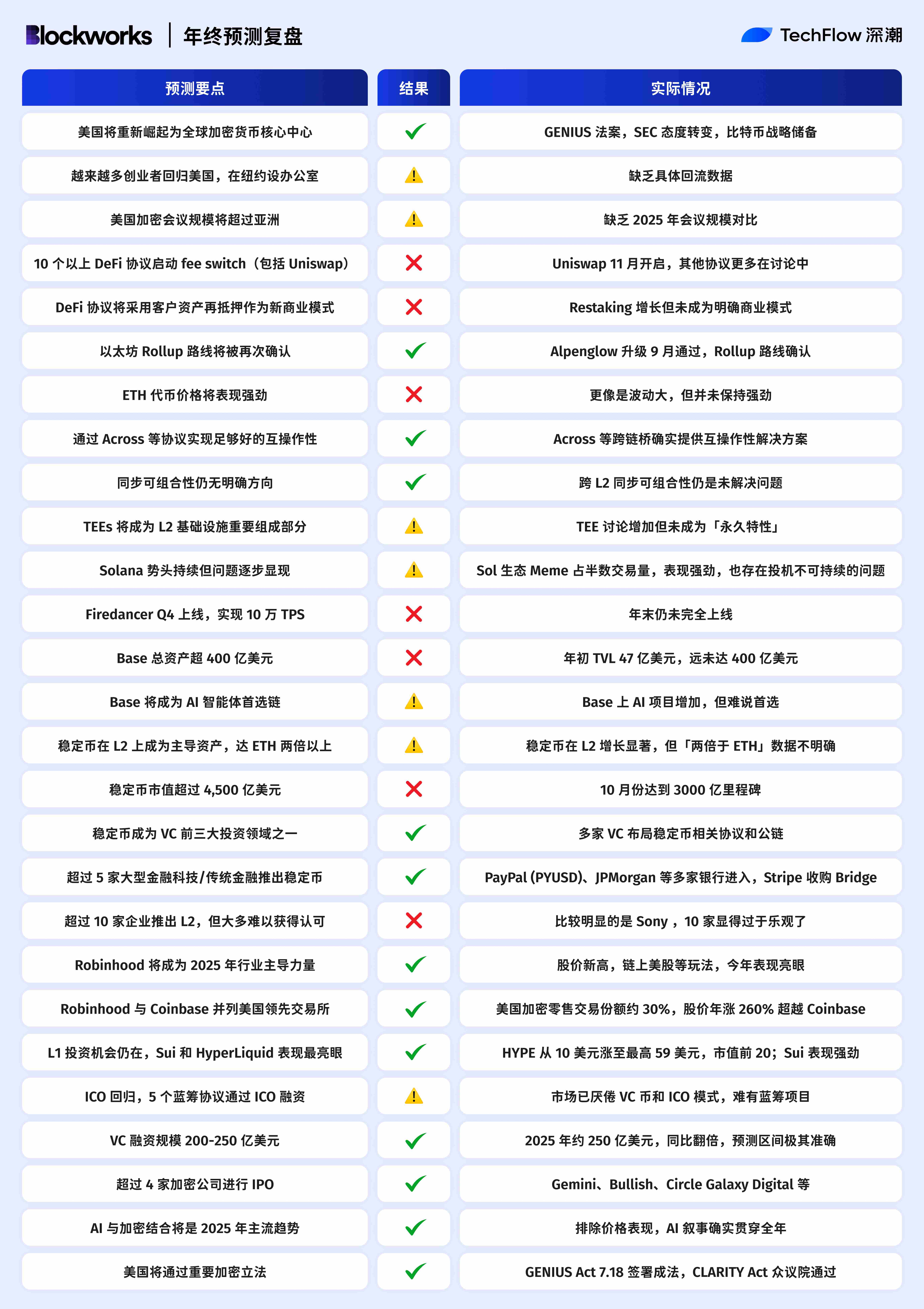
Blockworks co-founder Mippo (X: @MikeIppolito_) made the most predictions among the institutions and individuals we reviewed, and his accuracy rate was quite good, hitting nearly half.
Highlights include the completely correct prediction regarding the rise of Robinhood, as well as accurately identifying investment opportunities in L1, such as Hyperliquid and SUI, both of which had impressive performances this year.
10. Alliance DAO Wang Qiao & Imran: 50% accuracy, overly optimistic about BTC price
The two founders of Alliance DAO, Wang Qiao and Imran, also made predictions about developments in 2025 during a podcast chat.
We have organized their crypto-related viewpoints as follows:
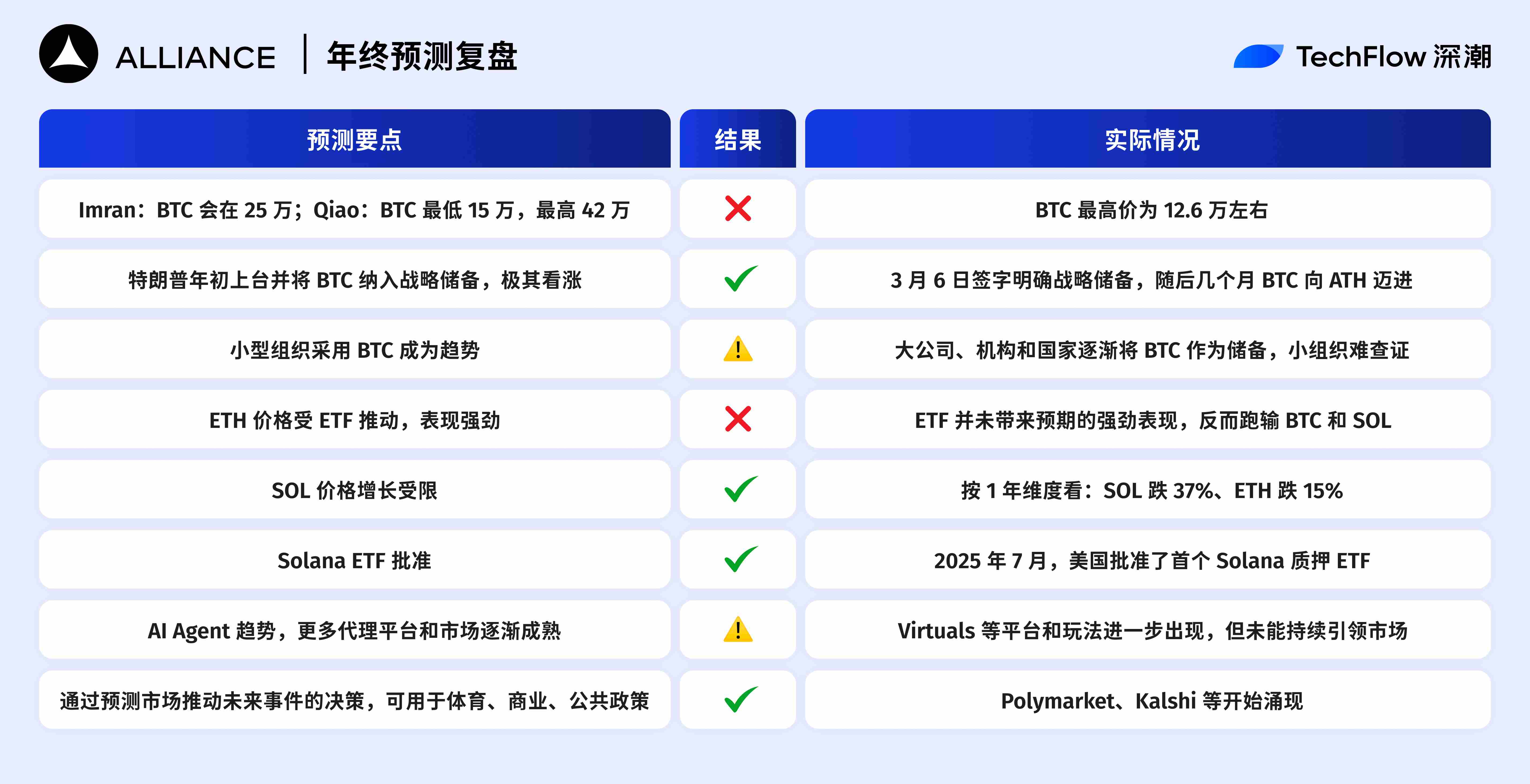
It can be seen that the two founders were overly optimistic about BTC's performance; even the lowest predicted value of $150K is still quite far from this year's highest BTC price.
However, their judgment on the prediction market was very accurate, as they foresaw this key trend a year in advance.
Summary
After reviewing last year's predictions, several patterns are evident:
The number of predictions is negatively correlated with accuracy; the more predictions made, the more errors occurred.
Attempts to predict specific price points and numbers generally resulted in disappointment.
Predictions regarding policy were very reliable; improvements in the regulatory environment and the U.S.'s friendliness towards crypto were accurately predicted by almost all institutions and individuals.
Finally, I believe that the value of these institutions' predictions each year lies not in "telling you what to buy," but in "telling you what the industry is thinking." We can treat these predictions as indicators of industry sentiment; however, if you use them as investment guides, the results may be disastrous.
At the same time, it is a good habit to remain skeptical of any predictions with specific numbers, regardless of who they come from, whether it's a KOL, an institution, or an industry leader.
This is not to say that we should criticize these industry elites, but rather that incorrect predictions can also hold value.
They reveal what the market once believed, and no one can predict the future.
Disclaimer: This article represents only the personal views of the author and does not represent the position and views of this platform. This article is for information sharing only and does not constitute any investment advice to anyone. Any disputes between users and authors are unrelated to this platform. If the articles or images on the webpage involve infringement, please provide relevant proof of rights and identity documents and send an email to support@aicoin.com. The relevant staff of this platform will conduct an investigation.