
Recently, we have continuously analyzed various practical technical indicators, gaining recognition from many friends. There are also many people who actively messaged customer service with numerous practical questions. We sincerely appreciate everyone's trust and support for our research institute over time. Whether you are a beginner or an experienced player, we will continue to provide clear and concise analysis.
Today, we will introduce a set of essential foundational indicators—RSI. It is also a classic tool with a very high usage rate in the community, and its full name is the Relative Strength Index. The core principle is to measure the price changes over a period of time to assess market strength, thus capturing trend turning points and reversal opportunities in advance. In simpler terms: specifically helps you accurately find market reversal points.
Exclusive benefits for AiCoin users: By registering through the AiCoin channel and authorizing Hyperliquid, binding exclusive invitation relationships, you will enjoy a permanent 4% commission rebate, which can save a lot of costs for long-term trading. Binding access: https://app.hyperliquid.xyz/join/AICOIN88
Invitation code: AICOIN88
Seeing everyone's high enthusiasm for learning, I will try to explain RSI in simple terms and gradually increase the depth. At the end of the document, there will also be a fully ready custom indicator source code given to everyone, so don’t leave.
Now, let's officially start understanding RSI! Follow me to open this indicator on the chart; we will use it today to analyze the real trends of Bitcoin and Ethereum. You can add it by searching RSI directly in the indicator bar.
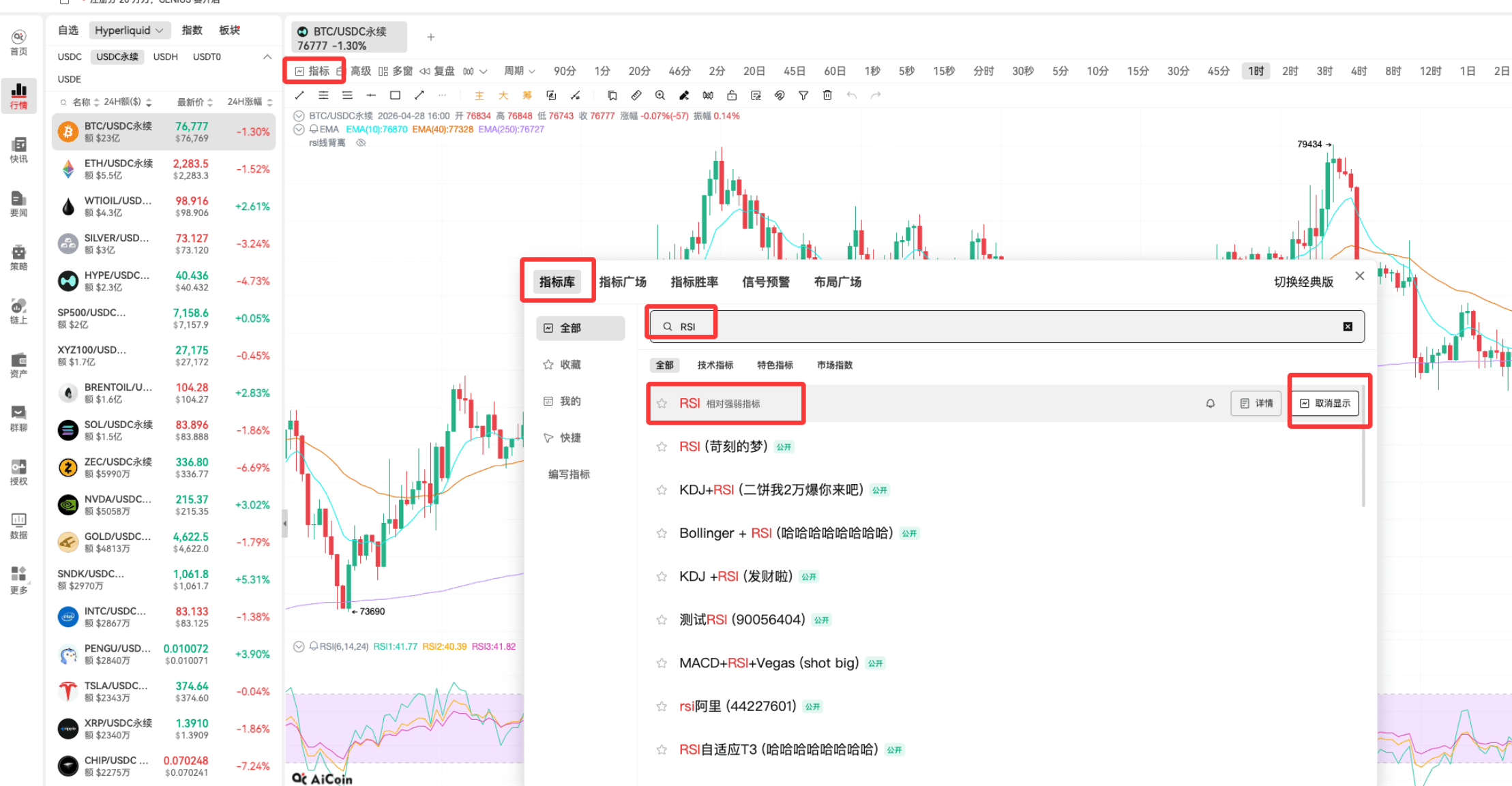
Next, let's briefly understand its core principles.
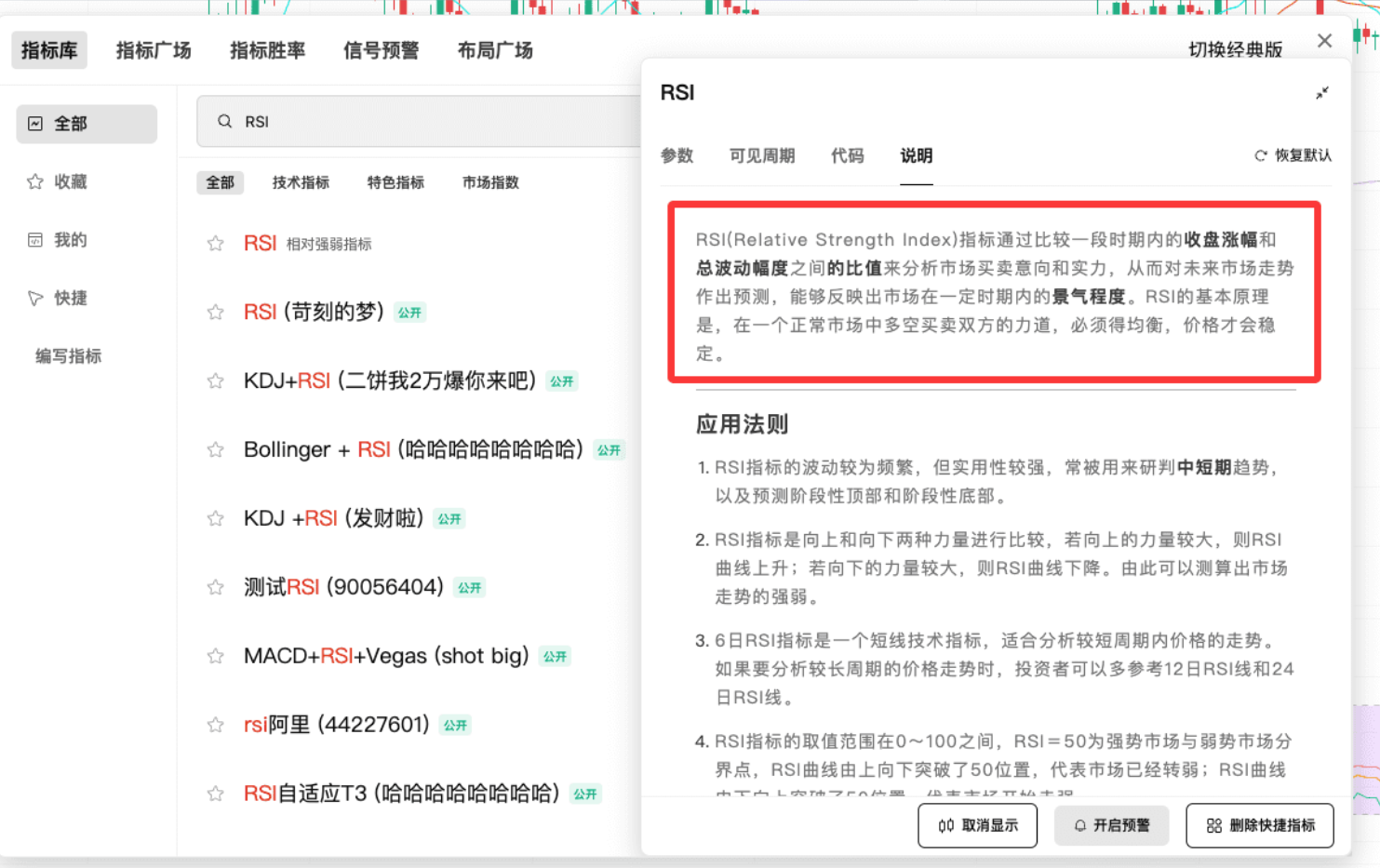
The official explanation is long and convoluted, so let me clarify it in one sentence: RSI calculates the price increase and decrease over a fixed period to form a strength curve, relying entirely on price changes to intuitively reflect the current market sentiment.
Once added, you will see the common RSI interface.
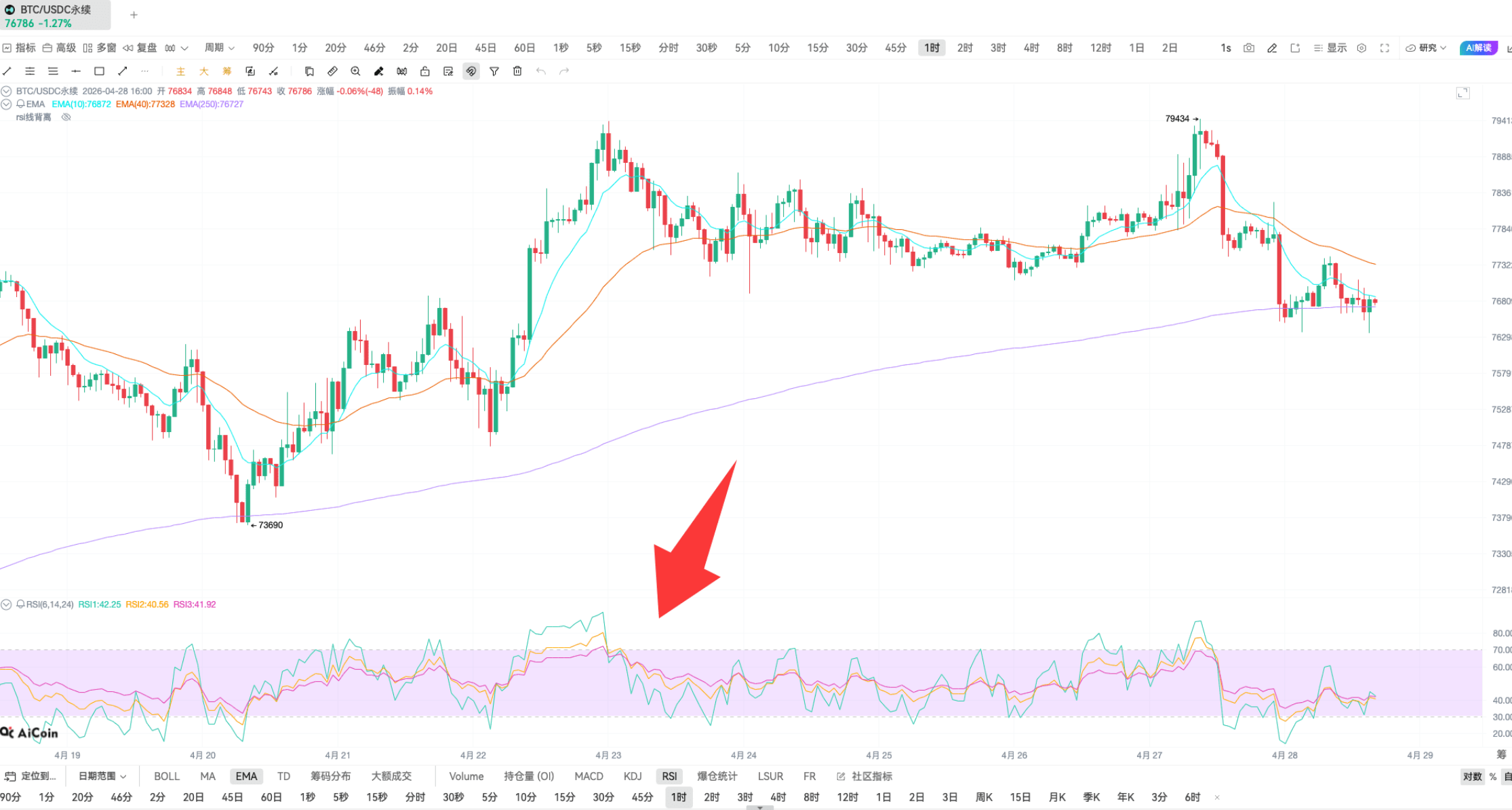
Many beginners may be confused when they first open it: why are there three lines? In fact, it's easy to distinguish; the three lines correspond to three commonly used period parameters: 6, 12, 24 representing: short-term RSI, medium-term RSI, and long-term RSI, respectively.
Simple usage categorization: for ultra-short-term trading, just look at the 6-period; for medium-term operation, focus on the 12-period; for long-term setups and big trends, keep an eye on the 24-period.
The three lines can be viewed together or selected individually, with different colors for easy differentiation.
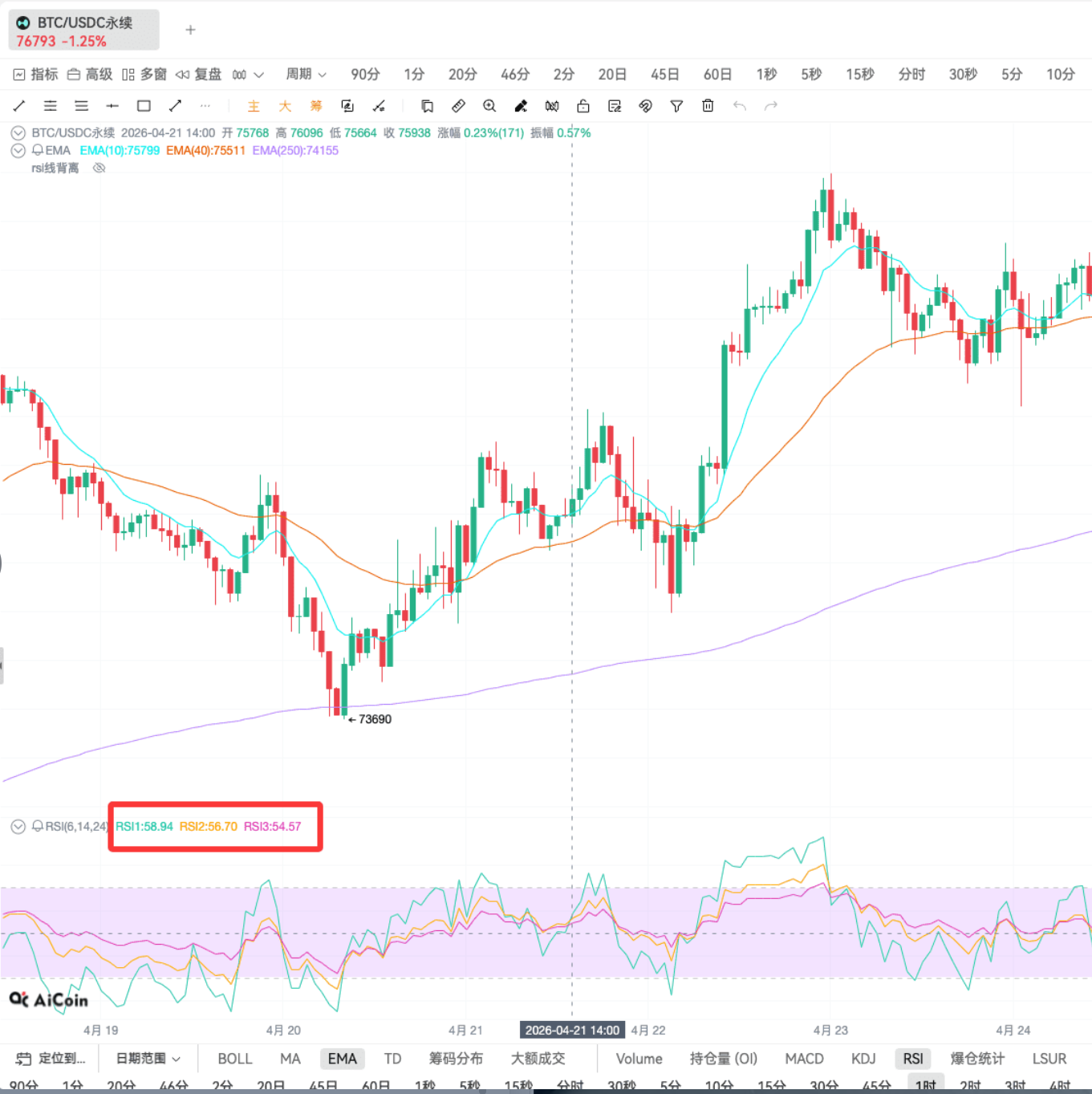
If you feel the lines are too many and look cluttered, you can hide the unnecessary periods manually and keep only what you commonly use.
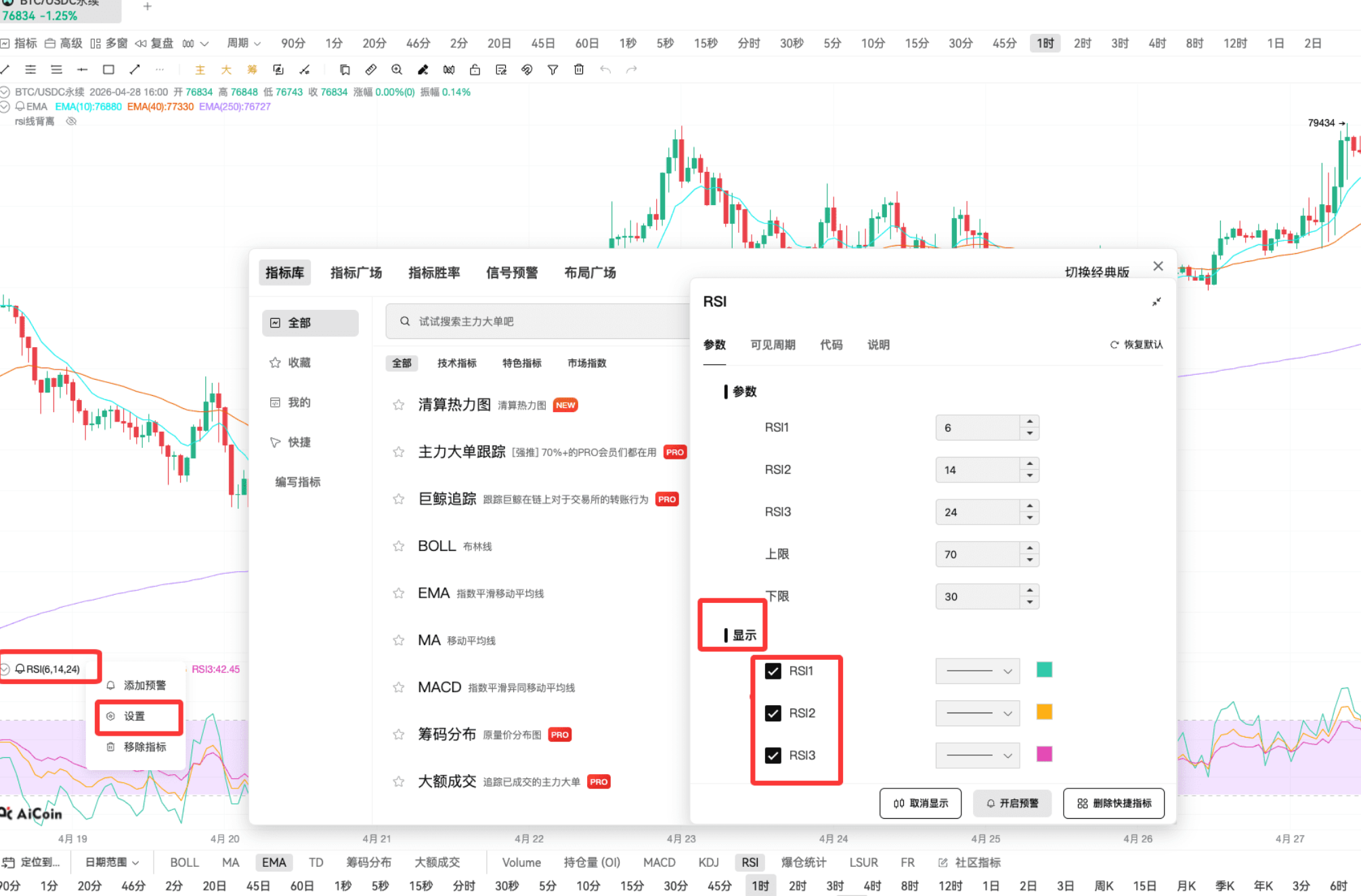
After understanding the basic shapes, next comes the key points! I will share two major core practical usage methods of RSI, which beginners must remember.
First: Classic Overbought and Oversold Trading Method
This is the most basic and useful core logic of RSI:
- Oversold zone: value below 20, prioritize buying low
- Overbought zone: value above 80, prioritize selling to take profit
Precise entry rhythm: best buy: RSI breaks below 20 and then breaks back up above 20; best sell: RSI breaks above 80 and then turns downward to break below 80.
Of course, many experienced players may use 30 and 70 as boundary standards, and you can adjust according to your own style.
Let's get hands-on and set it up together; follow me to modify the parameters and fix the boundary values at 20 and 80. After modification, the background range of the indicator will change synchronously, making the division clearer and more intuitive.
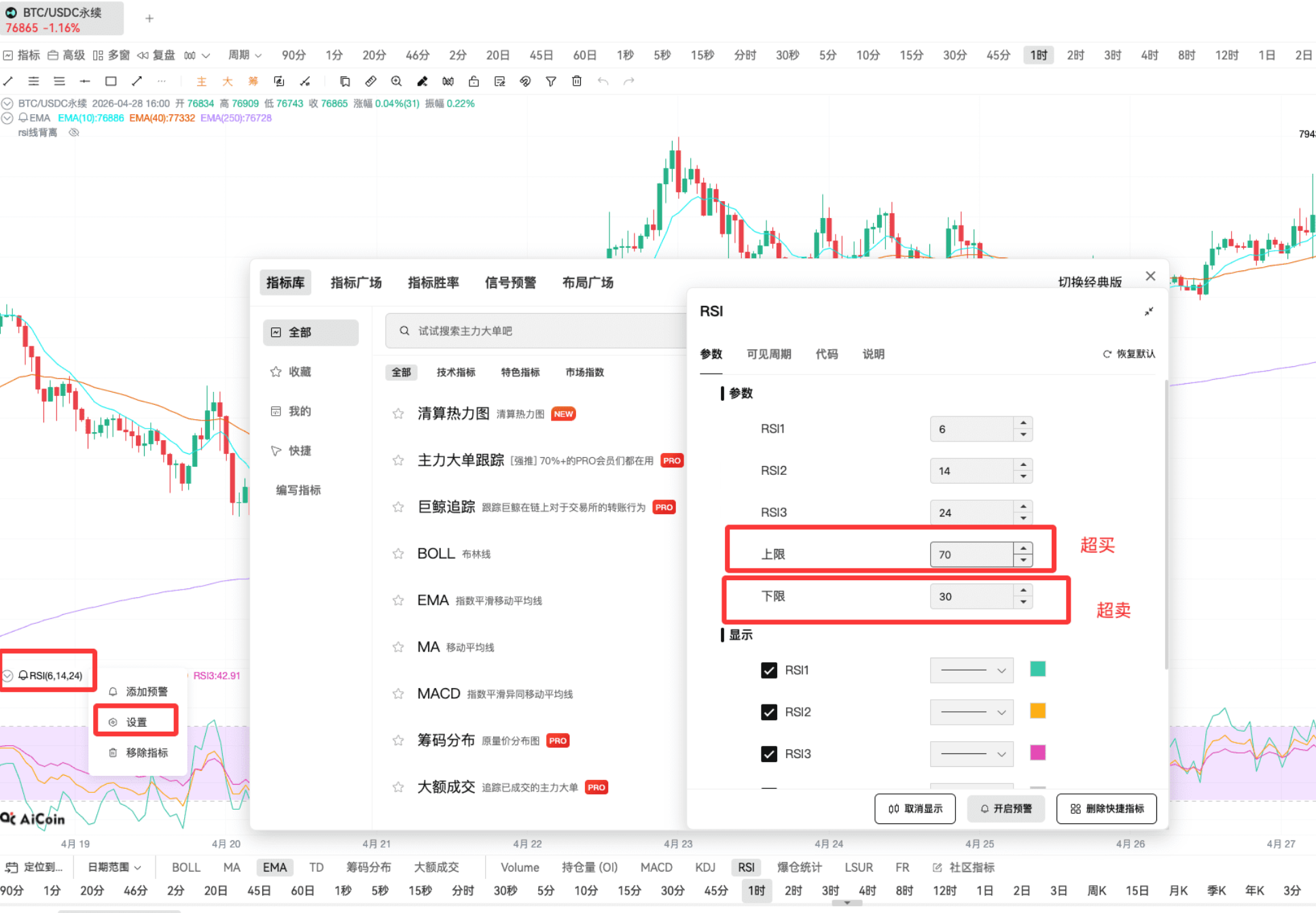
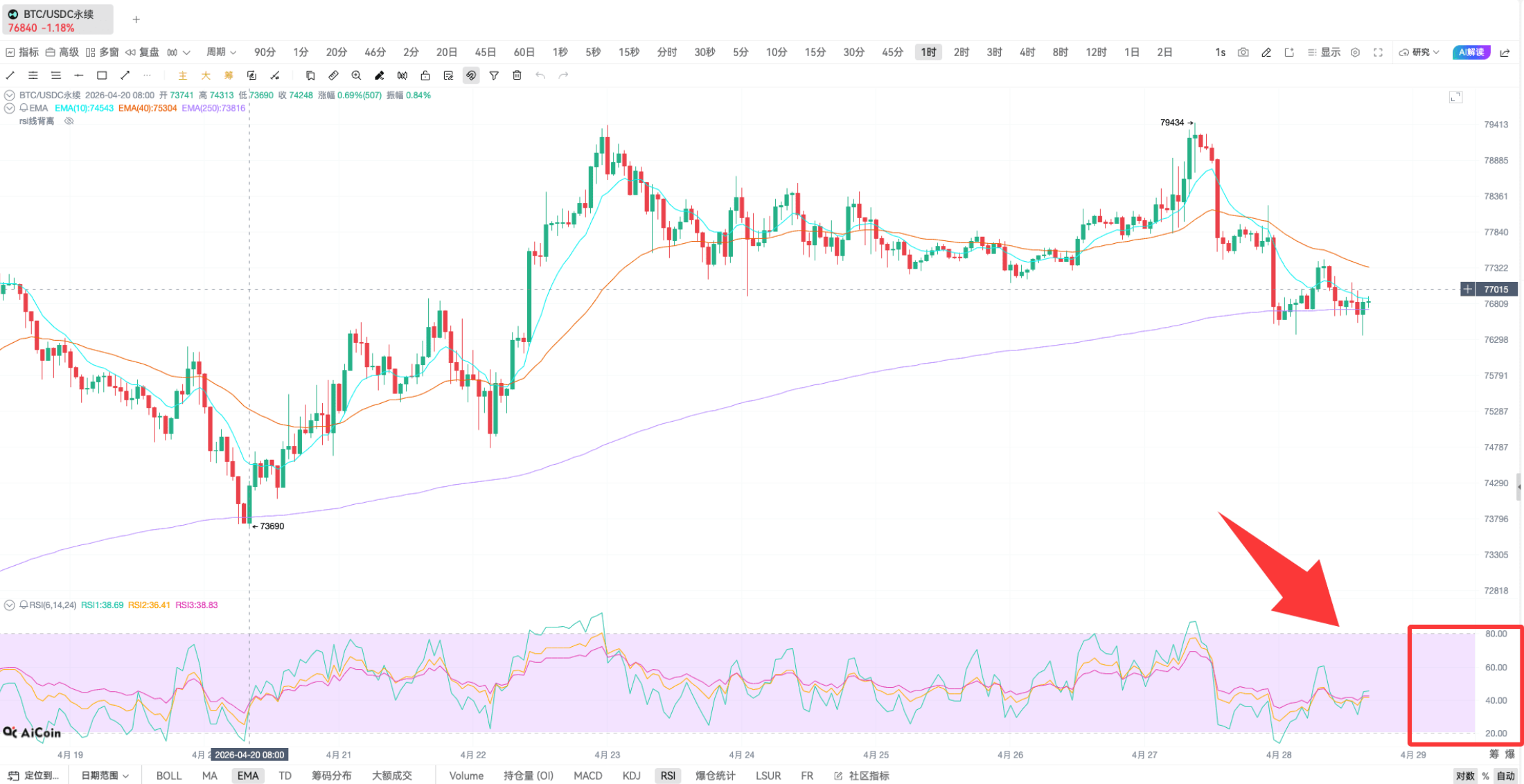
For short-term players, focusing on 6-period RSI is sufficient. Looking back at historical prices, relying solely on the overbought and oversold signals of RSI6, one can capture several high-quality entry and exit points.
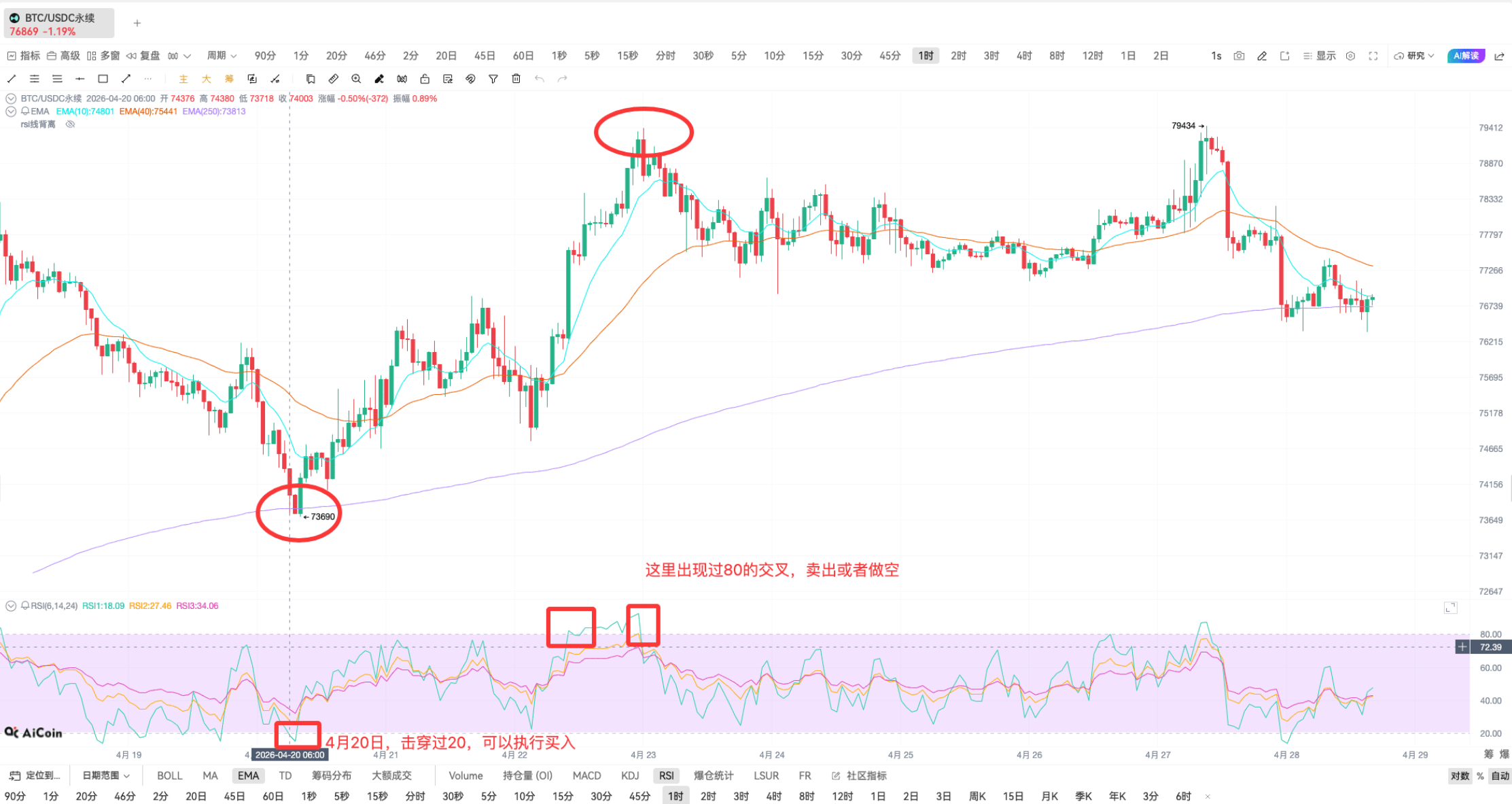
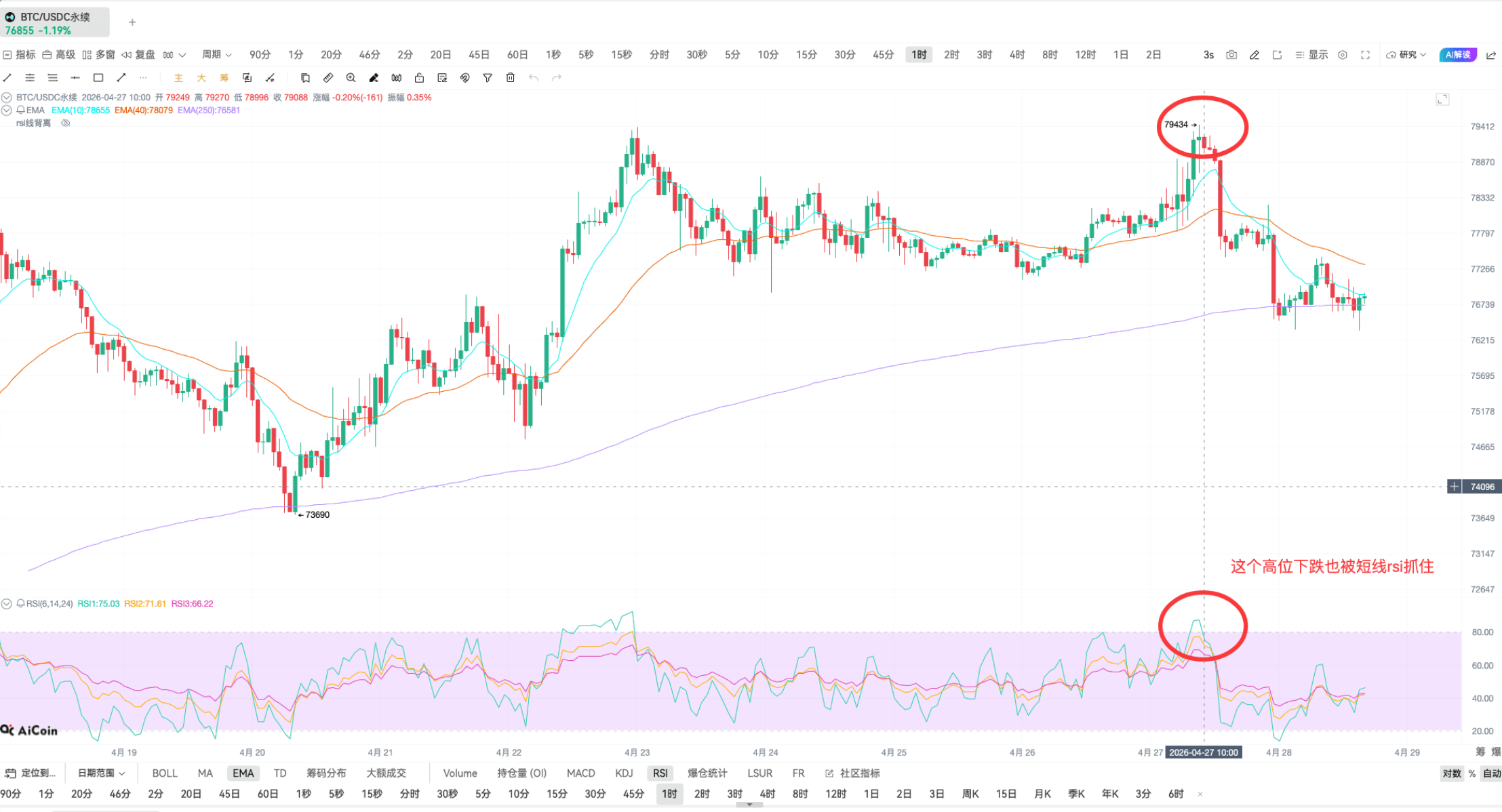
Looking back at previous market conditions, the signal accuracy remains high, and the practical effect is impressive.
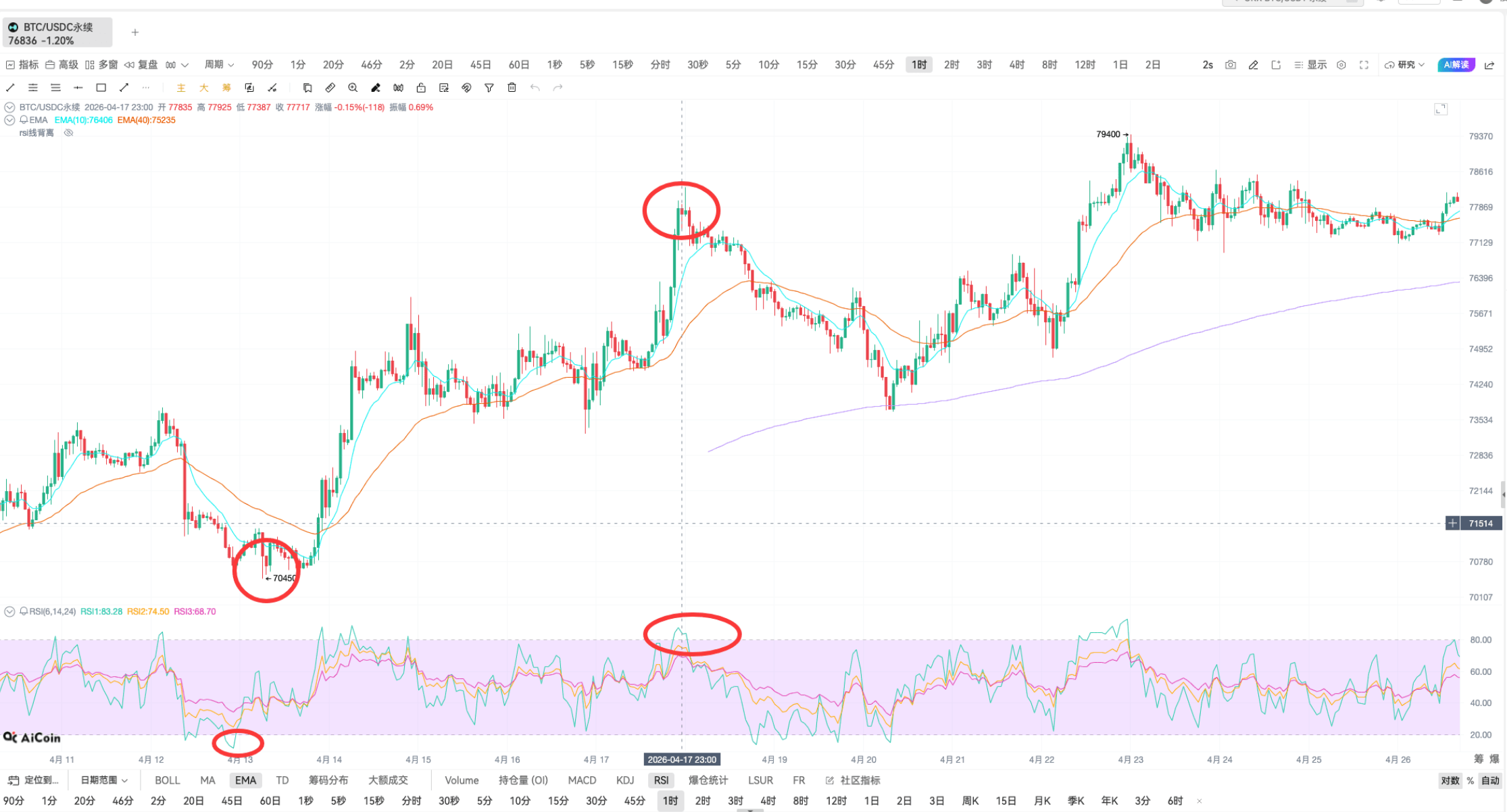
This proves that even with the most basic overbought and oversold logic, RSI can play a powerful role. For those who do not want to hold positions overnight or trade in 3-minute or 5-minute short cycle contracts, this method is completely suitable. The indicators will synchronize with the K-line cycle changes, and the signals will update accordingly, providing maximum flexibility.
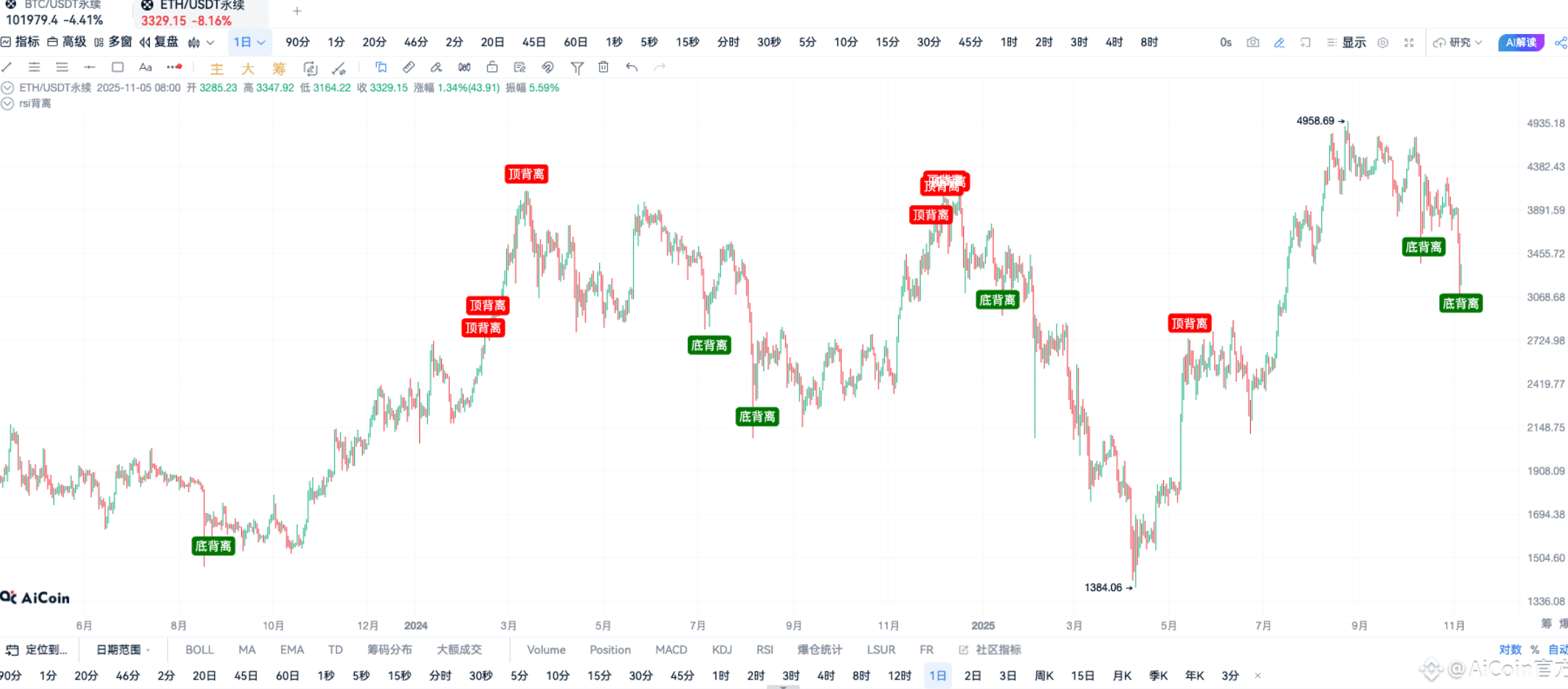
Second: RSI Divergence Trading Method
Similar to the MACD divergence logic we discussed earlier, RSI can also observe divergences to predict market reversals. A long time ago, I wrote a custom indicator specifically for RSI divergence, and I will share the usage for free with everyone.
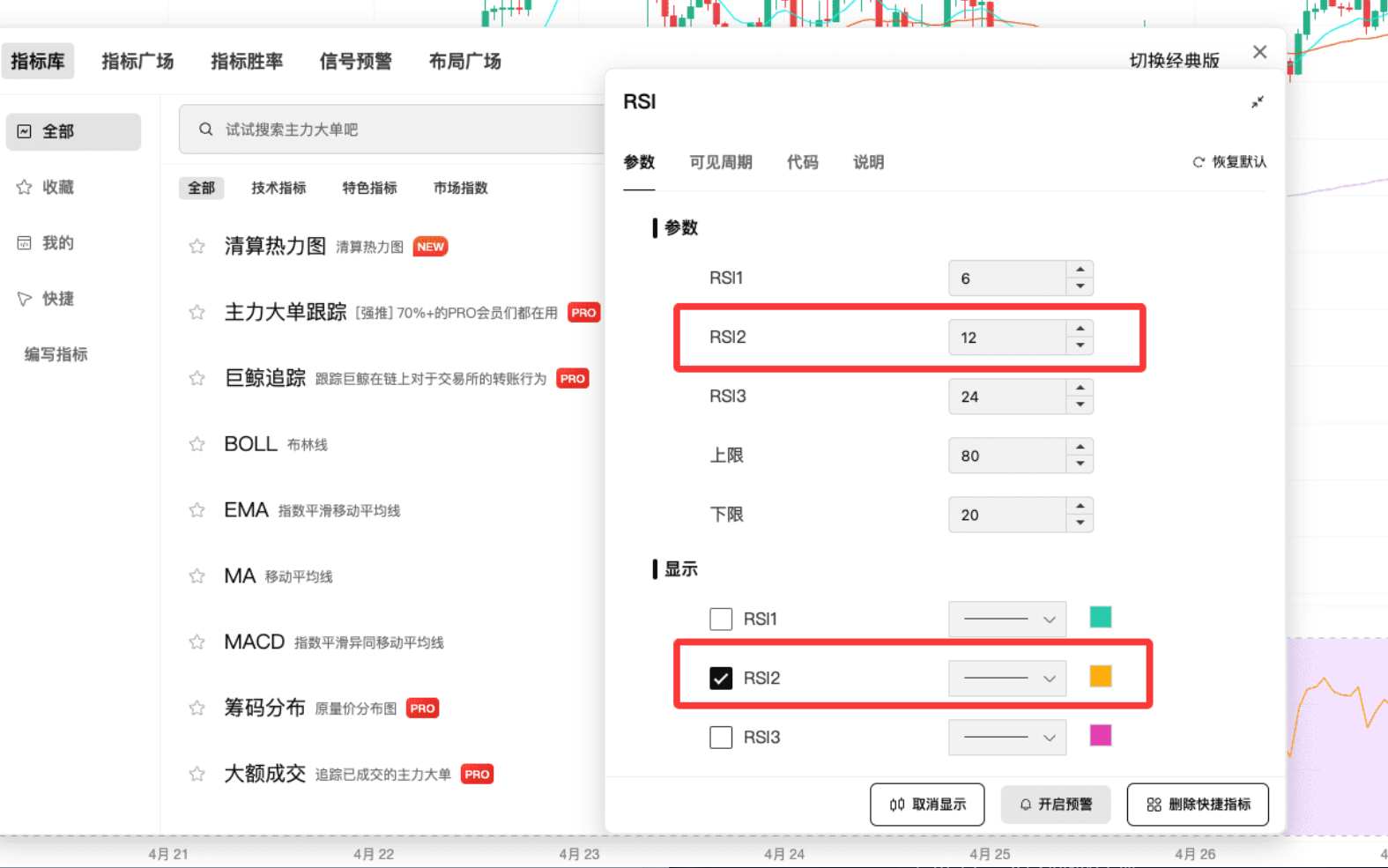
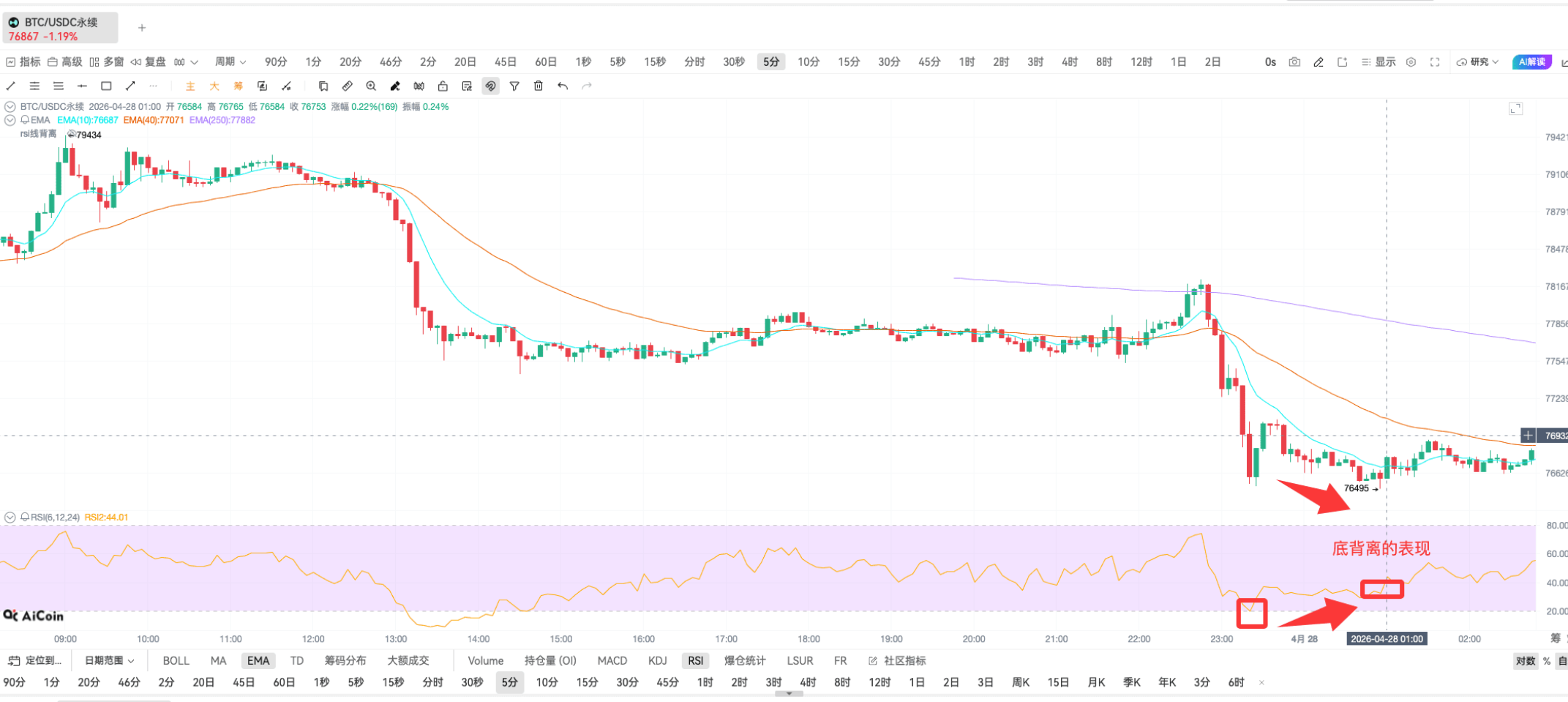
In the community, mainstream divergence analysis of RSI generally uses only 12 and 14 as parameters for optimal sensitivity. Here’s a summarized mantra for our institute's personal use, which is easy to remember: ✅ Top Divergence: Each peak of K-line is higher, but RSI peaks are lower = Bearish Warning ✅ Bottom Divergence: Each trough of K-line is lower, but RSI troughs are higher = Bullish Reversal
In simple terms: Short on top divergence, long on bottom divergence, which connects with the MACD divergence logic. Learning one allows you to understand the other.
Let's simplify the chart and keep only the single RSI line for the 12-period. Here we can clearly see the standard bottom divergence structure; after the signal appears, the chart immediately follows with a recovery rally.
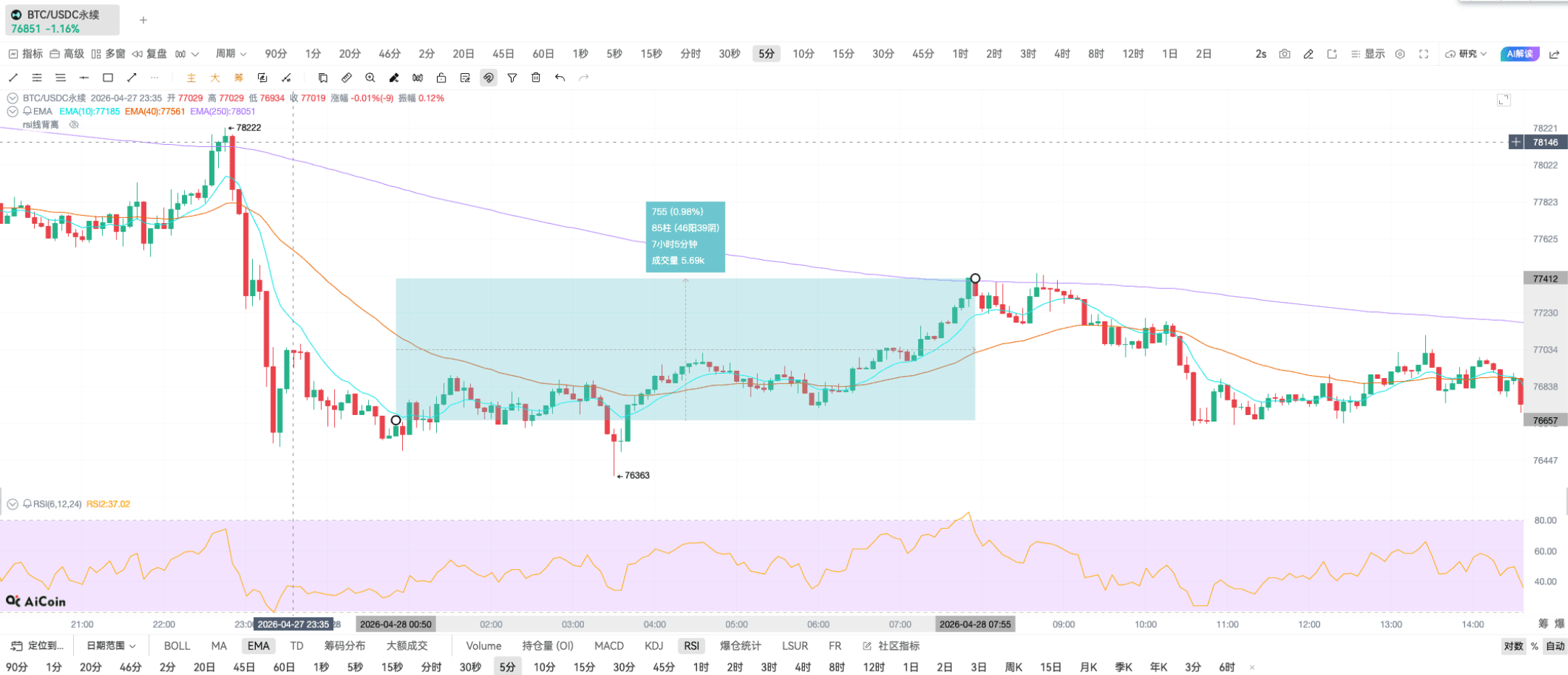
Let’s find a more classic case, switching to a 2-hour larger cycle.
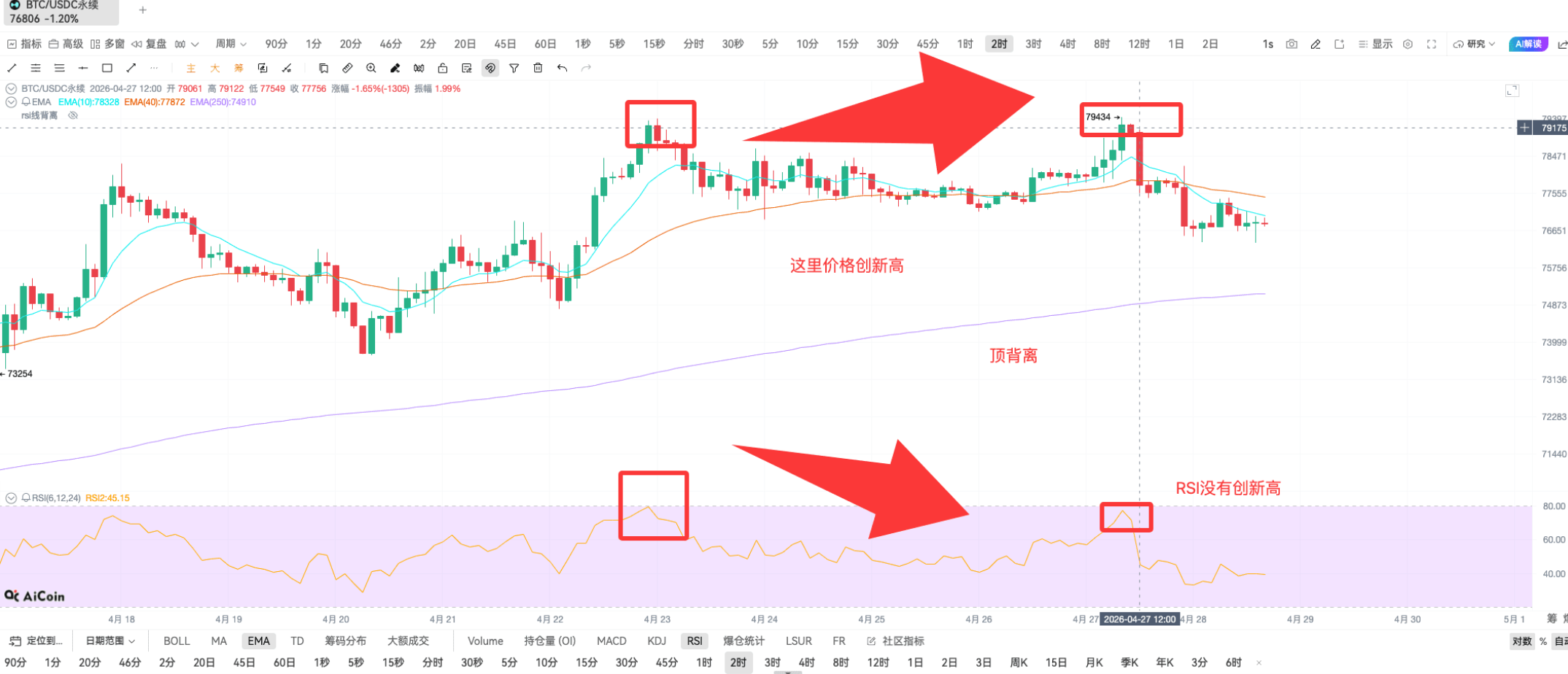
After a clear top divergence pattern forms, the market directly starts a significant pullback, showing substantial power, allowing risks of major drops to be avoided by looking at the signals in advance.
I will share the treasured custom indicator for RSI divergence, and due to the length of the source code, I will break it down into segments to provide.
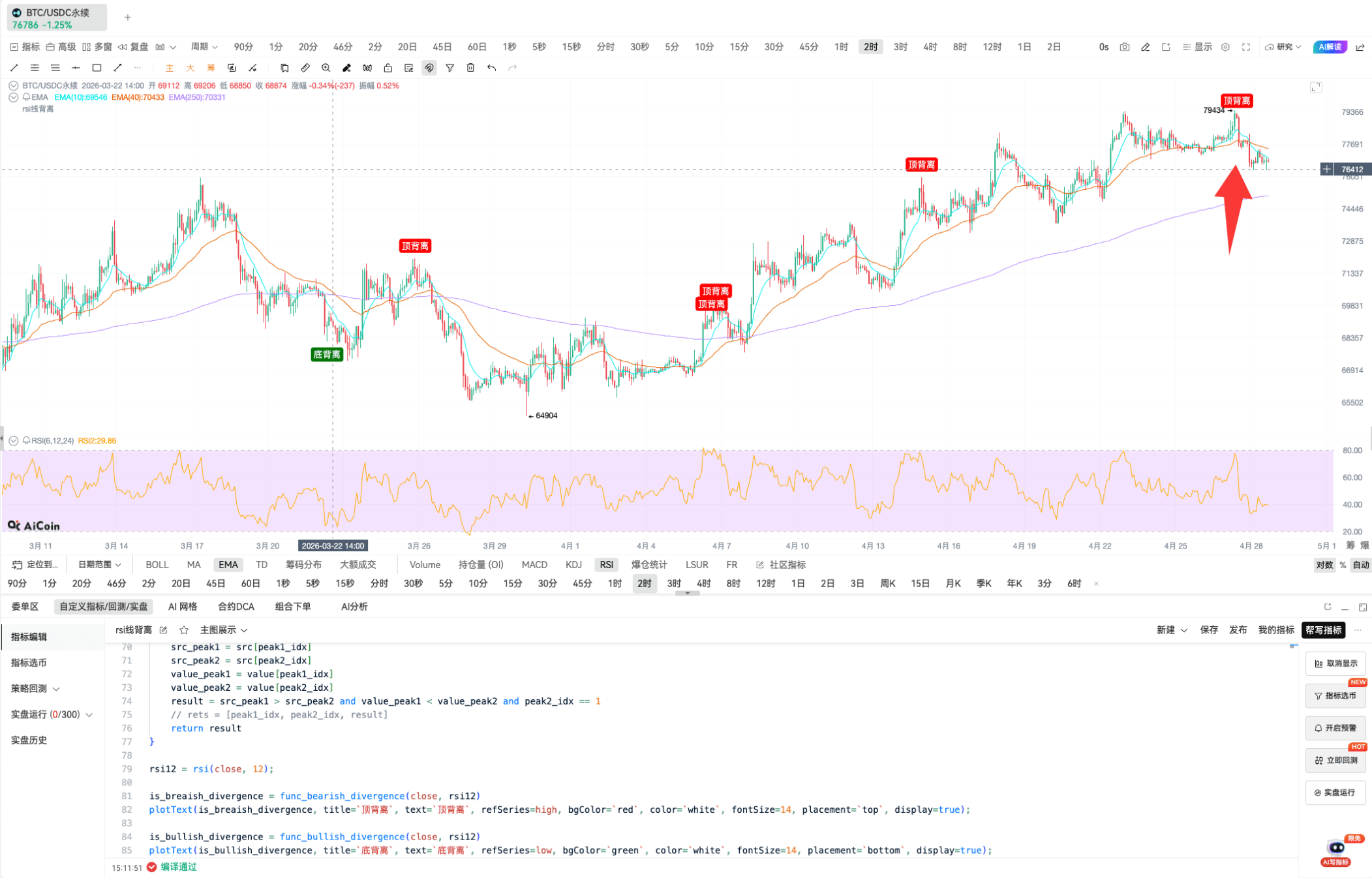
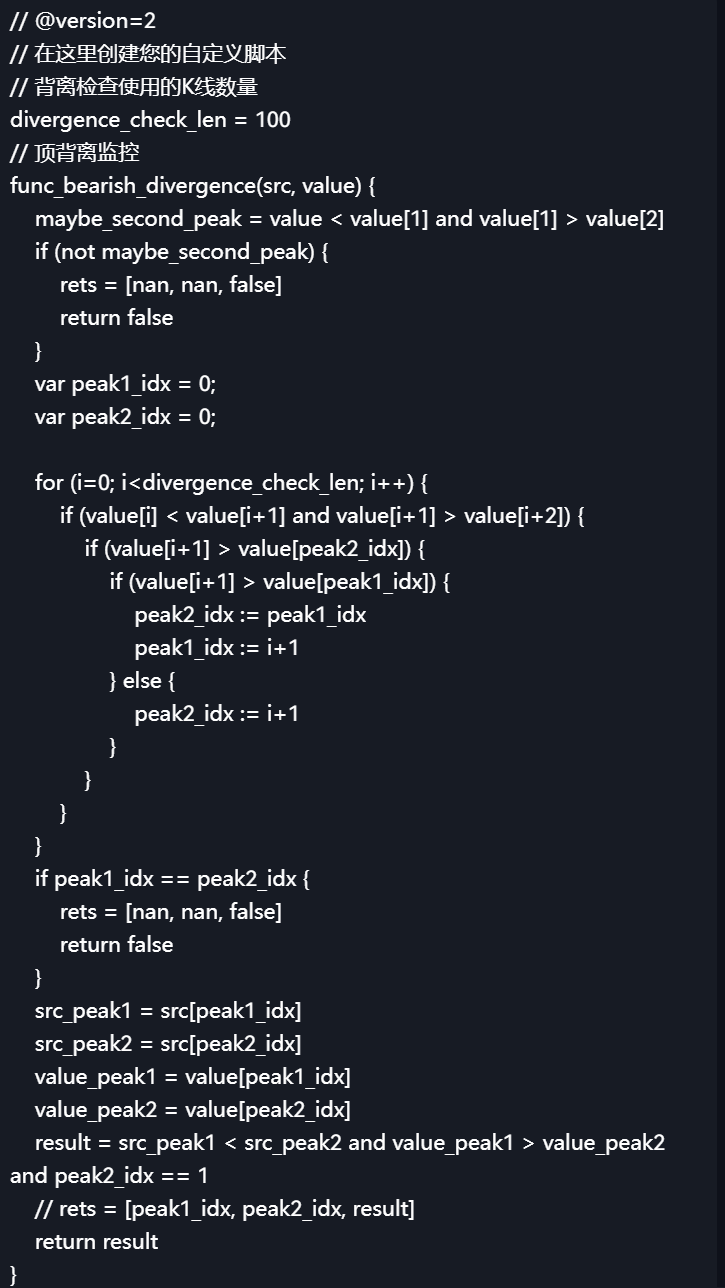
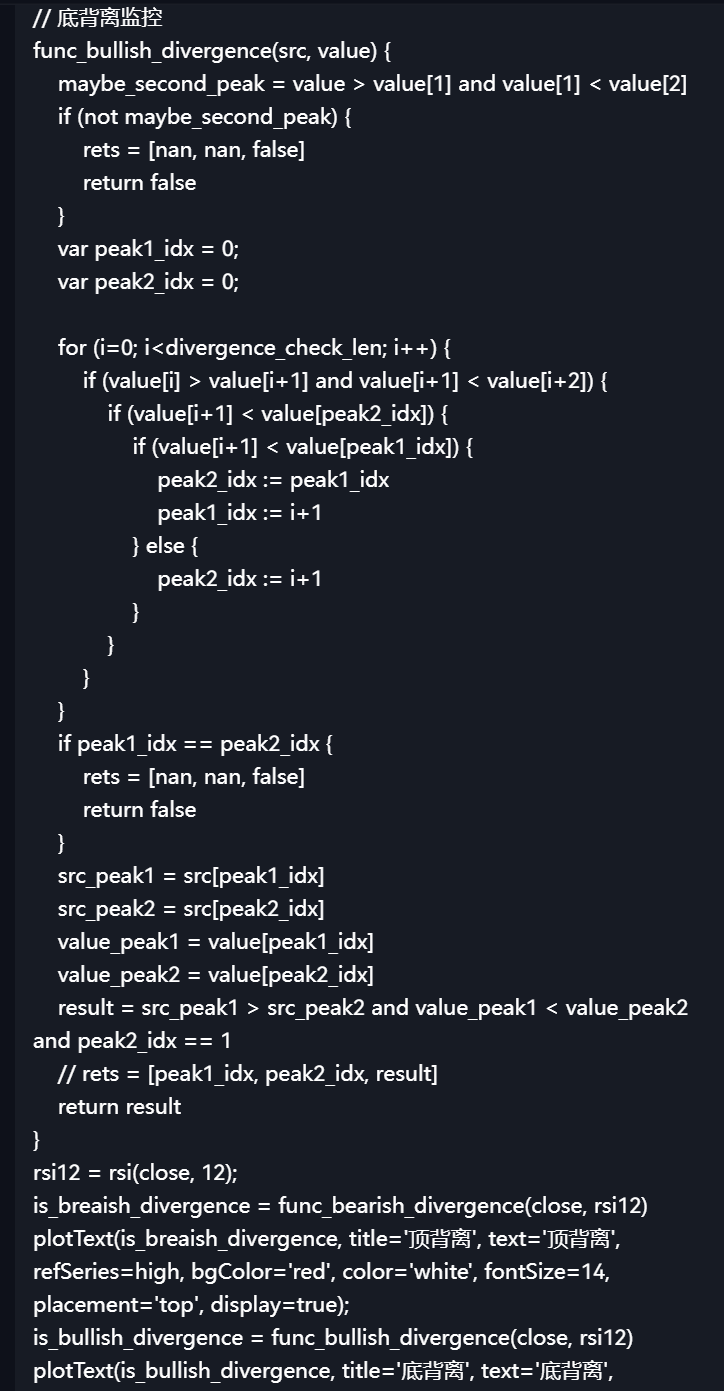

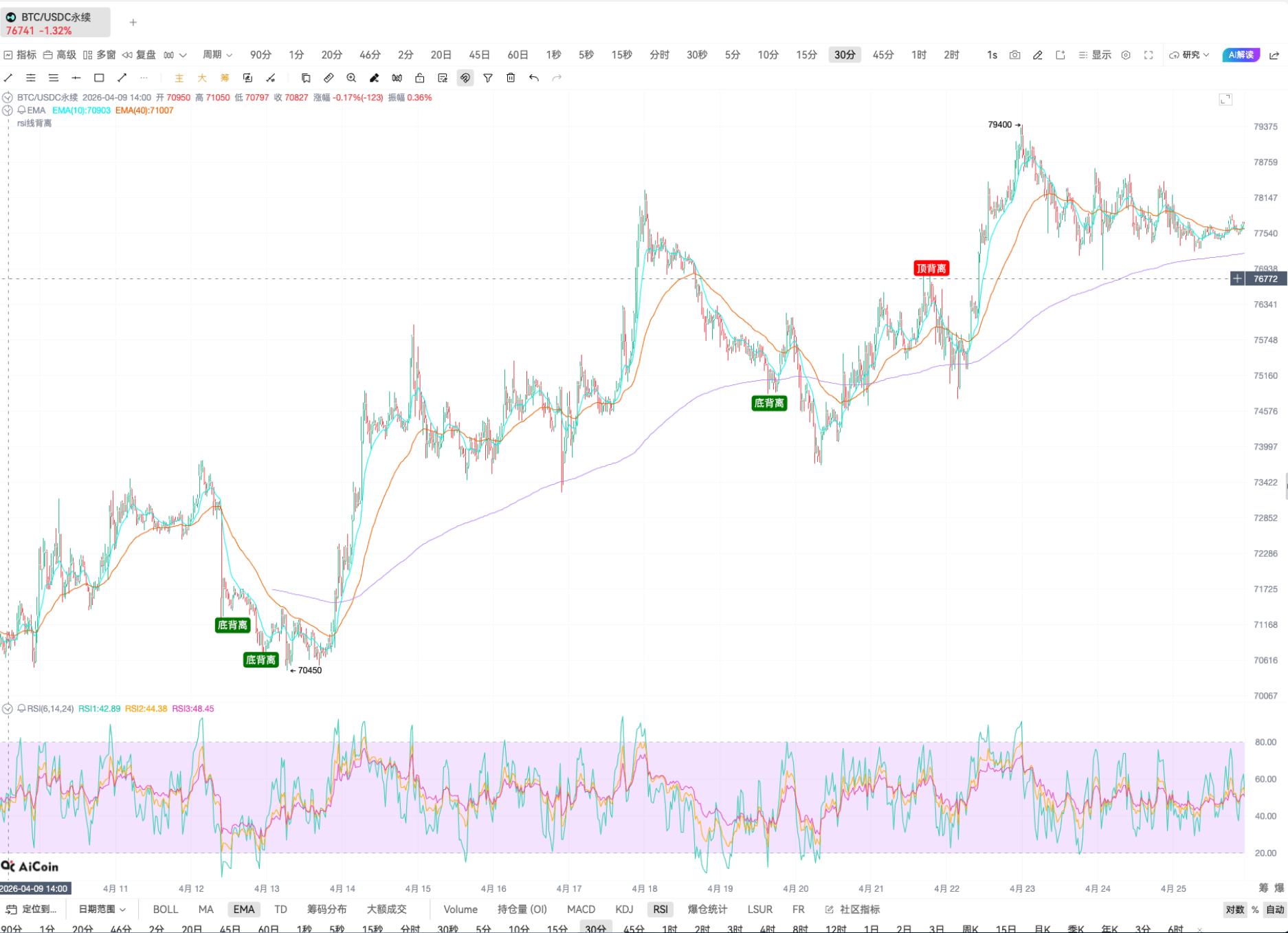
Beginners who are not familiar with manually creating indicators can contact customer service to import it, and it can be installed with one click.
Proficient use of RSI divergence can help you effectively control the bad habit of chasing highs and selling lows, significantly improving your trading success rate.
Finally, I want to clarify the applicable scenarios for RSI, to avoid the misuse of indicators: RSI performs best in clear trends, in one-sided upward or downward markets, allowing precise judgments of strength and reversals. If you encounter a choppy market or sideways movements, do not solely rely on RSI. It is recommended to combine it with MACD, EMA moving averages, and support and resistance levels for resonance; multiple signals combined will make judgments more precise.
Overall, today’s content is geared towards beginners, focusing on simplicity and ease of use, revolving around the two core signals of overbought and oversold, and divergence. Whether you are a newcomer to trading or someone looking to enrich your indicator library, you can follow this approach to gradually backtest and practice. Making profits within your understanding of the market and using simple and practical foundational indicators is key to stable long-term trading.
This article represents only the author's personal opinions and does not reflect the platform's stance or views. This article is for information sharing purposes only and does not constitute any investment advice to anyone.
Disclaimer: This article represents only the personal views of the author and does not represent the position and views of this platform. This article is for information sharing only and does not constitute any investment advice to anyone. Any disputes between users and authors are unrelated to this platform. If the articles or images on the webpage involve infringement, please provide relevant proof of rights and identity documents and send an email to support@aicoin.com. The relevant staff of this platform will conduct an investigation.