

Author|Xinyang & Ethan @ IOSG
In 2026, the GitHub activity curve of the Crypto open-source community underwent an astonishing “bottoming out.” The number of monthly active developers dropped from 45K during the peak in 2022 to about 23K. This halving in apparent figures sparked discussions about “narrative exhaustion” on social media. However, when we analyze the cross-section of this curve, what we see is not a contraction of the industry but a profound “talent deleveraging.”
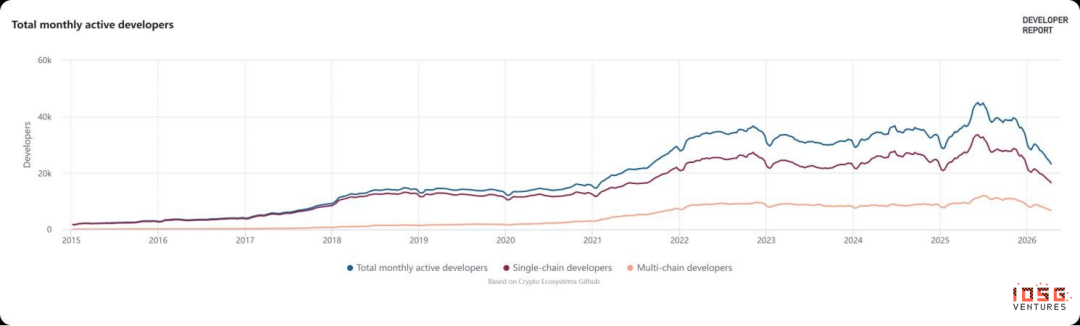
▲ Data Source: Electric Capital Developer Report, based on Crypto Ecosystems GitHub
Who left? Who stayed?
The ones who left were mainly newcomers. In February 2024, the number of new developers reached 5,462 for the month, followed by a sharp decline, with a 52% attrition rate for those who had been in the industry for less than a year. Most of these individuals surged in during the bull market, working on NFT minting contracts, forking DeFi protocols, and creating front-end for new L2s. These positions are highly dependent on market heat, and once the excitement wanes, the projects cease operations, and the positions disappear. Data shows that the code contributions from newcomers have never exceeded 25% of the total, indicating that this group was never part of the core circle of the industry.
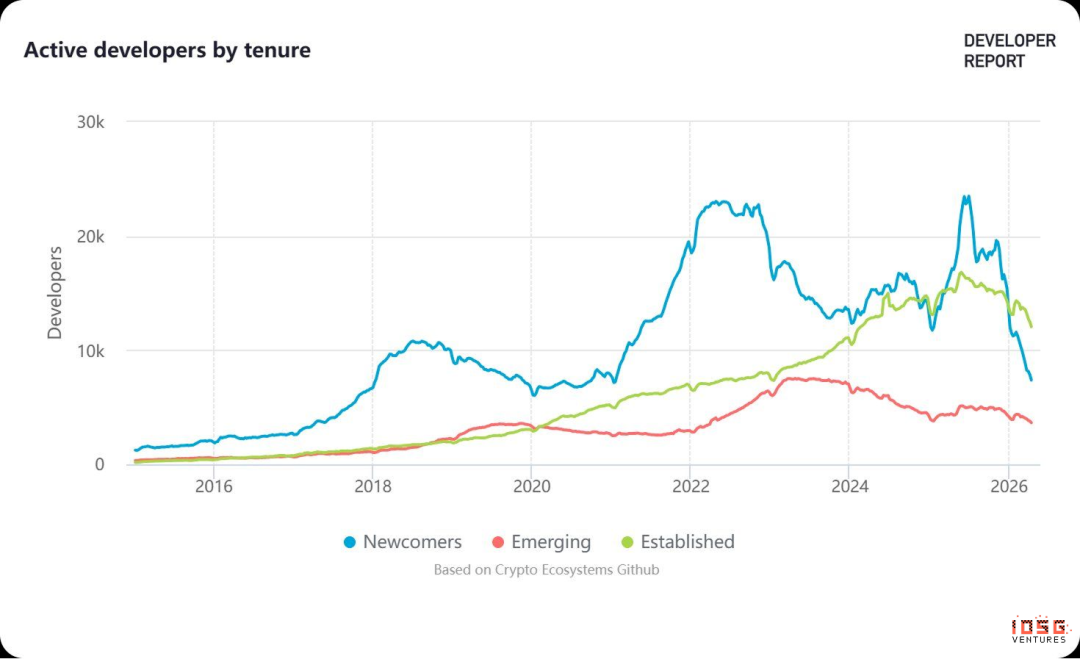
▲ Newcomers surged in during the bull market and left during the bear market; Established devs (with 2+ years of experience) reached a historical high during the same period
Data Source: Electric Capital Developer Report
On the other hand, developers with over two years of experience increased during the same period, achieving a historical high and contributing about 70% of the code volume. The judgment of Maria Shen, GP of Electric Capital, is very direct: “When we look at the established developers' group, it is growing, and it looks very healthy.”
They stayed not because they had no other choices.
Technically, the core work in crypto now generally requires years of accumulation to understand and involves infrastructure development: protocol layer development, security audits, cross-chain architecture. These tasks take years to truly grasp and cannot be easily eliminated once the market cools down.
Economically, many veterans hold unvested tokens, governance powers within protocols, and equity relationships. Their accumulation in the industry has formed real barriers and returns. From an ecological distribution perspective, they are voting with their feet: Bitcoin developers increased by 64.3% over two years, Solana by 11.1%, while Cosmos declined by 51.1% and Polkadot by 46.9%. Veterans are concentrating toward ecosystems with real users and revenue, leaving those projects that still rely on narratives to sustain themselves.
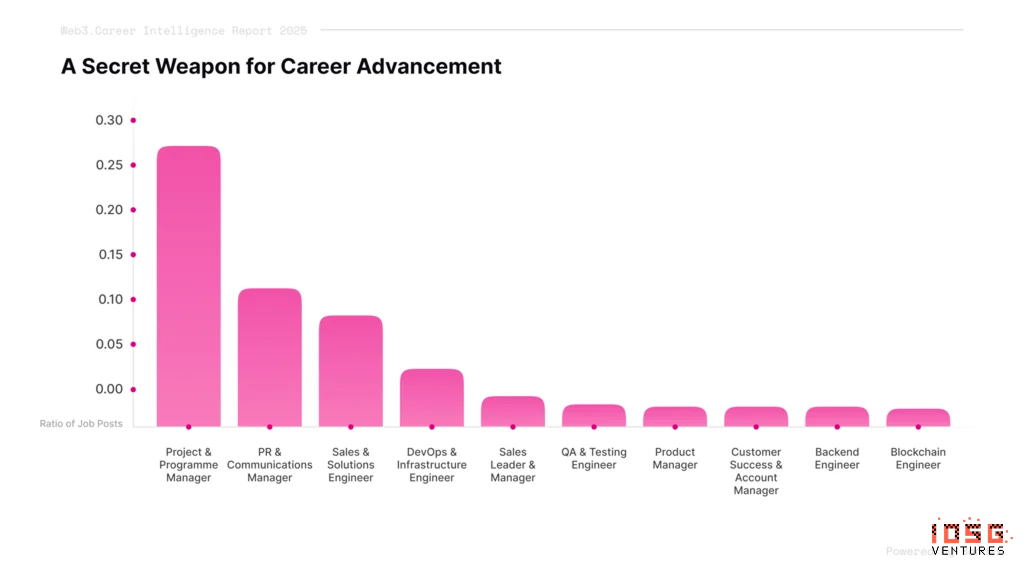
▲ Source: Coincub Web3 Jobs Report 2025
Data Source: Web3.Career
Changes in job structure are also confirming the same thing. Among the newly added Web3 positions in 2025, the highest proportion was not developers, but rather Project & Programme Management, making up over 27%. This is counterintuitive for an industry known for being technology-driven, but the logic behind it is not complex: the industry has shifted from a construction phase to an execution phase, with over 100 chains needing integration. Institutional clients have different compliance and security requirements upon entry, and DAO governance must find balance among stakeholders with varying interests. This is not traditional project management but involves coordination and judgment in an environment where rules are still being formed.
While the industry appears to be shrinking on the surface, its core density is actually increasing. The bear market from 2018-2019 also saw a significant loss of developers, but afterwards, phenomenal projects like Uniswap, Aave, and OpenSea emerged, defining the bull market of 2020-2021. The builders who remained this time have more mature infrastructure, and the AI age has provided them with a larger stage than in the previous cycle.
What capabilities do the ones who stayed possess?
What special abilities has the crypto industry cultivated in builders? To answer this question, we need to return to the fundamental principles of blockchain; across bull and bear cycles, this industry has always operated under the same fundamental rule: code is law, and execution is final.
In 2016, during The DAO incident, attackers exploited a recursive call vulnerability to steal $36 million. The code had no bugs; the logic executed as expected; it was simply that the boundary was not anticipated by the designers. In 2021, the Poly Network cross-chain bridge was attacked, with $610 million transferred within hours. There was no platform to call it off, no institution to revoke it, and no legal clause to seek redress. This is a structural characteristic that distinguishes crypto from almost all other industries: the margin for error is zero, and post-event interventions are almost non-existent.
This environment fosters a set of abilities that are rarely needed in other industries: the ability to build functioning systems from scratch that encourage participation from strangers under conditions of missing rules and trust.
This ability encompasses two aspects. One is establishing trust from scratch, relying solely on code and mechanisms to make strangers willing to invest real assets. The second is making judgments under technical and economic dual uncertainties, lacking regulatory frameworks, historical data, and industry standards, yet still being able to design operational systems.
Both aspects have concrete verification in crypto. Uniswap has no company guarantees, no KYC, and no customer service; anyone can put funds into the liquidity pool, relying only on trust in several hundred lines of code and an economic mechanism, achieving daily trading volumes in the hundreds of billions. MakerDAO has no central bank endorsement or deposit insurance, purely relying on on-chain governance and collateral mechanisms to maintain the stability of DAI. During the DeFi Summer, conditions were even more extreme; there were no regulatory frameworks, auditing standards, or any historical data to reference, yet builders designed AMM, lending protocols, and liquidity mining, taking just months to go from concept to billions of dollars in TVL. This ability manifests differently among builders at the protocol, application, and governance levels, but the underlying principles are the same.
The AI age is creating structurally similar issues. The model decision-making process is opaque, and the output results cannot be independently verified. AI agents begin to autonomously execute trades and allocate funds, while the accompanying rule systems and constraint mechanisms are non-existent. Large model companies control both the models and the evaluation standards, leaving users with insufficient means of verification. Computing power is highly concentrated in a few top firms, leading to monopolistic pricing when demand spikes. These issues point to a core problem: the trust issue of autonomous systems replays in the larger context of AI.
Crypto builders have been handling such issues for years in environments without external authoritative rule constraints; the former scenarios involved on-chain protocols, now it switches to AI. A group of individuals has already brought the abilities accumulated in crypto directly into AI and has produced results.
How will these abilities be repriced in the AI era?
Cases of transitioning from crypto to AI have become increasingly commonplace in recent years, but upon closer examination, what they take away is not the same.
The most intuitive path is the direct transfer of hardware and experience. The three founders of CoreWeave, Michael Intrator, Brian Venturo, and Brannin McBee, started mining Ethereum using GPUs in 2017, expanding from one machine to thousands. They closed down mining operations in 2022, and two months later, ChatGPT launched, turning their GPUs directly into AI computing power. In March 2025, they went public on NASDAQ, with an IPO valuation of about $23 billion, and their market cap peaked at nearly $70 billion. Alex Atallah, co-founder of OpenSea, dealt with aggregation and routing of extremely heterogeneous assets in the NFT market and transferred the same experience to AI model routing, founding OpenRouter, which served over 5 million developers within two years and reached a valuation of $500 million.
Another migration type is more noteworthy. NEAR founder Illia Polosukhin is one of the co-authors of the Transformer paper. When he left Google, he initially aimed to build AI applications using natural language, but encountered a real issue during development: he needed to make cross-border payments to data labelers around the world, most of whom lacked bank accounts, and blockchain technology became the best solution to this payment challenge. NEAR is now transforming into an AI infrastructure platform, focusing on user-owned AI and decentralized confidential machine learning (DCML), allowing users to utilize AI services without exposing their data. The decentralized architecture experience accumulated at NEAR became the most difficult-to-replicate starting point in this direction. Sean Neville, co-founder of Circle, founded Catena Labs after leaving, positioning it as an AI-native bank, directly transitioning the understanding of stablecoin infrastructure into AI agent financial scenarios, with a16z crypto leading a $18 million seed round. Nader Dabit, a senior developer at Aave and Lens Protocol, has shifted to Cognition, bringing the experience of building developer ecosystems across multiple crypto protocols into the AI agent tools space.
These individuals take away not only GPU hardware or user networks, but also intuition for mechanism design, experience in building developer ecosystems, and judgment in constructing trustworthy systems from scratch amid missing rules. These abilities correspond directly to the three structural gaps encountered in scaling AI.
Aggregation and Optimization of Computing Power
Computing power is the most direct bottleneck for AI scaling. Training and inference require vast amounts of GPUs, with demand fluctuating significantly. Cloud vendors are expensive and cause waiting lines, and enterprises prefer not to stock up on hardware themselves. This issue has two aspects: how to aggregate and allocate computing power, and how to use aggregated computing power more efficiently. Crypto builders have direct transferable experience on both aspects.
Hyperbolic addresses the distribution and trust issues. Founder Jasper Zhang brings decentralized mechanism design into the AI computing arena: tokens incentivize distributed GPU holders to contribute idle computing power, but the core issue is trust. Why trust a computation result provided by a stranger node? The core innovation PoSP uses random sampling and game theory to make honesty the dominant strategy for nodes, avoiding the need for full verification, ensuring low overhead, scalability, and reliable results. This mechanism is directly migrated from crypto verification logic of stranger node behaviors.
MoonMath solves the efficiency problem. Its predecessor, Ingonyama, focused on ZK hardware acceleration, significantly increasing the generation speed of ZK proofs under extreme computational constraints. Now the direction has shifted to the Physical AI performance layer, concentrating on sparse attention acceleration for video diffusion models (LiteAttention), low-rank decomposition of FFN layers (LiteLinear), and acceleration of training backpropagation (BackLite). Transitioning from ZK acceleration to AI inference acceleration relies on the same skill set: enabling mathematics to run faster under extreme computational constraints. The racing track has changed, but the aggregation has not been wasted.
AI Governance and Incentive Mechanism Design
When multiple AI agents begin to collaborate on tasks, how to ensure they do not disrupt the overall system in pursuit of their individual goals? Each participant pursues their objective functions, with no guarantees that their combined efforts will allow the system to operate normally, and the execution speed of the agents far exceeds the human intervention window.
This is the type of question crypto builders have repeatedly dealt with in DAO governance and tokenomics design: enabling participants with completely different interests to operate in a pre-set direction without a central authority. The answer provided by crypto is economic mechanisms, where violations incur genuine economic costs, and the rules are embedded in code, executing automatically.
EigenLayer has directly migrated this mechanism to the AI scenario. Through a restaking mechanism, nodes must pledge assets before participating in collaboration; non-compliance or violations trigger automatic penalties. Here, rules are not suggestions but rigid boundaries with real economic consequences. EigenCloud extends this logic to the verifiable computing and collaborative governance of AI agents, ensuring that agents stay within predefined bounds while pursuing their objectives. Using economic mechanisms to constrain agents is far more reliable than using ethical standards to do so.
Autonomous Payment for AI Agents
Another more fundamental issue is: how do agents make payments? Traditional payment systems are designed for human use; credit cards require accounts, and bank transfers need authorization, with each step assuming the operator is human, possesses an identity, and will wait. Agents do not wait; they may initiate a large number of requests every second, with each request potentially involving micropayments, rendering traditional payment pipes ineffective in this scenario.
Stablecoins and on-chain rules are the infrastructures already built by crypto builders, providing native support for programmable, authorization-free, and round-the-clock operation. These three features happen to be the essential requirements for agent payment scenarios, with the only missing layer being a protocol to connect stablecoins to agent workflows.
x402, launched by Coinbase in May 2025, activates the HTTP 402 status code and directly embeds stablecoin payments into HTTP requests, allowing agents to complete payments simultaneously while initiating requests, without needing accounts, with settlements taking about two seconds. As of April 2026, the x402 protocol had processed over 165 million transactions, with a cumulative transaction volume of approximately $50 million and 69,000 active agents (Data Source: x402 Foundation), with Cloudflare, AWS, Stripe, and Anthropic MCP all onboarded. Agent payments have become a track with real traffic.
The three directions correspond to the three structural gaps encountered in scaling AI: aggregation and efficiency of computing power, incentive alignment in multi-agent collaboration, and the infrastructure for autonomous payments. These problems do not have ready answers in traditional software architecture, but there is corresponding handling experience in the crypto industry. The abilities have not vanished; they have just found new contexts.
New Positioning for Builders: From Contract Writers to Rule Designers for AI
The scaling of AI is creating a functional gap that did not exist before. It is not a gap in technical talent but in individuals who can design trust mechanisms within autonomous systems. As the object of service shifts from humans to AI, the role of crypto builders is also being redefined.
The following table compares the dimensional changes of specific functional paradigms:
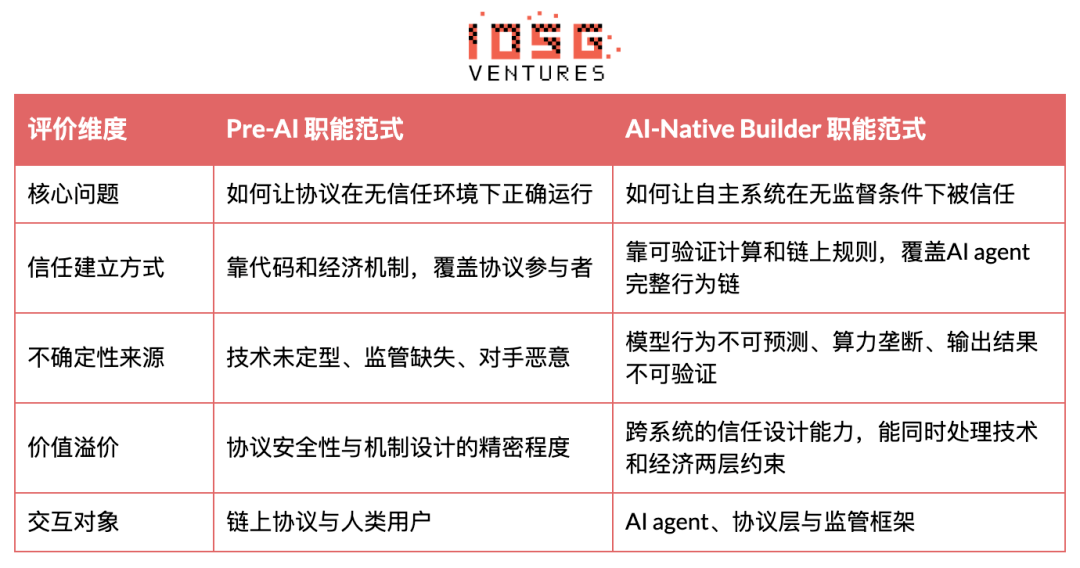
The core difference between the two paradigms lies not in the technology stack, but in the methods of establishing trust and the logic of executing rules. In the Pre-AI era, crypto builders faced human participants, where rules were written into contracts with zero margin for error, but the boundaries of the system were relatively clear. In the AI-Native era, as the interactive subjects become autonomously operating AI agents, the issues to be resolved include unpredictable agent behavior and execution speeds far exceeding human intervention windows, necessitating a redefinition of the system boundaries under greater uncertainty. The functional positioning of crypto builders is shifting from “writing secure contracts” to “designing trustworthy mechanisms for AI autonomous systems.”
Top institutions’ hiring has already reflected this change:
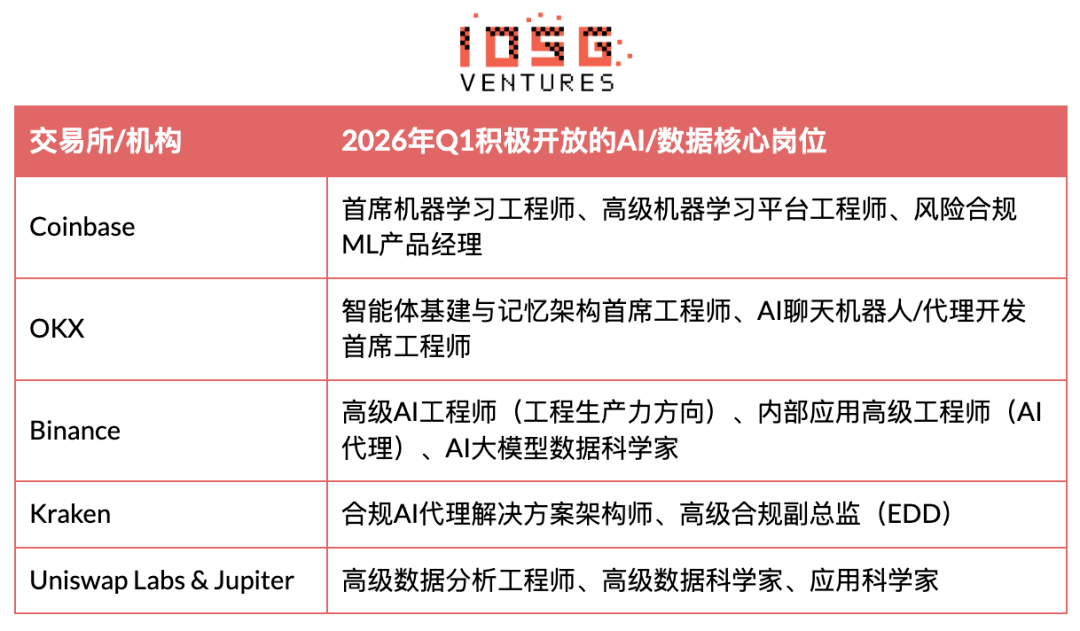
▲ High-profile exchanges actively opening AI/data core positions in Q1 2026
Source: Gate Research Institute
The hiring trends of top exchanges and institutions in 2026 clearly reflect this trend: they are no longer simply hiring AI engineers or crypto developers, but seeking individuals who can connect the two worlds, understanding on-chain incentive distortions and governance games while integrating AI tools deeply into crypto workflows and designing mechanisms that align agents with regulations and long-term user interests.
The direction of capital allocation has also reflected this judgment. Paradigm is raising a new fund of up to $1.5 billion, expanding its investment scope from crypto to AI and robotics. Haun Ventures completed its $1 billion Fund II, focusing primarily on financial infrastructure that merges crypto and AI, particularly supporting autonomous trading and coordination for AI agents through payment systems, stablecoins, and agent-to-agent economic systems. a16z crypto completed a $2.2 billion fifth fund (Crypto Fund V), explicitly stating that 100% of the fund will be directed toward crypto. They plan to focus on the transparency, verifiability, and decentralized characteristics of crypto amidst the complexity and opacity of the AI era. Furthermore, according to PitchBook data, in 2025, approximately 40% of VC investments in the U.S. crypto sector flowed into companies also involved in AI business, significantly up from 2024.
While both crypto builders are shifting to AI, the paths chosen under different market environments show clear disparities.
In the United States, with the regulatory environment becoming relatively clearer, innovation at the protocol layer has gained genuine living space. The capital network density is high, with shorter pathways from ideas to financing, and a greater margin for error. A group of projects, including Hyperbolic, EigenCloud, Gensyn, and Ritual, share the common characteristic of designing new mechanisms from scratch, rather than simply integrating existing systems. Top VCs have clear investment theses on “verifiable computing, agent coordination, decentralized ML,” and are willing to provide ample room for error for early-stage technology explorations.
The situation in Asia is different. Singapore and Hong Kong are more focused on compliance implementations and the role of intermediary funds for institutions, with more conservative regulatory frameworks and lower tolerance for pure protocol layer innovations. Builders with crypto backgrounds choosing to transition to AI often opt for application-layer and industry fusion paths, leveraging the user base, payment capabilities, or data assets accumulated in crypto for rapid access to AI products and services.
This is not a difference in abilities, but rather a divergence in path choices caused by varying market signals and regulatory environments: the U.S. encourages foundational mechanism innovation and early tech exploration, while Asia emphasizes compliance friendliness, rapid monetization, and deep integration with traditional industries.
Returning to the initial GitHub curve: the decrease of monthly active developers from 45K to 23K superficially suggests a shrinking industry. However, among those who remained, the proportion of established devs has reached a historical high, flocking towards ecosystems with real users, while being repriced by the AI industry in unprecedented ways. As AI scaling encounters structural bottlenecks like computing power aggregation, autonomous payments by agents, data and decision verifiability, and privacy coordination, these builders at the intersection of Crypto and AI, with their long-term sensitivity to rules, incentives, and authenticity, are gradually transforming into system-level capabilities that are scarce in the AI era.
As an investment institution deeply rooted in crypto infrastructure since 2017, IOSG's judgment on this line goes beyond mere observation. We participated in the investment in EigenLayer's restaking mechanism before it was widely recognized in the market, led the seed round investment in Ingonyama (now MoonMath) betting on the ZK hardware acceleration's transition to the AI performance layer, and invested in Hyperbolic in 2024, anticipating its path to solve decentralized computing trust issues using crypto-native verification mechanisms. The common logic behind these arrangements is that the trust, coordination, and verification issues encountered in AI scaling will ultimately require the mechanism design capabilities accumulated within the crypto industry to resolve. We believe that the intersection of crypto and AI is not just a narrative but a structural opportunity that is unfolding.
Disclaimer: This article represents only the personal views of the author and does not represent the position and views of this platform. This article is for information sharing only and does not constitute any investment advice to anyone. Any disputes between users and authors are unrelated to this platform. If the articles or images on the webpage involve infringement, please provide relevant proof of rights and identity documents and send an email to support@aicoin.com. The relevant staff of this platform will conduct an investigation.