
SpaceX seeks to be valued at over $2 trillion for its IPO, with a price-to-sales ratio of about 100 times, and its valuation logic has spilled over traditional financial frameworks, leading analysts to bet on concepts like Mars colonies and their "option value." A Wall Street veteran candidly stated, "This is a signal of the top of a bubble," while FOMO (fear of missing out) is driving analysts to collectively abandon rationality—fear of missing the next Tesla may be writing a critical historical coordinate.
Written by: Xu Chao
Source: Wall Street Journal
When "fear of missing out" overwhelms rational valuation, the largest IPO in history is testing the boundaries of the entire market.
SpaceX is seeking to go public with a valuation of over $2 trillion, equating to about 100 times revenue. This figure has forced some analysts to reinvent their analysis in the face of traditional valuation frameworks, betting instead on Musk turning space data centers, lunar bases, and even Mars colonies into reality, termed "option value." What drives this enthusiasm is less about financial logic and more about a more primal market emotion—the fear of missing the next Tesla.
Michael O'Rourke, chief market strategist at Jonestrading Institutional Services with over 30 years on Wall Street, bluntly stated:
This is something you see at market tops and bubbles. Looking back a year from now, I believe this will be a key signal.
Aswath Damodaran, a professor of finance at New York University, pointed out that FOMO is dominating analysts' judgments:
Many analysts have already decided to buy SpaceX because they feel the cost of not participating in this game is intolerable.
SpaceX plans to sell up to 30% of its shares to retail investors, and if the IPO raises $75 billion, the corresponding retail subscription amount could reach as high as $22.5 billion. According to Vanda data, this figure would exceed the total net purchases by retail investors in Tesla over the past year and even surpass the total amount of retail funds flowing into all asset classes in the past month.
Valuation Logic: From Car Company to "Option Value"
To understand SpaceX's valuation, one cannot avoid the path taken by Tesla.
Tesla's stock price has increased over 2,700% over the past decade, leaving countless skeptics empty-handed and establishing a solid credit backing for Musk in the capital markets. Nowadays, no sell-side analyst truly values Tesla's car sales business—even though the company plans to invest over $25 billion in capital expenditures this year—over twenty analysts rating the stock as a buy cite the Cybercab autonomous taxi and the humanoid robot Optimus as core pillars of valuation.
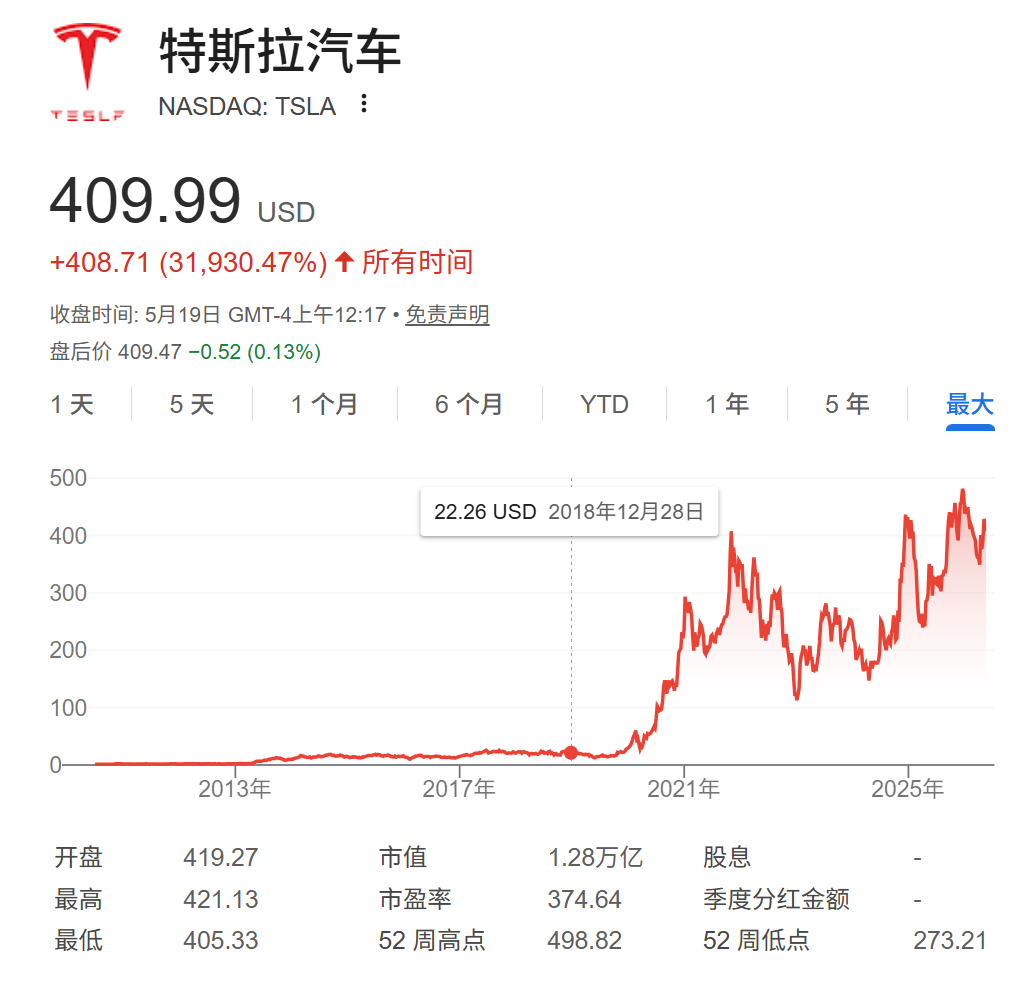
Piper Sandler analyst Alexander Potter wrote in a report on May 10 that car sales are simply "a secondary long-term revenue source," remarking, "Tesla is not a car company." His predictions indicate that in the coming decades, revenues will primarily come from Robotaxi operations, FSD licensing and subscriptions, and insurance, with car sales expected to peak in about five years.
SpaceX's narrative is built on a similar logic, but is harder to implement. Beyond government contracts for rocket launches and the Starlink satellite internet, the $2 trillion valuation implies potential businesses like space data centers, lunar bases, and Mars colonies that are still in the conceptual stage. The theoretical potential market space is "infinite"—at least in the eyes of its believers.
Pricing Opinions: Wide Disparity
Institutional investors show clear discrepancies in their judgments of SpaceX's value.
Ark Investment Management, as an existing investor in SpaceX, stated on April 20 that a $1.75 trillion valuation is "based on credible business development paths," and pointed out that "Musk's goals are ambitious by any historical standard, and SpaceX has repeatedly demonstrated its ability to compress timelines."
Scottish Mortgage Investment Trust, under Baillie Gifford and holding nearly $4 billion in SpaceX equity, marked SpaceX's valuation at $1.25 trillion at the end of the first quarter, which accounts for about one-fifth of the fund’s total assets. The fund stated it will reassess as the IPO process progresses.
Damodaran suggested a reference price of about $1 trillion—he would not buy at $2 trillion but acknowledges that SpaceX's upside potential is indeed considerable. "SpaceX is currently far ahead of its competitors in realizing option value, and is in a better position than Tesla at this moment," he said, while also endorsing Musk's achievements: "It must be acknowledged that he has created two companies that are truly technological miracles."
Skeptics: Money is being paid for unfulfilled success
However, not everyone believes that FOMO is a sufficient investment rationale.
O'Rourke's doubts target the numbers themselves: a $200 billion annual revenue corresponding to a $2 trillion valuation suggests about a 100 times price-to-sales ratio. "What you pay for is unfulfilled success," he said. "Even if space data centers become a reality, investors have no basis to judge whether their costs will be more efficient than terrestrial facilities."
UBS analyst Joseph Spak warned about the actual AI construction costs at Tesla, pointing out that the $25 billion capital expenditure is merely the starting point, and believes Musk's comments about the progress of Robotaxi and Optimus during the April earnings call were "cautiously worded."
In O'Rourke's view, the real signal to watch is not just SpaceX's valuation itself but the collective willingness of the market to accept that valuation. "When we look back in a year, this is likely to be a critical historical coordinate."
Disclaimer: This article represents only the personal views of the author and does not represent the position and views of this platform. This article is for information sharing only and does not constitute any investment advice to anyone. Any disputes between users and authors are unrelated to this platform. If the articles or images on the webpage involve infringement, please provide relevant proof of rights and identity documents and send an email to support@aicoin.com. The relevant staff of this platform will conduct an investigation.