
Recently, the capital flow of the US spot Bitcoin ETF has indeed released signals that are worth being cautious about.
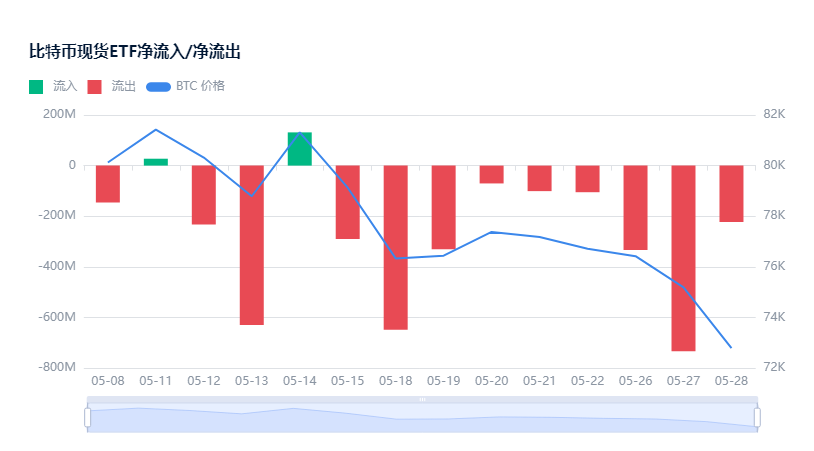
As of May 28, the US spot BTC ETF has seen a net outflow for nine consecutive trading days, with a single-day net outflow reaching $733 million, marking the largest single-day outflow since late January this year. This indicates that institutional funds have significantly reduced their exposure to Bitcoin spot over the past week.
1. Core Data Dashboard
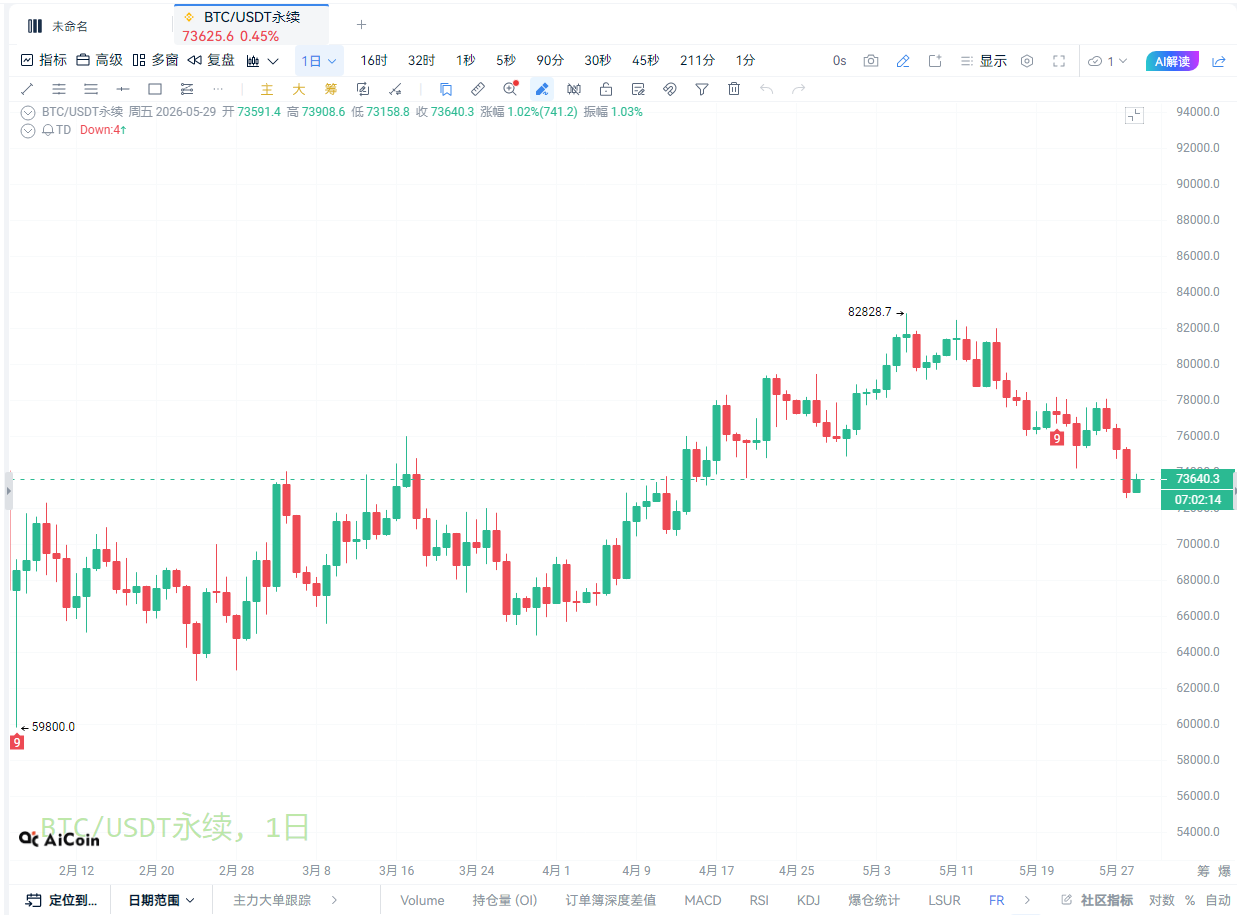
- Price Trend - BTC once fell below the key support level of $73,000, damaging the short-term upward trend, shifting to a high volatility bottom-seeking structure
- ETF Trend - Nine consecutive trading days of net outflows, with Wednesday's single-day loss of $733 million, creating a temporary void in institutional buying
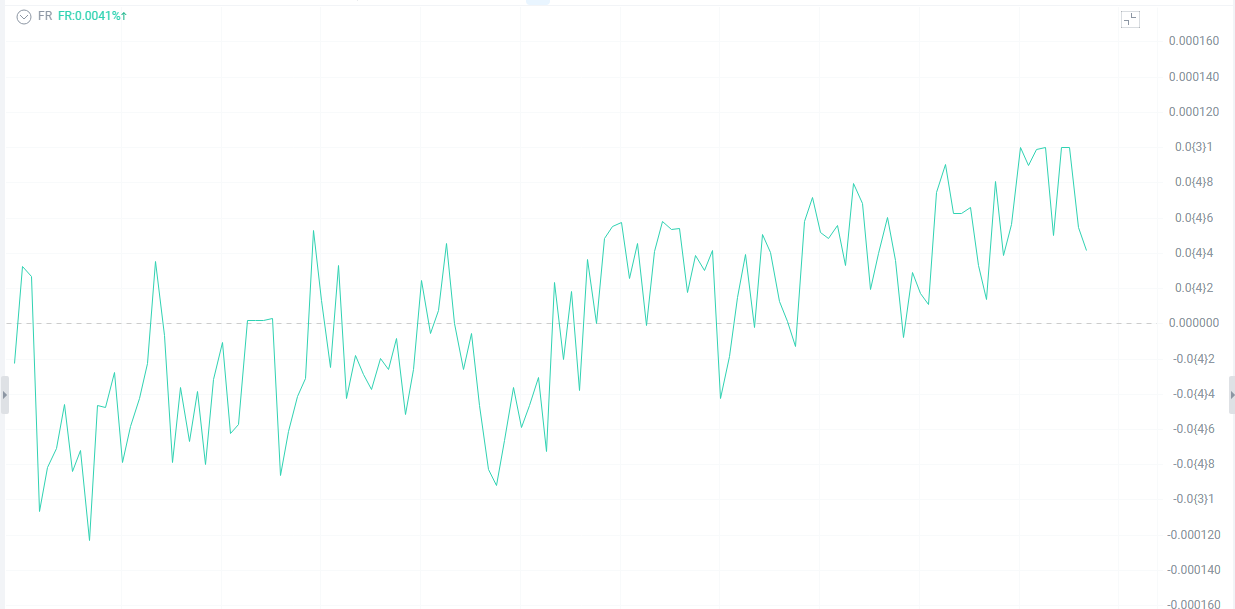
- Funding rate rising, "long squeeze"
2. Three Deep-rooted Logics Behind Institutional Capital Outflow
1. Macro Storm Eye: The Hard "De-leveraging Directive" of Risk Control Models
Institutional funds (especially quantitative funds and traditional asset management) heavily rely on macro risk control models for their position allocation. In the past few days, the external environment has been extremely harsh:
- Interest Rate Cut Expectations Frozen: The recently released PCE inflation data fluctuates, and the Federal Reserve's rates may remain high for an extended period, with concerns about rate hikes resurfacing.
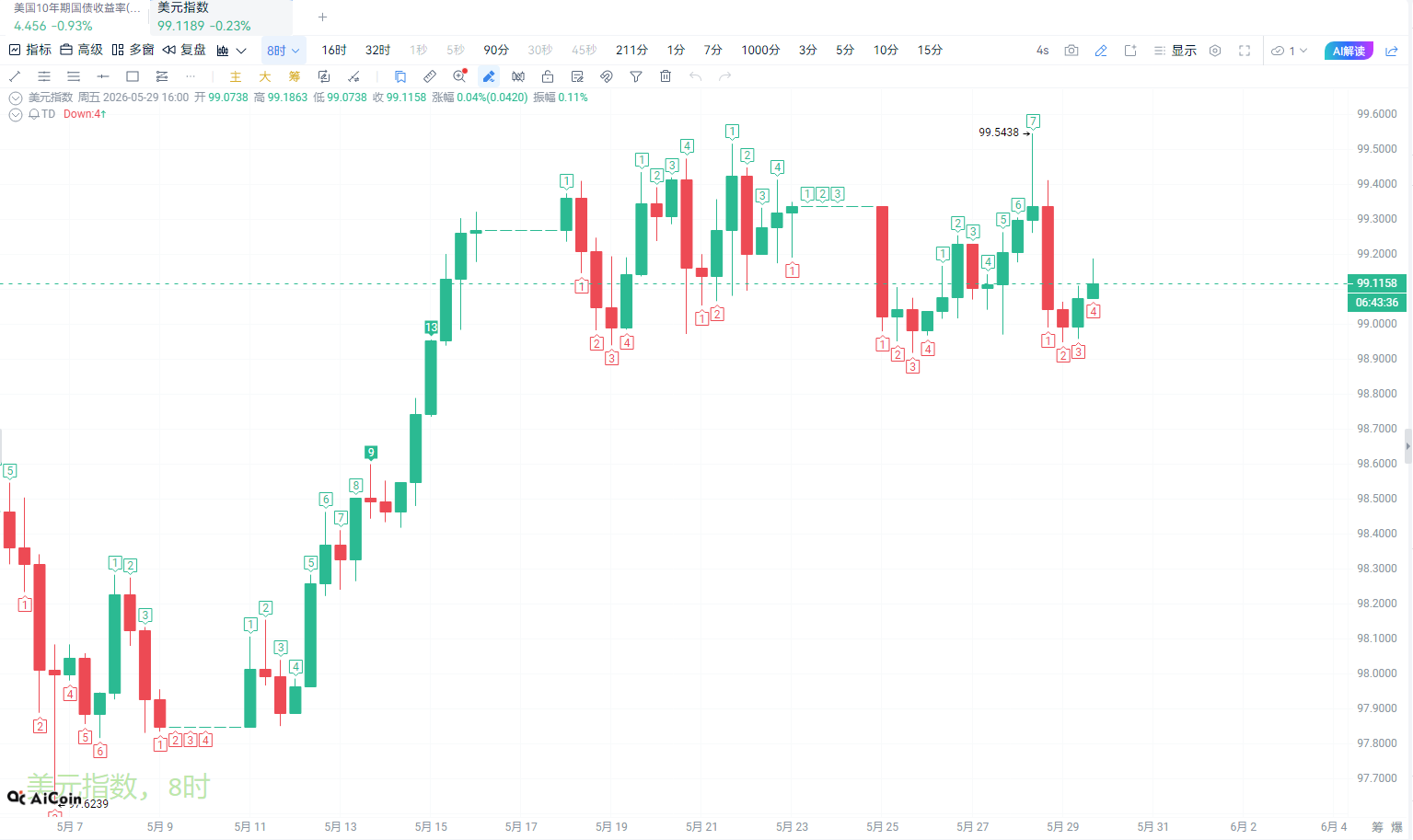
- Soaring US Treasury Yields: 10-year US Treasury yields surged directly (from 4.4% to 4.7%), strengthening the US dollar index.
- Geopolitical Crisis: Escalating tensions in the Middle East and soaring crude oil prices have triggered inflation anxiety.
When both the risk-free return rate (US Treasury) and inflation risks rise, institutional risk control models automatically trigger directives to "reduce exposure to high Beta risk assets." As the most elastic risk asset at present, Bitcoin naturally becomes the first to be forced to reduce positions.
2. Capital Siphoning Effect: Wall Street's "New Favorite" AI Tech Stocks
Recent capital flow monitoring shows that the institutional funds flowing out of crypto ETFs did not all turn into cash sitting idly in accounts; instead, they swiftly flowed into top AI tech stocks in the US stock market ( like Nvidia NVDA, Micron MU, etc.).
- Compared to Bitcoin, which currently lacks new narratives at the $74,000 level and is trapped in high volatility, Wall Street currently favors AI giants with strong cash flow, high gross margins, and highly certain financial reports.
- The strong profit-making effect of the AI sector is ruthlessly "siphoning liquidity" from the entire crypto derivatives and spot market.
3. Periodic Profit-Taking by Market Makers and Traditional Large Players
- Some hedge funds and asset management institutions on Wall Street settle their performance quarterly or semi-annually. The overall increase of BTC in the second quarter has been substantial (up to 30%). Under the current difficulty in breaking through high levels and the extremely high cost of derivatives positions (funding rates), quantitative models and risk control accounts choose at the end of May to "secure floating profits" to ensure their net asset value (NAV) and profit performance in Q2.
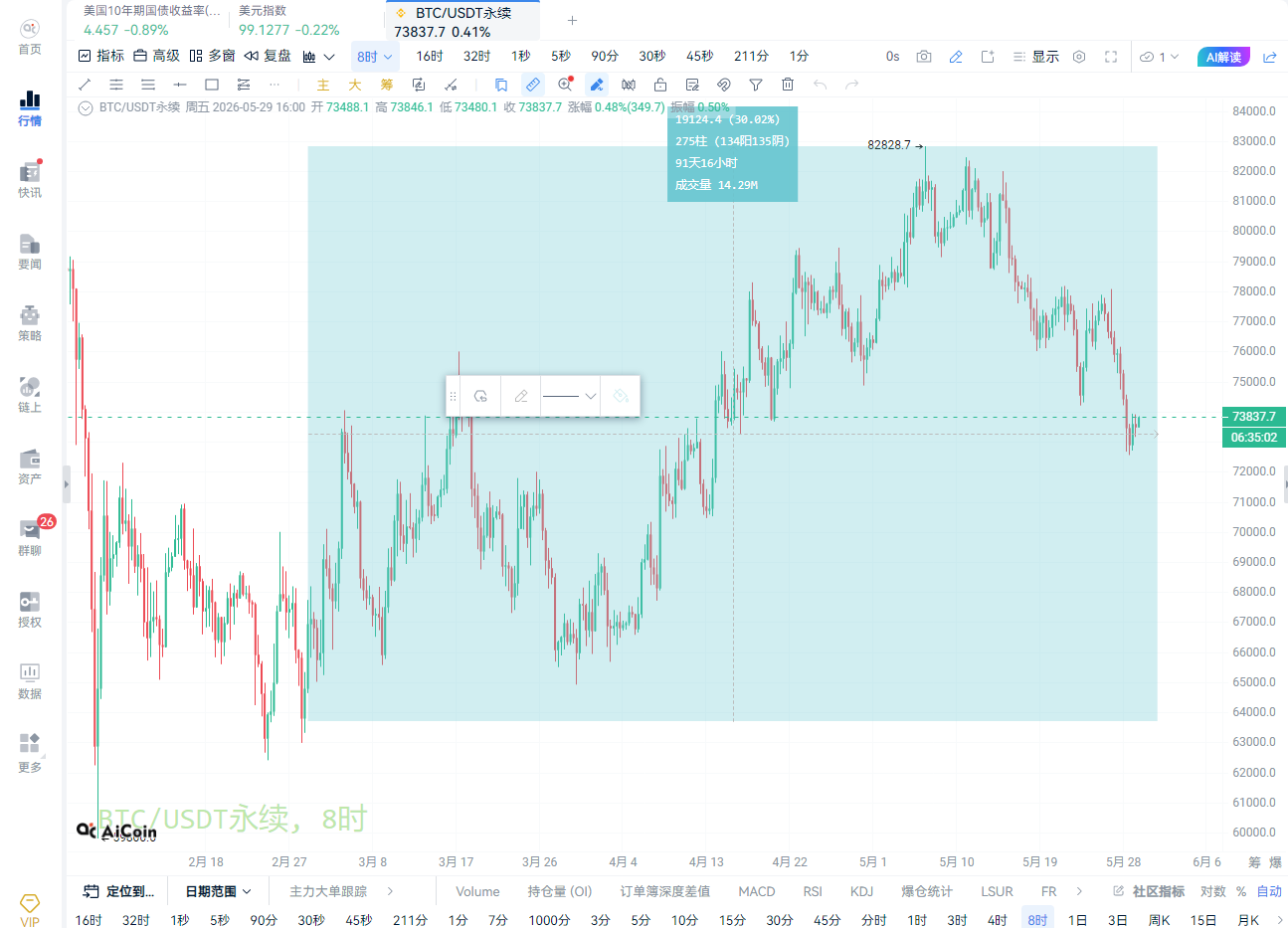
3. Technical Analysis
On the technical level, the market is currently focusing on three ranges:
- $75,800: First short-term resistance zone
- $77,800: High-density short liquidation area
- $70,000 integer level: Key psychological support in the medium term
If BTC cannot stabilize above $78,000 again, the market may continue to test the liquidity area between $73,000 and $70,000. Once the lower concentrated liquidation band is triggered, leveraged cascading could further amplify volatility.
The core contradiction of this market has shifted from "price fluctuations" to "whether institutional funds will flow back."
Compared to the price action itself, ETF flows, funding rates, changes in open interest, and liquidation distribution are often the key variables that truly affect short-term direction. AiCoin's open data API has covered:
- ETF fund flows
- Long-short ratio
- Open interest (OI)
- Funding rates
- History of liquidations
- Large move monitoring
Supports various scenarios such as quantification, agent, risk control, and automatic alerts:
https://www.aicoin.com/zh-Hans/opendata
Disclaimer: This article represents only the personal views of the author and does not represent the position and views of this platform. This article is for information sharing only and does not constitute any investment advice to anyone. Any disputes between users and authors are unrelated to this platform. If the articles or images on the webpage involve infringement, please provide relevant proof of rights and identity documents and send an email to support@aicoin.com. The relevant staff of this platform will conduct an investigation.