

1. Executive Summary
Market Cycle and Sector Resilience: In June 2026, the cryptocurrency market is overall in a high volatility adjustment period, with BTC oscillating around $63,000, and spot ETFs showing phased net outflows. Against this backdrop, the decentralized artificial intelligence (Decentralized AI) sector has demonstrated strong structural resilience against the trend.
Core Logic Upgrade: Led by Bittensor (TAO), AI flagship projects are undergoing a paradigm shift from "pure narrative speculation" to "subnet (Subnet) economic entity materialization." Through its unique incentive mechanism, Bittensor directly transforms globally distributed computing power and algorithms into tradable productivity.
Key Research Findings:
Stable Market Positioning: The circulating volume of TAO is approximately 10.99 million, with a market capitalization stabilizing in the range of $2-2.3 billion (ranking about 42), showcasing solid fundamental support.
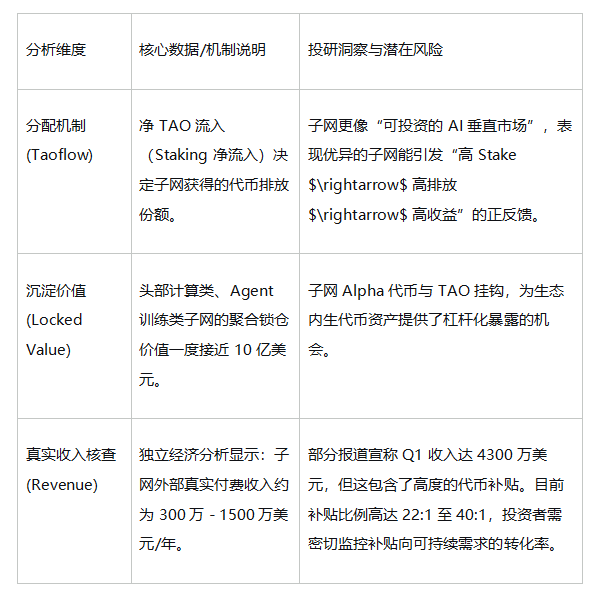
Self-Evolving Mechanism: The "Taoflow" model activated in November 2025 links subnet emission weight to net staking inflow, leading to a more mature market discovery mechanism.
Coexistence of Bubble and Value: Leading subnets lock up assets worth tens of millions up to over a hundred million dollars, but the ecosystem still highly relies on TAO token emission subsidies (subsidy ratio reaching 22:1 to 40:1). How to convert subsidy-driven growth into real external commercial payments is the core logic determining its valuation cap.
2. Macroeconomic Background: Fundamental Rotation in a Correction Market
In June 2026, under multiple pressures from macroeconomic sentiment and geopolitical factors, cryptocurrency market funds are rotating from purely financial speculative assets to infrastructure sectors with real utility and narrative depth.
Centralized AI (such as OpenAI, Google) is facing irreconcilable bottlenecks in development, including data monopoly, privacy breaches, concentration of computing power, and model black boxes. Meanwhile, the decentralized incentives, globally open collaboration, and on-chain transparent validation provided by Web3 perfectly form a natural solution. Bittensor transforms "Smart-as-a-Service" into a peer-to-peer machine intelligence marketplace, creating unique scarcity in the capital market.
3. Bittensor (TAO) Token Economics and Subnet Ecosystem Overview Data
Based on AiCoin data terminal and publicly monitored on-chain data
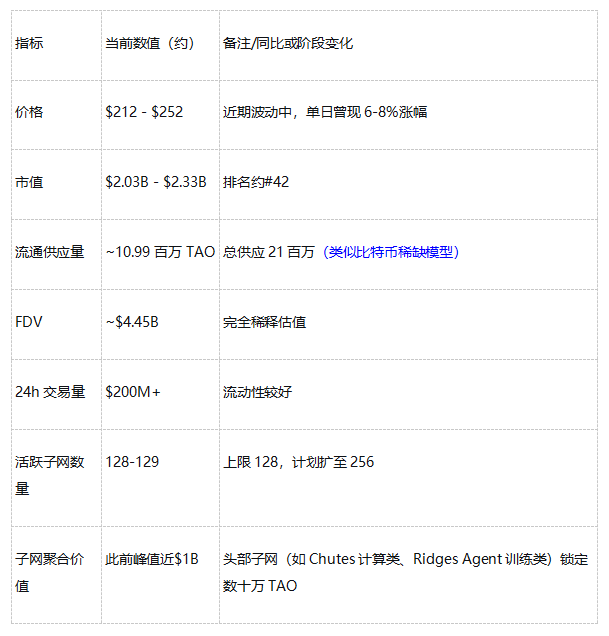
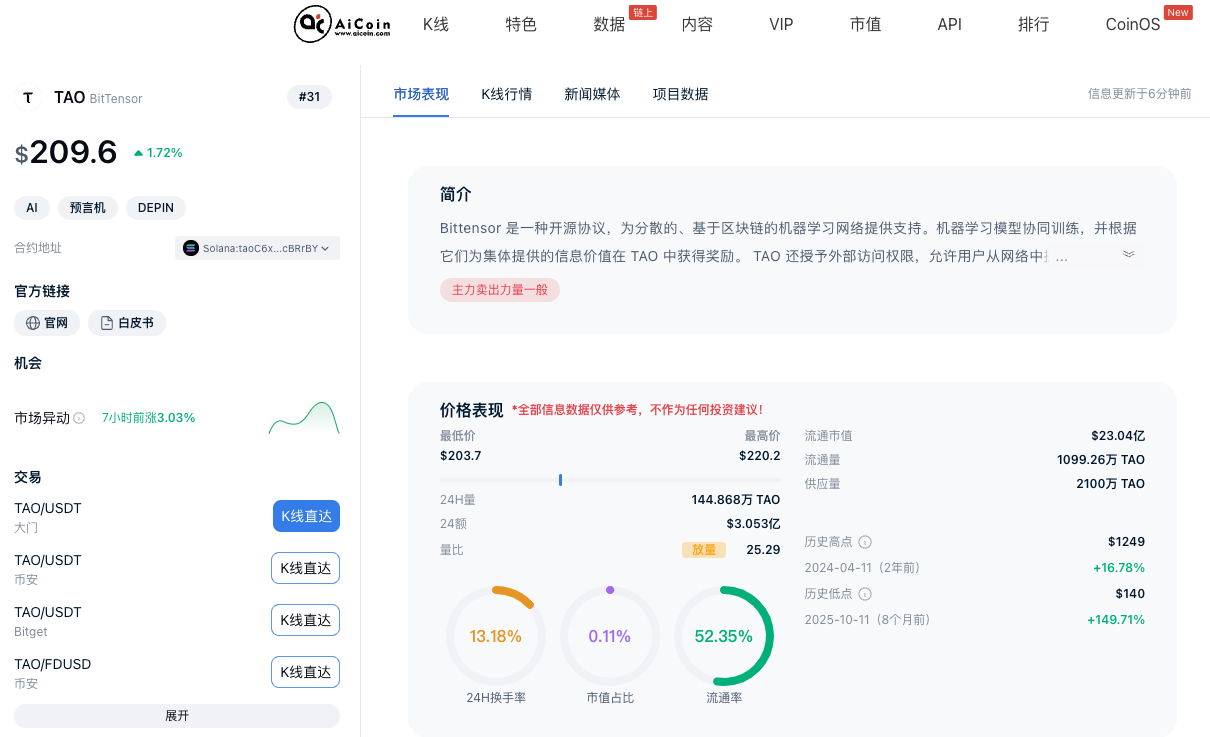
Dimension A: Token Inflation, Halving Logic, and Potential Supply Shock
TAO adopts a fixed maximum supply similar to Bitcoin (21 million) with a four-year halving mechanism. In the context of the continuous exponential expansion of AI computing power and model demand, secondary market supply shocks are brewing due to the sustained consumption of subnet registration fees (Burn TAO mechanism) and strategic locking of institutional funds (like Grayscale's release of AI funds and related ETF filings).
Dimension B: Subnet Lifecycle, Last Man Standing Elimination, and Expansion Dynamics
Currently, the Bittensor network supports a maximum of 128 subnets (close to saturation). The OpenTensor Foundation has introduced a rigorous last man standing elimination system: low-performance subnets that fail to attract stake will be automatically deregistered and replaced by newly bidded subnets.
Future Catalyst: The network is currently planning to expand the subnet capacity to 256. This expansion will provide more structural opportunities for global innovation teams while significantly intensifying competition for computing power and token attractiveness among subnets.
Dimension C: Taoflow and Subnet Economic Verification
To provide investors with a deeper and more balanced research perspective, the following table presents a multi-dimensional breakdown of Bittensor's core mechanisms and current financial status:
4. Comparative Analysis of Supporting AI Tokens
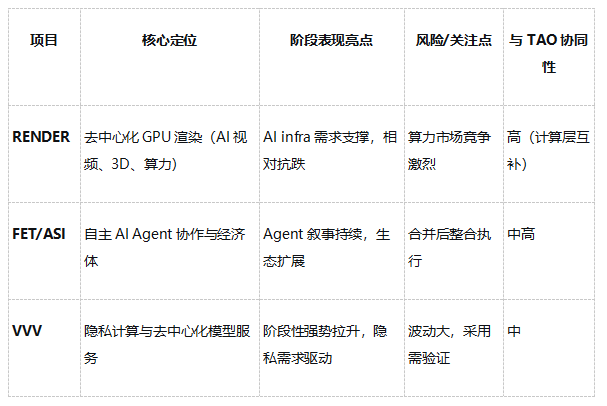
These projects collectively cover different levels of the AI stack: computing power (RENDER), agents (FET), privacy and models (VVV), forming ecological complements with TAO's "smart market." In the correction market, funds are more inclined towards projects with actual on-chain activity and revenue potential.
5. Market Sentiment and KOL Direction Insights (Based on Text Mining from X and Reddit)
During this price correction in mid-2026, KOLs (Key Opinion Leaders) and core communities in the cryptocurrency market showed significant consensus divergence and long-term high loyalty.
Optimistic Bullish Camp (approximately 75%, dominant)
Price Expectations: Mainstream analysts, including Michaël van de Poppe (@CryptoMichNL), believe that TAO is a cornerstone asset in this bull market, generally setting target prices at the end of 2026 between $500 - $1000, with extremely optimistic institutions (like Stillcore Capital) predicting potential ranges of $3000.
Core Logic: Core ecological KOLs like Finance Freeman (@FinanceFreeman) and Quas (@TalkingTensor) pointed out that "weak prices $\neq$ weak fundamentals." The current adjustment period is a healthy accumulation zone. They prefer to compare Bittensor with the NASDAQ giants of the Dot-com era, optimistic about its trillion-dollar market value long-term potential.
Careful and Technically Pressured Camp (approximately 25%)
Short-term Concerns: Some social media discussions (like Reddit and certain X traders @GACryptoO) have expressed concerns about earlier governance repercussions (like the Covenant AI incident).
Technical Support Testing: Technical KOLs believe that TAO exhibits high beta properties of volatility risk, potentially continuing to test deep support ranges of $150 - $200 in the short term, or conducting long-term range oscillation at the current bottom, suggesting investors maintain a "buy the dip" strategy with partial positions.
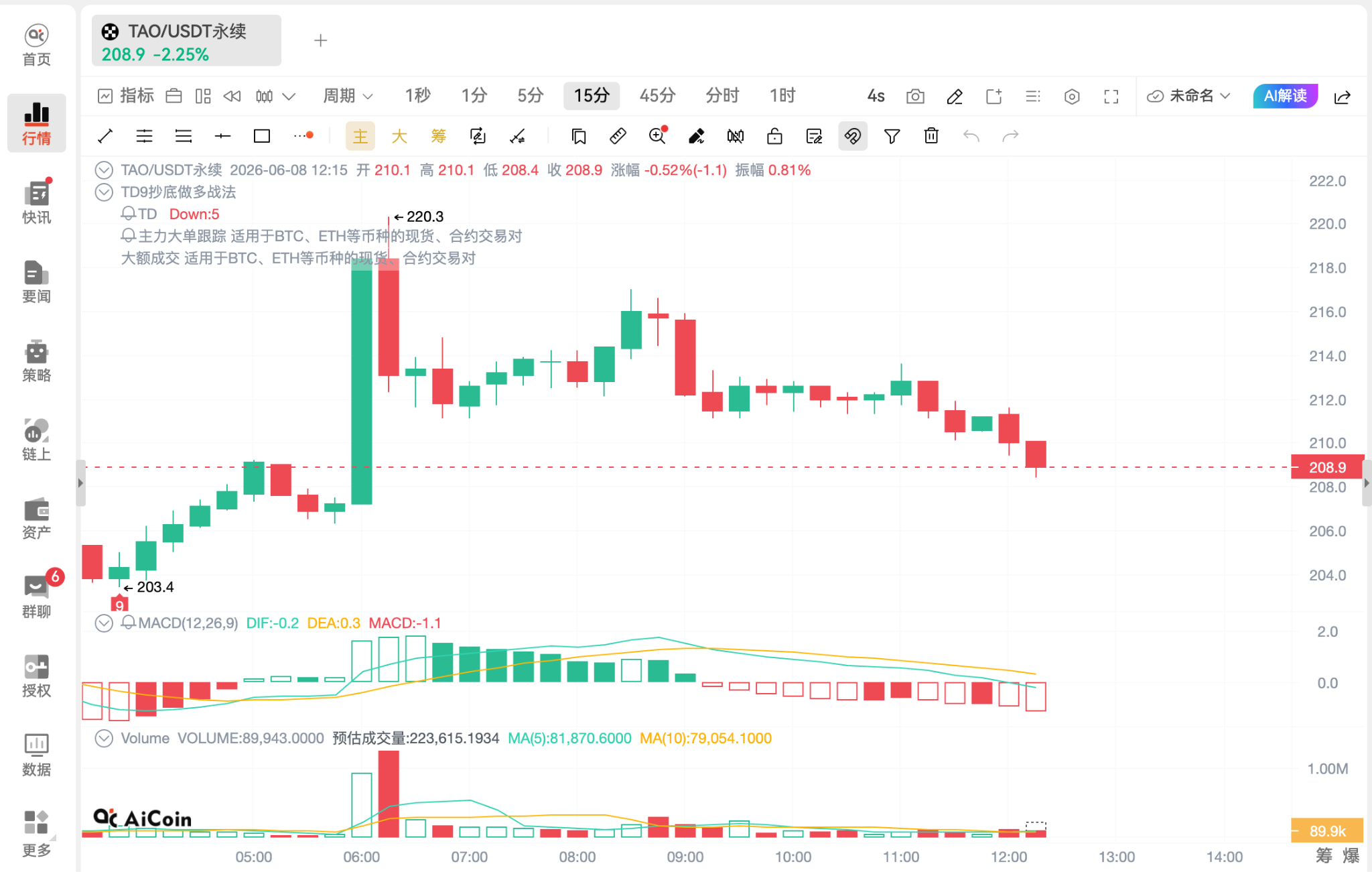 (AiCoin K-line chart, price alert can be set)
New users are recommended to register with the following two platforms (AiCoin exclusive benefit link):
Binance Link:
https://jump.do/zh-Hans/xlink-proxy?id=3
Invitation Code: aicoin668 ($500+ returns 10%)
OKX Link:
https://jump.do/zh-Hans/xlink?checkProxy=true&proxyId=2
Invitation Code: aicoin20 (permanent 20% return)
"The dividend of virtual AI has ended; the next three years belong to physical AI?"
"The dividend of virtual AI has ended; the next three years belong to physical AI" captures an important turning point in the AI industry in 2026. The explosive growth of generative large models (like ChatGPT, Sora) has entered the stage of diminishing marginal returns, while physical AI (Physical AI / Embodied AI)—the ability to bring AI into the real physical world and interact deeply with robots, sensors, and edge devices—is becoming the next battlefield for capital and technology.
This shift poses new demands on decentralized AI infrastructure. Bittensor (TAO) and its subnet ecosystem, with its unique incentive mechanisms and scalable architecture, are expected to occupy a critical position in this wave, but also face challenges and opportunities in transitioning from a "virtual intelligence market" to a "physical-virtual hybrid intelligence market."
The Logic Behind the Peak of Virtual AI Dividends
In the past three years, virtual AI (primarily focusing on large language models, image/video generation) has created astonishing valuation and adoption waves. The core driving force is cloud-based concentrated computing power + massive internet data + large-scale pre-training. However, diminishing marginal effects are becoming evident:
- The speed of performance improvement of models is slowing, and training costs are rising exponentially.
- The issue of data exhaustion is prominent (massive consumption of publicly available internet data).
- Actual commercial landing (especially in scenarios requiring interaction with the physical world) is far below expectations.
- Increased pressure from regulation and energy consumption.
Meanwhile, physical AI is accelerating its rise. Its typical characteristics include:
- Large-scale deployment of robotic bodies (humanoid robots, industrial arms, autonomous driving).
- Closed-loop training with world models (World Model) and simulation-to-real (Sim2Real).
- Demand for edge computing and real-time decision-making.
- Real-time processing of multimodal sensor data (visual, tactile, haptic) and privacy protection.
In the next three years, capital will flow more toward AI systems "that can move, perceive real environments, and execute physical tasks." This is not a denial of virtual AI but a necessary evolution from "cloud intelligence" to "cloud-edge-end hybrid intelligence."
Bittensor (TAO) Structural Advantages in the Physical AI Wave
The core design of Bittensor—subnet economy + traffic-based emissions + TAO incentives—naturally fits the three major pain points of physical AI: decentralization of computing power, verification of data authenticity, and cross-device intelligent collaboration.
6. Analysis of Leading Subnet Case Studies
Based on publicly available on-chain data and project disclosures, the following are current representative leading subnet case studies (data dynamically changes, based on real-time data from AiCoin/taostats):
1) Chutes (Computing/Inference Subnet, Representative High-Value Subnet)
- Positioning: Decentralized GPU/computing resource scheduling and inference services, catering to AI model training and inference needs.
- On-Chain Performance: Previously locked value close to or exceeding $100 million (priced in TAO), ranking high on the subnet value list. Large daily token processing volumes (some reports exceed trillions).
- Revenue and Subsidy: External paid revenue exists, but independent analysis shows most still relies on TAO emission subsidies (ratio could reach 22:1–40:1). This reflects the genuine demand in the computing sector, but large-scale payments will still take time.
- Investment Implications: As a core of the TAO ecosystem's "computing power layer," if external demand continues to grow, it will directly drive staking inflows and increase emission weight.
2) Ridges (Agent Training and Complex Task Subnet)
- Positioning: Focused on the training, optimization, and deployment of autonomous AI agents, solving complex multi-step tasks.
- On-Chain Performance: A star subnet under the agent narrative, significant value lockup (previously above $45 million), high community and developer activity.
- Highlights: In the absence of a "user-friendly killer app," the agent domain is seen as the most likely vertical field to break through first.
- Risks: High technical complexity, actual landing and user adoption still need verification.
3) Other Noteworthy Subnet Types
- Pretrain / Templar Types: Model pre-training and foundational intelligence services, with strong long-term infrastructure attributes.
- Privacy/Security Subnets (such as some related to Enigma): Combining zero-knowledge or privacy computing, aligning with regulatory and enterprise-level needs.
- Emerging/Vertical Tracks: Drug discovery, robotics, and quantum computing-related subnets are in early accumulation stages, with both volatility and potential.
- Subnet Investment Insights: Leading subnets have formed a significant Matthew effect, but competition for registration of new subnets is intense. It is advisable to monitor net staking inflow, Alpha token prices, and emission weight changes through AiCoin or taostats as leading indicators.
7. Multi-scenario Analysis and Probability Outlook
Based on current subnet expansion, revenue realities, institutional interest, and the macro environment, we construct three types of scenarios:
Scenario A: Optimistic/Bull Market Scenario (Probability about 25–35%)
Driving Factors: Smooth expansion to 256 subnets, significant increase in external revenue for leading subnets (reduction in subsidy ratio), approval of ETFs like Grayscale/Bitwise, emergence of phenomenal agent applications.
Result: TAO price is expected to challenge $500–$800+ (or even higher), subnet aggregate value breaking through $2–3 billion, and the overall sector enjoying a premium.
Key Observational Indicators: Continuous acceleration of net inflows to subnets, quarter-on-quarter growth in external paid revenue, and increase in institutional holdings.
Scenario B: Benchmark/Neutral Scenario (Probability about 45–55%)
Driving Factors: Slow expansion and iteration of subnets, gradual improvement in external revenue but still partially reliant on subsidies, intensified competition without systemic risk.
Result: TAO fluctuating in the range of $180–$350 establishing a bottom, significant subnet differentiation (leading players remaining strong), the sector maintaining resilience relative to the broader market but struggling to burst forth.
Suitable Strategy: Swing trading + long-term DCA, focusing on exposure to leading subnets.
Scenario C: Pessimistic/Bear Market Scenario (Probability about 20–30%)
Driving Factors: Long-term sluggish external demand, market has fully priced in subsidy reliance, competitors (other L1s or centralized solutions) diverting activity, further macro deterioration or regulatory tightening.
Result: TAO retracing to $120–$180 or even lower, significant depreciation of subnet value, with overall pressure on the sector.
Risk Control: Strict position limits, setting hard stop-losses, prioritizing observation of outflow signals from staking on-chain.
Scenario probabilities will dynamically adjust with actual subnet revenue data, ETF developments, and macro environment. It is advisable to review key indicators quarterly.
8. Practical Trading Strategy Framework with AICoin
1. Tool Preparation (AiCoin as the Core)
Monitoring Module: Net inflows/outflows of subnet stakes, Alpha token prices, emission weight rankings, large on-chain TAO transfers.
Alert Settings: News of subnet registration/replacement, breakthroughs in leading subnet value, critical price support levels.
Data Comparison: Complementary with TradingView/CoinMarketCap, focusing on the granularity of on-chain data and sentiments within the Chinese community.
2. Layered Trading Strategies
Short-term Swing (1–4 weeks):
Signal: Significant net stake inflow to subnets + price correction to support levels + recovery in AICoin sentiment indicators.
Operation: Light positions to test long, targeting partial profit near previous highs.
Risk: Strict stop-loss (single-loss limit within 2–3% of total positions).
Medium-term Swing (1–3 months):
Signal: Continuous value increase in leading subnets (like Chutes, Ridges) + improvement in external revenue data + stable macro sentiment.
Operation: Gradual building of positions, combining Grid/DCA strategies on platforms like Bitget to lower costs.
Position Suggestions: No single project should exceed 8–12% of the portfolio.
Long-term Allocation (6 months or more):
Signal: Subnets expanding to 256, ETF implementations, emergence of killer apps, external revenue accounting for increasing share of emissions.
Operation: Core holdings + periodic rebalancing, ignoring short-term volatility.
Strategy: Dollar-cost averaging + milestone-based position increases (for instance, when subnet numbers hit new highs or revenue reports exceed expectations).
General Risk Management Principles (Protecting Principal First):
Total Position Control: AI cryptocurrency sector should not exceed 20–30% of the portfolio.
Stop-loss/Take profit: Set multi-level take profits (50%, 100% targets in batches), with hard stop-loss levels based on individual risk tolerance.
Leveraged Use: Cautious, prioritizing spot or low leverage.
Monitoring Checklist: Weekly checking of AICoin subnet data and monthly reviews of scenario probabilities.
9. Risk Matrix & Disclaimers
Subsidy-reliance and growth fallacy risk: Given that current computing power growth largely depends on TAO's token emissions, if external business models can't be delivered in the long term, high subsidies may translate into long-term institutional selling pressure in the future.
Last man standing elimination and leverage liquidation risk: Subnet Alpha tokens exhibit high financial leverage. Once a subnet is deregistered, the liquidity of related tokens may rapidly dry up.
Competition from centralized giants: The traditional power alliances of Web2 like AWS and NVIDIA present significant long-term technological pressure on decentralized computing networks.
Disclaimer: This report is compiled from publicly available market data, on-chain monitoring, and AiCoin data terminals, aiming to provide an objective deconstruction of market narratives. All assets and views mentioned in this report do not constitute any explicit or implicit investment advice. Cryptocurrency asset prices demonstrate extremely high volatility; please establish an independent DYOR (Do Your Own Research) framework, ensuring protection of principal and position stop-loss management.
Disclaimer: This article represents only the personal views of the author and does not represent the position and views of this platform. This article is for information sharing only and does not constitute any investment advice to anyone. Any disputes between users and authors are unrelated to this platform. If the articles or images on the webpage involve infringement, please provide relevant proof of rights and identity documents and send an email to support@aicoin.com. The relevant staff of this platform will conduct an investigation.