
TL;DR
- During the closure of the South Korean stock market, the perpetual contracts of SK Hynix on Hyperliquid continued trading and have reflected most of the decline observed at the open on Monday in advance.
- In the three minutes before the market opened, the decline in the on-chain price corresponded to a difference of only 0.13 percentage points from the actual opening decline; the subsequent volume rebound in the last two minutes was later validated in the underlying stock market.
- Associated assets: SK Hynix, Hyperliquid, TradeXYZ
In the past, the closure of traditional financial markets usually meant a pause in price discovery. Assets such as stocks, commodities, and ETFs enter a silent state after closing on Friday, and investors can only wait until the next trading day to see the actual price reflect any event stress.
However, the on-chain derivatives market initiated by Hyperliquid is changing this structure.
With Hyperliquid HIP-3 allowing external builders to deploy perpetual contracts for real-world assets (RWA) such as stocks, commodities, and indices, some traditional assets represented by the XYZ market can now achieve 24/7 continuous trading on-chain. When traditional markets are closed, the on-chain market does not stop matching; instead, it may become a preliminary venue for risk expression and price discovery.
Just past the last weekend, the on-chain movement of South Korean chip manufacturer SK Hynix provided a clear observation sample. Hyperliquid xyz:SKHX did not just see sporadic trades during the KRX market closure, but according to the candleSnapshot 1m K-line data, both bulls and bears completed a significant amount of chip exchange over the weekend.
By Monday, June 8, before the official opening of KRX, the on-chain market had already provided a complete weekend price pathway in advance.
Precision of 0.13%: Weekend Price Discovery of SK Hynix
On June 5, the closing price of KRX SK Hynix was 2,070,000 KRW. Subsequently, the South Korean stock market entered the weekend break.
According to Hyperliquid's 1-minute K-line data, its benchmark price remained at 1336.5 USDC after closing on Friday. Just before the opening of KRX on Monday morning, the on-chain price displayed significant volatility:
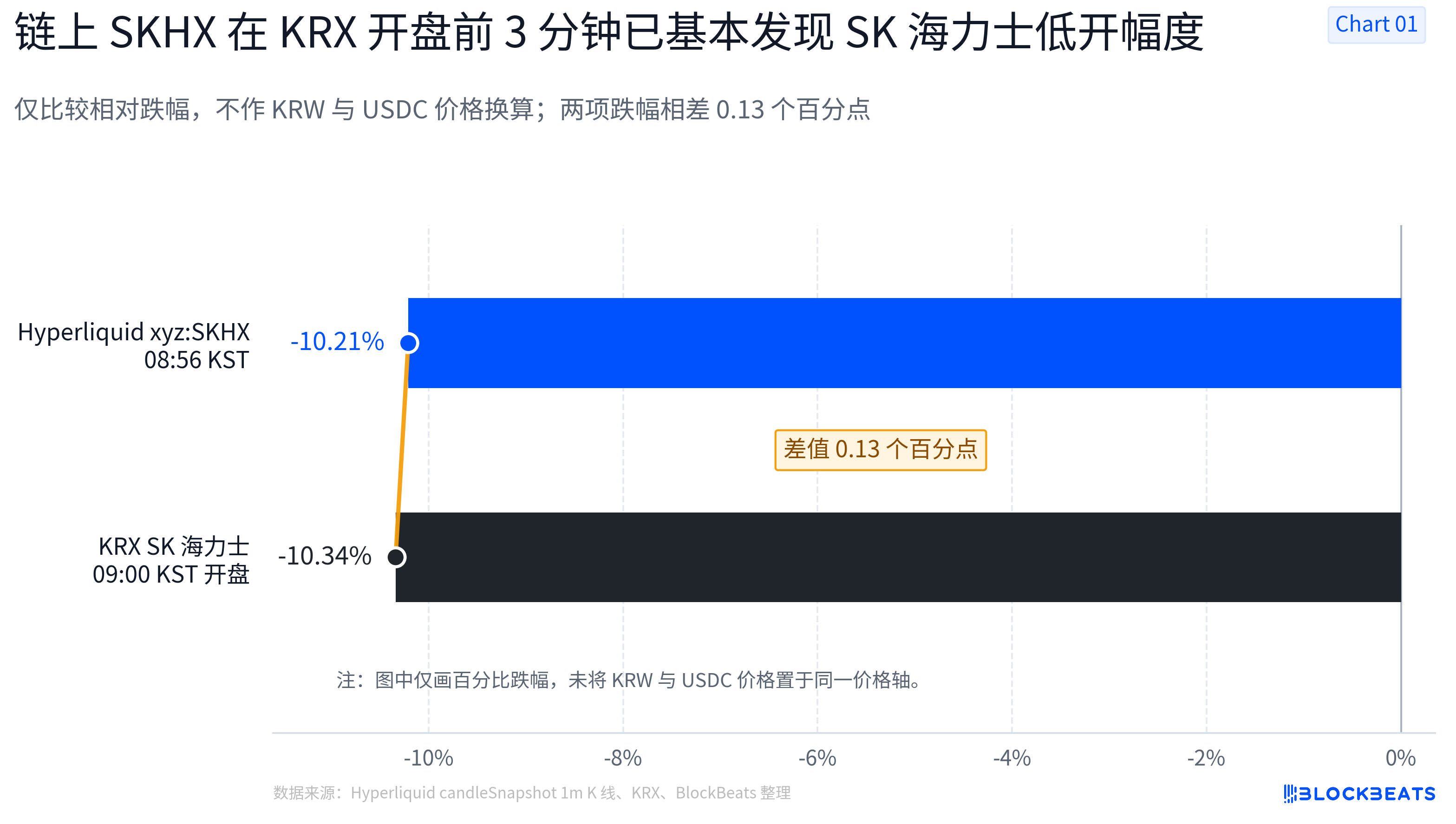
- Monday at 08:56 KST: xyz:SKHX dropped to a low of 1200.0 USDC, a decline of -10.21%.
Three minutes later, the KRX officially opened, with actual data as follows:
- Monday KRX official opening: 1,856,000 KRW, corresponding to a decline of -10.34%.
The difference between the two is only 0.13 percentage points.
This means that in the three minutes before the official opening of KRX, the on-chain market had almost completely discovered the extent of SK Hynix's low opening on Monday. It did not vaguely express a direction of "will drop," but precisely priced the drop at around 10%, highly consistent with the actual opening results.
Key Reversal: Not a Failed Prediction, But an Early Trading of Post-Open Movements
Following this, the market underwent a second phase of change, primarily concentrated in the last 120 seconds before opening.
During 08:58 - 08:59 KST, xyz:SKHX saw an abnormal surge in volume:
- 08:58: Minute volume rose to 708.132, ranking in the 99.85% percentile for the entire weekend;
- 08:59: Volume maintained at 665.584 (99.82% percentile), price surged from 1201.1 USDC to 1228.8 USDC, a rebound of +2.31% in two minutes.
If only the final price of 08:59 is considered, the on-chain price was about 2 percentage points higher than the subsequent actual opening price of KRX. However, this does not mean that the on-chain price discovery failed; a more reasonable explanation is that the on-chain market had already traded the low positions expected after the stock opened.
Turning to the actual movements post-KRX opening:
- KRX opened at a low point of 1,855,000 KRW;
- 09:03 KST: The stock price has rebounded to 1,904,000 KRW, a rebound of about +2.64%.
BlockBeats Note: On the surface, the on-chain closing decline (-8.06%) differs from the opening decline of the underlying stock (-10.34%) by 2%; however, if the timeline is broken down, the conclusion is entirely different. The on-chain market completed the discovery of the "opening bottom" at 08:56 (error of only 0.13%), and by 08:58 had switched to trading the "post-opening recovery" (the rebound amplitude and rhythm were highly synchronized).
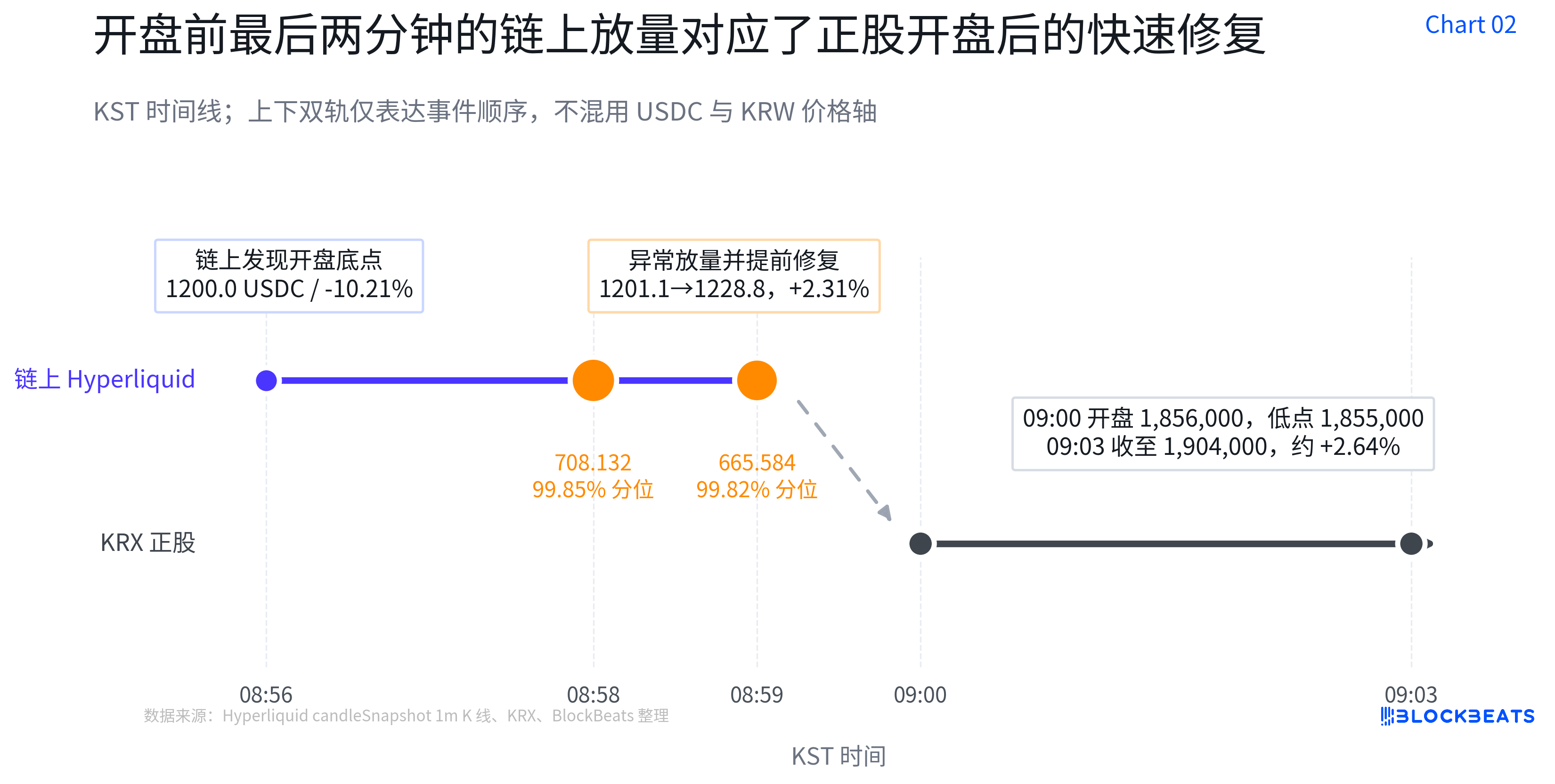
The price discovery of the on-chain market is not a static single-point prediction; it demonstrates a continuous, dynamic path discovery ability.
Data Review: 4 Times the On-Chain Trading Volume Compared to the Underlying Trading Period
In terms of specific trading data, the performance of the Hynix on-chain perpetual contracts during normal South Korean trading hours shows a significant contrast to the weekend market closure.
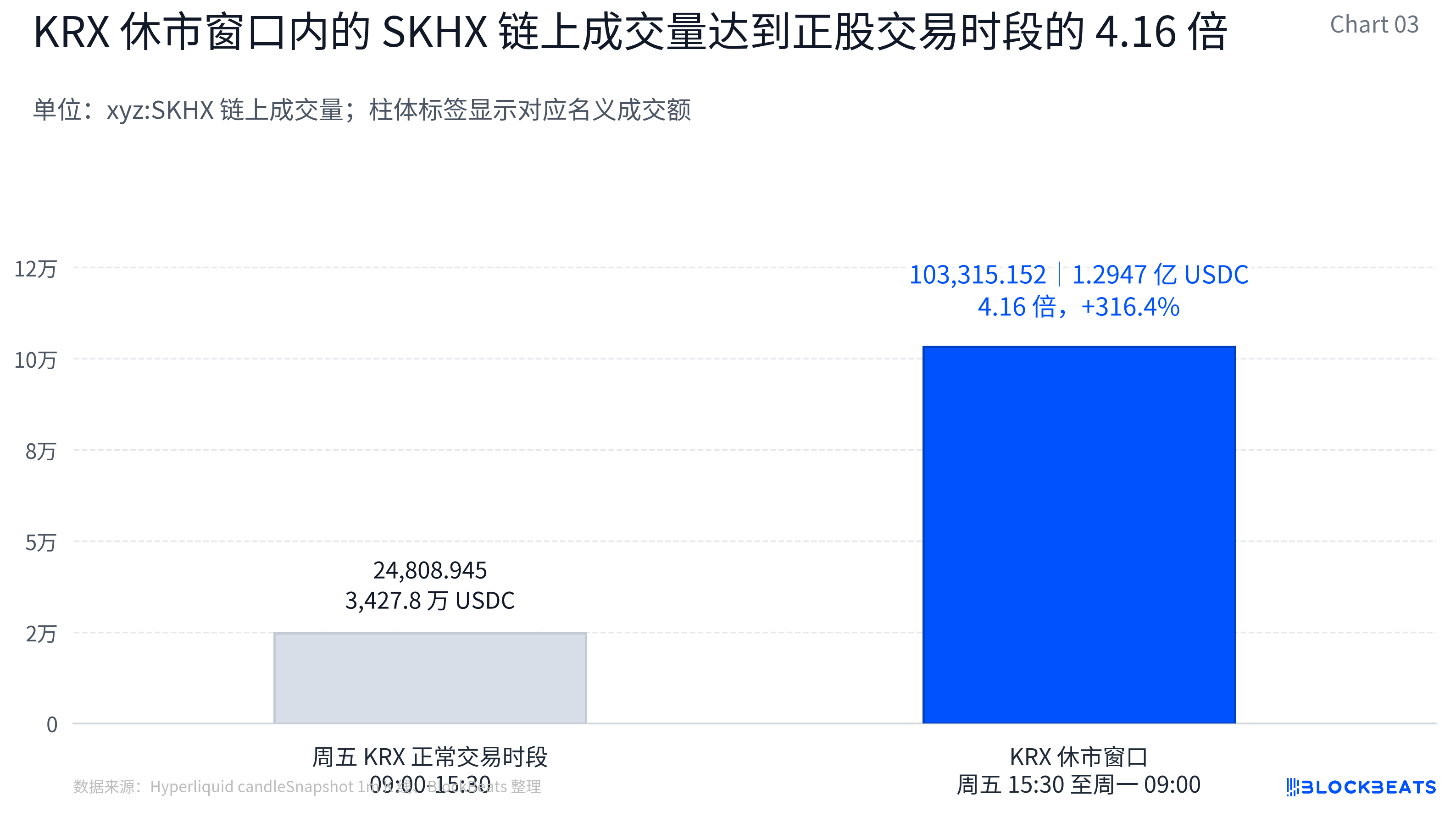
During the normal trading period of the South Korean stock market on Friday (09:00-15:30 KST), the number of contracts traded for the Hynix on-chain perpetual was 24,808.945, corresponding to an estimated trading volume of about 34.278 million USDC.
From the close of the South Korean stock market on Friday to the opening on Monday (15:30-09:00 KST), the cumulative trading volume of this contract reached 103,315.152, corresponding to approximately 129.47 million USDC.
In other words, during the period when the Hynix underlying stock could not be traded over the weekend, the trading volume of its on-chain perpetual contracts reached 4.16 times the on-chain trading volume during normal trading hours on Friday in South Korea, an increase of about 316.4%.
More pronounced liquidity acceleration occurred just before the opening on Monday:
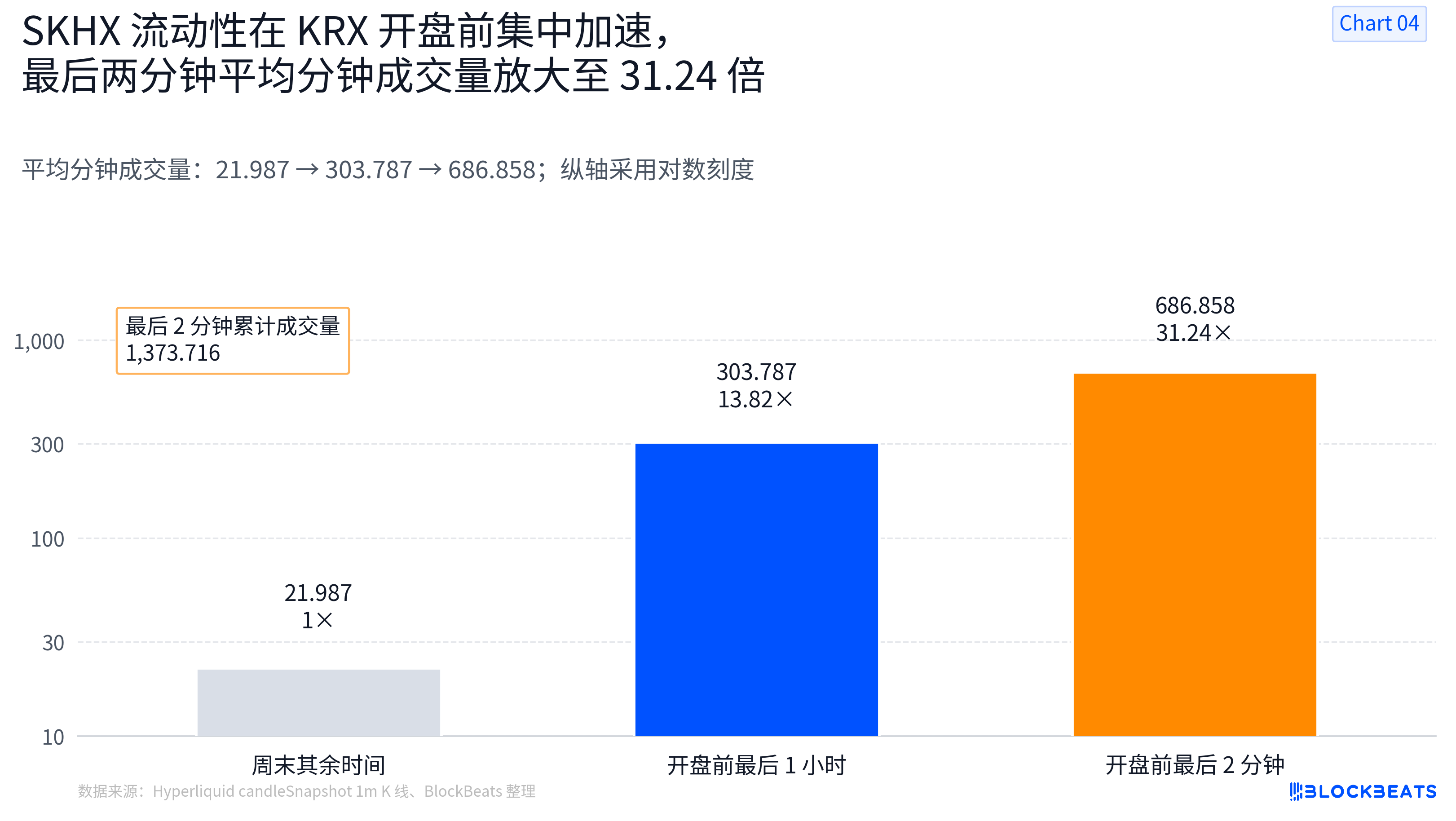
- In the last hour before opening: except for the last hour of the weekend, the average minute trading volume for this Hynix on-chain perpetual was about 21.987 contracts; during the last hour before opening on Monday, the average minute trading volume surged to 303.787 contracts, magnified to 13.82 times the former, an increase of about 1281.7%.
- In the last two minutes before opening: from 08:58 to 09:00 KST, the cumulative trading volume reached 1,373.716 contracts, with an average per minute trading volume of approximately 686.858 contracts, magnified to 31.24 times the average minute trading volume for the rest of the weekend, an increase of about 3024%.
This set of data indicates that price discovery does not only occur at the moment of opening in traditional markets. In the on-chain market before the opening, the trading scale had already significantly increased, and concentrated pricing had occurred in advance.
Why is On-Chain TradFi becoming stronger?
First, there is a continuous demand for expressing expectations during market closures.
In the past, when the KRX exchange closed, the underlying stock price stopped fluctuating, and market participants could only wait for the next trading day to digest information. However, fluctuations in the US semiconductor sector, changes in macro liquidity, and the evolving sentiment within the AI supply chain continue to evolve. The on-chain perpetual market provides a continuous trading window to fill this gap, allowing traders to continue to express expectations on price during the closure of traditional markets.
Moreover, it is noteworthy that on-chain pricing has surpassed mere emotional reactions.
If it were merely a sentiment-based market, prices could typically only roughly reflect the direction of risk. However, the lowest price of xyz:SKHX in the three minutes before KRX’s opening differed from the actual opening price on Monday by only 0.13 percentage points. This precision indicates that funds participating in on-chain trading may include high-net-worth individuals or quantitative strategies, whose pricing models are sophisticated enough for on-chain prices to possess actual reference value.
Additionally, the volume increase before opening reveals market participants' advanced processing of complex information.
The volume significantly amplified in the last hour, especially in the last two minutes, indicates that some traders or quantitative strategies are proactively digesting the price response expected after opening. They are not passively waiting for KRX to open, but are instead preemptively hedging and arbitraging against possible opening volatility on-chain.
In summary, the power of on-chain TradFi is gradually becoming apparent. It not only provides a continuous trading channel during the closure of traditional markets but also begins to take on some of the price discovery functions, with its precision and information processing capabilities gradually approaching traditional market reference standards.
Limitations and Future Potential
It is undeniable that the current on-chain TradFi still has significant limitations.
Firstly, the distribution of liquidity is extremely unbalanced. The enormous volume in the last two minutes indicates that funds only concentrate in critical moments, while the usual order book may still be thin and easily distorted by a minority of funds. Secondly, the coverage of targets is limited; currently, the assets that possess this level of precision are confined to popular blue-chip stocks such as Hynix, Samsung, and US tech giants, while long-tail assets often lack liquidity when it comes to on-chain perpetual contracts. Furthermore, due to the lack of tick data and more detailed taker/maker depth data, it is not yet possible to fully restore the complete picture of the competitive game of active buy and sell orders at that time.
However, the future potential it shows is also quite clear.
As more professional liquidity providers (LPs) and cross-market arbitragers enter the HIP-3 market, the minute-level trading volumes on-chain may become more stable. With the integration of more stocks, ETFs, commodities, and indices, the on-chain market may gradually form a cross-asset, cross-timezone, uninterrupted price discovery network.
The weekend market is no longer silent. When the traditional financial world closes on Friday, the market has already completed the first round of pricing on-chain in advance and has begun trading the next phase of movements after opening. On-chain perpetuals are becoming an undeniable "preemptive oracle" in the global asset pricing system.
Disclaimer: This article represents only the personal views of the author and does not represent the position and views of this platform. This article is for information sharing only and does not constitute any investment advice to anyone. Any disputes between users and authors are unrelated to this platform. If the articles or images on the webpage involve infringement, please provide relevant proof of rights and identity documents and send an email to support@aicoin.com. The relevant staff of this platform will conduct an investigation.