
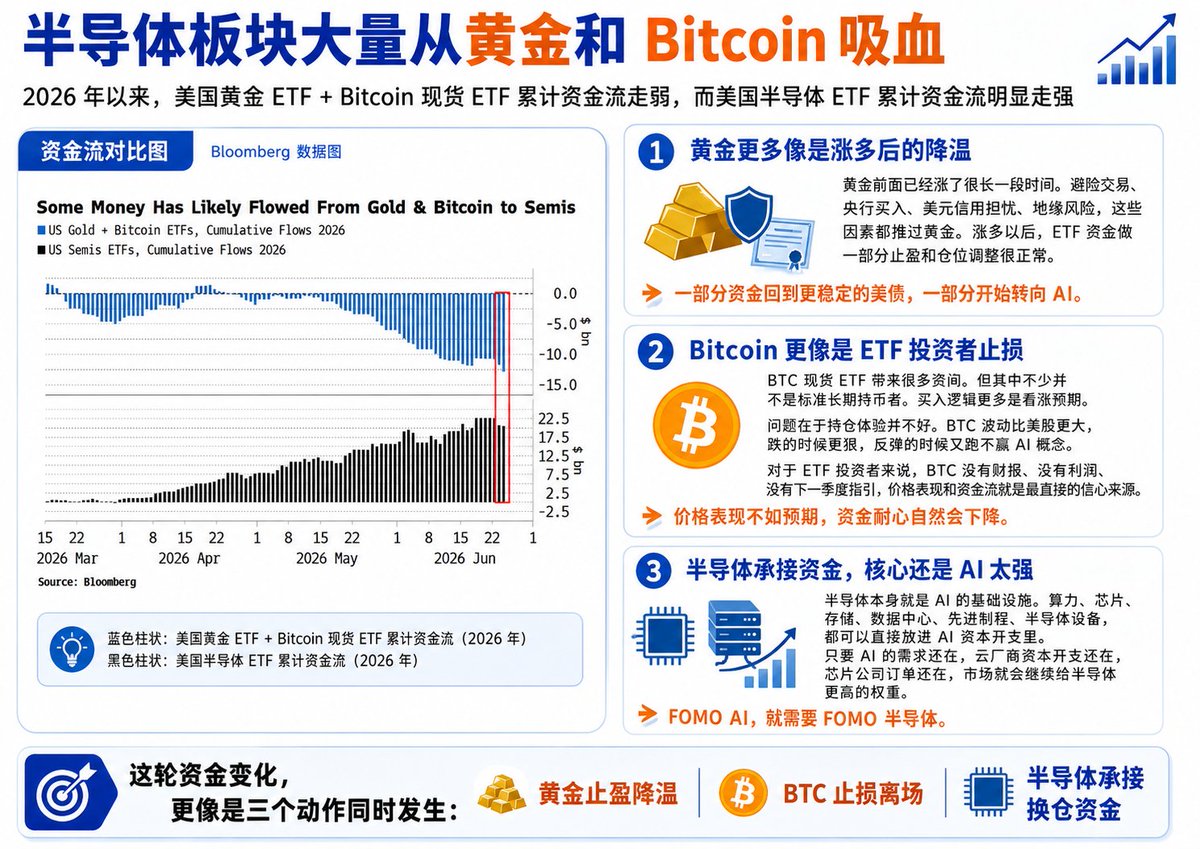
The semiconductor sector is heavily drawing capital from gold and Bitcoin.
Since 2026, the cumulative capital flow of U.S. gold ETFs and Bitcoin spot ETFs has weakened overall, while the cumulative capital flow of U.S. semiconductor ETFs has clearly strengthened.
Here are my personal views:
1. The outflow of gold seems more like a cooling down after a significant increase.
Gold has already risen for a long time; factors such as risk-averse trading, central bank purchases, concerns over the dollar's credibility, and geopolitical risks have all pushed gold up. After such a rise, it is normal for ETF funds to take some profits and adjust their positions. The long-term logic of gold has not disappeared; it’s just that the cost-effectiveness of chasing higher prices in the short term has diminished.
2. The outflow of Bitcoin feels more like a stop-loss and disappointment following losses experienced by ETF investors.
The bitcoin:native spot ETF has brought in a lot of capital, which does not come from standard long-term holders or native crypto users. The logic behind buying BTC spot ETFs is quite straightforward; it is likely based on the belief that after approval, ETFs would bring in incremental capital, and that BTC would continue to rise.
However, the current issue is that many ETF investors are not having a good experience with their holdings. The volatility of BTC is greater than that of U.S. stocks; it drops harder when falling and doesn’t bounce back as strongly against AI-related concepts. Moreover, for ETF investors, BTC lacks earnings reports, profits, and guidance for the next quarter; in the short term, confidence is supported only by price performance and capital flow.
If price performance does not meet expectations, and capital flow does not continuously improve, the patience of these investors will naturally decline.
3. The capital flowing into semiconductors is primarily due to the strong demand related to AI.
The semiconductor sector is the infrastructure of AI. Computing power, chips, storage, data centers, advanced processes, and semiconductor equipment can all be directly included in AI capital expenditures by the market. As long as the demand for AI persists, and cloud vendors’ capital expenditures continue, and chip companies receive orders, the market will continue to assign a higher weight to semiconductors.
Moreover, for many investors, AI has already taken on a new defensive attribute.
This defense is different from that of gold. Gold is a traditional safe haven, while AI resembles a place where funds prefer to remain in the strongest, most verifiably performing, and most consensus-driven mainlines in an uncertain market. Semiconductors have been rising longer, have a clearer logic, and their earnings reports are easier to verify; thus, investors naturally perceive this avenue as safer than many other assets.
Therefore, I prefer to interpret this round of capital changes as three actions occurring simultaneously.
The situation with gold is about taking profits and cooling down after significant gains. In the current market, under the high uncertainty of the Federal Reserve, it is evident that investors are choosing either more stable U.S. bonds or the more FOMO-driven AI.
On the other hand, BTC seems more like a stop-loss action following losses experienced by ETF investors. The capital shifting from BTC to semiconductors, primarily driven by AI, resembles the transition from altcoins to mainstream cryptocurrencies; since the altcoin season hasn’t arrived, and altcoins have very low liquidity, it is better to switch directly to mainstream coins.
Semiconductors are now receiving the capital that has been transferred out after the strengthening of AI as a main narrative. As the hottest sector in AI, FOMO in AI necessitates FOMO in semiconductors.
This also explains why the cumulative capital flow of gold and BTC spot ETFs is flowing out, while the cumulative capital flow of semiconductor ETFs is strengthening.
#Bitget is here, it's VIP! Crypto, U.S. stocks, CFDs, global opportunities all in one!
Disclaimer: This article represents only the personal views of the author and does not represent the position and views of this platform. This article is for information sharing only and does not constitute any investment advice to anyone. Any disputes between users and authors are unrelated to this platform. If the articles or images on the webpage involve infringement, please provide relevant proof of rights and identity documents and send an email to support@aicoin.com. The relevant staff of this platform will conduct an investigation.