
Author: Wang Jianshuo, Founder of Baixing.com
Many people say "big models are everything." I don't really believe that.
Every time I hear phrases like "swallowing everything," I feel that it's mostly because our understanding of the future hasn't reached that level, which leads to such vague statements. Otherwise, how could one thing swallow everything? Let's talk about the internet— the internet has claimed for many years to swallow everything, but has it really swallowed everything now? Is it the internet that swallows everything, or is it the big model? Both are swallowing, and nothing is left?
So I would rather say: it is a very important foundation. Without this foundation, the whole world cannot develop, just like the internet cannot work without its backbone, just like electricity cannot exist without power plants. I can agree with that.
But once we have the foundation, that is where the excitement happens.
Take electricity as an example. Once electricity is generated, what is the first application everyone sees? Light bulbs. Thomas Edison lit the first bulb, and then it kept shining, shining, shining. If the world stopped there with just one light bulb, I could completely say: the power plant is the core of the world, the power plant swallows everything.
But that's not the case. Later, engines were invented to drive machines; and then you will find that once something like electricity exists at the base level, countless electrical appliances will emerge to use it. Washing machines wash clothes, televisions allow you to watch TV, vacuum cleaners vacuum dust— they are all applications of electricity. Without electricity, none of these things exist. But if you say "electricity swallows everything," I don't believe that.
Big models are the same. They provide basic intelligence. However, this intelligence must be placed into a specific machine or device for it to take effect and truly change the world.
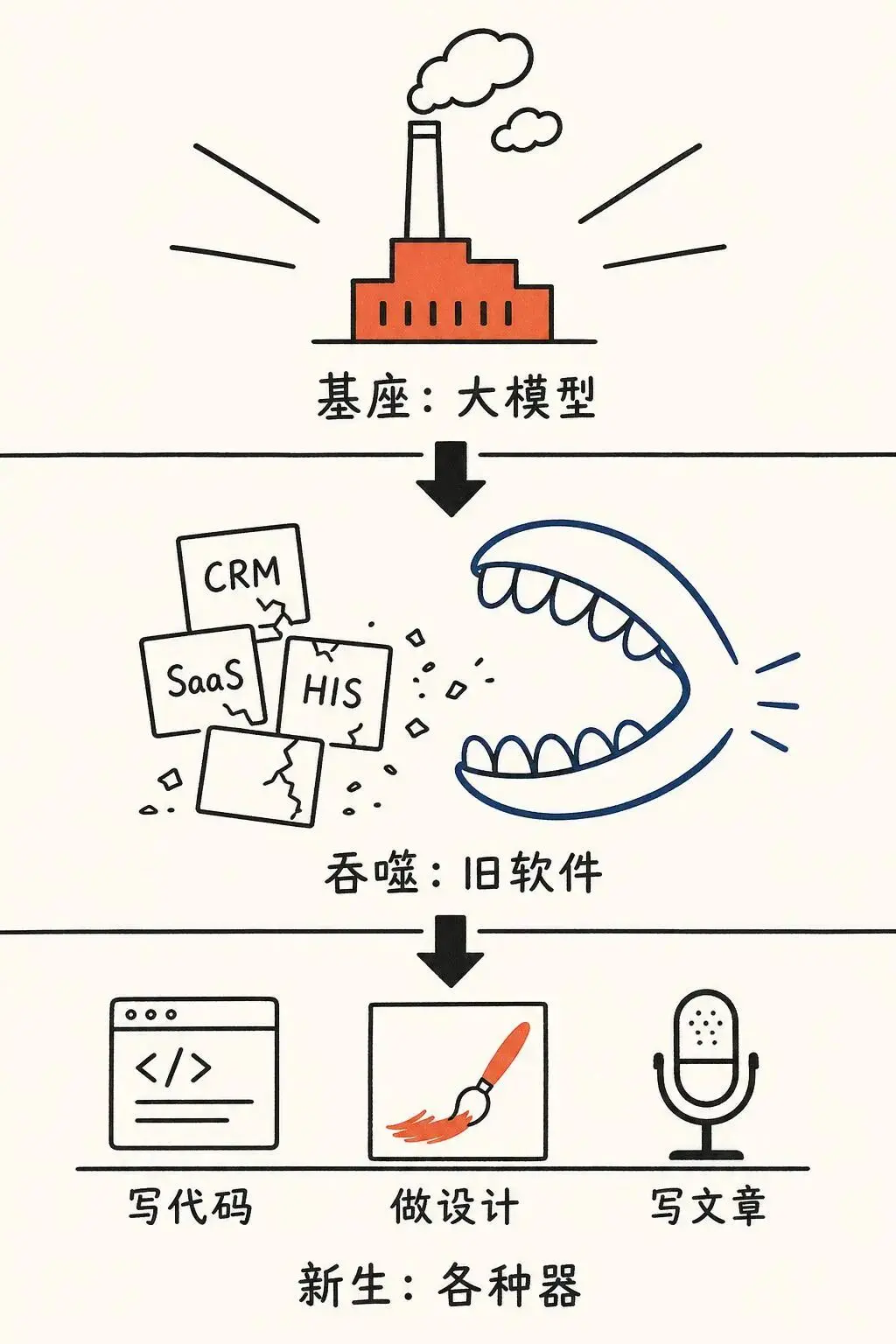
Claude Code is for writing code, Claude Design is for design, VoiceDrop is for writing articles. Even though they are all big models, put into different devices, they solve completely different problems.
Just having electricity or just having water isn't enough; without a washing machine, clothes still cannot be washed. Imagine, if a power plant produces a massive amount of electricity, it's very powerful, and then what? Without a washing machine, can that heap of electricity wash clothes on its own?
Intelligence is great, but most things in the world need various elements to work together, just like a washing machine requires a combination of electricity, water, and even a tub; while big models may be able to replace many things in the software domain, there are few application scenarios in the world that require only one element.
Take a present example. Now we have big models, but just having big models isn't enough; there needs to be a layer called Harness above them—this layer has only emerged recently—to establish a connection with the code, and only then can a truly usable thing be formed. A big model alone cannot write code. Of course, I could honestly write something that runs in about fifty lines, and if a bit longer, I could add a few more lines to have it running and writing programs. But you have to see: without that outer layer, just having a big model makes it still not very useful—meaning, the intelligence of the big model does not combine with the code execution capabilities provided by the operating system; relying on the big model to do mathematics is not economical and is sometimes even impossible.
The core value of this interface layer is to help us put that intelligence, akin to electricity or water, into a specific application scenario, transforming it into a machine that can solve specific problems.
That said, of course, I do not entirely disbelieve the logic behind "swallowing everything."
What it means is primarily addressing existing software. Up to now, we have built up a very large layer of software—composed of many rules, forms, buttons, and workflows. There are a lot of filters, fixed templates, a bunch of backend operations, and many SaaS detection functions. Then there are various things we used to know called "M," whether it's CRM or HIS (hospital information system), essentially all sorts of so-called "systems," "software," and other such things, a great deal of them.
I believe this layer will indeed swallow a lot of it.
Why? Because those original software entities are indeed things whose instructions were executable by computers, clearly defined, and repeated—this is what we call software. And this is precisely what big language models are best at tackling.
However.
In this layer, besides software, there are a lot of other things. Customer information. Execution capabilities—for example, if you book a flight, the actual ability to transport a plane and people from here to there. Also, trust. Many things from the physical world. These, I don't think will be swallowed.
After swallowing that layer, it actually opens up a bigger space—new types of software on top of it.
New types of software will certainly have a fluid interface, not necessarily having to solidify so many rules like before. Once those rules are handed over to AI, you think about it, we previously accomplished CRM systems like Salesforce, which was already the highest level of human capability, we put in a tremendous amount of effort. But if that part becomes relatively easier to solve, then what everyone needs to do is to unlock more imagination and possibilities on top of that— and that part is precisely what we have not seen yet.
The mistake we often make is right here. When a new technology arrives, because we cannot see the larger path afterward, we can only focus on this part in front of us. A single leaf obstructs the view of the mountain.
Not to mention these trend judgments. I still remember back in 2004, a group of friends were complaining, saying that no company larger than Sina, Sohu, or NetEase would ever appear in the entire internet, that the internet was nearing its end, they would monopolize everything. But just a few years later? Everything changed. We should be crying over our own shortsightedness back then.
So my stance is this: is the big model important? Yes, it is important; it is the foundation, the main focus of recent efforts. But once it becomes something stable and consistently provided, various machines and devices above it are needed to solve specific problems. That thick layer of material—where it is used and how it is used—will be the mainstream of the second wave of this trend.
The phrase "swallowing everything" is too imprecise. Is there anything in the world, any form of society, or any technology that has truly swallowed everything?
Finding opportunities in the spaces it swallows— that is the truly important thing.
Disclaimer: This article represents only the personal views of the author and does not represent the position and views of this platform. This article is for information sharing only and does not constitute any investment advice to anyone. Any disputes between users and authors are unrelated to this platform. If the articles or images on the webpage involve infringement, please provide relevant proof of rights and identity documents and send an email to support@aicoin.com. The relevant staff of this platform will conduct an investigation.