
Introduction
On July 10, 2026, the American Depositary Receipts of the world's leading HBM supplier SK hynix were listed on Nasdaq. In the past two years, the market has mainly focused on Nvidia and the GPU shortage; entering 2026, funds began to reprice bottlenecks in industries such as HBM, advanced packaging, network equipment, electricity, and data centers. The AI competition has thus shifted from model capability to capital expenditure, supply chain construction, and global asset pricing.
Meanwhile, the AI industry chain is creating a "second battlefield" in the cryptocurrency market. According to CoinGecko data, the monthly trading volume of perpetual contracts on major crypto platforms has soared from $831 million in July 2025 to $34 billion in May 2026, nearly a 40-fold increase. AI stocks from Nvidia, Micron, Microsoft, and others are being repackaged as price exposures that are settled in stablecoins, operate 24/7, and support leveraged trading. This is not a simple replication of the traditional stock market, nor is it a true on-chain ownership of stocks; it is a new pricing experiment centered around price, liquidity, and trading time. This article will discuss how this "second battlefield" is formed, starting from the AI capital expenditure cycle, the current state of the industry chain, trading product structures, and risk mechanisms, and whether it could further evolve into a second pricing layer for global technology assets.
1. AI Enters Super Cycle: From Technology Narrative to Capital Expenditure Phase
To determine whether AI has entered a super cycle, one cannot simply look at model parameters, user numbers, or tech stock prices. What truly distinguishes short-term narratives from structural cycles are capital expenditures, capacity building, supply chain orders, electricity demand, and balance sheet changes. When leading enterprises are willing to continuously invest hundreds of billions of dollars over several years to build data centers, purchase chips, and secure energy supplies, AI becomes more than just a product innovation in the software industry; it starts to represent an infrastructure cycle encompassing semiconductors, manufacturing, communication, energy, and financial markets. However, a "super cycle" does not mean the industry will rise in a straight line, nor does it imply that every company tagged with AI will gain returns. It describes the scale of investment, construction cycles, and industry chain length rather than making definitive judgments about stock prices.
1.1 From Model Competition to Balance Sheet Competition
The AI competition from 2023 to 2024 mainly manifested as a race for model capability: parameter scale, training data, inference performance, and user growth determined market attention. From 2025 to 2026, the focus of the competition gradually shifted. Owning a model is no longer sufficient for establishing a long-term advantage; enterprises also need stable access to GPUs, custom ASICs, HBM, advanced packaging, network bandwidth, data center land, and electricity access.
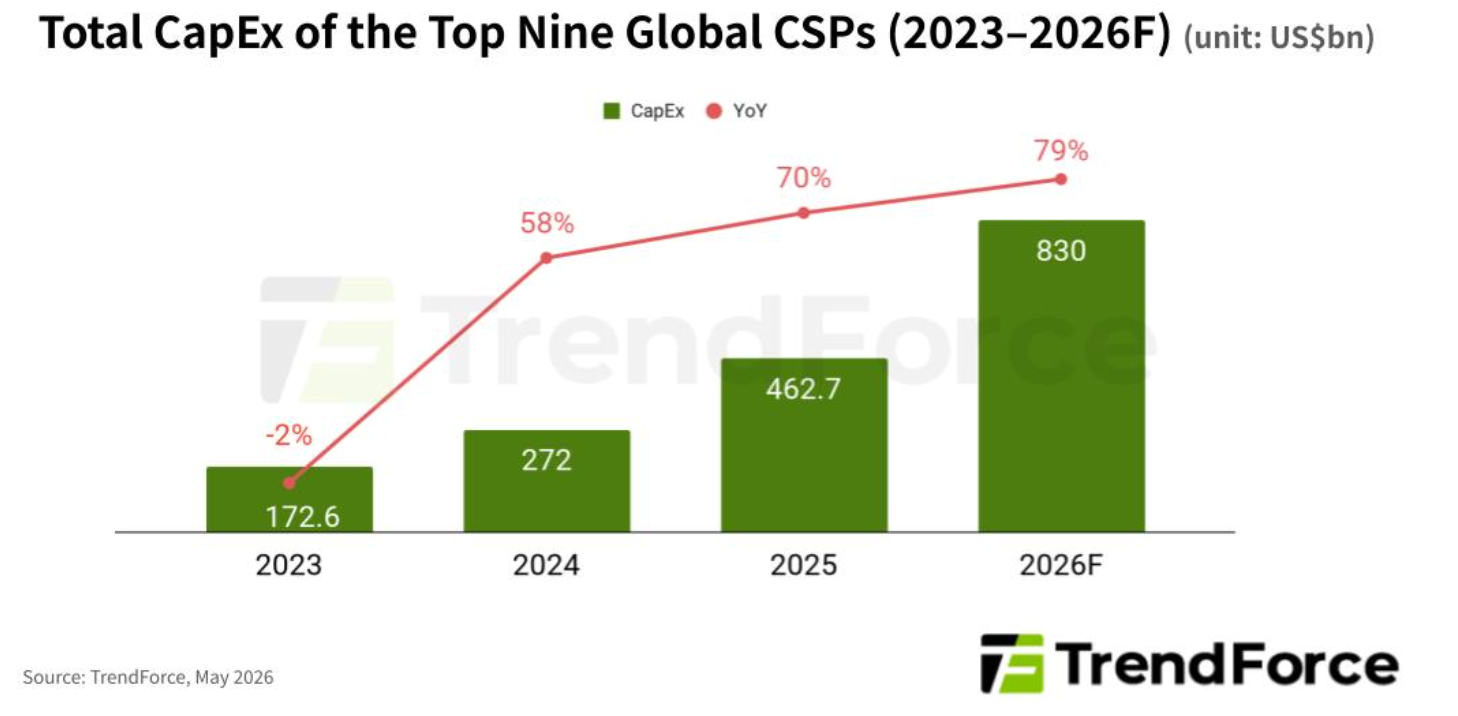
According to forecasts released by TrendForce in May 2026, nine major cloud service providers—Google, AWS, Meta, Microsoft, Oracle, ByteDance, Tencent, Alibaba, and Baidu—are expected to have combined capital expenditures of approximately $830 billion in 2026, a year-on-year increase of 79%. S&P Global Ratings, using different samples and statistical methods, estimates that capital expenditures for five large cloud providers—Alphabet, Amazon, Meta, Microsoft, and Oracle—will amount to about $750 billion in 2026, equivalent to 38% of their combined revenues. Both sets of figures point to the same trend: AI competition has become one of the largest capital allocation cycles in the history of global tech companies.
Source: https://www.trendforce.com/presscenter/news/20260506-13033.html
On a deeper level, the AI competition has shifted from "who can train better models" to "who can continuously provide lower-cost, larger-scale, and more stable inference capabilities for the models." Model capability remains important, but the factors that determine the upper limits of competition increasingly derive from balance sheets: financing ability, cash flow, procurement scale, supply chain control, and energy acquisition capabilities.
1.2 Semiconductor Growth is Spreading from GPUs to Entire Computing Systems
The demand for AI infrastructure originally focused on GPUs, but GPUs are not standalone products. A system capable of running large model training and inference requires the synchronized operation of computing chips, HBM, advanced packaging, high-speed networks, storage, servers, power supplies, and cooling systems. Insufficient supply in any single element may limit the delivery of the entire system.
Gartner predicts that global semiconductor revenue will reach $1.3202 trillion in 2026, a 64% year-on-year growth, marking the highest growth rate in the past twenty years. Among this, revenue from memory chips is expected to grow from $216.3 billion in 2025 to $633.3 billion in 2026; AI semiconductors are estimated to account for about 30% of global semiconductor revenue. Gartner also anticipates that the annual prices of DRAM and NAND Flash may increase by 125% and 234% respectively in 2026, with meaningful price relief likely to occur only after the second half of 2027.
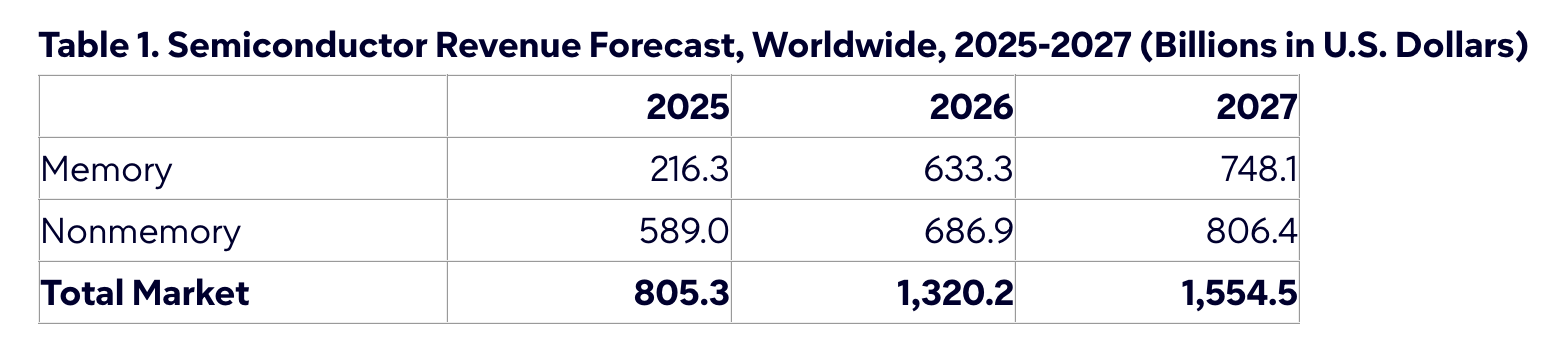
This data explains why Micron, SK hynix, and Samsung are receiving increasing market attention. As the scale of large models expands, the limitations on computing efficiency are not only the number of GPUs but also whether processors can continuously and rapidly access data. HBM, by providing higher bandwidth and lower unit energy consumption to alleviate the "memory wall," has become an irreplaceable component of AI accelerators.
TrendForce predicts that global AI server shipments will grow by over 28% year-on-year in 2026, with GPU servers still accounting for about 69.7%, while ASIC-based AI servers may rise to a share of 27.8%. This indicates that the AI chip market is not just a simple "Nvidia growth story." Google, Meta, Amazon, and Microsoft are accelerating the development of custom chips, which will continue to drive demand towards wafer foundries, HBM, packaging, and networking, and push the supply chain from a single GPU route to coexistence of GPUs and custom ASICs.
Disclaimer: This article represents only the personal views of the author and does not represent the position and views of this platform. This article is for information sharing only and does not constitute any investment advice to anyone. Any disputes between users and authors are unrelated to this platform. If the articles or images on the webpage involve infringement, please provide relevant proof of rights and identity documents and send an email to support@aicoin.com. The relevant staff of this platform will conduct an investigation.