
Is PayPal in the front, and Tempo in the back?
Written by: William M. Peaster
Translated by: Saoirse, Foresight News
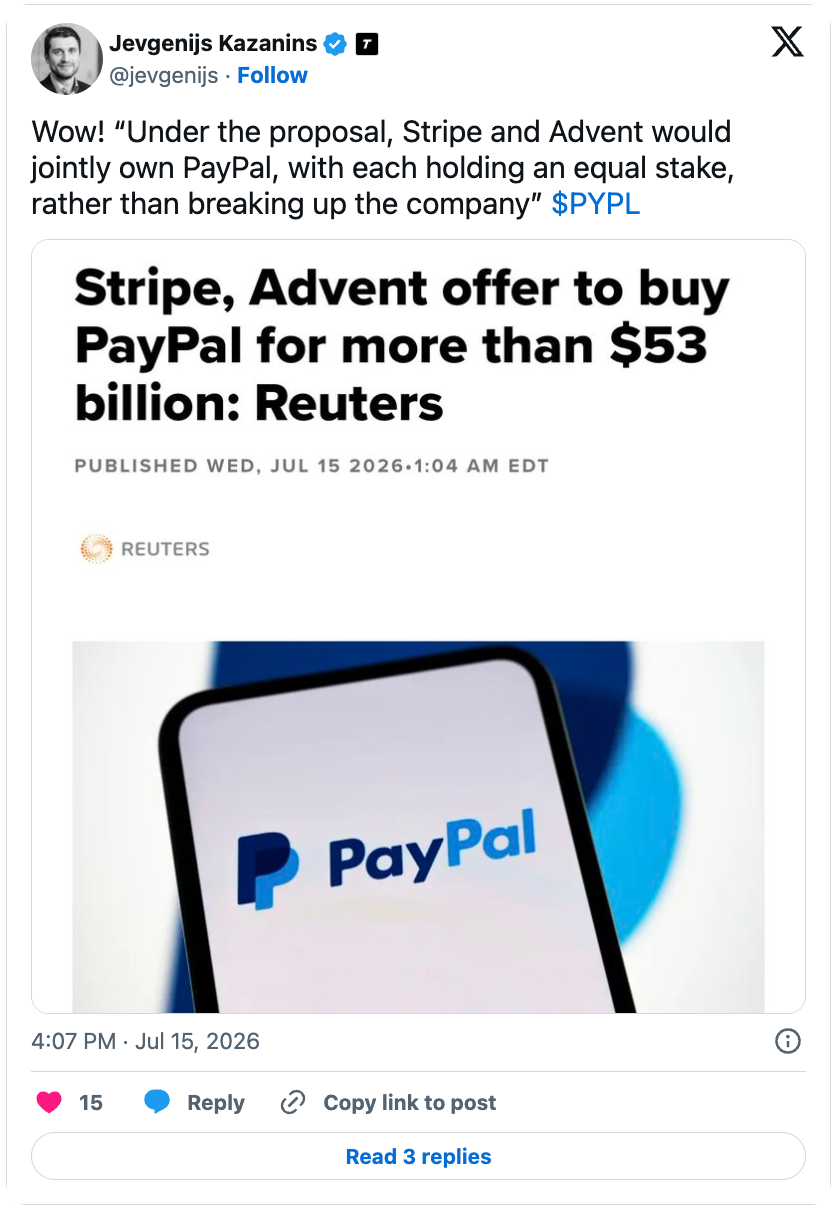
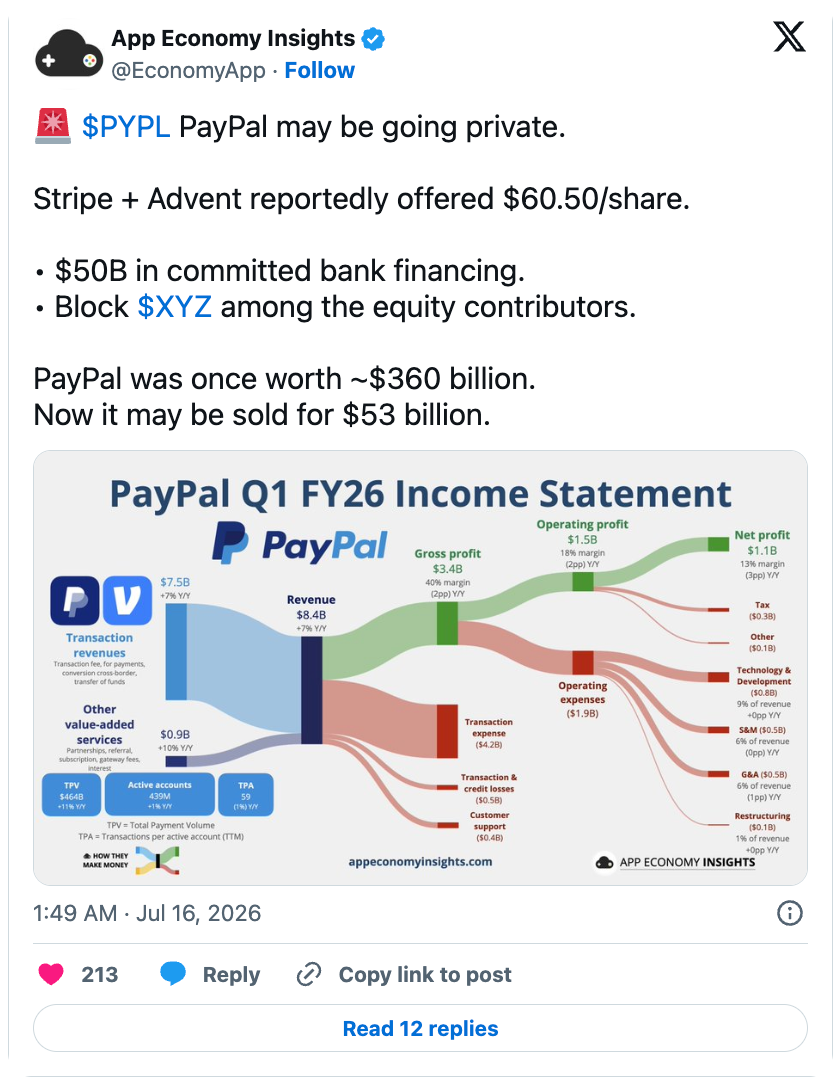
According to reports, payment giant Stripe is joining forces with private equity firm Advent International to initiate a buyout offer, with a price of $60.50 per share, totaling $53.4 billion for the deal. The PayPal board will likely meet this week to review the buyout proposal.
Currently, nothing is finalized, and it remains uncertain whether the buyout will go through. If the board does not directly reject it, they will likely request the other party to raise the offer further.
However, if the deal is successfully completed, it will become the largest fintech acquisition in history, and the implications for the cryptocurrency industry behind this deal are worth examining.
Looking back at recent years, it is not hard to find that Stripe has been quietly building a complete ecosystem of stablecoins: spending about $1.1 billion to acquire the stablecoin issuance platform Bridge; securing a leading embedded wallet service provider Privy; collaborating with Paradigm to incubate the payment-focused Layer 1 blockchain Tempo; and recently joining over a hundred companies to support the new alliance stablecoin Open USD (OUSD). This stablecoin has a unique design, planning to distribute the earnings from reserve assets to channel distributors, rather than the token issuer.
This infrastructure layout is missing only one link: end users. For a long time, Stripe has only focused on B2B business, providing underlying payment infrastructure for merchants and developers, without products aimed at ordinary consumers, nor does it have access to mass user traffic.
In contrast, PayPal holds hundreds of millions of active accounts, operates the national-level payment application Venmo, and launched its own compliant stablecoin PYUSD in 2023.
Currently, all acquisition-related news comes from Reuters citing anonymous industry insiders; Stripe has not publicly explained the core motivations behind this acquisition. However, one cannot help but wonder: could the acquisition of PayPal be aimed at securing a widespread distribution channel for its stablecoin infrastructure, making this one of the core motivations for the acquisition?
At present, stablecoins have become the ace application of the cryptocurrency industry, leading to an arms race in infrastructure development. Projects like Tempo, Arc from Circle, and Plasma have all entered the fray. Previously, it was widely accepted that whoever had a stronger underlying payment channel performance would seize market share. However, Stripe's acquisition move conveys a completely different industry judgment: the construction of underlying payment channels has become increasingly refined, and the main competitive battlefield has shifted to user-facing traffic entry points.
Let us imagine the business closed loop that would form after the acquisition is completed: Stripe connecting to the merchant side, PayPal and Venmo reaching vast consumers, and adding a stablecoin clearing layer, thus creating a complete fund circulation link. Funds could flow directly from the user wallet to the merchant, entirely bypassing card clearing networks like Visa and Mastercard, saving high fees, while the presence of stablecoins would further reduce overall clearing costs, achieving vertical integration across the entire industry chain.
However, this merger still faces numerous unresolved issues: Will the currently $2.8 billion market-cap PYUSD, issued by Paxos, migrate to the Tempo blockchain in the future? After OUSD officially launches, will PYUSD be integrated into that alliance stablecoin system? Will Venmo become a mass-market wallet exclusive to the Tempo blockchain?
Looking solely at PYUSD, its size is less than one-twentieth that of USDC issued by Circle, limiting its appeal. What truly makes this acquisition valuable is the vast user accounts holding cryptocurrency assets within the PayPal app—substantial user base, broad market coverage, and deep brand recognition comprise its core value.
Besides, even if the acquisition goes through, it might not lead to explosive growth for Tempo. Advent International will hold an equal percentage of equity, and the core of private equity management is maximizing cash flow returns. The restructured PayPal will likely be strict with costs, and cryptocurrency-related operations on-chain could be deprioritized.
There is another intriguing detail about this acquisition: Block, the company under Jack Dorsey (the parent company of Cash App and a direct competitor of Venmo), is also participating in this $17 billion equity investment. Currently, it is entirely unclear what benefits Block will gain from this move, and its future developments remain to be seen.
It is worth mentioning that as this acquisition offer comes to light, the industry is witnessing several significant changes: the rapid rise of the Robinhood blockchain, aggressively expanding into the retail user market; Coinbase's Base blockchain continuing to ramp up its global financial business; the Solana ecosystem maintaining high momentum. If Stripe successfully acquires PayPal, it will not only have a profound impact on the traditional financial industry, but if Venmo becomes the front-end entry point for Tempo targeting the public, Tempo's competitive advantage in the blockchain track will significantly improve, propelling this payment blockchain into mainstream public awareness.
This is currently the most noteworthy core clue for the entire industry, and the unfolding of this matter is quite dramatic. PayPal once set out to create a native internet currency but ended up as a middleman in the traditional bank card payment system. Now, with Stripe throwing out a $53.4 billion acquisition offer, in some respects, it aims to realize the vision that PayPal could not achieve years ago through a cryptocurrency stablecoin payment system.
Of course, this acquisition could entirely fall through next week; it could also pass approval after a price increase. But regardless of the final outcome, this acquisition offer alone is enough to glimpse Stripe's long-term plans, and this layout will significantly change Tempo's payment blockchain future development prospects.
So, is the front-end reliant on PayPal and the back-end on Tempo? The answer can only be left to time. Regardless of the success or failure of the acquisition, Stripe's continuous strategic moves indicate that its stablecoin business empire has only just begun.
Disclaimer: This article represents only the personal views of the author and does not represent the position and views of this platform. This article is for information sharing only and does not constitute any investment advice to anyone. Any disputes between users and authors are unrelated to this platform. If the articles or images on the webpage involve infringement, please provide relevant proof of rights and identity documents and send an email to support@aicoin.com. The relevant staff of this platform will conduct an investigation.