
The endpoint of Web3 Neobank is hard to be just a more user-friendly wallet or a cheaper card.
Written by: Duck TATAYA
Bank the Unbanked, the initial promise of financial inclusion
“Bank the Unbanked” was once one of the most ethical slogans in the fintech industry. Its promise was not to shrink bank branches into a more attractive mobile application, but to provide those excluded by geography, income, identification documents, credit history, and cross-border costs with an account where they could receive payments, make payments, and store value for the first time. At that stage, accounts themselves were scarce: without an account, salaries, remittances, savings, and credit would struggle to enter the formal financial system.Neobank (digital banks) originally aimed to lower the barriers to access financial services, rather than increase the number of financial products.
Let's summarize the story of early Neobanks; they primarily did three things: moving account opening from physical locations to mobile devices, making obscure account fees more transparent, and integrating cards, currency exchange, and cross-border remittances into one interface. The paths of well-known companies in the industry, such as Revolut, Nubank, and Chime, differ; some later obtained banking licenses, while others continued to rely on partner banks, but they collectively achieved a distribution revolution. By the end of 2025, this revolution has solidified real account relationships: Revolut's annual report disclosed 68.3 million retail customers, although this is not based on active user criteria; Nubank disclosed 131 million customers in documents submitted to the U.S. Securities and Exchange Commission (SEC), along with a reported 83.4% monthly active rate; Chime revealed that the number of active members who had funds move in the latest calendar month reached 9.5 million. These three figures together indicate that account experience, service speed, and fee transparency are no longer just product packaging, but can translate into sustained financial competitiveness.

Then Web3 posed this question in another way. Today's Neobank accounts no longer contain only fiat currency balances; they might simultaneously present stablecoins, self-custody wallets, crypto cards, fiat on/off-ramps, cross-chain exchanges, decentralized finance (DeFi), and real-world asset (RWA) yields.Funds seem to be able to move seamlessly between banks, cards, and blockchains around the clock, with more financial gateways than ever before. However, with more gateways, another issue becomes harder to avoid: do more gateways truly mean more financial rights, or do they imply users need to take on more custody, contract, liquidity, and partner risks that they might not fully understand?
Does Web3 Neobank continue the mission to Bank the Unbanked, or does it simply repackage banks, cards, wallets, and yield protocols into a one-stop interface? The judgment cannot stop at the menu of functions. Who receives services not available in the past? Where do fees and yields come from? When accounts are frozen, card payments fail, partners withdraw, or on-chain protocols pause, who can explain and assume responsibility? Inclusive access is just the first step. The ability to reorganize dispersed rights, rules, and remedies will determine whether it is closer to financial infrastructure or just a patchwork interface.
What Neobank has changed from bank accounts to on-chain accounts
Understanding bank accounts cannot avoid the balance sheet. Banks accept deposits, issue loans, and participate in settlements, maintaining capital buffers between credit creation, term mismatches, and liquidity management; regulations, deposit guarantees, and disposal mechanisms define what users can claim after risks occur and what banks must undertake. From a legal and accounting perspective, account balances are not just cash locked in a vault but represent the user's claim against the bank and are also a liability on the bank's balance sheet. Mobile apps can display balances, but cannot acquire the ability to accept deposits, configure credit, and absorb losses just by having a screen.
The first thing traditional Neobanks moved was the counter, not the vault. Licensed digital banks can operate deposit and loan services close to banks through digital channels;Banking as a Service (BaaS) or partner-bank type Neobanks hand over account, card, and payment experiences to users, leaving licensing, clearing, and some risk responsibilities with partner banks, issuing institutions, or payment entities. Chime explicitly stated that it is not a bank, and that banking services are provided by partner banks, which is the most direct example of this structure. The two types of products appear to be “light,” but their sources of light are entirely different. For users, branding, interfaces, and customer service channels may belong to the same company, while fund custody, card issuance, and dispute handling may correspond to three different contracts. Neobanks have not made banking responsibilities disappear; they have just hidden those responsibilities in a smoother backend experience.
Building on this foundation, Web3 Neobanks make accounts “broader.” Stablecoins bring part of the dollar liquidity on-chain, wallets allow users or smart contracts to directly control assets, fiat on/off-ramps connect fiat entry and exit points, DeFi and RWA provide new funding allocation paths, and cross-chain routing helps the same amount of money find settlement and liquidity across different networks. Its advantages lie in composability; payments, exchanges, and yields can be continuously called upon;its problems also lie in composability; for every additional layer of protocol, custody, or liquidity source added, a new control point and failure point is introduced.On-chain accounts connect more assets, but this does not automatically generate bank capital, deposit guarantees, and unified consumer protections.
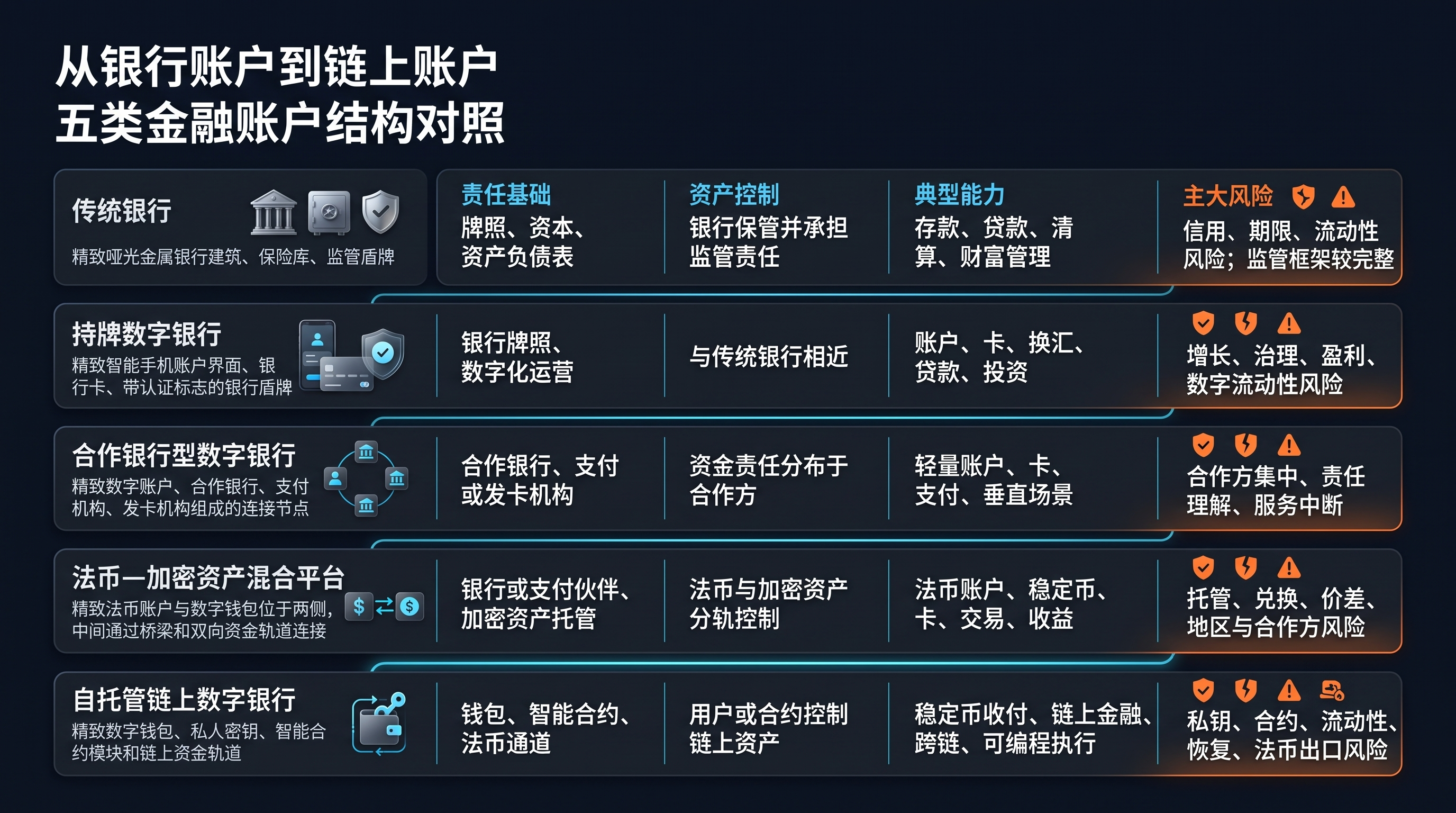
Identical $1 appearances do not mean users hold the same type of money. Revolut reported a total customer balance of £50.183 billion in its 2025 annual report. Bank deposits, dollars in partner accounts, stablecoins held by the platform, and USDC in users' wallets correspond to different issuers, redemption paths, freezing powers, deposit guarantees, and default risks. One side has stronger self-management, around-the-clock settlements, and composability, while the other side features more mature risk absorption and remediation mechanisms. The two aspects may not inherently distinguish themselves but cannot be confused just because they share the same dollar symbol. On-chain accounts do not equate to bank accounts; while balances may be similar, the rights to claim and the risk bearers may be completely different.
Who do you serve, what do you serve: the real users of Neobank
“Whether one has a bank account” is not a black-and-white question.Users who have been unbanked may not even possess stable accounts and identity entries; underbanked users already have accounts but are still hindered by cross-border fees, currency types, account opening locations, timing of deposits, and product availability from effective services.Just because a person nominally owns a bank account does not mean they can receive overseas income at low cost; a company holding dollars does not guarantee it can smoothly pay global suppliers. Financial inclusion cannot merely count how many accounts have been opened, but must assess if these accounts can continuously help users complete payments, receive payments, and store value, and provide remedies when failures occur.
When banks, cards, and blockchains enter the same company, friction shifts from “can it transfer” to “can it complete business.”An independent developer targeting global clients may collect stablecoins via electronic invoices or payment links and then convert some funds into local fiat; a Web3 enterprise may manage bank accounts, multi-signature wallets, corporate cards, and on-chain treasuries while also requiring employees, suppliers, and finance teams to adhere to different limits and approvals; finance personnel may see a transaction on-chain represented simply by an address and transaction hash (Transaction Hash) and must revert to spreadsheets, chat records, and bank backends to complete invoices, contracts, notes, and accounting classifications. What users lack is not another button but a system that can return different financial tracks into the same business context.

A few representative paths currently illustrate that Web3 Neobank is not a homogeneous track. AllScale started from electronic billing and the company’s official announcement states that its consumer and business products have formed over 1.5 million registered wallets; Infini emphasizes enterprise payments, fiat bridging, approvals, reconciliation, and workflows for financial personnel, stating on its website that it has served over 100,000 users and supports more than 180 countries. Bitget Wallet represents a consumer wallet entry, and the company announced in July 2026 that cumulative users exceeded 100 million, with monthly active users (MAU) reaching 40 million, and issued over 150,000 cards; in the first half of 2026, card consumption amounted to $31 million, increasing by 191% compared to the second half of 2025. Reah aims to unify banks, cards, wallets, Treasuries, and Agents under a single control layer, with its official website claiming its service capabilities cover 150 countries. Thus, the four paths have been distinguished: some compete for gateways, some engage in vertical workflows, while others aim to control the rules among all tracks, varying strategies yet all thriving.
However, financial management is not a faith test that must migrate to Web3. Users with adequate local banking services, simple fund paths, a focus on deposit guarantees, no need for stablecoins, and unwillingness to take on private key and smart contract risks have no reason to change their account structure for the sake of being “more advanced.”Web3 Neobank is only valuable when complexity already exists: it does not actively add tracks but reduces the cost of cross-track operations. Stablecoins can serve as underlying liquidity; Neobanks can provide user guidance, but what determines whether users remain is still whether the platform can successfully manage payments, receipts, approvals, reconciliations, and exits.
Free is just an entry point; where do risks and costs go?
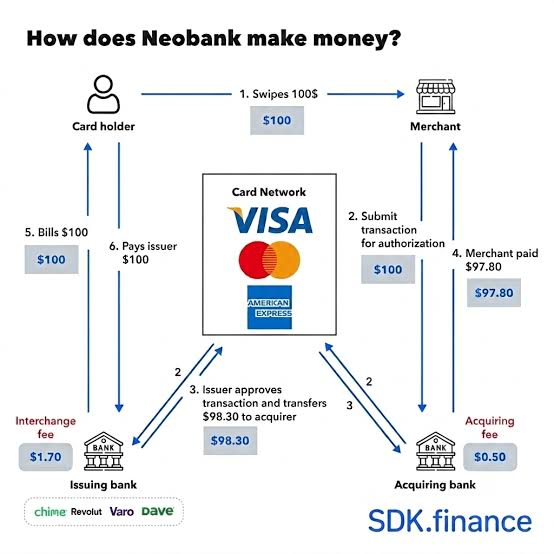
Free is a price, not a business model. Free accounts, low exchange fees, cashback, Gas (on-chain transaction fees) subsidies, and high APY (annualized yield) can lower the barrier for first-time use, but platforms still need to generate revenue from card transaction splits, payments and FX, fiat on/off-ramping, subscriptions, SaaS, APIs, Treasury services, or compensation from partners. Users may not pay at account opening but can pay for the system through spreads, fund sinking, trading behavior, or subsequent value-added services. Once scaled, these revenue sources can indeed form profits: Revolut's income reached £4.516 billion and net profit £1.305 billion in 2025; Nubank achieved a revenue of $15.775 billion and a net profit of $2.872 billion in the same year under IFRS (International Financial Reporting Standards).Charging is not in itself suspicious; what needs to be studied is whether the pricing is transparent, whether revenues align with the value delivered to users, and whether users can exit without bearing extraordinary losses.
No physical branches do not mean no costs. Chime reported revenues of $2.187 billion in 2025, yet had a GAAP (Generally Accepted Accounting Principles) net loss of about $1.010 billion; however, the same SEC document also reveals approximately $1.093 billion in equity incentives and related taxes, with the adjusted EBITDA (Earnings Before Interest, Taxes, Depreciation, and Amortization) defined by the company as positive $126.6 million. Note that these three numbers must be viewed together: net losses cannot be erased, and adjusted metrics cannot be treated as audited profits, yet reading only one will misjudge operational changes. Research has indicated that digitization can reduce some offline operational costs but will not eliminate expenses related to funding, technology, marketing, compliance, customer support, and risk management. In Web3, the backend can actually become longer: bank partners, issuing banks, payment processors, KYC/KYB, wallet security, smart contract audits, on-chain liquidity, and anomalous transaction handling all require continued payments. Regular payments may be automated, but an anomalous payment could simultaneously bring in compliance, customer service, partners, and engineering teams.The longer the cooperation chain, the more the platform must cover these not easily visible costs through scale, fee-based revenues, or workflow stickiness.
High APYs are the most attractive yet can easily skew the problem. Yields displayed on the Treasury page may stem from on-chain lending, liquidity provisioning, tokenized real assets, protocol subsidies, or third-party credit; specific yield rates, underlying strategies, fees, and available regions must be judged on each platform's product pages and terms at the time, rather than extrapolating from one company to the entire sector. If these products are simply described as “idle money generating interest,” credit, terms, liquidity, smart contract risks, and redemption risks will be compressed into one number. On-chain transparency can make some positions and trading paths easier to observe, but it cannot guarantee that underlying assets will not default, protocols will not be attacked, and liquidity will not disappear. High yields do not appear out of thin air; they are merely disassembled, packaged, transferred, and presented again through simpler account interfaces.
Therefore, stitching is not the original sin; only aggregation without orchestration is.Modern finance is inherently completed by banks, card organizations, clearing networks, payment institutions, and technology providers; the issue has never been whether there are third parties, but whether unified services can form among them. Aggregation merely places multiple gateways together, while orchestration must handle state synchronization, rule priorities, permission transfers, and failure rollbacks. The former lowers the user’s cost of finding tools, while the latter reduces the cost of completing business. Only aggregating accounts, cards, wallets, and yields while leaving ledgers, policies, and responsibilities dispersed is pseudo-stitching; the ability to unify ledgers, policies, audits, partner disclosures, anomaly handling, and recovery paths begins to approach the infrastructure.
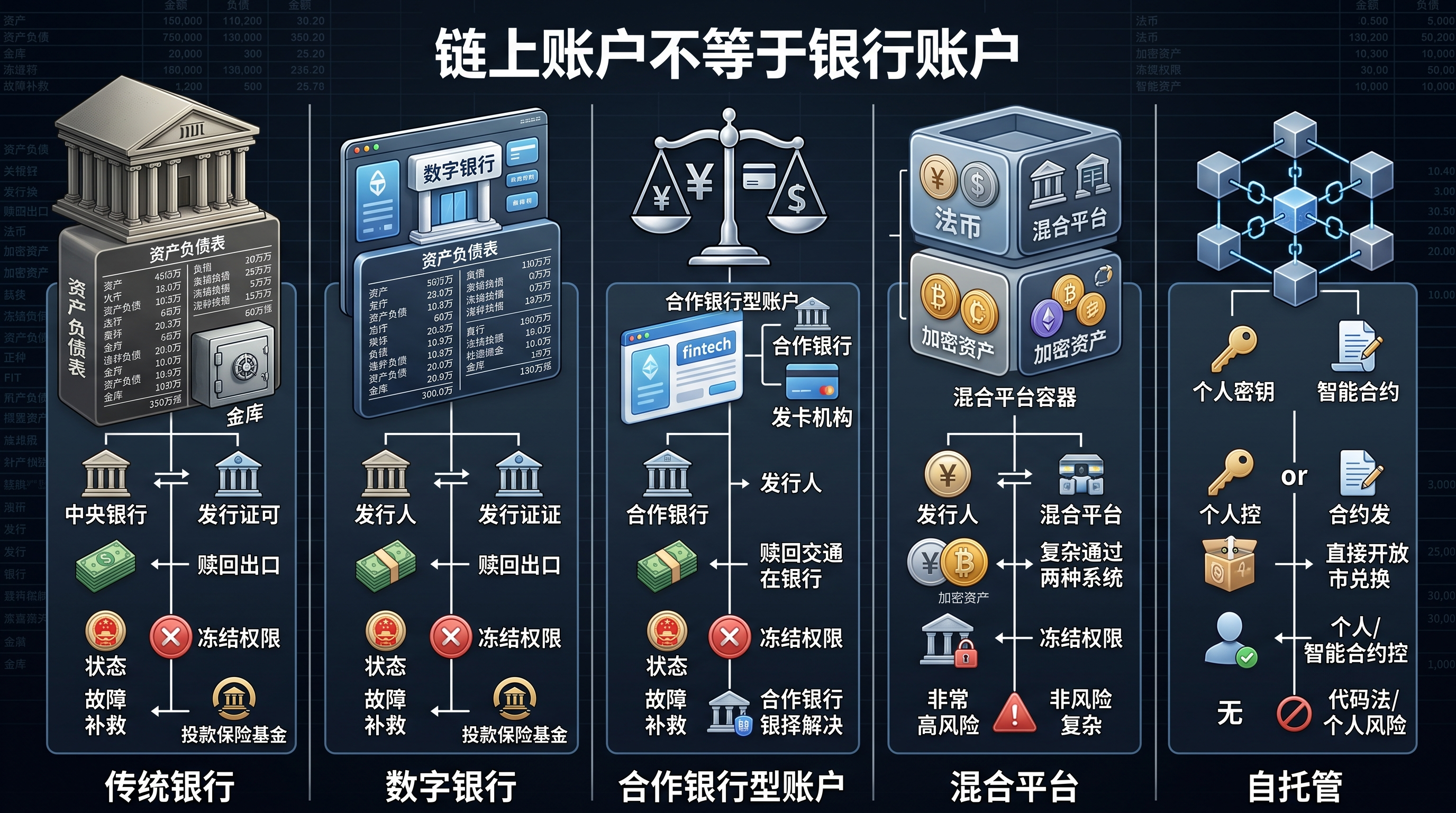
The best way to judge this boundary is not to review the feature list again, but to place the platform in a moment of failure. When a card is declined, who can pinpoint the cause? When an account is frozen, who can explain the status of the funds? When a partner withdraws, who is responsible for migration? When the on-chain protocol pauses redemptions, who explains the losses and the exit paths? When an agent makes an unauthorized payment, who can suspend, track, and remedy the situation? The platform may not bear every form of underlying loss, but it must make users aware of where the risks lie, who has control, and who to consult when issues arise. Stitching itself is not a problem. The real issue is when one link fails, who can reconnect the entire chain of responsibility.
When Agents start paying, will Neobank become more “Neo”?
Agentic Payment is not just an upgraded version of password-free payments. Ordinary automatic debits execute the fixed rules chosen by users beforehand, while Agents may represent users in searching for products, comparing conditions, selecting merchants, creating orders, and completing payments. What the system now needs to verify is not simply the account and password, but who the Agent is, who they represent, what task they are completing, and how much money, over what time frame, and how much discretionary space the user has authorized.
Neobank and Agents seem better matched not because AI has finally learned to swipe cards, but because accounts now have the potential to be read and constrained by programs.A policy engine can encode budgets, merchants, categories, times, tasks, and approval conditions into rules executable by machines; audit trails record who initiated, who approved, under what policies they were executed, and what happened in the end. Traditional card authorizations typically only answer “can it pay?”; Agent authorizations must also answer “why pay, under what conditions to continue, and when must it stop to seek human intervention.” Official materials from Reah and Rain regard limited-use cards and pre-transaction control as product directions; Infini’s website places AI Agents within expense management, reconciliations, and corporate financial operations. These materials can demonstrate what vendors are designing, but they cannot prove that Agentic Payments have been widely adopted, as all three companies have not publicly disclosed comparable Agent payment volumes, failure rates, or manual takeover data. The direction remains clear: AI does not need a new button but a machine-readable account policy.
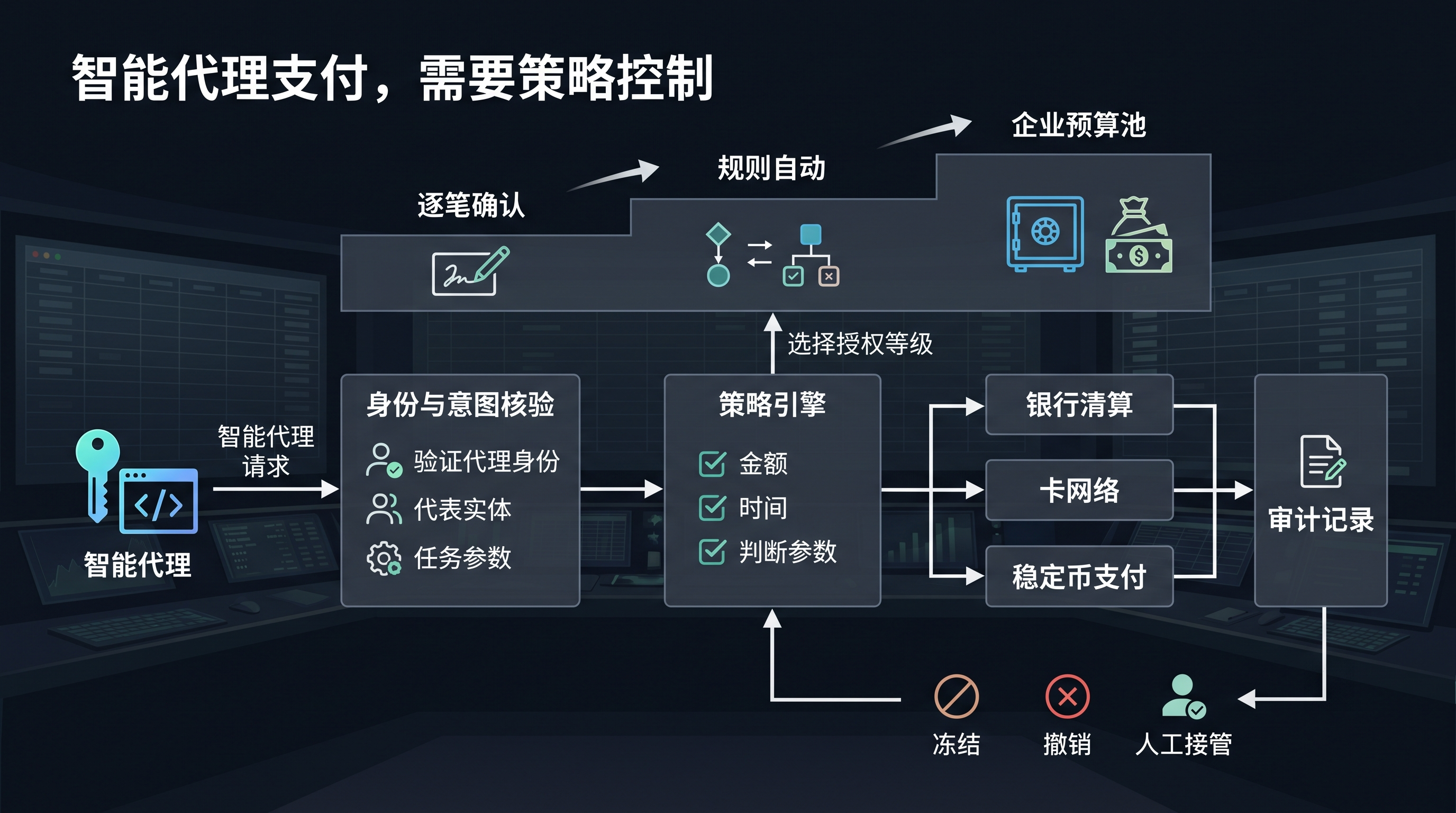
Authorization will also not directly jump from manual clicks to full autonomy. The first layer remains per-transaction confirmation, applicable for high amounts, unfamiliar merchants, and irreversible transactions; the second layer entails rule-based automatic payments that allow predictable, low-value, high-frequency tasks to be completed within fixed time and limits; the third layer represents corporate budget pools, with Agents continuing to execute under role definitions, merchant whitelists, multi-level approvals, and real-time limits. The stronger the execution capability of the Agent, the more the rules need to be observable, suspendable, and revocable. The boundaries of automation should expand with the capacity for remediation, rather than broadening with model marketing claims.
Otherwise, AI will amplify both efficiency and errors. Prompt injections can shift task goals, malicious plugins can impersonate merchants, and incorrect context can cause duplicate payments or unauthorized expenditures; refunds, chargebacks, and on-chain irreversible transactions correspond to varying responsibilities and remediation paths. A mature system requires emergency freezes, permission revocations, manual takeovers, and complete retracing, retaining stricter human thresholds for high-risk actions.What truly matches with AI is not “AI + card” but “Agent + policy-controlled account.”
Looking ahead, from yield entry points to robust financial systems
Understanding whether Web3 Neobank is mature is not enough with registered users, card numbers, transaction counts, TVL, and maximum APY. These numbers can prove that the platform was accessed but do not establish that it is already undertaking the functions of a financial system. Subsidies can create card openings, market conditions can boost TVL, and a hot event can generate transaction volume; only real businesses that occur repeatedly will turn product gateways into account relationships. More meaningful indicators include: whether real business users continue to remain, how success and anomaly rates of payments compare, the recovery time after failures, whether customer service and compliance costs are controllable, and how much of the funds movement truly undergoes the platform's policies, approvals, and audits.
The flow of funds controlled by policies is not yet an industry standard, but it pulls evaluation back to one matter: what the platform controls and what it is willing to take responsibility for.Robustness does not mean restructuring Web3 into a closed bank. It first signifies that rights and responsibilities are clear, fund locations, custody methods, and yield sources are transparent, different funding tracks can apply consistent policies, and in the case of failures there are customer service, recovery, and business continuity. Business continuity is not just about servers being online; it also includes partner changes, key recovery, account migration, dispute handling, and manual downgrades. When automated links are unavailable, businesses should still know how to retrieve funds, restore payments, and complete audits. Users can choose higher risk or more autonomous account structures, but the sources of risk, control methods, and exit conditions must be visible.
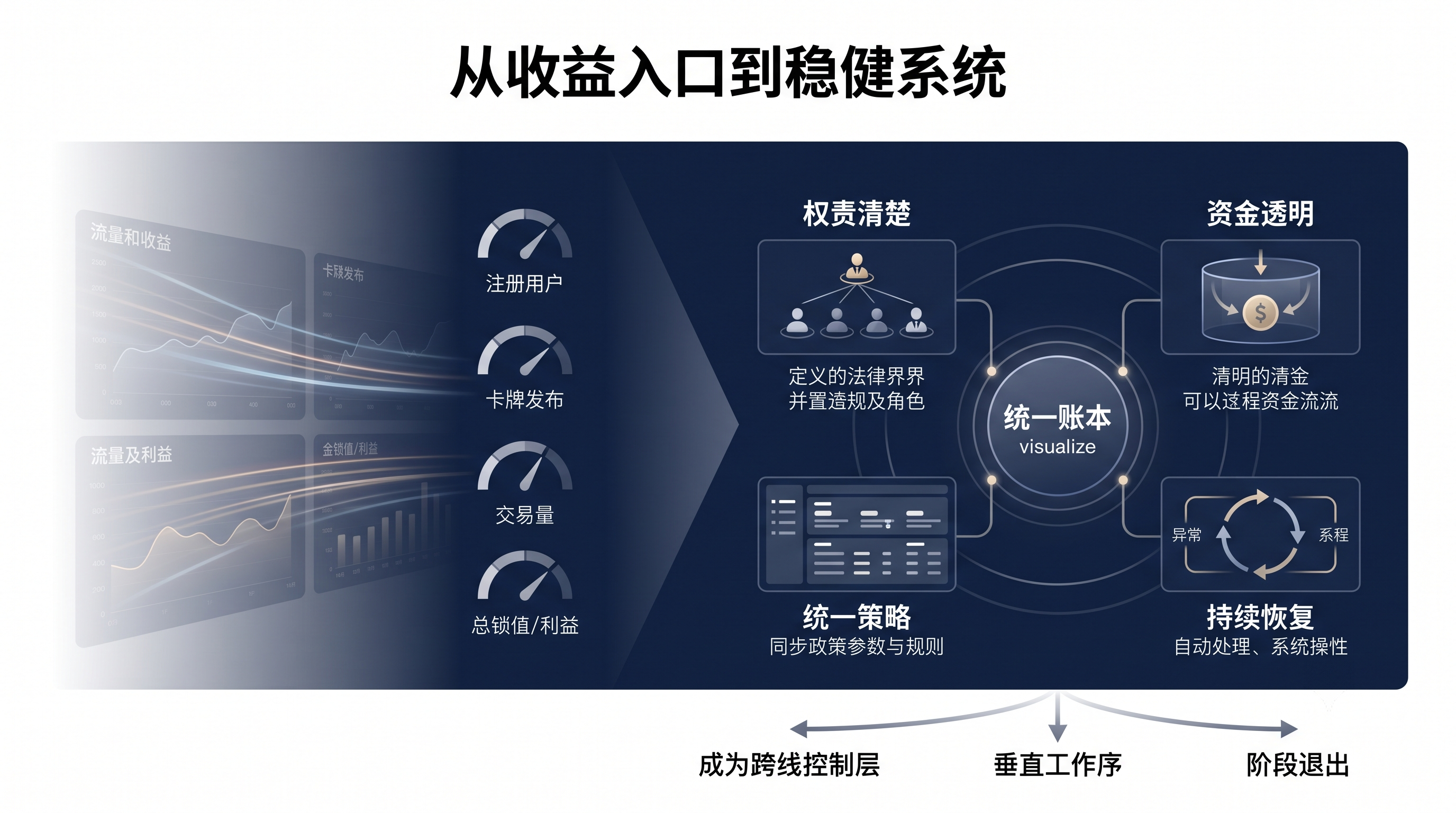
Yield and operating systems are not simply an either-or choice. Businesses can improve the efficiency of some idle funds through stablecoins, RWAs, or DeFi, but the Treasury must first resolve cash visibility, liquidity, permissions, approvals, and audits before yield enhancement takes precedence. A healthy financial system can accommodate yields but cannot rely on the highest APY to prove its own value, nor should it use yield to obscure underlying responsibilities and liquidity gaps. Low yields are not inherently safe, and RWAs and DeFi do not constitute the same category of risks. Truly mature products are those that place every type of funding configuration into an understandable, limited, and exitable framework.
It can be seen that capital is also voting with amounts, but the terminal platforms and underlying infrastructures do not receive the same pricing.AllScale disclosed $1.5 million in financing and $5 million in seed rounds in June and December 2025, respectively. Rain, which provides stablecoin payment infrastructure, completed a $250 million Series C round in 2026 with a valuation of $1.95 billion, with cumulative financing exceeding $338 million. Rain's official announcements also state that its annual transaction volume surpasses $3 billion, partnering with over 200 companies. This disparity at least indicates that capital is currently more willing to pay a premium for compliance payment tracks that can be called by multiple terminals, while terminal Web3 Neobanks are still proving whether their user base can convert into stable business. From this perspective, the endpoint of Web3 Neobank can be categorized into three scenarios: optimistically, a few platforms integrate banks, cards, stablecoins, and on-chain protocols into a trusted cross-track control layer; neutrally, most platforms stay within specific regions, specific users, or engage in electronic billing, payments, cards, Treasury, and other vertical workflows; pessimistically, platforms reliant on subsidies, vague responsibilities, and single partners will gradually exit after disruptions, risk events, or regulatory tightening. The three scenarios correspond to the same maturity criteria: it is not about providing users with more financial products, but about integrating these products into a sustainable financial order.
Stitching is not the endpoint; ensuring is the boundary
Returning to Bank the Unbanked, financial inclusion has never been merely about allowing more people to see an account, obtain a card, or first enter some yield product. True inclusion is when the services users receive can be understood, can be used long-term, can exit when necessary, and can provide explanations and remedies when failures occur. Traditional banks also face issues of high fees, slow services, and exclusion of specific users, and expanding entry still holds value in Web3;but only when trustworthy responsibility relations are established behind entry will this value solidify into institutional capabilities from product experiences.
Returning to the question, whether Web3 Neobank is new financial infrastructure or a pseudo-stitching platform does not depend on whether it relies on third parties. Merely aggregating accounts, cards, wallets, and yield products, while leaving rule conflicts and failure costs to partners and users, constitutes pseudo-stitching; the ability to unify control, recording, explanation, recovery, and remediation is what may constitute new financial infrastructure.Today, most platforms are still in the stitching phase, but stitching may be a necessary starting point for moving across financial tracks towards a unified system.The endpoint of Web3 Neobank is unlikely to be simply a more usable wallet or a cheaper card. The true boundary lies in whether the market is willing to entrust it with funds, rules, and responsibilities for the long term.
Disclaimer: This article represents only the personal views of the author and does not represent the position and views of this platform. This article is for information sharing only and does not constitute any investment advice to anyone. Any disputes between users and authors are unrelated to this platform. If the articles or images on the webpage involve infringement, please provide relevant proof of rights and identity documents and send an email to support@aicoin.com. The relevant staff of this platform will conduct an investigation.