
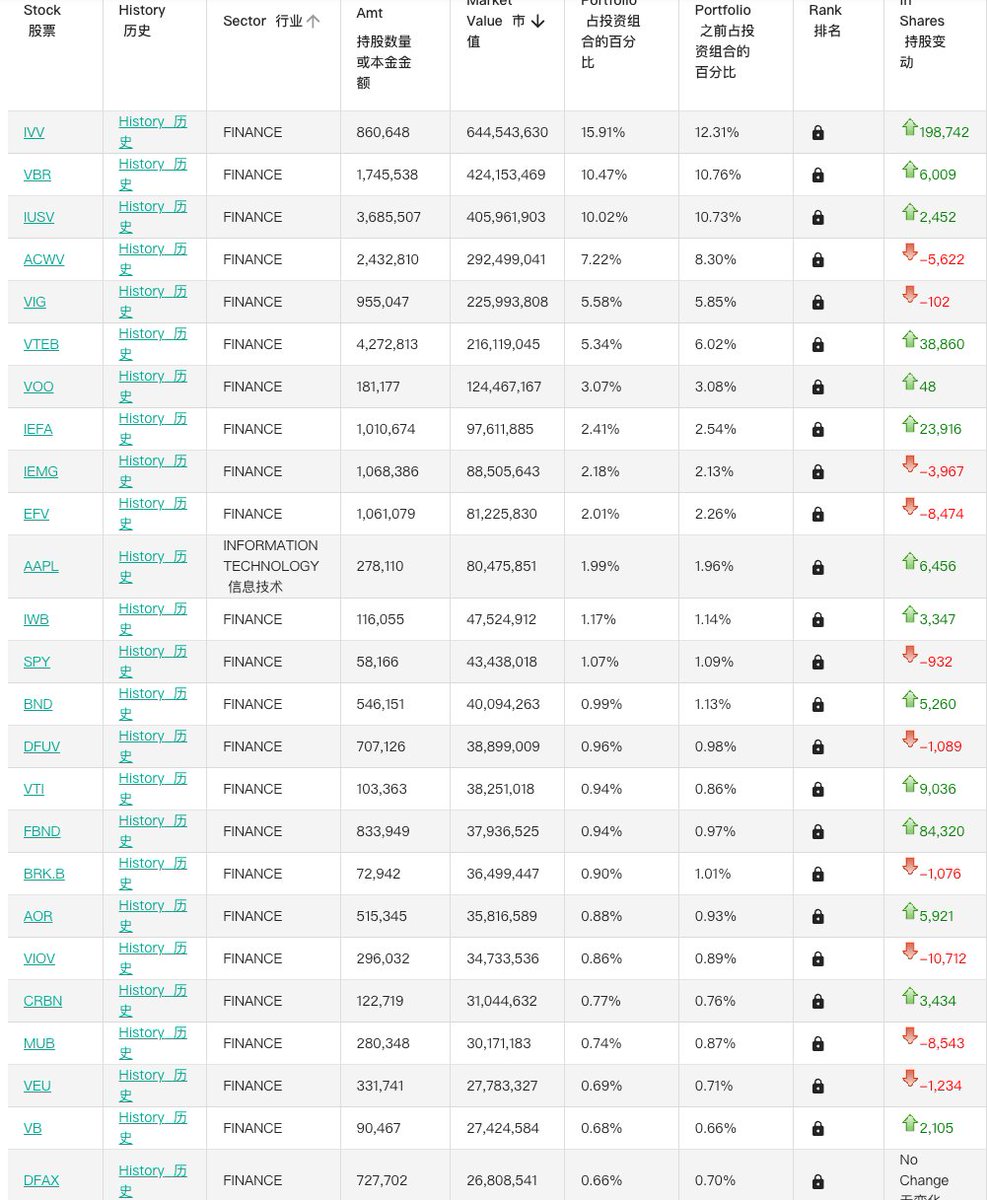
For the vast majority of retail investors, learning about the ETFs in this image is enough to greatly succeed in U.S. stocks! 🧐
This image shows the holdings of ASPIRIANT fund, which manages assets of up to 4 billion USD, with only 2,000 clients, averaging 2 million USD per person, primarily serving high-net-worth individuals and family offices.
Its asset portfolio is mainly composed of various ETFs, very worthy of study and reference, and strictly follows the 64 allocation ratio for stocks/bonds, aligning with the four quadrants investment strategy of the Merrill Lynch clock.
1️⃣ U.S. Large Cap and Core of the Entire Market
Representing assets: $IVV / $VOO / $SPY / $VTI / $IWB
Core positioning: U.S. foundational assets.
Differentiation analysis:
IVV / VOO / SPY: All track the S&P 500 index, with the top three holdings almost identical, representing the core of the U.S. stock market. SPY has the highest liquidity, suitable for options/institutional trading; IVV and VOO have lower fees, suitable for long-term buy & hold.
VTI / IWB: Includes large, mid, and small caps representing the "entire U.S. stock market." VTI includes over 3,000 companies, making it more broadly representative than the S&P 500.
2️⃣ U.S. Stock Styles and Factor Strategies
Value factors: $IUSV (Large Mid Cap Value), $DFUV (Entire Market Value), $VBR (Small Cap Value), $VIOV (S&P 600 Small Cap Value)
Logic: Inclined towards mature companies or cyclical stocks (finance, industrials, energy) with low price-to-earnings ratios and high dividends. VBR and VIOV combine small cap with value, offering high elasticity.
Dividend growth: $VIG
Logic: Filters large quality companies that have increased dividend payouts for over 10 consecutive years, with strong defensive attributes, cash flow, and high-quality financials.
Small cap core: $VB
Logic: Covers the entire U.S. small cap market, more directly influenced by macroeconomic cycles and interest rates.
3️⃣ International and Global Stocks
Developed market: $IEFA, $EFV
Logic: Concentrated in developed markets such as Europe, Japan, and Australia, usually with lower valuations than U.S. stocks and higher dividend rates.
Emerging markets: $IEMG
Logic: Covers countries like China, India, South Korea, and Brazil, where high growth and high volatility coexist.
Global entire market and active factors: $VEU (Non-U.S. entire market), $DFAX (Non-U.S. core factors), $ACWV (Global Low Volatility)
Logic: ACWV screens for low beta and low variance stocks, resulting in minimal drawdowns during bear markets; DFAX relies on academic factors (market capitalization, value, profitability) for active enhancements.
4️⃣ Bonds and Fixed Income
Comprehensive bonds: $BND (Vanguard Total U.S. Bond), $FBND (Fidelity Active Managed Aggregate Bond)
Logic: Includes government bonds, investment-grade corporate bonds, and agency mortgage-backed securities, providing stable interest income and the ability to hedge stock risks.
Muni bonds: $VTEB / $MUB
Logic: Issued by U.S. state/local governments, their interest income is typically exempt from federal income tax, making them very popular among high-income and high-tax brackets in the U.S.
5️⃣ Mixed Assets
Stock-bond mix: $AOR (iShares 60/40 Classic Growth Allocation)
Logic: A one-click global “60% stocks + 40% bonds” dynamically balanced asset allocation.
📝 Overall, the four-quadrant investment portfolio of the Merrill Lynch clock:
[Interest rate cuts / Economic recovery]: Small cap: VBR/VIOV, Bonds: BND
[High inflation / High interest rates]: Value: IUSV/EFV, Dividends: VIG
[Recession / Bear market hedging]: Defensive: ACWV/VIG, Bonds: BND/VTEB
[Bull market / Technology focus]: Core: IVV/QQQ, Bonds: BND
Here, I've added one ETF, which is QQQ. During tech bulls, QQQ performs stronger than the traditional S&P 500 ETF IVV, but the drawdown volatility may be larger too, each has its pros and cons. However, from the data perspective, IVV has risen from 102 USD to 761 USD since 2012, increasing 7.6 times. Meanwhile, QQQ has risen from 60 USD to a peak of 747 USD, increasing 12.4 times, making it more representative!
Basically, for the vast majority of people, understanding these ETFs, relying on ETFs for consistent investment, is completely sufficient for U.S. stock investment. U.S. stocks require a long-term lifelong strategy, and long-term stable compound interest will be the biggest weapon! 🧐
Disclaimer: This article represents only the personal views of the author and does not represent the position and views of this platform. This article is for information sharing only and does not constitute any investment advice to anyone. Any disputes between users and authors are unrelated to this platform. If the articles or images on the webpage involve infringement, please provide relevant proof of rights and identity documents and send an email to support@aicoin.com. The relevant staff of this platform will conduct an investigation.