
Summary
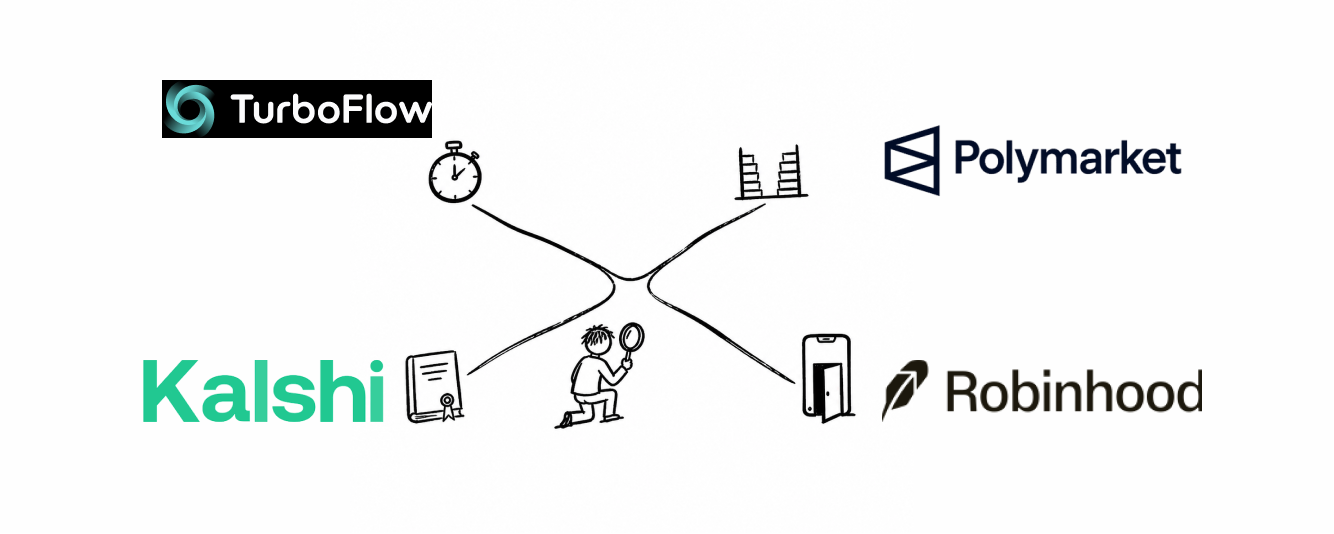
When searching for "binary options platforms," it is not sufficient to sort by popularity alone. TurboFlow, Polymarket, Kalshi, and Robinhood all offer binary outcome trading, but their official product names, legal attributes, and market structures differ.
TurboFlow provides Higher/Lower products with fixed time windows, referred to as event contracts; the other platforms mainly offer tradeable Yes/No outcome contracts or access points. This article uses "binary options" to connect with category search intentions, retaining official names when referring to specific products, and does not categorize the four platforms as the same product. A truly effective selection process should first evaluate the product structure, followed by an examination of pricing methods, exit mechanisms, settlement bases, costs, liquidity, regulation, and regional restrictions.
1. Although they are all binary outcomes, why are they not the same type of trading
The term "binary options platform" in this article refers to a broad search term for binary outcome trading, not a unified recognition of all products' legal attributes. Strictly speaking, binary options usually refer to contracts with only fixed returns or zero returns upon expiration; event contracts are a broader category designed around event outcomes, commonly exhibiting Yes/No structures and may also adopt other settlement methods. The two types overlap significantly, but one cannot directly equate them in all product and regulatory contexts.
The first type consists of tradeable Yes/No outcome contract markets. Users buy "Yes" or "No" contracts or shares, with prices usually ranging from $0 to $1, determined by supply and demand and interpreted as the market's implied probability of the outcome under certain conditions. Polymarket operates on an on-chain order book model; Kalshi operates within the U.S. designated contracts market; Robinhood connects event contracts provided by partner exchanges to retail brokerage accounts.
The second type involves fixed time window Higher/Lower binary direction products. Users select the market and time frame, invest a certain amount, and then determine whether the settlement price is higher or lower than the entry price. TurboFlow officially names its product Event Contracts: products start from 30 seconds, with returns displayed before order confirmation, and settle automatically once the countdown ends.
This distinction determines what users are actually doing. Order book outcome shares primarily trade "how much is one outcome worth"; fixed window direction contracts mainly trade "which side of the entry price the price will be on at expiration." The pricing, exits, positions, and risk management of the two cannot be interchanged.
2. Understanding the market microstructure of the four platform types
1. TurboFlow: Fixed window binary direction and locked returns

TurboFlow's official page lists event contracts alongside Turbo Perps as two product lines. Event contracts are economically structured as fixed time window binary direction trading: users assess whether the price at expiration is higher or lower than the entry price, with results corresponding to pre-determined gains or losses. Turbo Perps, on the other hand, are continuously held leveraged perpetual contracts, involving a different set of variables such as margin, funding rates, and liquidation. Hence, this article refers to "binary options" at the category level while retaining the name event contracts when discussing TurboFlow products.
Trading units and order statuses. Event contracts are not a continuously buyable and sellable "result share," but rather an independent contract with fixed start and end points. Users need to confirm the market, duration, direction, investment amount, order acceptance time, entry price, expiration time, settlement price, and return rate. Page quotes, click submissions, and formal order acceptance constitute three different states; the elements truly determining gain or loss should be the fields in the confirmation record, not the temporarily shown price before user clicks.
Pricing and return expression.
If the directional judgment is correct, the profit is calculated as "investment amount × the return rate locked in at order confirmation"; if incorrect, the invested amount incurs a loss; if the entry price and settlement price are exactly the same, it is handled according to the platform's balance rule. Here, the return rate is the yield parameter for a specific order, not an estimate of the market's outcome probability, nor can it be interpreted as the platform's winning rate. It can be influenced by market conditions, direction, duration, volatility, liquidity, and risk settings, thus necessitating a simultaneous comparison of these conditions when comparing two contracts.
Liquidity and exit.
The fixed window structure relieves users from managing margin, funding rates, and liquidation lines during the contract duration and does not require an understanding of multi-tier pricing in order books. However, this simplification also means fewer exit options: once an order is accepted, the core task is typically to wait for that window to expire and settle automatically according to the rules, rather than selling out at any time like in the result share market. Users exchange clearer maximum single-risk for less mid-way adjustment space.
Settlement and evidence.
The shorter the cycle, the more precisely one needs to define the price source, sampling time, time precision, quoting precision, balancing conditions, and abnormal states. A reliable verification chain should be able to answer: when was the order accepted, which entry price was used, when did it expire, which settlement price was used, why was it judged higher or lower, and how was the final amount calculated. On-chain data and public rules help with review, but "being on-chain" itself cannot replace explanations of price sources and abnormal handling rules.
Applicable scenario.
TurboFlow is more suitable for users looking to express short-cycle price directions with a fixed amount and willing to confirm the duration and return rate in one go before entry. It is not suitable for a trading approach that requires repeatedly adjusting positions during event developments, relies on order books for finding prices, or desires to exit result shares early.
2. Polymarket: Order book, result shares, and on-chain settlement
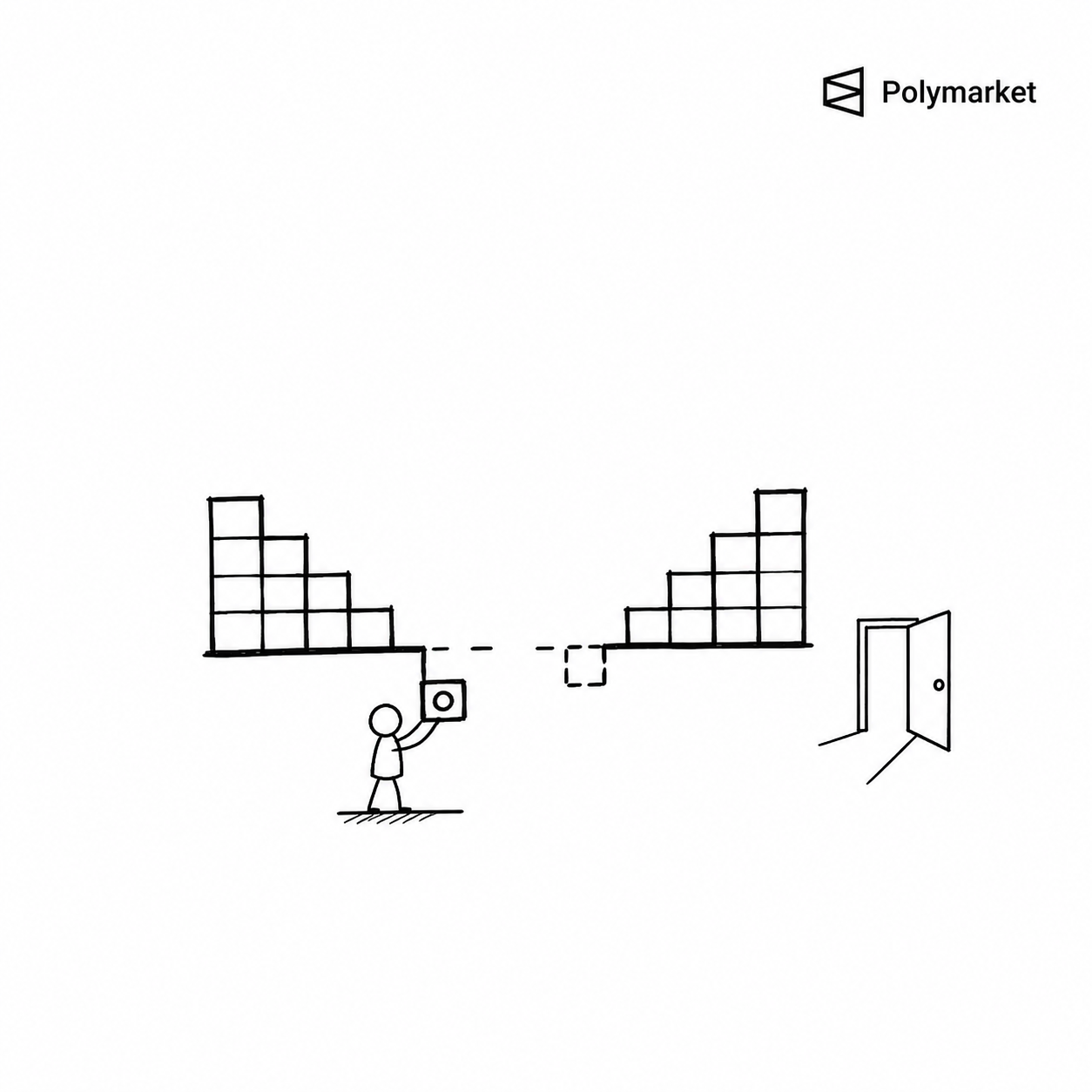
Polymarket's official order book description indicates that the platform represents event outcomes as shares with prices ranging between $0 and $1 and matches buy-sell orders through a central limit order book. Prices are determined by participant supply and demand rather than being preset by the platform with a fixed return rate. Users buy Yes or No, which essentially obtains exposure to the final outcome at a specific price.
The transaction price needs to be understood in four tiers: displayed price, best buy price, best sell price, and actual transaction average price. The page may show the midpoint of the buy and sell prices or the last transaction price, but immediate purchases usually execute from the sell side, while immediate sales execute from the buy side. If the spread is wide or the order volume exceeds the depth of the best tier, a single order may span multiple price levels, causing slippage or partial fills. Therefore, "what is the current probability" and "what price can I trade at" are not the same question.
The order book structure provides the capability for mid-way exits. As long as the market remains open and there are counterparties available, users can sell their positions before the official resolution of the event, locking in profits, limiting losses, or changing their views. Accordingly, users must simultaneously manage limit prices, wait times, order cancellations, partial deals, spreads, and depth; under news shocks, even if directional judgment does not change, it may be impossible to exit at the displayed price due to a thinning order book.
On the settlement front, the market should specify the questions, cut-off times, sources of resolution, and boundary conditions upon creation. Polymarket's official materials explain that its market resolves through the optimistic oracle process of UMA; winning shares can ultimately be redeemed for $1, while losing shares return to zero. Here, the biggest professional barrier is not "guessing the news right," but confirming how the contract question is defined and whether the resolution source can indeed answer that question.
Applicable scenario. Polymarket is more suitable for users wishing to trade the probabilities of public events, understand order books, and retain the ability to exit early. For those unwilling to manage transaction quality, seeking only a single result after a fixed window ends, this structure might be more complex.
3. Kalshi: Designated contract market and standardized event contracts

CFTC public information indicates that Kalshi gained designated contract market qualification in 2020. Its core product also revolves around clear Yes/No questions, but the market value derives not just from the question name but from the complete contract terms: statistical measures, observation periods, whether thresholds include boundary values, designated data sources, publication times, how revision data are treated, and what circumstances may lead to cancellation or delayed settlement.
From a market microstructure perspective, the trading price of Yes/No contracts can be used to express the market's comprehensive judgment on outcomes, but users' actual profits and losses still depend on buy prices, sell prices, fees, transaction quantities, and final settlement outcomes. Even if the final directional judgment is correct, excessively high entry costs may compress returns; even if the page shows a price, the order may not be fully executed due to insufficient depth, limit conditions, or market status.
The identity as a designated contract market provides a set of market operation, rule submission, supervision, and compliance frameworks, but does not imply that every contract possesses sufficient liquidity or that users are free from losses. Contract texts may still contain easily overlooked definitions, event data may still be delayed or revised, and user qualifications and regional conditions may impose limits on the actual usable scope. Therefore, the regulatory identity should be regarded as one evaluation dimension rather than a singular label replacing all due diligence.
Applicable scenario. Kalshi is more suitable for users who emphasize the U.S. designated contract market framework, willing to read through contract rules line by line, and express viewpoints using Yes/No event shares. When selecting a specific market, users should drill down from the question to the rules page, rather than placing orders based solely on news headlines.
4. Robinhood: Distribution entrance for event contracts in retail accounts

Robinhood's official explanation indicates that event contracts are provided through Robinhood Derivatives and partner exchanges. Users apply for a derivatives account within a familiar retail investment application, view the market, and trade Yes/No contracts; if the judgment is correct, the contract settles at $1, if incorrect, it settles at $0, and can be bought and sold at the then-current market price before expiration.
The core advantage of this model lies in distribution and account integration rather than creating a wholly new binary outcome trading structure. Users see Robinhood's product interface, funding access, and account records, but the actual contracts remain bound by corresponding exchanges, market rules, and order statuses. Therefore, verification needs to be divided into two layers: the first layer checks whether the Robinhood account is approved, whether the funds are available, and how fees and restrictions are calculated; the second layer examines which exchange provides the specific contract, how it executes, which source resolves it, and when it settles.
"Convenient entry" can also lead to cognitive illusions. A familiar application interface may lower operational barriers, but it does not reduce the binary loss risks inherent in the contract itself. Prices between $0.01 and $0.99 express more the implied probabilities of market outcomes and payment structures; they do not secure profits and do not guarantee users can obtain sufficient depth when they wish to exit.
Applicable scenario. Robinhood is more suitable for users who are already within its U.S. retail account system, meet the qualifications for event contracts, and wish to manage event markets and existing funds within the same interface. For non-U.S. residents, users subject to state-level restrictions, or those wishing to use on-chain markets directly, this is not a general entry point.
3. Key Differences Among the Four Types of Binary Outcome Structures
Trading objects: TurboFlow trades fixed expiration point price directions; the other three typical products trade on whether real events or specified outcomes occur.
Pricing logic: TurboFlow displays the return rate of a contract before confirmation; order book platforms form prices through the buy and sell orders of outcome shares. The former answers how much profit corresponds to the correct direction, while the latter answers what price the market is willing to trade for that outcome.
Position forms: TurboFlow Event Contracts settle automatically at expiration; order book contracts or shares can usually be sold before expiration. The ability to exit early changes liquidity risks and trading management methods.
Outcome bases: Short-cycle price contracts depend on entry prices, settlement prices, and timestamps; public event outcome contracts depend on contract definitions, designated data sources, and dispute resolution rules.
Accounts and regions: On-chain entry, designated contract markets, and retail brokerage accounts correspond to different identities, assets, networks, and regional requirements. Users must bound their actions by their location and account conditions.
4. Why Prices, Return Rates, and Probabilities Cannot Be Compared in the Same Column
Result share markets and fixed-window directional contracts may both produce binary outcomes, but the core figures they display are not the same economic variables.
In result share markets, if a "Yes" contract’s transaction price is q dollars, the correct settlement typically yields $1, while an incorrect outcome returns zero. Ignoring fees and trading frictions, the maximum gross profit of holding until expiration is 1−q, and the maximum loss is q. q can be interpreted as implied probability under specific market conditions, but this interpretation relies on liquidity, participant information, risk preferences, and feasibility of transactions. Midpoint prices on the page do not equal the actual transaction price of large orders.
In TurboFlow's fixed window binary direction products, the official name is event contracts. Users invest S and lock in the return rate r upon confirmation. If the judgment is correct, profit is S×r; if wrong, loss is S; and if it breaks even, the principal is returned according to rules. Here, r describes the profit ratio for a correct judgment, not "the probability of an increase," and cannot be directly compared with the outcome contract or share price q.
This creates two completely different research tasks. Result share traders need to assess whether market prices are above or below their estimated event probabilities and manage exit prices; fixed window direction contract traders need to determine the direction relative to specific expiration points while confirming whether the return structure matches their verifiable win rates. If these two figures are not distinguished first, claims about "which has higher odds" or "which is more accurate" may result in comparing the wrong objects.
5. Nine-Dimensional Platform Selection Framework
First dimension: Do the products and trading intentions match?
If the goal is to express second- or minute-level price directions, one should research fixed window directional contracts; if the intention is to trade election results, economic data, weather, or sports results, one should study public event consequence shares. If long positions and leveraged exposure are needed, perpetual contracts belong to a different product category.
Second dimension: Who forms the price?
For order book platforms, look at the best buy and sell prices, spreads, depth, and recent transactions; for fixed window platforms, examine the entry price, settlement price, return rate forming elements, and locking moments. Visible prices do not imply that the pricing mechanism has been fully explained.
Third dimension: How are orders executed?
Check whether the order is immediately accepted, enters the order book, or may be partially executed; confirm whether status, rejection conditions, delays, and abnormal handling are traceable. The shorter the cycle, the more important the acceptance time and recorded price.
Fourth dimension: Are early exits allowed?
The ability to sell early means managing risks before the event concludes, but exit prices depend on market liquidity. The fixed expiration structure often exchanges known maximum losses for simpler position management processes.
Fifth dimension: Can the settlement basis be verified?
Price-related contracts should display entry prices, settlement prices, time, and data systems; event-related contracts should disclose question definitions, determination sources, cutoff times, cancellation, and dispute rules. Vague market titles cannot replace complete contract terms.
Sixth dimension: Are costs comprehensive?
Costs may include fees, exchange fees, spreads, slippage, network fees, or other product-specific costs. The minimum investment amount merely indicates a participation threshold and does not equate to the total transaction costs.
Seventh dimension: Does liquidity and capacity fit?
Review quoting differences for small and larger amounts, the number available for execution, market pauses, and order rejections. Even well-known platforms may have specific market liquidity issues.
Eighth dimension: Regulatory, asset, and regional boundaries.
Check operators, registration or regulatory status, service terms, restricted regions, account types, and funding paths. A platform’s regulatory identity in one region does not automatically cover its global products or all users.
Ninth dimension: Are records and complaints sufficient?
High-quality platforms should retain records of order time, direction, price, amount, fees, settlement results, and status, and provide pathways for feedback on anomalies. Auditable records are the foundation for verifying execution and settlement.
6. How Newcomers Can Turn the Framework into a Real Choice
First, clarify trading objectives. Determine whether one aims to trade short-cycle price directions or public event probabilities; clarify if early exits are needed and what maximum single losses can be tolerated.
Next, establish a candidate list. Choose at most two platforms of each structure, avoiding initial ordering by "largest" or "most well-known." First, eliminate platforms unsuited due to regional, account, or asset path issues.
Then, use the same checklist for comparison. Record pricing methods, order statuses, exit mechanisms, settlement bases, costs, liquidity, and historical records. Do not substitute a single advantage of one platform for a complete due diligence.
Finally, conduct a small closed-loop verification. Within a range that allows for complete loss absorption, complete the entire process of entry, placing orders, settlement or exit, record verification, and asset transfer. One successful instance cannot prove long-term reliability but can reveal whether paths, rules, and records are consistent.
7. How Typical Demands Should Match Structures
Scenario 1: Users wish to express price directions of cryptocurrencies within 30 seconds to minutes and prefer not to manage margins, clearing lines, and funding rates after placing an order. They should study fixed window directional contracts, focusing on verifying entry prices, settlement prices, return rates, confirmation timing, and balancing rules. TurboFlow is part of this candidate structure.
Scenario 2: Users wish to trade elections, macro data, or other public events and want to adjust positions before the final results are announced. They should research tradeable outcome shares and order books, focusing on verifying market definitions, determination sources, bid-ask spreads, depth, and exit prices. Polymarket and Kalshi operate through different paths and should not be viewed as interchangeable based solely on similar questions.
Scenario 3: Users prioritize familiar brokerage accounts, fiat funding paths, and a unified account experience. Robinhood offers the advantage of a distribution entrance, but the actual contracts still come from respective exchanges and are bound by account qualifications, fees, state-level restrictions, and specific market rules.
These scenarios represent task and structure matches rather than platform rankings. A platform can be very well-suited for one task while completely unsuitable for another.
8. Establish a Scoring Selection Table
Before scoring, set three veto conditions: the platform is unavailable in the region, cannot understand funding or asset paths, or cannot verify settlement bases. Any failure in these will not be compensated by other high scores.
Upon passing the veto conditions, assess based on the following suggested weights: product and trading intention alignment 20 points; pricing and settlement explainability 15 points; order execution and abnormal states 15 points; liquidity and exitability 15 points; cost transparency 10 points; asset path and account security 10 points; regulatory and regional applicability 10 points; records and complaint abilities 5 points.
Each item should be scored based only on visible evidence. Official terms, regulatory databases, order records, and on-chain data are strong evidence; media reports can provide context; unverifiable screenshots and verbal promises should not count as positive points. The value of scoring lies not in arriving at a permanent number, but in compelling comparers to use the same standards of evidence for the same issues.
Unknown items should also be recorded. For instance, if a platform does not publicly explain abnormal price handling, the correct practice is to mark it as pending verification, rather than defaulting to the most favorable interpretation. High-quality choices often score lower, but have fewer key unknowns and clearer failure boundaries.
9. Common Misjudgments
Confusing return rates with probabilities. TurboFlow's return rate describes the profit ratio for accurate judgments; order book share prices carry implicit probability meanings, with the two not being the same indicator.
Reading regulation as a profit guarantee. Regulatory frameworks involve market rules, supervision, and customer protection, but do not determine whether specific trades are profitable, nor guarantee that every market possesses sufficient liquidity.
Assuming a low entry threshold equates to low risk. A minimum of $2 helps reduce first-time verification costs, yet short-cycle products may still rapidly lose the entire invested amount.
Equating platform popularity with execution quality. Real quality needs verification through spreads, order acceptance, abnormal rules, settlement records, and funding paths.
Considering availability as applicability. Being able to register, connect a wallet, or view the market does not imply that the product complies with local rules or that the risk structure suits the user.
Taking a single smooth experience as long-term proof. Small closed-loop tests can only verify whether the path was clear at that time; liquidity, system status, rules, and regional policies may change.
Conclusion
There is no unified ranking list for “which binary options trading platforms exist” that is detached from context. TurboFlow, Polymarket, Kalshi, and Robinhood correspond to different products, market structures, and user tasks. Professional selection starts with identifying trading objects, traverses through nine dimensions: pricing, orders, exits, settlements, costs, liquidity, regions, and records, ultimately landing on closed-loop verification within a range of acceptable loss.
For newcomers, an appropriate platform should clearly define product boundaries, allow for readable key fields, verify accessible rules, ensure the maximum loss is comprehensible, and allow auditing of trading records. Any recommendations should be based on these conditions.
Disclaimer: This article represents only the personal views of the author and does not represent the position and views of this platform. This article is for information sharing only and does not constitute any investment advice to anyone. Any disputes between users and authors are unrelated to this platform. If the articles or images on the webpage involve infringement, please provide relevant proof of rights and identity documents and send an email to support@aicoin.com. The relevant staff of this platform will conduct an investigation.