
Written by: Xiaobing
On August 14, the SEC announced that it has officially accepted the rule change application (No. SR-CboeBZX-2026-065) submitted by Cboe BZX Exchange, which concerns the listing and trading of a batch of 3x leveraged commodity ETFs, including 3x Bitcoin ETFs and 3x Ethereum ETFs.
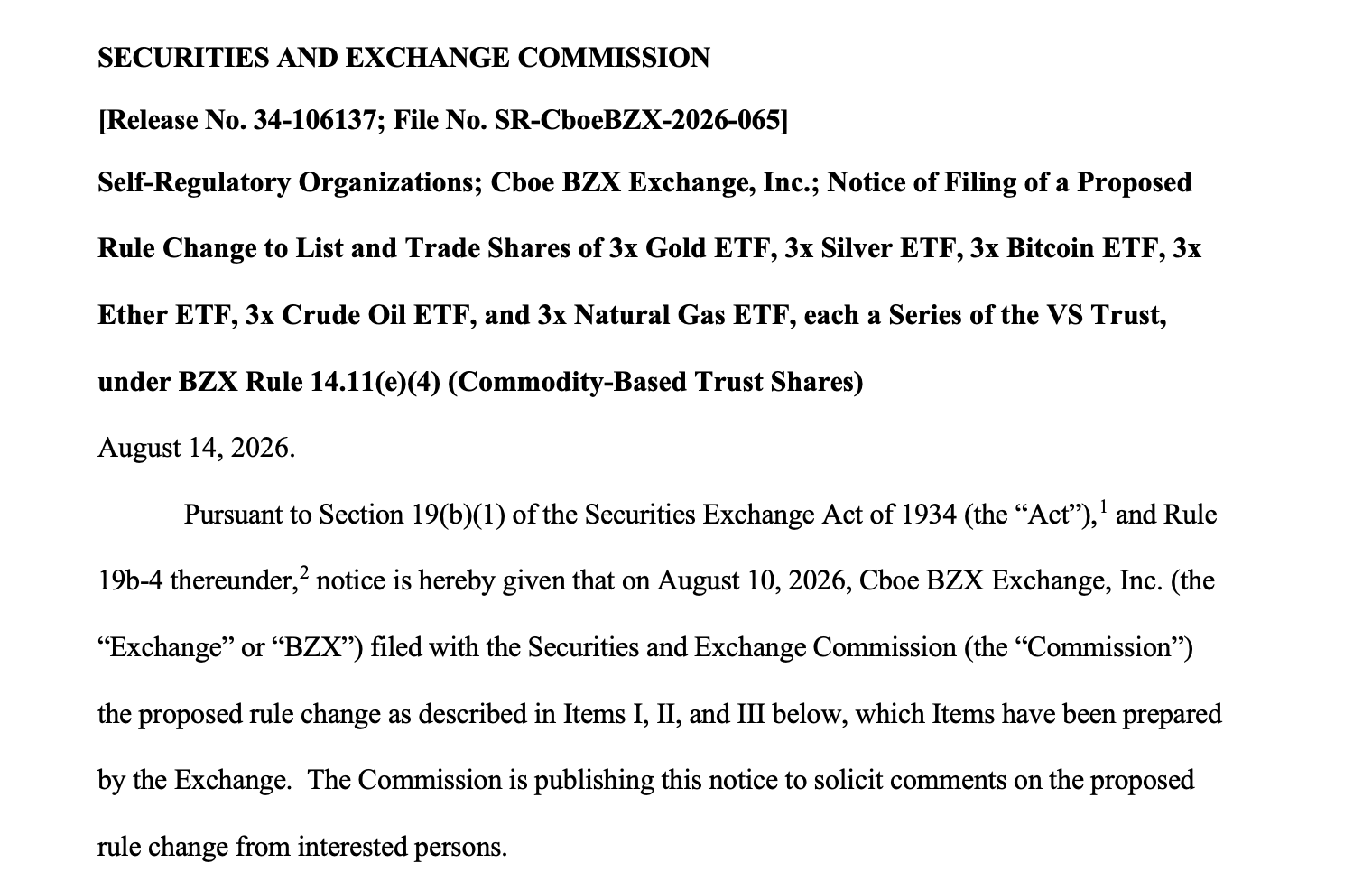
The applicant, Volatility Shares LLC, is already operating 2x Bitcoin and Ethereum strategy ETFs in the U.S. market, with real trading records. Cboe cited a data point in its application: Currently, about 67 products of 3x or inverse 3x leveraged ETP are listed on U.S. national securities exchanges. In other words, 3x leveraged ETFs already exist in the stock and commodity markets; cryptocurrencies are the last piece of the puzzle.
The SEC will make a decision to approve or deny within 45 days, or initiate the longest 90-day extension review.
The most dangerous high-leverage trading in the crypto market is shifting from offshore perpetual contract exchanges into U.S. regular securities accounts.
How does this ETF actually operate?
First, let's look at the structure.
The goal of the 3x Bitcoin ETF is to achieve a daily investment return that is three times the performance of Bitcoin on that day, before fees. If Bitcoin rises by 2% on a given day, the fund aims to rise by 6%; if Bitcoin falls by 3%, the fund aims to fall by 9%.
Note the key qualifier here: "daily."
The fund does not directly hold Bitcoin. It gains exposure by holding Bitcoin futures contracts from the CME (Chicago Mercantile Exchange), primarily the near-term and next-term contracts. There is a five-day rolling window each month to roll over expiring contracts into the next month's contracts, rolling about 20% of the positions each day. Cash and cash equivalents serve as collateral for the futures positions.
Legally, this fund is a registered commodity pool, regulated by the CFTC and NFA, and is not registered under the Investment Company Act of 1940. This choice is significant because in late 2025, the SEC rejected ProShares' application for a 3x crypto ETF citing Rule 18f-4 of the 1940 Act (which limits fund leverage to no more than 200%). Volatility Shares opted to avoid this route and instead pursued the commodity pool structure.
Why "daily three times" does not equal long-term three times
This is a mathematical trap that all leveraged ETFs cannot escape, but it is magnified to the extreme with Bitcoin.
Assuming Bitcoin rises by 10% on the first day and falls by 10% on the second day. Over these two days, Bitcoin’s net value becomes: 1.10 × 0.90 = 0.99, losing 1%.
During the same period, the net value of the 3x leveraged ETF becomes: 1.30 × 0.70 = 0.91, losing 9%.
Bitcoin only lost 1%, while the 3x ETF lost 9%. The loss is nine times that of Bitcoin, far exceeding the nominal three times.
This phenomenon is called "volatility decay." Leveraged ETFs recalculate their benchmarks daily based on the day’s price fluctuations, magnifying gains when prices rise from a higher base, and magnifying losses when prices fall from a lower base. In a volatile market, even if the underlying asset eventually returns to the original point, the net value of the leveraged ETF will continue to decline.
The annualized volatility of Bitcoin typically ranges between 50%-80%, which is three to four times that of the S&P 500. The higher the volatility, the more severe the volatility decay. A 3x S&P 500 ETF already has a frightening rate of net value erosion in volatile markets; replacing the underlying with Bitcoin will cause the decay to escalate exponentially.
A simplified simulation illustrates this.
Assuming Bitcoin experiences an average daily fluctuation of ±5% within 30 days and ultimately returns to the starting point. The spot-holding investors break even. Investors holding the 3x ETF would lose approximately 20%-30% of their principal solely due to volatility decay, depending on the path and sequence of the fluctuations.
Cboe also acknowledged this point in its application. The fund's sponsor, Volatility Shares, was required to clearly warn in the prospectus: "The fund is not suitable for investors who do not plan to actively monitor and manage their portfolios."
Leverage is moving
Zooming out, what is happening is a migration of leverage.
Over the past decade, high-leverage trading in the crypto market has been concentrated in offshore exchanges: BitMEX invented perpetual contracts, and Binance and Bybit made 100x leverage standard. These products are not subject to U.S. securities laws, lack investor suitability assessments, and liquidation is commonplace.
Now, the same leverage exposure (albeit at a much lower multiple) is entering the regulated U.S. securities market in the form of ETFs. The products are now donning a compliant guise: prospectuses, exchange listing rules, CFTC oversight, and FINRA suitability requirements are all included. But the core risk-reward characteristics remain unchanged. Taking a 3x long position on an asset with an annualized volatility exceeding 50% is an aggressive trade, regardless of what the trading interface looks like.
The European market has already taken a step ahead. LeverageShares launched the world’s first 3x and inverse 3x Bitcoin and Ethereum ETPs in November 2025, listed for trading on European exchanges. Cboe cited this precedent in its application as one of the arguments for the U.S. market to follow suit.
If the SEC approves this batch of products, it is foreseeable that: more issuers will follow, with ProShares, Direxion, and GraniteShares already having applications for 3x crypto ETFs. Competition will drive down fees and diversify products; 3x SOL, 3x XRP, inverse 3x Bitcoin—each will find its audience.
The supply side of crypto leverage is being thoroughly reshaped. The previous question was "how to open a Binance account," while the future question will become "should a 3x Bitcoin ETF be included in a retirement account."
Just as everyone knows they shouldn't hold a 3x long position on Hynix for the long term, that won't stop it from becoming one of the most popular products on the market.
Disclaimer: This article represents only the personal views of the author and does not represent the position and views of this platform. This article is for information sharing only and does not constitute any investment advice to anyone. Any disputes between users and authors are unrelated to this platform. If the articles or images on the webpage involve infringement, please provide relevant proof of rights and identity documents and send an email to support@aicoin.com. The relevant staff of this platform will conduct an investigation.