
If someone told you:
Now even football, esports, F1, and even macro data can be “traded”.
Your first reaction might be:
Isn’t that gambling?
But if you look at it from another angle, you might find that it is not as far from the BTC trading we do every day as we think.
Trading BTC is essentially about judging: Will the future price rise or fall?
Predicting a football match is essentially about judging: Which team has a higher probability of winning in the future?
Predicting a League of Legends match becomes : What is the probability that this team will win the match?
It seems one is the financial market and the other is a sports event.
But what they are really trading in is actually:
Judgment of the future.
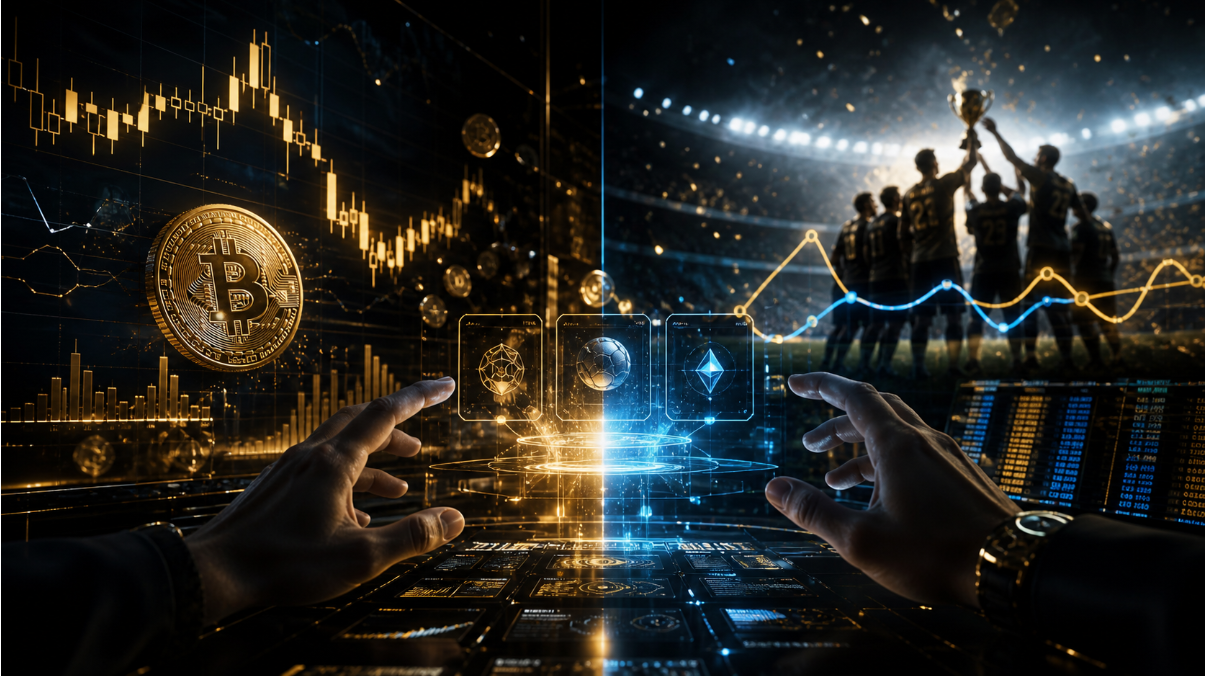
You think you are guessing the match, but you are actually comparing probabilities with the market.
Suppose before a match starts, the market gives the result as:
Team A winning probability: 60%
At this moment, an ordinary spectator might just ask: “Will Team A win?”
But a trader's thinking might be completely different.
What he really wants to ask is: “Does Team A really have a 60% win rate?”
If you research both teams' recent form, lineups, injuries, historical encounters, and version environment, and you believe Team A's real win rate is only 45%.
Then the problem arises.
You are not simply thinking: Team A will lose.
Instead, you believe: The market may have overestimated Team A.
Conversely, if the market only gives Team A a 40% probability, and you analyze and think it actually has a 60% win rate, then what you see might be a kind of “pricing error”.
At this time, the line that originally seemed very clear between guessing and trading begins to blur.
Those trading BTC are actually doing the same thing every day
When we usually look at the BTC market, we often say : “The probability of breaking through here is relatively high.”
Or: “The probability of risk assets rising is higher after the Federal Reserve cuts interest rates.”
Even: “This position is too crowded with short positions; once it breaks through, there could be a short squeeze.”
These words translated into the simplest language essentially mean:
We are assigning a probability to something that will happen in the future.
Only the financial market has turned this probability into price.
And the prediction market puts this probability directly in front of you.
This is also why prediction markets have recently gained more attention.
It is not simply letting users “guess an answer”.
What’s more interesting is: The market itself is constantly pricing the future.
A match can also have its own “candlestick”
Imagine.
Before the match begins:
Team A winning probability 60%.
The starting lineup is announced.
The core player of Team A is absent due to an emergency.
The market begins to reprice:
60% → 52%.
The match starts.
Team A gains a huge advantage early:
52% → 71%.
Then a team fight error occurs.
71% → 43%.
The match enters the final team fight.
43% → 82%.
Finally, the match ends.
The result is determined.
From this perspective, a match actually has its own:
Price change, information catalyst, emotional fluctuations, and market expectations.
Moreover, the information changes in a match are often more frequent than in financial markets.
An injury to a key player, a lineup adjustment, a crucial team fight, a BP choice, can all lead the market to reprice.
So the really interesting part of the prediction market is not: “Guess right and win.”
But rather: Can you discover earlier than the market that the probability of a particular outcome is changing?
Esports may be one of the most suitable fields for prediction markets
If you usually watch esports matches like LOL, CS, Dota, you will find that a match actually has a lot of quantifiable information.
For example:
The recent performance of the team.
The individual state of players.
Historical encounters between both sides.
Version changes.
Hero pool.
BP ability.
Map win rates.
Match phases.
Even the operational ability of a team after taking the lead.
All of these factors ultimately affect : “Who is more likely to win?”
And for Crypto users, esports has another natural advantage:
The user base itself has a high degree of overlap.
Many Crypto users also pay attention to esports, gaming, AI, and internet culture.
So when the prediction market puts these contents together, it actually provides a very familiar way to participate:
Research information → Judge probabilities → Observe market prices → Make predictions → Wait for results.
Does this process sound a lot like trading?
So what’s the difference between prediction markets and gambling?
This is an unavoidable question.
If it’s just: “I think Team A will win, so I guess Team A.”
That can definitely be easily understood as ordinary guessing.
But the more interesting part of prediction markets is:
You are not just facing an outcome, but the market itself.
The real question worth studying is not: “Will Team A win?”
But rather: “Is the probability the market gives Team A reasonable?”
This is the difference in thinking.
One is guessing the outcome.
The other is making a judgment:
Is the market pricing correctly?
And this is exactly what traders do every day.
From this perspective, prediction markets are actually a form of “probability trading”
The financial market trades in: price.
The prediction market trades in: the probability of an event occurring.
Behind a stock’s rise or fall is the market pricing of future profitability.
Behind the BTC price is the market’s pricing of future supply and demand, liquidity, macro environment, and risk preference.
Prediction markets are more direct: What is the probability of a certain event happening?
This is also why prediction markets are now gradually expanding from purely sports betting to more real-world events.
Football can be predicted.
Esports can be predicted.
F1 can be predicted.
Even macro data, political events, and other real-world outcomes can also become prediction targets.
In a sense: Prediction markets are trying to turn “the future” itself into information that can be priced by the market.
OKX is bringing this playstyle to more events
This is also what makes OKX's launch of activities like “Prophet” particularly interesting.
Previously, OKX launched a football prediction activity around the 2026 World Cup, where users could earn XP by completing tasks and use XP to participate in match result predictions; the activity itself adopted a free participation mechanism, and the XP are activity points with no monetary value.
However, OKX's current prediction market is no longer limited to a single sport, and the official page can see multiple events and result markets, including the football World Cup.
So if you only understand it as: “OKX has done another guessing activity.”
That would actually be a pity.
What’s more worth observing behind this is: The trading platform is expanding the “trading mindset” familiar to users to more real-world events.
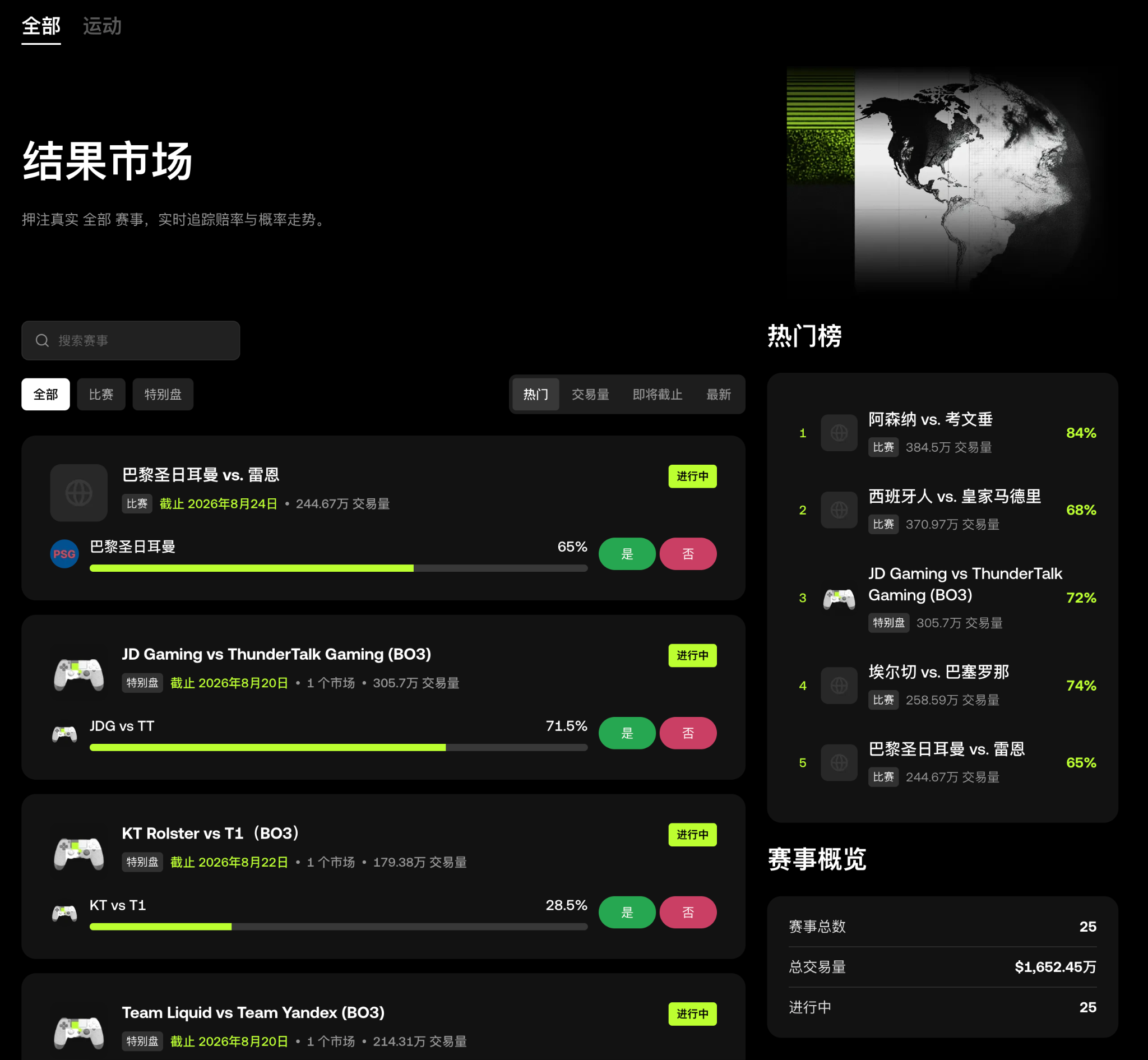
For traders, this is an interesting experiment
If you have been trading BTC for a long time, you can try to do a very simple experiment.
The next time you watch a football or esports match, don’t first ask : “I think who will win?”
But rather ask : “If I were to assign winning probabilities to both sides, how much would I give?”
Then look at the probabilities given by the market.
If your judgment is completely consistent with the market:
That means your understanding is about the same as the market’s.
If your judgment is significantly different:
This is where the truly interesting things start.
You need to continue asking:
Why does the market price this way?
Did I miss any information?
Or does the market really have a deviation?
This way of thinking is actually very close to trading.
 But be sure not to understand “prediction” as “certain win”
This is also the most crucial point that prediction markets need to be cautious about.
No probability judgment can guarantee a result.
Even if a team has an 80% win rate, it still means:
It still has a 20% probability of losing the match.
This is completely the same as trading.
A BTC trade you think has an 80% probability of rising can also end up at a loss.
So the truly mature predictive thinking is not: “I must be right.”
But rather: “If my judgment is only 70% likely to be correct, how much risk am I willing to take?”
At this point, prediction and trading have again returned to the same question:
Risk management.
Tomorrow, why not look at matches in a different way
If you are a trader yourself, you may have already become accustomed to staring every day at:
BTC, ETH, SOL, OI, funding rates, ETF inflows and outflows.
But the next time before a match starts, you can also try another way of thinking:
If this is a candlestick, what do I see now?
If this is a market price, is it reasonable?
If information changes, how should the probabilities change?
Have I discovered a certain variable earlier than the market?
This might be the truly interesting aspect of prediction markets.
Because you will ultimately discover:
Whether trading BTC, predicting football, or predicting esports, what you are really facing is never a definite answer.
You are facing the future.
And what the market does is continuously price the future.
If you also want to try this feeling of “trading the future”, OKX is currently launching “Prophet” related prediction gameplay.
Rather than understanding it as an ordinary guessing activity, you might as well consider it a small experiment:
Use your trading mindset for BTC to predict a football or esports match.
See if you are actually: guessing the result,
Or : judging probabilities.
Sometimes, the latter is closer to real trading.
🎁 AiCoin exclusive registration benefits are here!
Registering for OKX through AiCoin exclusive link offers a permanent 20% rebate
👉 Register for OKX now:
https://jump.do/zh-Hans/xlink?checkProxy=true&proxyId=2
📢 Join the AiCoin community for more information on new tokens and profit opportunities across exchanges
Official Telegram community:
AiCoin Chinese Twitter:
OKX benefits group:
https://aicoin.com/link/chat?cid=l61eM4owQ
The content of this article represents only the author's personal views and does not represent the position of this platform. The views, conclusions, and suggestions in the article are for investor reference only and do not constitute any investment advice related to this platform. The market has risks; invest cautiously.
Disclaimer: This article represents only the personal views of the author and does not represent the position and views of this platform. This article is for information sharing only and does not constitute any investment advice to anyone. Any disputes between users and authors are unrelated to this platform. If the articles or images on the webpage involve infringement, please provide relevant proof of rights and identity documents and send an email to support@aicoin.com. The relevant staff of this platform will conduct an investigation.