
Iran may be trying to turn the Hormuz Strait into a "de-Americanized" shipping route
Regarding the issues of Iran and Hormuz, I have recently begun to lean in another direction, suggesting that Iran may ultimately not need to restore Hormuz to its pre-war state, nor wait for the United States and Iran to reach a complete agreement before global oil supplies can resume.
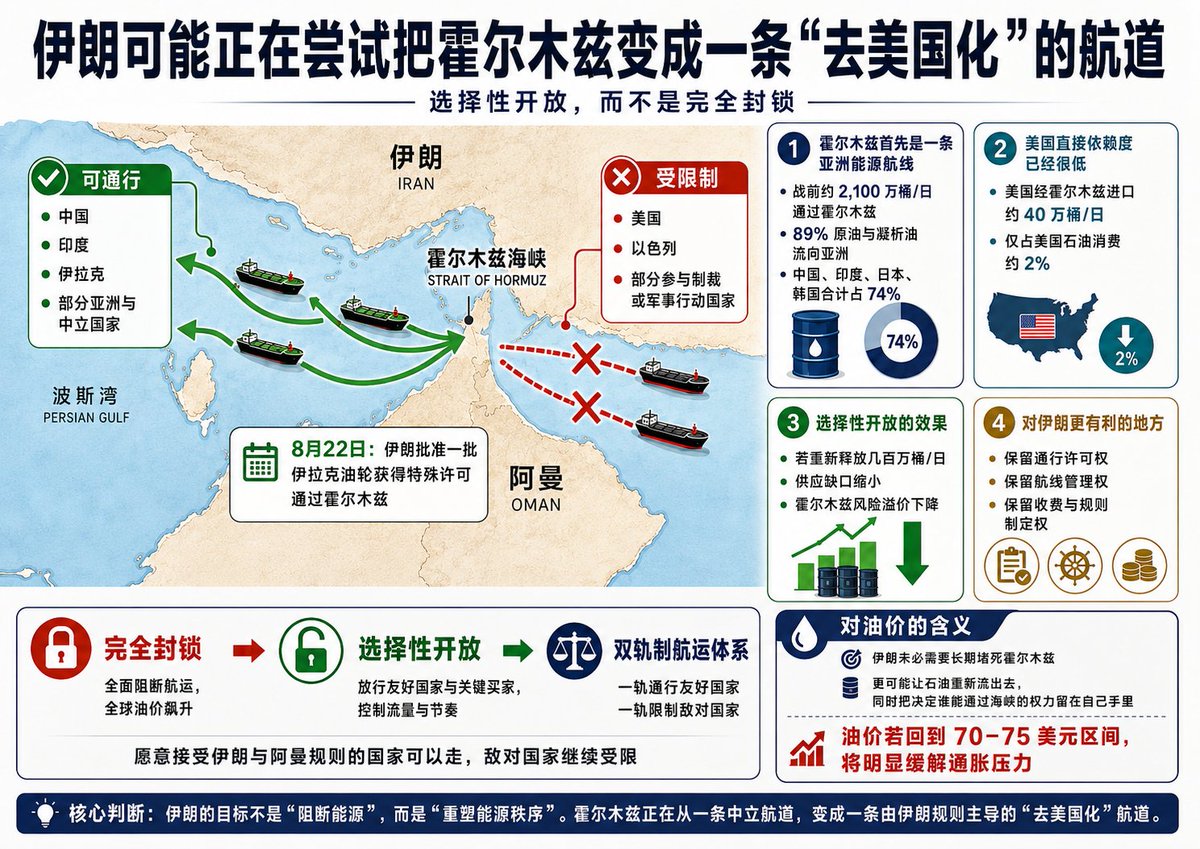
Iran can selectively open Hormuz.
American and Israeli-related vessels cannot pass, some U.S. allies involved in sanctions and military actions face restrictions, but China, India, Iraq, and other countries that have not participated in actions against Iran can continue to enter and exit the Persian Gulf through new routes established with Oman.
There are already some signs of this direction. On August 22, Iran approved a batch of Iraqi tankers to obtain special permission to pass through the Strait of Hormuz. Iran had also been discussing temporary safe corridors and new shipping management plans with Oman.
If such a system were to emerge, it could actually be more favorable to Iran. Before the outbreak of the Hormuz War, nearly 21 million barrels of oil passed through daily, with 89% of crude oil and condensate ultimately going to Asia; China, India, Japan, and South Korea alone accounted for 74%.
The U.S. itself imports only about 400,000 barrels of crude oil and condensate through Hormuz daily, accounting for only 2% of U.S. oil consumption. Therefore, from the perspective of physical supply, Hormuz is primarily an Asian energy route, and the direct dependence of the U.S. on this route is already very low.
This gives Iran a completely different choice. Previously, I thought about Hormuz mostly in two extremes: either Iran blocks the strait and holds back more than 20 million barrels of oil, or the U.S. forces Iran to reopen it for all countries to resume free navigation.
But in reality, there is a vast space in between. I only realized this recently!
Iran can allow China, India, Iraq, and some Asian and neutral countries to continue to pass while restraining U.S., Israeli, and certain hostile nations.
If several million barrels of oil can be released daily, the global actual supply gap will rapidly shrink, and a significant part of the Hormuz risk premium in oil prices will also decrease. For Iran, this approach may be even more profitable than completely closing Hormuz.
A complete closure would also harm China, India, Japan, South Korea, and the Gulf states; the higher the oil price, the greater the pressure on these countries to demand the restoration of free navigation, ultimately pushing countries that originally did not participate in the war to opposing Iran. This is also what I have been saying: Hormuz is not just a U.S. issue, but a global problem.
After selective opening, the situation would be completely different.
China can pass through, India can pass through, Iraq can pass through, and the energy pressure in Asia would decrease. Iran can also continue to control ship licensing, route management, and charging rights. This way, Iran still holds Hormuz but does not have to bear the political pressure from the disappearance of 20 million barrels of oil daily that affects the global economy.
Meanwhile, the U.S. would face a rather awkward situation. The U.S. is indeed no longer dependent on Hormuz oil, but oil is still globally priced, and America's Asian allies, such as Japan and South Korea, also heavily rely on energy supplies from here.
If Iran can gradually establish a new set of rules, nations willing to accept Iran and Oman's shipping regulations can pass, while countries involved in sanctions and military actions against Iran cannot. Thus, what may emerge in Hormuz is a dual-track shipping system.
The U.S. continues to emphasize free navigation and existing international shipping rules, while Iran relies on its control of the northern side of the strait and military security capability to establish another actual operating licensing system.
Of course, this plan currently faces significant obstacles. U.S. sanctions, ship insurance, and international shipping regulations will make ship owners very cautious, and the shipping industry currently believes that some of the fees and management plans proposed by Iran are difficult to execute directly.
But yesterday, Iran granted special transit permits to Iraqi tankers, indicating that at least Iran has begun to explore the possibility of differentiated treatment.
Therefore, my judgment regarding the future development of Hormuz is starting to change. But for shorting oil, I have gained more confidence.
Iran may not necessarily need to permanently block Hormuz. A more valuable outcome for Iran could be to gradually turn Hormuz into a "de-Americanized" shipping route, allowing oil to flow out again, reducing oil prices, and keeping the power to decide who can pass through the strait in its own hands.
If it truly comes to this, even if the U.S. and Iran remain hostile, the issue of high oil prices may be partially resolved. As long as oil prices can be controlled around $70 to $75, it can significantly alleviate the inflation issues globally triggered by rising oil prices.
@Gate Crypto, U.S. stocks, Hong Kong stocks, Korean stocks, gold, CFD, one-stop trading for prediction markets
Disclaimer: This article represents only the personal views of the author and does not represent the position and views of this platform. This article is for information sharing only and does not constitute any investment advice to anyone. Any disputes between users and authors are unrelated to this platform. If the articles or images on the webpage involve infringement, please provide relevant proof of rights and identity documents and send an email to support@aicoin.com. The relevant staff of this platform will conduct an investigation.