
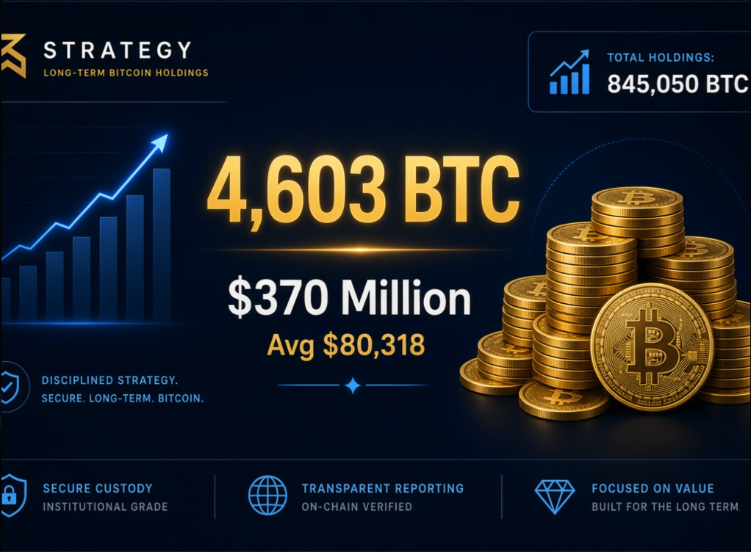
On August 31, Strategy (formerly MicroStrategy) suddenly announced: in the past week, it bought 4,603 bitcoins for about $370 million, with an average cost of $80,318. This is the first increase after a full two months, bringing the total holdings to 845,050 BTC. More importantly, the day before, Michael Saylor posted just three words—“We’re Back”, and the next day the document was filed. This is not a simple “we bought again”, but rather a clear signal from a leading institution: the hoarding mode is fully restarted.

1. How hardcore is this purchase?
- Buy quantity: 4,603 BTC
- Total expenditure: about $369.7 million
- Average cost: $80,318
- Latest holdings: 845,050 BTC (still the largest corporate holder in the global public market)
- Source of funds: completely reliant on ATM stock issuance, with net fundraising exceeding $600 million that week, most of which went directly into Bitcoin
Notice the timing—this purchase was not made at the lowest point, but after BTC rebounded over 24% from the August low and resumed above $78,000. Saylor doesn’t care about short-term fluctuations; he wants to continuously stack Bitcoin into the balance sheet.
2. Why does this time have a completely different significance?
In the past two months, Strategy was actually in a “rest period”: pausing purchases and even slightly selling some Bitcoin, mainly to optimize the balance sheet, repurchase preferred stock, and reduce leverage. The market once doubted whether they were “unable to hoard anymore”.
What happened? After adjusting, they returned full strength.
Now the company has ample dollar reserves, net leverage close to zero, and healthier finances, allowing it to attack more comfortably. This sends a clear signal: it’s not that there isn’t money to buy, but they are ready to buy again.
On the same day, Strive also announced an increase of 1,800 BTC, bringing its total holdings to 23,156, making it the fifth largest corporate holder in the public market. The near-simultaneous actions of the two companies are by no means a coincidence.
3. What does this mean for the market?
1. Institutional narrative re-emerges
In the current environment of hawkish macroeconomic sentiment, tensions between the U.S. and Iran, and weak trading volume, actual large purchases are more effective than any analyst predictions.
2. The corporate hoarding wave enters a “second phase”
It’s no longer just Strategy dancing alone; more and more listed companies are starting to regard Bitcoin as a core reserve asset.
3. Short-term sentiment catalysts are clear
The four letters “We’re Back” are enough to refocus the market on “who is really hoarding Bitcoin”, instead of just watching the short-term ups and downs every day.
4. What should we focus on next?
- Will Strategy form a steady rhythm of weekly/monthly increases?
- Will other listed companies follow suit and disclose their purchases?
- If BTC rises back above $82,000, will this round of institutional buying accelerate?
- Conversely, if it breaks below the key support of $76,000–$77,000, will corporations hold off temporarily?
In summary:
Saylor uses real money to tell the market— the bear market adjustment phase has ended, and the main narrative of institutions hoarding Bitcoin has officially returned.
In the coming weeks, what truly determines the height of the market may not be the noise from news, but the sustained inflow speed of this “real money”.

(Data as of August 31, 2026, official disclosure, for reference only and not considered investment advice.)
Disclaimer: This article represents only the personal views of the author and does not represent the position and views of this platform. This article is for information sharing only and does not constitute any investment advice to anyone. Any disputes between users and authors are unrelated to this platform. If the articles or images on the webpage involve infringement, please provide relevant proof of rights and identity documents and send an email to support@aicoin.com. The relevant staff of this platform will conduct an investigation.