
Bitcoin has returned to above $80,000.
This time, the market is not purely driven by emotions in the crypto space. More accurately, it is driven by loosening expectations of interest rate hikes from the Federal Reserve, a drop in U.S. Treasury yields, a weaker dollar, a return of ETF funds, and the closing of previous short positions.
BiyaPay market data shows that as of September 4, BTC briefly surged above $81,000, with a 24-hour increase of about 4%. ETH also rebounded, returning to around $2,500. Meanwhile, some popular tokens such as Zcash, XRP, and HYPE strengthened, and crypto-related stocks like Coinbase, Robinhood, and Strategy also rose simultaneously.
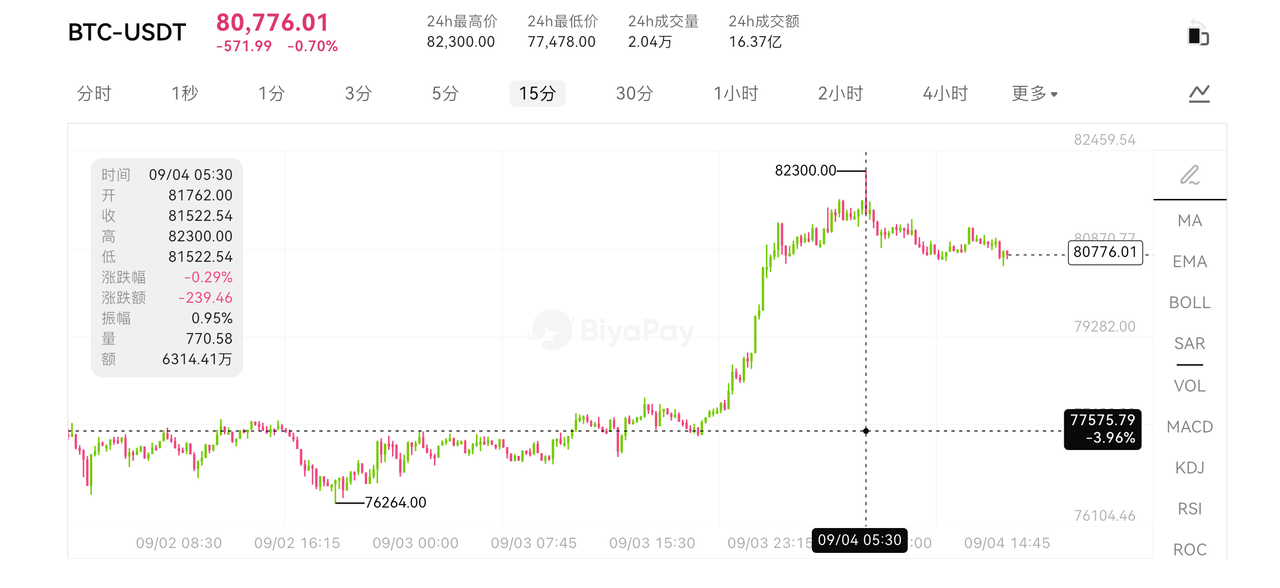
This time, the market is not purely driven by emotions in the crypto space. More accurately, it is driven by loosening expectations of interest rate hikes from the Federal Reserve, a drop in U.S. Treasury yields, a weaker dollar, a return of ETF funds, and the closing of previous short positions.
The market is not trading an independent trend of a single cryptocurrency, but rather the risk appetite is recovering. However, recovery does not mean a reversal. After BTC reestablishes a position above $80,000, the real question becomes whether this position can be maintained.
In this increasingly interconnected multi-asset phase, platforms like BiyaPay's global one-stop asset allocation platform are also more easily used to observe cross-market trends. It covers multiple asset scenarios, including digital assets, U.S. stocks, Hong Kong stocks, and fiat currency exchanges, allowing observation of the trend changes of different assets such as BTC, ETH, U.S. stocks, and Hong Kong stocks. Especially when Bitcoin, U.S. Treasuries, the dollar, and tech stocks fluctuate together, looking only at a single market can easily overlook the real lines that affect prices.

Interest rate hike probability back to coin toss, BTC reacted first
This round of Bitcoin's sudden rally back above $80,000 was most directly triggered by changes in expectations from the Federal Reserve.
Previously, the market was concerned that the Fed might raise interest rates again at the September meeting. U.S. Treasury yields were rising, the dollar was strong, and risk assets were generally under pressure, with Bitcoin fluctuating in the range of $76,000 to $78,000. However, Fed Governor Waller recently expressed a cautious stance, mentioning that if inflation continues to ease, he would prefer to support keeping rates unchanged.
This statement caused the market to reprice. Data shows that the probability of a rate hike in September dropped from over 60% earlier this week to around 48%, essentially returning to a "coin toss" scenario. As the interest rate bets changed, U.S. Treasury yields fell, the dollar weakened, funds returned to risk assets, and Bitcoin reacted the fastest.
The "coin toss" here does not mean that the Federal Reserve has decided against raising rates, but that the market's judgment of the September policy outcome has become wobbly again. For BTC, as long as interest rate pressures decrease intermittently, price elasticity is easily magnified.
ETF funds returning, adding strength to the market
If relying solely on interest rate expectations, it would be difficult for Bitcoin to stay at high levels continuously. What truly makes the market willing to reassess levels above $80,000 is that spot ETF funds are also flowing back in.
Public data shows that the U.S. spot Bitcoin ETF recorded approximately $277 million in net inflow on Thursday. This number is not exaggerated, but it supports market sentiment. Because ETF funds represent more than just short-term emotions within exchanges; they indicate the flow of funds leaning more towards traditional financial channels.
In recent months, every significant fluctuation in Bitcoin has been closely monitored alongside ETF flows. When prices rise, if ETF funds flow in concurrently, it indicates that there is support on the spot side; if the rise is sparked only by the futures market, prices can easily spike and then retreat. The current issue lies here: a single-day inflow can only indicate a warming sentiment; to confirm a trend, we need to see if there can be continuous inflows afterward.
In other words, while ETFs are not a panacea, they serve as an important clue in determining whether there is genuine support above $80,000.
Short covering amplified the gains
This rally in Bitcoin is also related to short covering.
When U.S. Treasury yields were rising and interest rate expectations were heating up, many funds had originally bet that BTC would continue to be under pressure. Once expectations from the Fed loosened suddenly, and prices broke back above $80,000, some short positions were forced to cover. Short covering itself represents buying pressure; the more prices rise, the greater the pressure to cover, making the short-term rally more intense.
Thus, in this rally, there were both proactive buying and passive buying. Proactive buying came from ETFs, spot demand, and the recovery of risk appetite, while passive buying came from short covering. The combination of these two forces led Bitcoin to surge back over $81,000 in a short time.
However, this also means that the subsequent trends cannot be assessed solely by gains. The spikes caused by short covering are usually short-lived; sustainability depends on whether there are buyers willing to step in when prices retrace. If sufficient volume trades above $80,000, it indicates that the market is willing to accept the new price range; if prices quickly drop back to around $78,000, this rally may resemble a short-term repair after a change in interest rate expectations.

Ethereum rises alongside, but the altcoin market should not be hastily defined
During this rebound, Ethereum has also returned to around $2,500, with BNB, DOGE, XRP, HYPE, Zcash, and others experiencing varying degrees of increase. On the surface, it seems like the entire crypto market is warming, but structurally, the main lines still lie within BTC and ETH.
BTC represents macro funds' risk appetite toward crypto assets, while ETH better reflects chain activity, stablecoins, DeFi, and application layer dynamism. Bitcoin's reestablishment above $80,000 mainly reflects interest rate expectations and ETF funds; Ethereum's rise indicates that risk appetite is beginning to overflow from BTC into mainstream assets.
However, this should not be simply interpreted as the complete start of an altcoin market. A true altcoin cycle usually requires an increase in stablecoin supply, a rebound in on-chain activity, sustained market trading expansion, and continuous alignment with macro liquidity. Currently, it appears more like a localized diffusion following a recovery of risk appetite, rather than all assets entering a strong trend simultaneously.
This is also a point that needs to be cautiously distinguished moving forward. BTC's rise can enhance market temperature, but the quality of increases in different assets is not the same. Rapid gainers do not necessarily have stronger support; slow gainers also may not lack funds' attention.
Crypto stocks rise in tandem, indicating U.S. funds are also participating
When Bitcoin rises, crypto-related stocks often react more strongly. Coinbase represents trading activity and expectations for compliant trading platforms, Robinhood represents retail trading enthusiasm, and Strategy represents the leveraged nature of publicly traded companies holding BTC. After BTC surged back over $80,000, these stocks also rose, indicating that the U.S. stock market is participating in this round of crypto asset rebound.
However, crypto stocks and BTC are not the same. They are influenced not only by Bitcoin's price but also by company performance, trading volumes, regulatory environment, valuation levels, and overall risk appetite in U.S. stocks. When Bitcoin rises, they may rise faster; when Bitcoin falls, their volatility may be even greater.
This is why observing this market cannot focus solely on BTC's price itself. U.S. Treasury yields, the dollar index, spot ETFs, crypto stocks, and U.S. tech stocks should be analyzed together to determine whether funds are genuinely re-entering risk assets or merely engaging in short-term covering.
Beyond $80,000, the key is on the support strength
Bitcoin's surge to $81,000 is not just about that number itself; it is more important to see whether $80,000 can shift from a resistance level to a support level.
If BTC can maintain a fluctuation above $80,000 while ETF funds continue to flow in, and U.S. Treasury yields do not show significant upward movement, then the market will be more willing to believe that this rebound is not just emotional repair. Conversely, if prices quickly drop back below $78,000, it indicates that selling pressure above $80,000 remains heavy, and funds have not formed a sufficiently stable base of support.
From the trading structure, there will definitely be differences around the $80,000 mark. Previously trapped funds may choose to reduce exposure, short-term funds might want to realize gains, while trend-following funds will observe the strength of support after a pullback. A truly healthy rally does not fear a pullback; what it fears is a lack of trades and buying pressure during the pullback.
So moving forward, more important than "whether it can continue to push higher" is whether the market is willing to buy when prices retrace.
Next, we need to watch the Federal Reserve and also the data
Before the Fed's September meeting, the market will be focused on employment, CPI, PCE, and U.S. Treasury yields. Waller's statements have caused interest rate hike probabilities to decrease, but they do not directly eliminate the possibility of a rate hike. If subsequent inflation data continues to cool, risk assets will find it easier to maintain momentum; if inflation reverts to a strong state, U.S. Treasury yields may rise again, testing the support above $80,000 for Bitcoin.
This is the most delicate aspect of the market right now. BTC has indeed returned to above $80,000, but it has not detached from the macro environment. ETF funds have provided backing, Fed expectations have given elasticity, and short covering has amplified the speed. Whether this rebound can go further will still depend on whether these factors can continue to align.
Bitcoin's return above $81,000 suggests that the market's risk appetite is recovering. However, $80,000 is not the end; rather, it feels more like a new pressure test. Standing firm here would create a basis for further market expansion; if it does not hold, this surge may resemble a rapid recovery following a drop in interest rate expectations.
Disclaimer: This article represents only the personal views of the author and does not represent the position and views of this platform. This article is for information sharing only and does not constitute any investment advice to anyone. Any disputes between users and authors are unrelated to this platform. If the articles or images on the webpage involve infringement, please provide relevant proof of rights and identity documents and send an email to support@aicoin.com. The relevant staff of this platform will conduct an investigation.