
Written by: Gandalf, Techub News
Introduction
From submitting a proposal for a tokenized regulatory framework to the SEC in May 2025, to "borrowing the Arbitrum chain" at the Cannes launch, and then opening its self-built mainnet at the "The World is Flat" conference in London on July 1, 2026—Robinhood has taken 14 months to go from "we don’t build chains" to "we built a chain." This article recounts each step of this transition chronologically: why it first borrowed a chain, where the borrowed chain fell short, and what exactly "autonomous control" entails.
Key Points
- May 2025: Initial regulatory action—submitting a proposal for a "tokenized real-world asset regulatory framework" to the US SEC, followed by product actions
- Cannes launch from June 30 to July 1, 2025: Launching tokenized stocks aimed at EU users, based on Arbitrum, with a future announcement of building an L2
- OpenAI stock tokens and inquiries from the Lithuanian central bank exposing the product and compliance tension under the "borrowed chain" model
- February 11, 2026: Testnet goes live, first week trading 4 million transactions; mainnet opened at the London press conference on July 1
- Technology stack remains Arbitrum (10% cut at the protocol layer)—"autonomous control" pertains to the execution layer and economic model, not consensus
On July 18, 2025, Techub News published an article titled "Dialogue with Robinhood Co-Founder: Why We Don't Build Our Own Chain?" One year and seven months later, on July 1, 2026, Robinhood opened the public mainnet of Robinhood Chain at the "The World is Flat" conference in London.
The path from "we don’t build chains" to "we built a chain" is worth reviewing in its entirety—it explains why this chain exists in its current form and why it spiraled out of control.
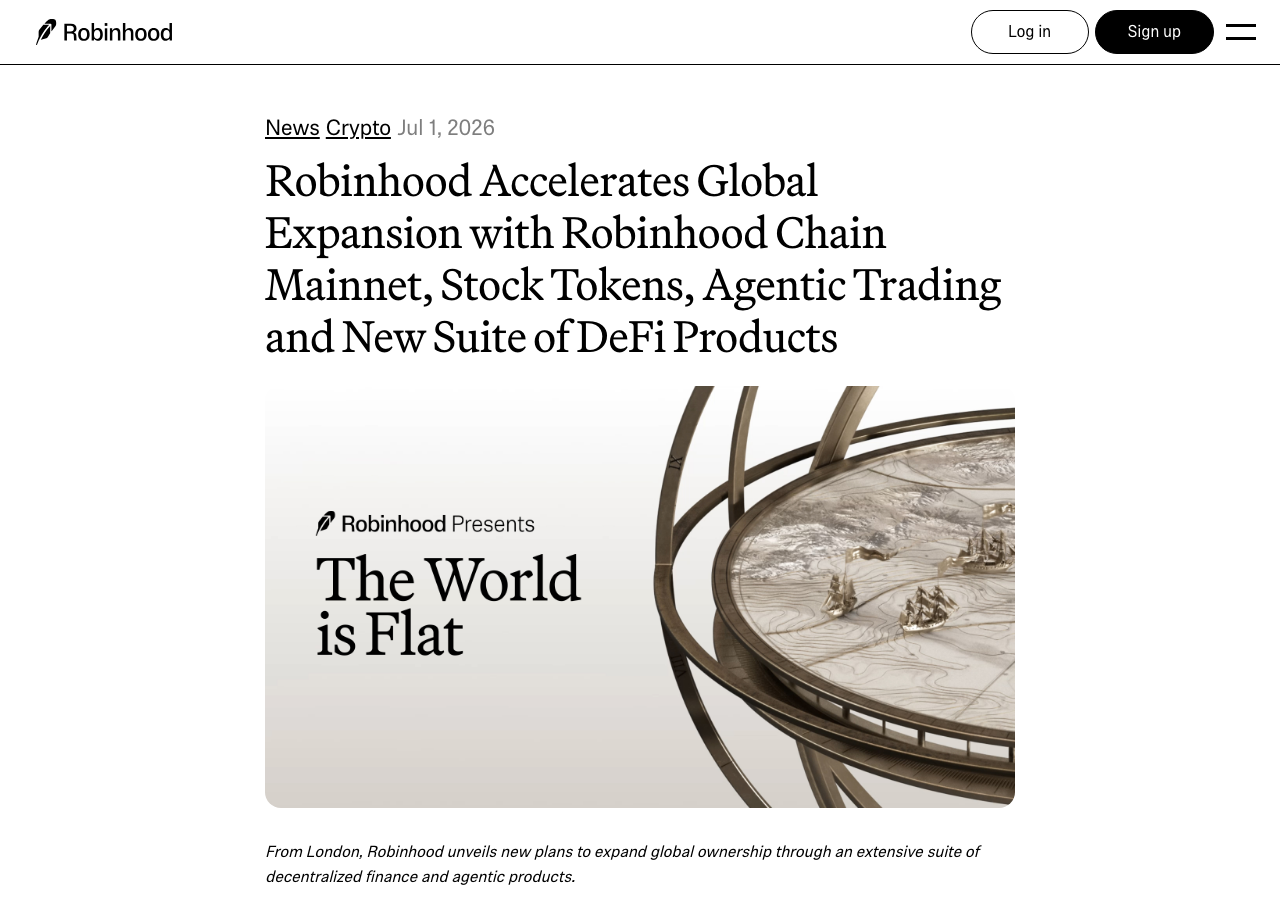
Image source: Robinhood official press release "The World is Flat" (July 1, 2026)
Step One: Borrow Someone Else's Chain
The starting point is May 2025. On the 8th of that month, it was reported that Robinhood planned to launch a blockchain-based US stock trading platform in Europe; on May 20, Robinhood submitted a proposal to the US SEC to create a "tokenized real-world asset regulatory framework." Viewing these two events together, the direction is clear: what it wants to do is not cryptocurrency brokerage, but to move US stocks onto the chain itself.
From June 30 to July 1, Robinhood held a launch event in Cannes, which would be repeatedly referenced: launching tokenized stocks for EU users, choosing Arbitrum as the underlying technology while announcing plans to build its own Layer 2 in the future. The positioning at that time was quite restrained—first, run the product on someone else's chain.
On July 2, chain data showed that Robinhood had minted approximately 2,305 OpenAI stock tokens on Arbitrum. This was the first instance of real controversy arising: the equity of an unlisted company was tokenized without OpenAI's involvement. On July 8, the Lithuanian central bank demanded that Robinhood provide clarification on the product structure of its tokenized stocks.
Step Two: The Scale Couldn’t Hold
Over the next year, the product side continued to expand. On October 19, 2025, Robinhood added 80 new stock tokens on Arbitrum, bringing the total number of tokenized assets to around 500. However, data from Entropy Advisors on November 17 presented another aspect: since June, the total value of Robinhood's tokenized assets exceeded $7.43 million—this number is disproportionately small relative to its tens of millions of users.
The issue was not demand, but rather that the "borrowed chain" limited the product format. To enable 24/7 trading, incorporate stock tokens into lending and derivatives, and manage sorting and fee structures, Robinhood needed complete control over the execution layer. On January 29, 2026, CEO Vlad Tenev clearly stated that they would open continuous stock token trading and DeFi services in the coming months—this was already a precursor to building their own chain.
Step Three: From Technical Leverage to Autonomous Control
On February 11, 2026, the Robinhood Chain testnet went live. Techub News' judgment at the time was that Robinhood's tokenization strategy was shifting from "technical leverage" to "autonomous control." On February 21, transaction volume in the first week of the testnet surpassed 4 million transactions.
Five months later, on July 1, the mainnet opened. From July 2 onwards, actions on the platform were densely implemented: stock tokens supported over 90 US stocks, Uniswap launched simultaneously with an AI plugin, Maple released syrupUSDG, Trust Wallet completed integration, and dYdX Labs' incubated Arcus launched supporting 95 types of tokenized stocks on the DEX. On July 9, Robinhood integrated Morpho to launch the on-chain lending product Earn.
It’s noteworthy that the choice of technology remained unchanged—Robinhood Chain was still built on the Arbitrum technology stack. On July 16, the Arbitrum Foundation officially announced the mainnet launch. The so-called "autonomous control" pertains to the execution layer and economic model, not building a consensus from scratch. This trade-off later reflected in revenue distribution: data from September 2 showed that Robinhood's daily fee revenue was $2.13 million, while Arbitrum took a 10% cut at the protocol layer.
A Chain Built for Stocks
When this timeline is straightened out, the design intent of Robinhood Chain has been consistently clear from start to finish: it is designed as a settlement layer for tokenized stocks and RWAs, aiming to connect Robinhood's retail distribution capabilities directly to the chain. On July 18, Robinhood stated that "it will attract millions of users onto the chain through tokenized assets."
Then the mainnet ran. Once it started running, what happened had almost nothing to do with this design intent.
Disclaimer: This article represents only the personal views of the author and does not represent the position and views of this platform. This article is for information sharing only and does not constitute any investment advice to anyone. Any disputes between users and authors are unrelated to this platform. If the articles or images on the webpage involve infringement, please provide relevant proof of rights and identity documents and send an email to support@aicoin.com. The relevant staff of this platform will conduct an investigation.