
By: Gandalf, Techub News

Introduction
A NASDAQ company with 15 employees selling dried shiitake mushrooms saw its stock price surge 350% in one day, with a trading volume of 720 million shares — nearly 90 times its average daily volume. This was not driven by any institution, but by a meme coin called JINQIAN on the Robinhood Chain. According to data from Nansen, the FAMI token paired with it has no minting or redemption relation to real stocks. This article provides a comprehensive recap of this event, which marked the first substantial reverse impact of on-chain speculation on the traditional stock market, along with the regulatory vacuum it exposed.
Key Points
- September 2: JINQIAN launched and paired with the "FAMI" on-chain token, Farmmi's stock price rose from $0.12 to $0.50 (intraday +350%), before falling back to $0.18
- Trading volume of 720 million shares ≈ 90 times the daily average; meme peak implied valuation of $60 million ≈ 10 times the market cap of the listed company
- Most critical detail: The FAMI token is not an official stock token from Robinhood, and has no minting or redemption relation to real shares (Nansen)
- Wealth distribution: Early participants made $19,000 → $198,000 in one hour; most latecomers are believed to have incurred losses
- Two days later, AMC CEO's outcry was not a coincidence — listed companies began to realize their stocks were being priced by others on-chain
On September 2, 2026, the stock price of NASDAQ-listed company Farmmi (stock code FAMI) surged 350% intraday. This company specializes in agricultural products like dried shiitake mushrooms, has 15 employees, and prior to this had a market value of only a few million dollars.
What drove this was not financial statements or mergers, but a meme coin called JINQIAN on the Robinhood Chain.
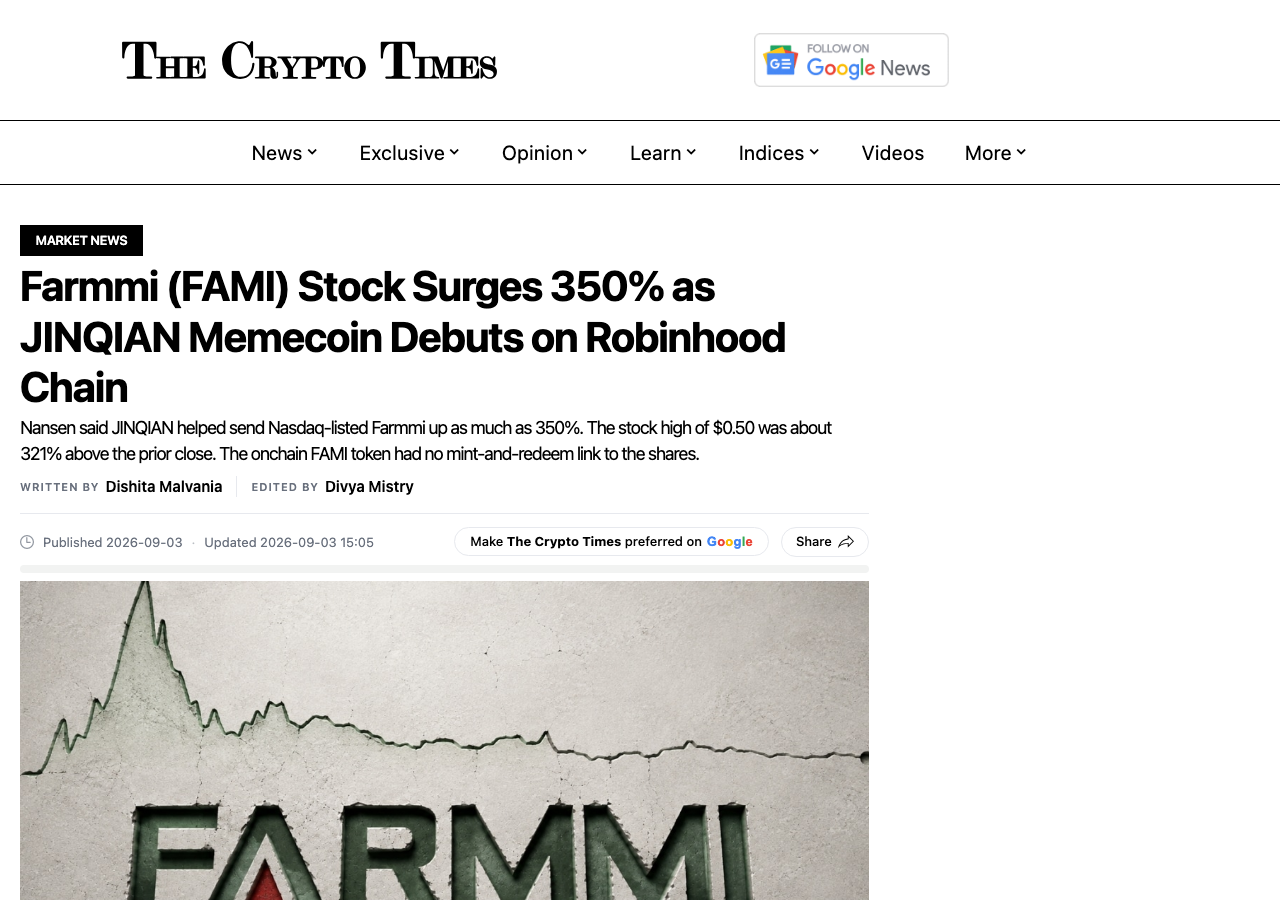
Source: The Crypto Times (September 3, 2026)
Event Progression
JINQIAN is named after the "money mushroom" sold by Farmmi. It was issued on the Robinhood Chain and paired with an on-chain token that uses the FAMI code and claims to represent Farmmi's stock, creating a pool according to the popular "coin-stock meme" play on this chain.
The hype around the meme quickly overflowed into the real stock market. Farmmi's stock price jumped from about $0.12 at Tuesday's close to as high as $0.50, before falling back to around $0.18. The trading volume exceeded 720 million shares, close to 90 times its average daily volume.
At its peak, the implied valuation of this meme was about $60 million, roughly 10 times the market value of the listed company itself. Some early participants turned about $19,000 into approximately $198,000 within an hour; the vast majority of later investors were believed to have suffered losses.
The Most Critical Detail: That FAMI Token is not Issued by Robinhood
This is the most easily overlooked yet vital point of the entire event: The FAMI token paired with JINQIAN does not belong to the official stock tokens issued by Robinhood, but is independently issued.
In other words, the pricing anomaly of a NASDAQ company's stock is driven by an on-chain asset that is neither bound by securities laws nor included in the official products of brokerage firms. Robinhood's official stock tokens at least have Jersey Island entities, U.S. custodians, and a 1:1 support structure; this FAMI token has none of that.
Why Small-cap Stocks?
Previous research by KuCoin has pointed out that meme speculation usually does not materially affect the real stock prices of large companies — price deviations due to thin liquidity mainly occur on-chain, during off-trading hours, on small-cap targets.
Farmmi precisely falls within this overlap: a very small circulating market value, extremely low average daily trading volume, and a topic that can be directly ignited by on-chain narratives. When the speculative capital on-chain exceeded the absorption capacity of stocks off-chain, the direction of price transmission reversed — it was not the stock pricing the token, but the token pricing the stock.
Regulatory Vacuums
The significance of this event goes beyond merely creating a short squeeze. It substantively proves for the first time that on-chain meme speculation can reverse impact the regulated traditional stock market, and the existing rules are almost completely unprepared for it.
Some law firms have already written discussing the regulatory loopholes around cryptocurrency market manipulation — issuing a meme requires no disclosure, pairing a non-official stock token does not require consent from the underlying company, while the entities being pushed are real securities on NASDAQ.
Two days later, on September 4, AMC's CEO publicly criticized Robinhood for issuing tokenized AMC stock without authorization. The proximity of these two events in time is not coincidence — listed companies are beginning to realize what is happening to their stocks on-chain, and they have no veto power over it.
Disclaimer: This article represents only the personal views of the author and does not represent the position and views of this platform. This article is for information sharing only and does not constitute any investment advice to anyone. Any disputes between users and authors are unrelated to this platform. If the articles or images on the webpage involve infringement, please provide relevant proof of rights and identity documents and send an email to support@aicoin.com. The relevant staff of this platform will conduct an investigation.