
Trading is no longer the only value capture segment; Hong Kong's stablecoin infrastructure is providing a new observation sample.
Written by: Farmer Frank
For a long time, the crypto industry held a nearly rigid view of the compliance ecosystem for virtual assets in Hong Kong.
Licenses are hard to obtain, compliance costs are high, there are restrictions on listing tokens, and user access is much stricter compared to offshore markets, especially in terms of the most critical trading depth, where licensed platforms in Hong Kong have long found it difficult to compete on the same scale as Binance, OKX, and others.
Over time, in the minds of many, "compliance" has even become synonymous with "lack of liquidity."
However, data disclosed during the 2026 mid-year reporting season has rendered this judgment somewhat outdated, with the most obvious change coming from OSL:
In the first half of the year, the total trading volume on the OSL platform reached 172 billion Hong Kong dollars, a year-on-year increase of 241.3%. By early September, it had risen to 8th place in the global exchange rankings on CoinGecko, becoming the licensed digital asset platform with the highest spot trading volume and stablecoin trading volume in Hong Kong.
At the same time, another leading licensed platform in Hong Kong, HashKey, also maintained growth, with trading volume increasing by 31.8% year-on-year in the first half of the year, with institutional client trading volume rising by 58.8%.
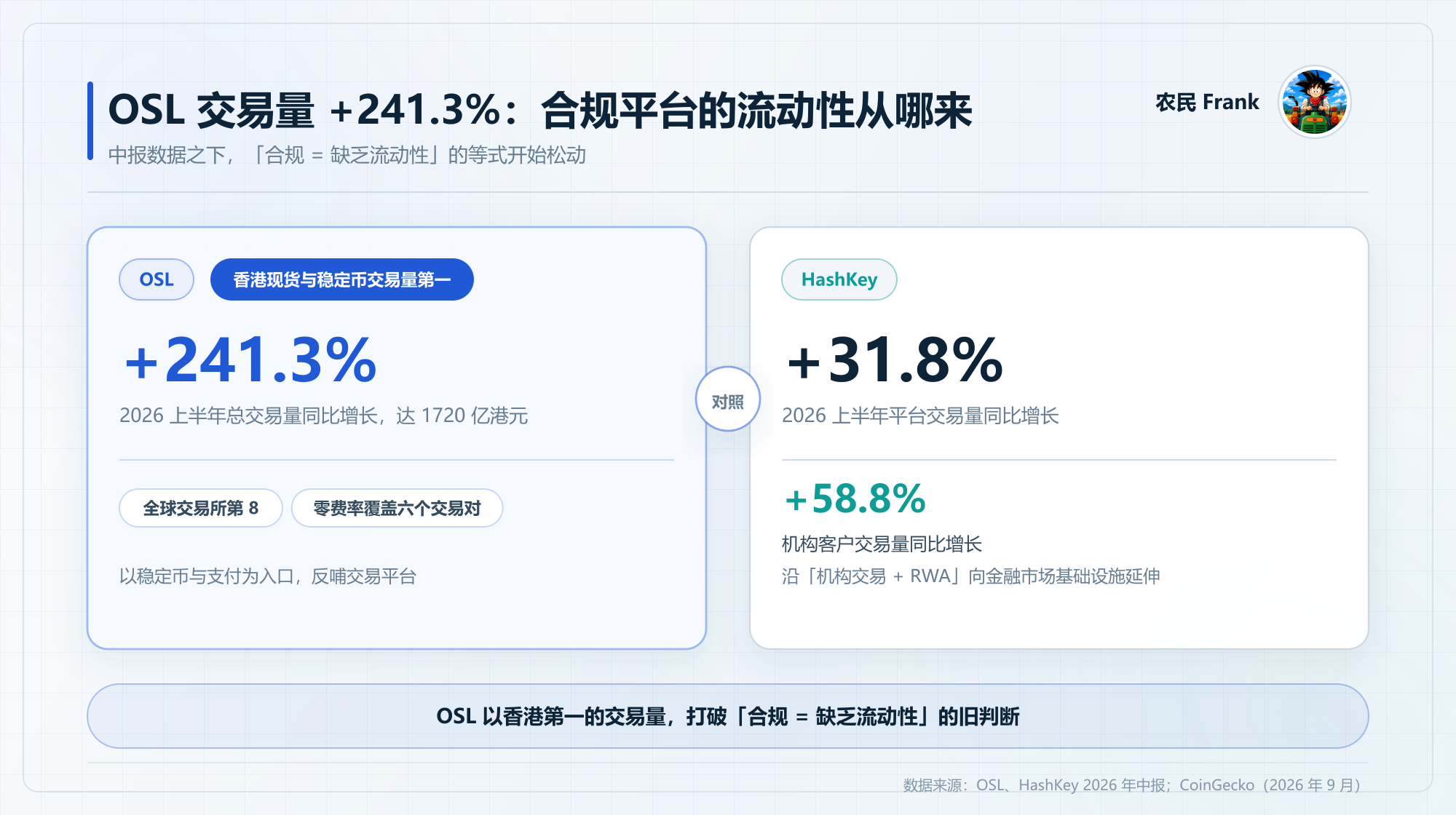
These two sets of data also illustrate that compliance and liquidity are not a mutually exclusive choice, especially the significantly accelerated growth curve of OSL in the past half-year is worth analyzing separately.
Looking back now, the investments that occurred last year largely "outside of trading" are now funneling liquidity back into OSL Exchange. This raises a question worth more discussion than "Why has OSL become number one in Hong Kong?":
Why is stablecoin infrastructure beginning to expand a trading platform? And further, does this path hide the true breakthrough direction for Hong Kong's Web3 market?
1. In the Second Half for License Holders, the "Liquidity" Divide of Hong Kong Exchanges
The most important keyword in the previous phase of Hong Kong's virtual asset market was always "license."
This is not hard to understand.
When a new regulatory market is just being established, whether one is qualified to operate legally and can serve retail and institutional clients becomes the scarcest resource; the license determines whether a platform can sit at the table, while banking channels, custody capabilities, and asset entry determine the type of services it can provide.
However, as the regulatory framework gradually stabilizes and the market matures, a more practical issue begins to surface: being qualified to trade and actually having someone willing to trade are two different matters.
For ordinary investors, if a platform has larger bid-ask spreads, problematic deposit and withdrawal processes, and fewer asset choices, there is naturally no motivation to move funds; for institutions with sizes ranging from tens of millions to over a hundred million dollars, even a few basis points in slippage, transaction fees, and fund allocation costs will ultimately turn into real money.
Thus, the focus of competition will naturally shift from the scarcity of licenses to something more difficult to replicate: who can bring funds in at a lower cost and more efficiently, and keep them there.
OSL's recent series of actions are, to some extent, the most direct embodiment of this change.
Recently, OSL HK announced that for professional investors and institutional clients, all stablecoin-to-stablecoin and stablecoin-to-fiat spot trading pairs would have Maker and Taker fees reduced to 0, covering the trading pairs USDT/USD, USDT/HKD, USDGO/USD, USDGO/USDC, USDGO/USDT, and RLUSD/HKD.
According to OSL's claims, it is currently the only licensed platform in Hong Kong implementing a zero fee rate for Maker/Taker in the aforementioned institutional stablecoin spot trading.
For large-scale, high-frequency institutional trading, this is not a trivial offer.
When trading volume rises from millions to tens or even hundreds of millions of dollars, even a few basis points' cost difference is enough to directly impact the final execution result, especially with lower trading fees, deeper order books, and smaller slippage, combined with how brokers and asset management firms access funds via omnibus structures, once a scale is formed, liquidity itself will create obvious network effects.
The more funds there are, the deeper the liquidity, and the better the execution conditions; a better trading experience will continue to attract more funds, which is also the most typical "the rich get richer" phenomenon. OSL simultaneously jumping to the first position in both spot and stablecoin trading volumes in Hong Kong indicates that this liquidity competition has started to reflect actual market performance.
However, from the traditional exchange's business logic, actively reducing fees to zero seems somewhat contra-intuitive.
After all, for the past decade, the classic business model of crypto exchanges has been extremely simple: " Users come in → Complete trades → The platform collects fees from each match." Under this logic, the larger the trading volume, the higher the fee income.
Actively giving up Maker and Taker fees looks like cutting off the most core piece of business income; if OSL were still just an exchange that survives by matching trades, this would undoubtedly be hard to sustain in the long term.
But the problem lies in the fact that if you look at the financial report, you will find that trading fees are no longer the only commercial task that OSL has to bear.
As per OSL's 2026 mid-year financial report, payment business income reached 49.083 billion Hong Kong dollars, accounting for 88% of total group income. Due to the method of recognizing the total amount involved in digital asset transactions, this number cannot be simply understood as traditional revenue or profit. However, at least from a business structure perspective, payment and stablecoin-related businesses have grown from an ancillary sector to an extremely important part of OSL's entire business system.
This also changes the pricing logic of the trading business itself.
When a platform really aims to compete for not just a few basis points from a single transaction, but for the entire life cycle of funds from entry, exchange, custody, trading, to payment and settlement, then trading itself can be completely repriced.
Thus, the so-called "zero-fee rate" need not be a simple money-burning exchange for volume; it resembles a public plot: first lowering trading costs to attract institutional liquidity, and then amplifying the long-term value of this capital within the entire system through more complete capital and account relationships.
And why OSL can start doing this under certain conditions actually requires looking beyond the exchange.
2. When Exchanges Are No Longer Just "Exchanges"
If we turn the clock back more than a year ago when OSL announced its transition to stablecoins, many, including the author, easily interpreted trading and payments as two independent businesses.
On one side was the relatively mature exchange business responsible for buying and selling crypto, facilitating trading and earning fees; on the other hand was the still-expanding stablecoin payment business, requiring continuous resource investment to build cross-border payments, corporate settlements, and fiat channels, likely becoming a bottomless pit requiring ongoing infusion.
But looking back today, payment business has not turned into a purely consuming resource new business; instead, with the continual expansion of stablecoin trading volume, payment scale, and fiat channels, it has begun to provide a funding entry and liquidity for the trading platform.
This allows OSL's originally transaction-centered business model to potentially be redefined.
In fact, traditional internet brokerage firms have walked a similar path, with platforms like Robinhood and Futu already having income beyond just stock trading commissions, such as net interest, financing services, securities lending, and membership subscriptions, gradually becoming part of a complete business model.
Ultimately, "low commission" or even "zero commission" means that platforms begin to manage users' complete account relationships, causing the importance of any given transaction to diminish, while the duration, turnover frequency, and subsequent payment, financing, custody, and asset management requirements generated around the funds within the system become increasingly important.
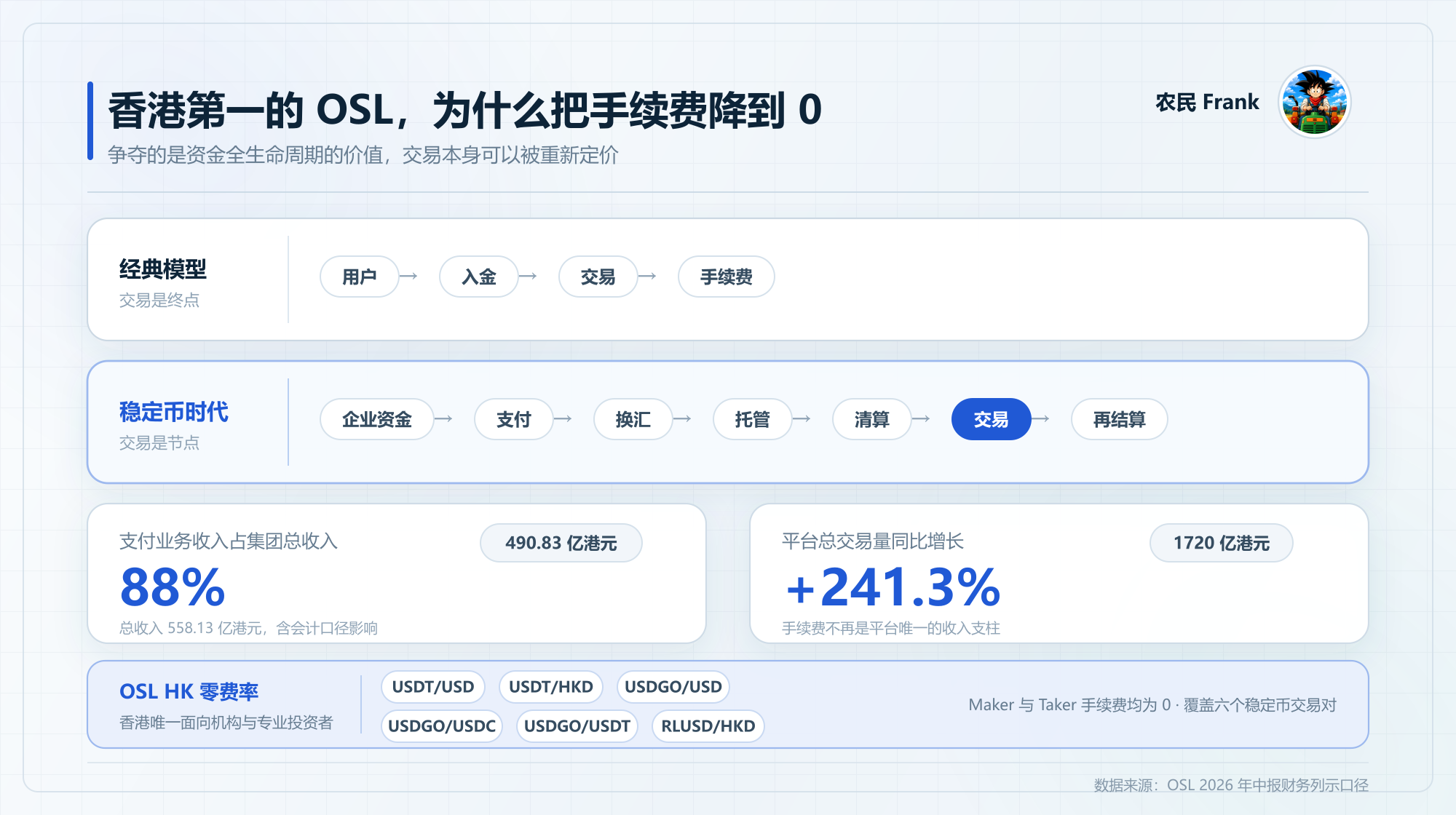
Crypto is experiencing similar changes.
The classic trading model of exchanges in the past was quite simple: "Users → Deposit → Trade → Fees," but moving into the stablecoin era, a clearly longer funding pathway started to emerge: "Corporate Funds → Payment → Currency Exchange → Custody → Clearing → Trading → Re-settlement."
The service chain has been extended; trading is no longer the endpoint of the capital lifecycle but merely one segment of it.
From this perspective, re-reviewing OSL's activities over the past year reveals that many actions that originally seemed scattered have started to connect: whether it’s Banxa, MiCA, Australia's AFSL, or StableHub, USDGO, all aim to allow more capital to legally enter the digital asset system, stay, exchange, trade, and settle within it, and finally return smoothly to the fiat world.
The core asset, naturally, is USDGO.
In February, OSL launched an enterprise-level US dollar stablecoin USDGO, issued by the US federal regulatory bank, Anchorage Digital Bank N.A. After six months of launch, its circulation scale grew from about 50 million dollars to over 1.2 billion dollars, an increase of more than 24 times, becoming the sixth largest compliant stablecoin by circulation globally.
Next is StableHub. After about four months of operation, StableHub's USDC deposit scale surpassed 200 million dollars, initially establishing the path for how to centralize stablecoin exchange, dollar exchange, custody, and settlement within a single system.
Spreading one layer further is the fiat world.
In January, OSL completed the acquisition of Web3 payment infrastructure company Banxa, expanding its regulatory footprint to more than 40 trading and payment licenses and registrations covering major markets like the US, Canada, Europe, the UK, and Australia. Subsequently, it obtained EU MiCA authorization and Australian AFSL, completing the compliance foundation for conducting payment, custody, and digital asset-related services for global institutional clients.
In August, OSL obtained its SWIFT Business Identifier Code, or BIC, further connecting to the traditional banking cross-border payment network and strengthening the cross-border settlement capabilities between USD virtual accounts, fiat, stablecoins, and digital assets.
Meanwhile, it became the major recognized distributor for the first phase of institutional applications for HKDAP, a regulated Hong Kong dollar stablecoin, providing distribution and liquidity support; on the other end, it launched AgentPay, attempting to provide automated stablecoin payment and settlement infrastructure supporting assets like USDT, USDC, and USDGO for AI agents.
Looking at these actions individually, they can easily turn into a lengthy series of company news, but placing them within the same capital pathway clarifies their logic:
Banxa and SWIFT BIC resolve fiat entry and exit;
USDGO and HKDAP showcase stablecoin operations and distribution capabilities;
StableHub aggregates liquidity and settlement; OSL Exchange undertakes trading and price discovery;
Payment networks and AgentPay enable stablecoins to re-enter businesses, cross-border payments, and new agent economy scenarios;
Thus, a platform that originally relied mainly on users coming in to "buy and sell" has gradually transformed into a necessary node in the flow of capital between different currencies, digital assets, countries, and business scenarios.
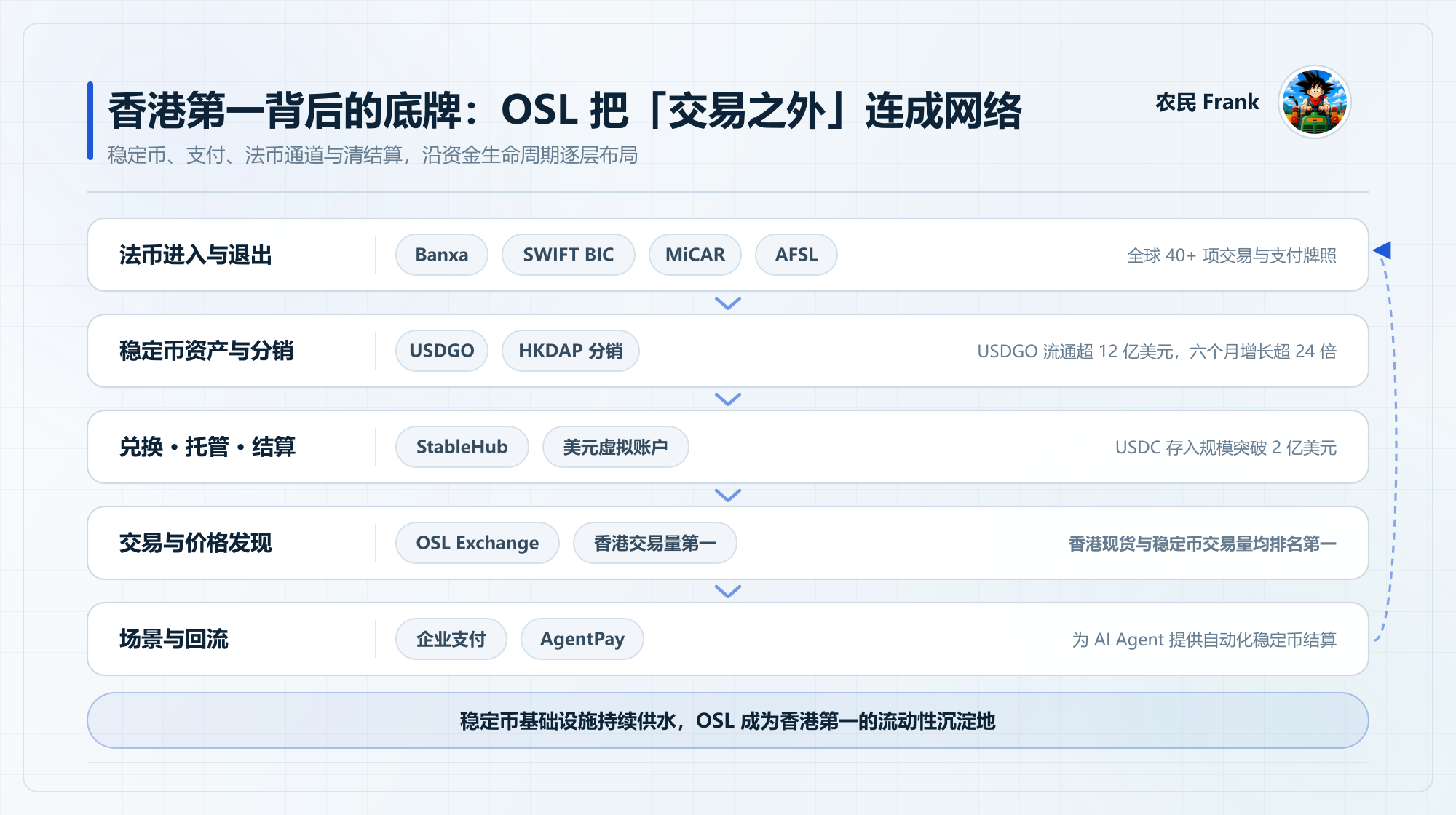
At this point, looking back at OSL Exchange's recent trading volume growth, the logic is completely different: previously, we understood exchanges making money and then using that income to invest in payment and stablecoin businesses, but now it's the opposite, stablecoin infrastructure is actively supplying liquidity to the exchange:
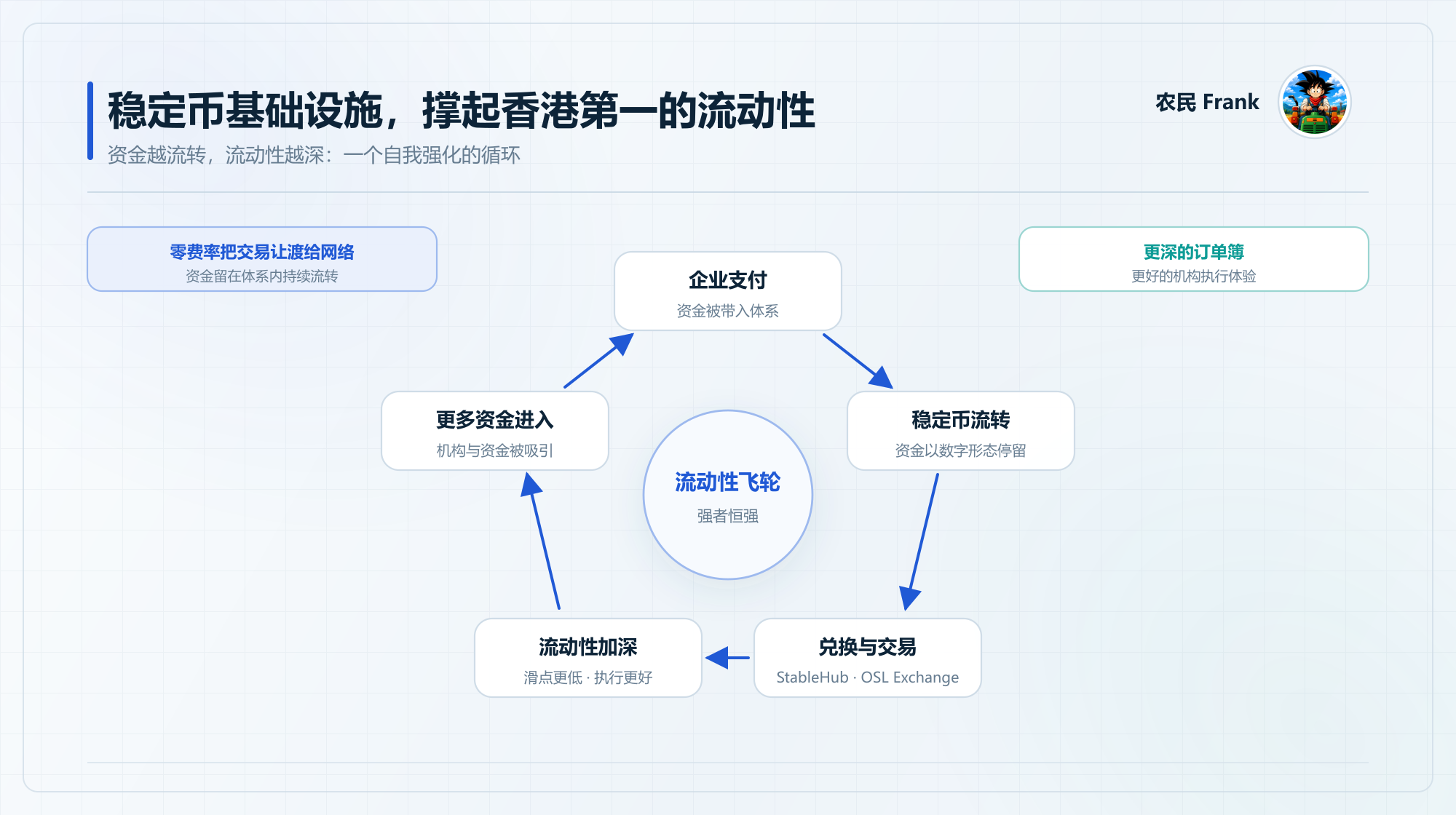
Enterprise payments bring funds in, stablecoins allow funds to stay and circulate in digital form, and StableHub and the trading platform meet exchange and liquidity needs; deeper liquidity leads to lower slippage and better institutional execution, thereby attracting more funds and financial institutions.
The ultimately formed cycle is a self-reinforcing loop: "Funds enter → Stablecoins settle → Trade and exchange → Liquidity deepens → Institutions access → More funds enter," and it is only within this structure that the previously mentioned "zero fees" becomes truly understandable.
What the platform truly seeks to retain is not just a few basis points of income generated from a transaction, but the money itself and the next payment, currency exchange, custody, trading, and settlement continually generated around that money.
When trading shifts from being the endpoint of a business model to a node in the capital network, an exchange is no longer just an "exchange."
3. Will Hong Kong's Web3 Welcome Its Own "DeepSeek Moment"?
At this point, the question is no longer just why OSL can obtain more trading volume.
What is more worthy of attention is that as competition between exchanges extends from the number of listed coins, transaction fees, and app experience, to compliance networks, funding entries, stablecoin liquidity, and institutional-level clearing and settlement capabilities, Hong Kong's digital asset market is also entering a new phase.
Once these capabilities truly connect, what is formed is not just trading volume, but a funding network that is much harder to replicate than a simple order book.
In a sense, whether it's OSL or HashKey, the changes occurring today cannot be observed solely through the lens of a single company; they point to a question that Hong Kong has been answering for the past few years:
Can a highly regulated virtual asset market truly grow its own commercial scale?
After all, over the past few years, Hong Kong has completed some very important first steps. Trading platforms are licensed, stablecoins enter regulatory frameworks, traditional brokers and asset management firms begin entering the digital asset market, RWA, ETFs, custody, and institutional trading gradually establish their own compliance pathways.
However, if the ultimate service of Hong Kong's Web3 is merely facilitating local users in trading BTC and ETH, then even if policies are more open, its market ceiling remains quite clear, which is not the logic Hong Kong has relied on as an international financial center for decades.
What makes it truly special is that it has long played a role as a "connector": connecting mainland China with global capital, linking Asian enterprises with USD financing markets, and also connecting trade, banking, wealth management, and global asset allocation.
In the era of digital assets, this role has not fundamentally changed.
It’s just that the objects it connects have begun to extend from stocks, bonds, and traditional currencies to stablecoins, tokenized assets, and on-chain finance.
From this perspective, looking back at OSL and HashKey, although their paths are different, they represent two directions of Hong Kong's digital finance growing outward.
OSL focuses more on stablecoins, payments, global fiat channels, and clearing and settlement networks, facilitating smoother fund flows into the on-chain world; HashKey leans towards institutional trading, asset management, and RWA, bringing traditional financial assets into a digitalized system.
One leans towards "capital," while the other leans towards "assets," and a truly mature digital financial market inherently needs both sides simultaneously.
This may very well be where Hong Kong's Web3 is most likely to nurture its "DeepSeek Moment."
It's not about Hong Kong issuing one more policy, granting several more licenses, or suddenly having a highly valued Web3 company emerge; rather, the greatest possibility is that one day the market suddenly discovers that a system previously perceived as stricter in regulatory terms, higher in costs, and difficult to compete with offshore markets can also demonstrate its own efficiency, commercial scale, and global competitiveness.
If such companies continue to emerge from Hong Kong, then the market's perception that "compliance inherently means low efficiency" would truly change.
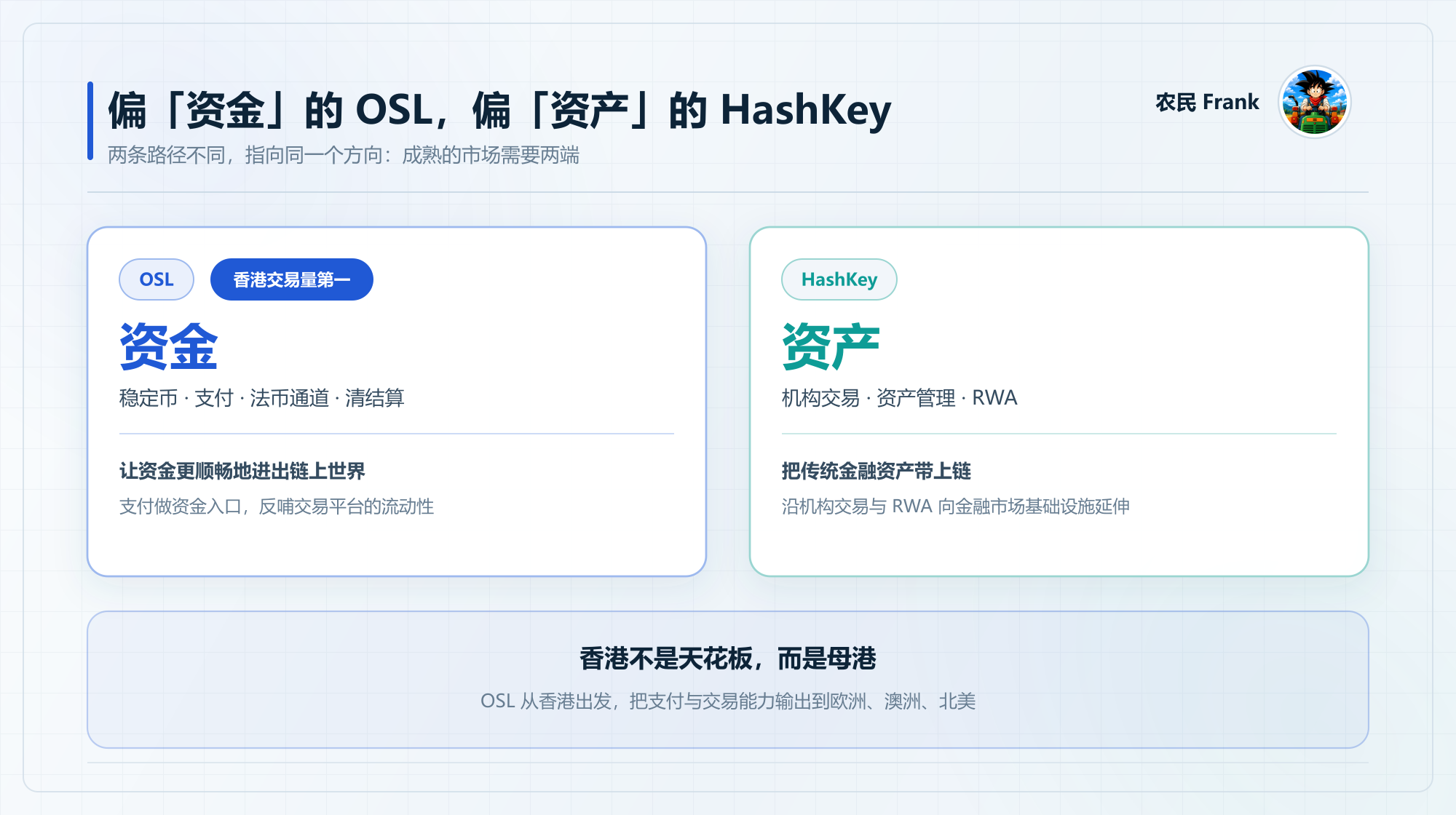
From this perspective, Hong Kong resembles a mother port, where platforms establish regulatory frameworks, governance capabilities, and institutional credit, and then export payment, trading, custody, and capital service capabilities to the broader global market.
This is also the logic Hong Kong, as an international financial center, is most familiar with; the local market has never been the entirety—what truly matters is why global capital is willing to pass through here.
If this path can ultimately be realized, then in the future, global funds, assets, and institutions would be more inclined to enter the digital economy through the compliance infrastructure established in Hong Kong.
Upon reaching that point, Hong Kong's Web3 could genuinely embrace its own "DeepSeek Moment."
In Conclusion
The first decade of Web3 has essentially been driven by "speculative trading" and "token narratives."
This is also the golden age many older users fondly remember, with new public chains, new assets, and new wealth effects constantly appearing; one market cycle after another revolves around "how much the next token will rise."
But the feast of brutal growth will not last forever; over the past two years, the industry's focus has visibly shifted towards stablecoins, payments, settlements, RWA, and institutional financial infrastructure.
This does not mean opportunities will disappear; from a human perspective, as long as assets remain volatile, trading will always be one of the most important demands in the digital asset world; what truly changes is that trading no longer needs to bear the entire value capture task.
For trading platforms, competition is no longer merely about how many BTC are transacted or how much in fees is collected, but rather who can keep more capital within their ecosystem, allowing it to continue fulfilling payments, exchanges, custody, investments, and settlements.
This change is especially evident in Hong Kong, a hub connecting Eastern and Western capital and financial systems.
Thus, OSL Exchange becoming the licensed digital asset platform with the highest spot and stablecoin trading volumes in Hong Kong is not the most noteworthy aspect; rankings fluctuate, market shares change, and trading volumes sway with cycles.
What is important is that after extending from "Hong Kong licensed digital asset exchange" to "stablecoin payment and trading infrastructure," a new growth path is gradually being verified: Payments bring funds in, stablecoins let funds flow, and the trading platform becomes the place where liquidity naturally sediment within the entire capital network.
If this cycle can persist, then what ultimately determines the upper limits of a compliant trading platform's scale may no longer solely depend on how many users are involved in speculating on cryptocurrencies.
But rather, it will depend on how much real capital is willing to pass through it.
Disclaimer: This article represents only the personal views of the author and does not represent the position and views of this platform. This article is for information sharing only and does not constitute any investment advice to anyone. Any disputes between users and authors are unrelated to this platform. If the articles or images on the webpage involve infringement, please provide relevant proof of rights and identity documents and send an email to support@aicoin.com. The relevant staff of this platform will conduct an investigation.