
Author: CICC Insights
Abstract
Recently, overseas AI capital spending has continued to expand significantly and has had an spillover effect on the Chinese economy through the global AI industry chain. On one hand, the construction of overseas data centers and AI infrastructure has driven demand for servers, optical modules, PCBs, communication equipment, and related components, supporting the export of related products in China; on the other hand, the growth of overseas orders has also improved the revenue expectations of domestic AI industry chain enterprises, thereby driving investment in capacity expansion and boosting fixed capital formation. Looking ahead to 2027, according to the consensus expectations of the market, overseas AI capital expenditure is expected to continue growing, but the year-on-year growth rate may decline from the high level of 2026. If the growth rate of overseas AI capital expenditure slows down, what marginal impact will it have on the Chinese economy?
1. Overseas AI capital expenditure is still expanding, but growth may slow after Q4 2026
We mainly focus on the impact of changes in U.S. AI capital expenditures. In Q2 2026, the capital expenditures of five representative cloud service providers—Amazon, Alphabet, Microsoft, Meta, and Oracle—grew by 86.5% year-on-year, continuing the trend of rapid expansion (Chart 1). However, according to FactSet consensus expectations, the scale of overseas AI capital expenditures represented by cloud service providers is still expected to grow, but the year-on-year growth rate may slow after Q4 2026. We believe that, in addition to the high base factor, the slowdown in growth may also be related to the gradual visibility of constraints such as financing, physical, and security governance.
Chart 1: Market expects year-on-year growth of overseas AI capital expenditures to slow in Q4 this year

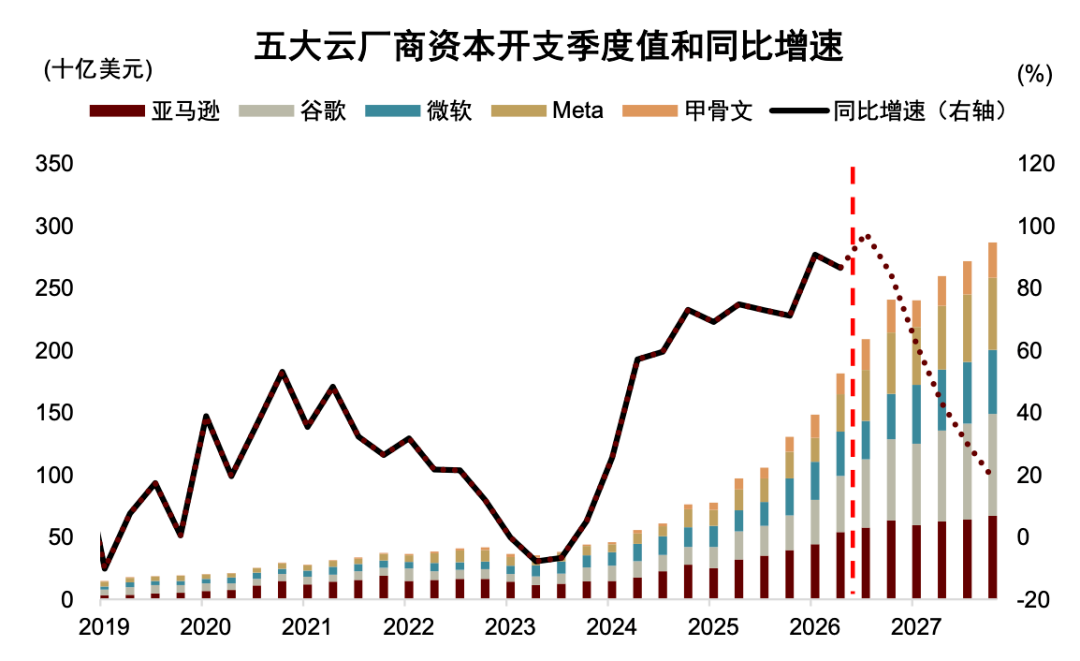
Note: Overseas AI capital expenditure in Q3 2026 and beyond is FactSet's consensus forecast
Source: FactSet, CICC Research Department;
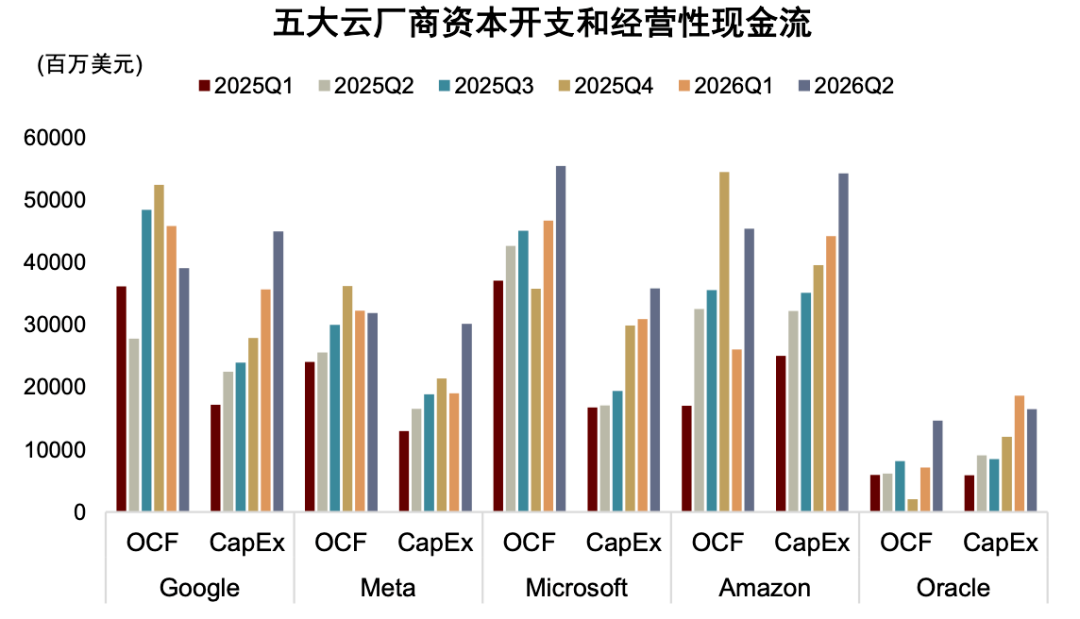
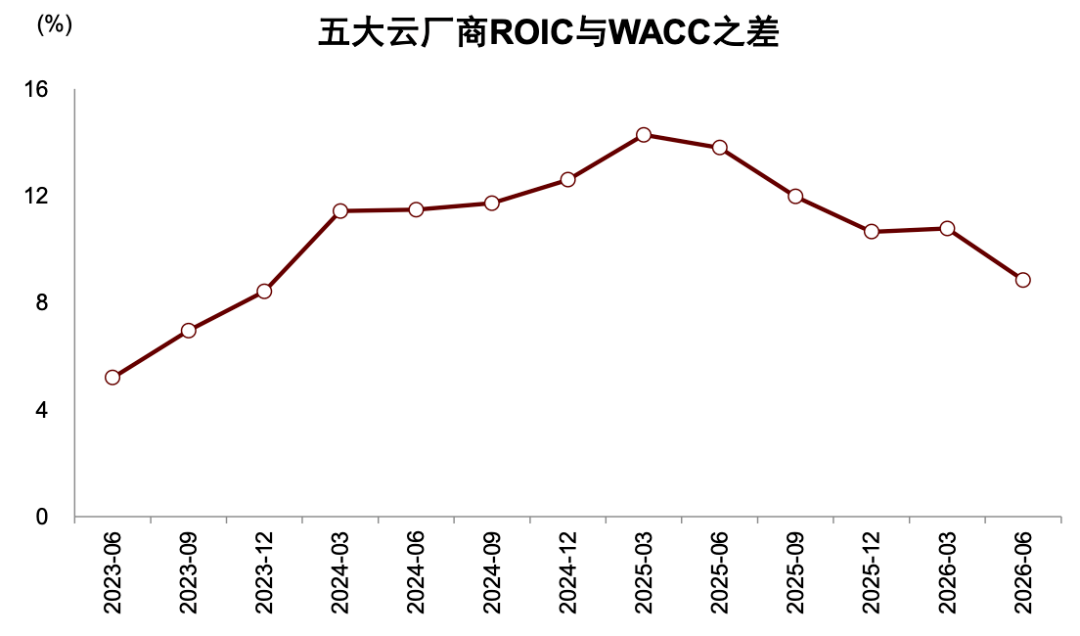
First, as the capital stock expands rapidly, corporate investment returns and financing constraints gradually increase. Over the past two years, capital expenditures by cloud service providers have expanded rapidly, putting pressure on free cash flow (Chart 2), leading to increased dependence on external financing. Against the backdrop of relatively high long-term interest rates and rising credit spreads for some cloud providers, the increase in financing costs may further raise the return threshold for new investments. At the same time, the large capital stock formed in the early stages also means that future depreciation and amortization pressure will rise. In the context where AI commercialization still needs further realization, the gap between recent ROIC and WACC has also narrowed (Chart 3), suggesting that corporate capital allocation may gradually shift from previous strategies focused on computing power and scale to one that pays more attention to the verification of investment returns, thereby leading to a slowdown in the growth of AI capital expenditures.
Chart 2: The proportion of capital expenditures to operating cash flow for the five major cloud service providers has risen
Source: FactSet, CICC Research Department
Chart 3: ROIC and WACC of cloud service providers have gradually narrowed
Source: FactSet, Bloomberg, CICC Research Department
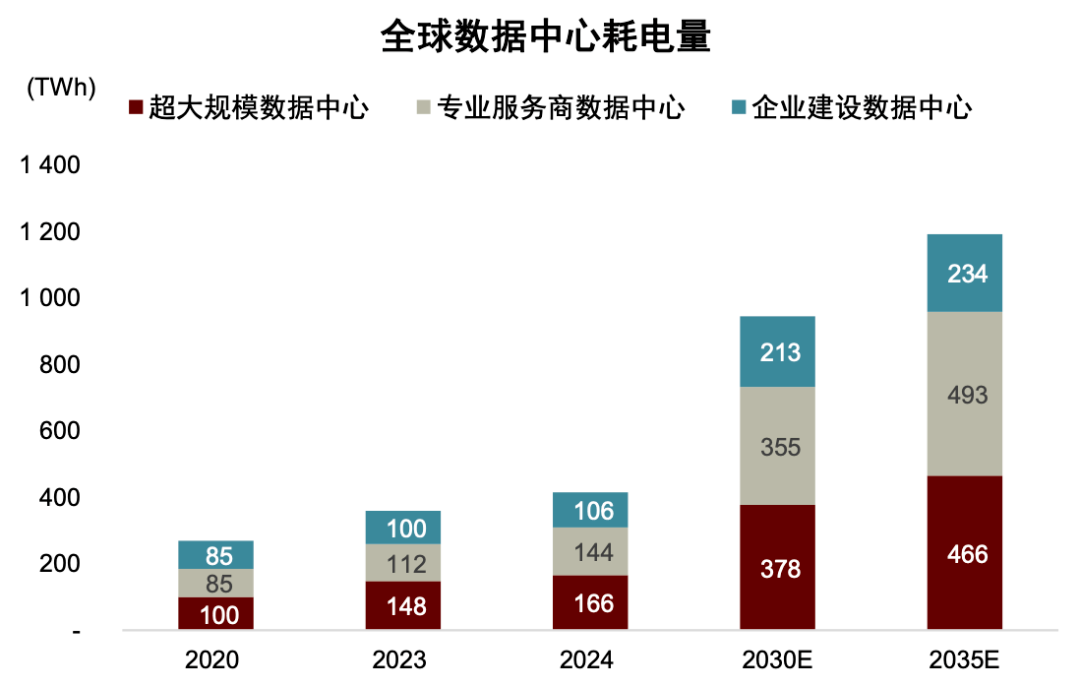
Second, physical constraints are beginning to limit project implementation speed. The expansion of data centers imposes higher requirements on grid capacity, electricity prices, water resources, and land (Chart 4). Since 2025, disputes in some areas of the U.S. surrounding electricity, water, and community costs for data centers have intensified, and constraints have been strengthened through methods such as suspending approvals and raising access requirements, leading to a forced slowdown in the expansion of data center projects [1]. The expansion of overseas AI infrastructure may face pressure characterized by “strong demand but limited project implementation.”
Chart 4: Data center expansion places higher demands on power supply
Source: IEA, CICC Research Department
Third, security governance risks may lead to a slowdown in capital expenditure. As AI's ability to autonomously complete complex tasks rapidly increases, the number of risk events in actual operations is also rising [2], and the importance and urgency of AI security governance are simultaneously increasing. Recently, Anthropic CEO Dario Amodei suggested that the pace of improvement in the capabilities of cutting-edge models should be appropriately slowed down [3], allowing more time for third-party assessment and risk prevention. If similar initiatives translate into industry coordination or regulatory requirements, the large training cycles for cutting-edge models may be extended, resulting in marginal constraints on the demand for training computing power.
2. Export Channels: A slowdown in overseas AI capital expenditure may reduce its contribution to GDP through exports
If the growth of overseas AI capital expenditure slows down, what impact will it have on the Chinese economy? We believe that the most direct impact comes from exports. The construction of overseas data centers requires a large number of servers, optical modules, PCBs, network equipment, and electronic components, in which the Chinese supply chain has a strong participation. Therefore, there has been a noticeable synchronicity between the recent rise in overseas AI investment and the improvement in Chinese exports.
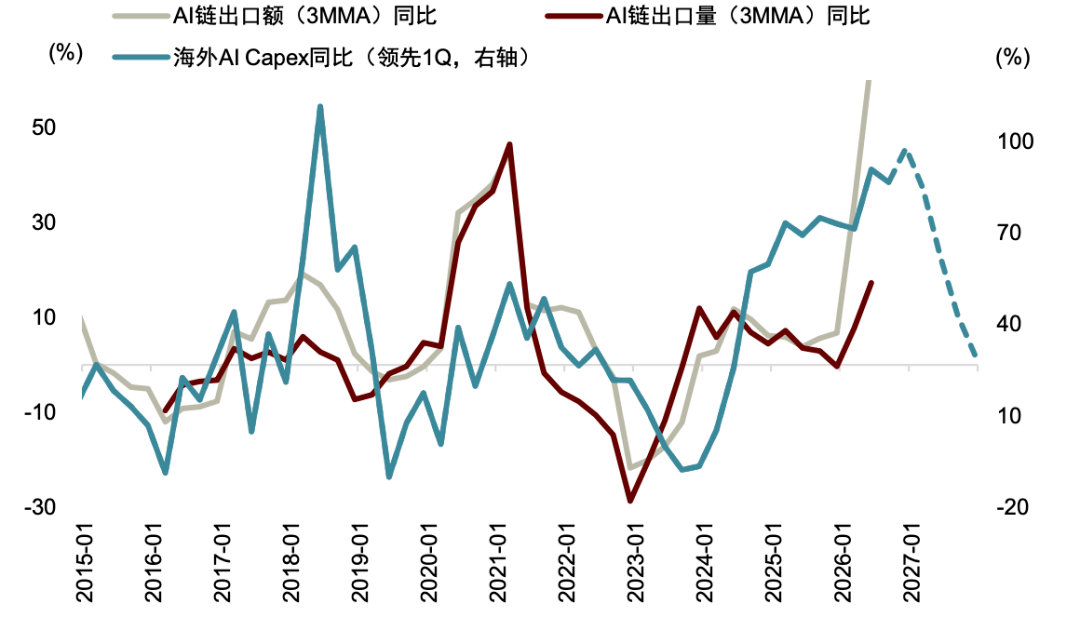
From quarterly data, we find that the growth rate of overseas AI capital expenditure tends to lead the year-on-year growth of Chinese exports and AI chain product exports by about one quarter (Chart 5). Our calculations indicate that for every 10 percentage points increase in the year-on-year growth of overseas AI capital expenditure, the year-on-year growth of China's AI chain product exports increases by about 2.8 percentage points, with a corresponding transmission coefficient of about 0.28. According to the current consensus expectations, the AI capital expenditure of major cloud service providers may decline from 89.9% year-on-year in 2026 to 38.6% in 2027, a decrease of about 51.3 percentage points. This corresponds to maintaining positive year-on-year growth for China's AI chain product exports but with a marginal slowdown of around 10 percentage points. However, we expect that next year, overseas AI capital expenditure is expected to maintain positive growth, still providing some support to China's AI chain exports, just with a contribution that may be lower than this year.
Chart 5: The growth rate of overseas AI capital expenditure generally leads Chinese exports by one quarter
Note: Overseas AI capital expenditure in Q3 2026 and beyond is FactSet's consensus forecast
Source: FactSet, Wind, CICC Research Department
3. Investment Channels: The impact of external demand slowdown is relatively lagging
Overseas AI demand, in addition to directly driving exports, may also further influence the investment in the AI industry chain by raising domestic AI industry chain enterprises' orders and capacity utilization rates. Therefore, the impact of overseas AI capital expenditure on domestic investment is essentially an investment effect induced by external demand.
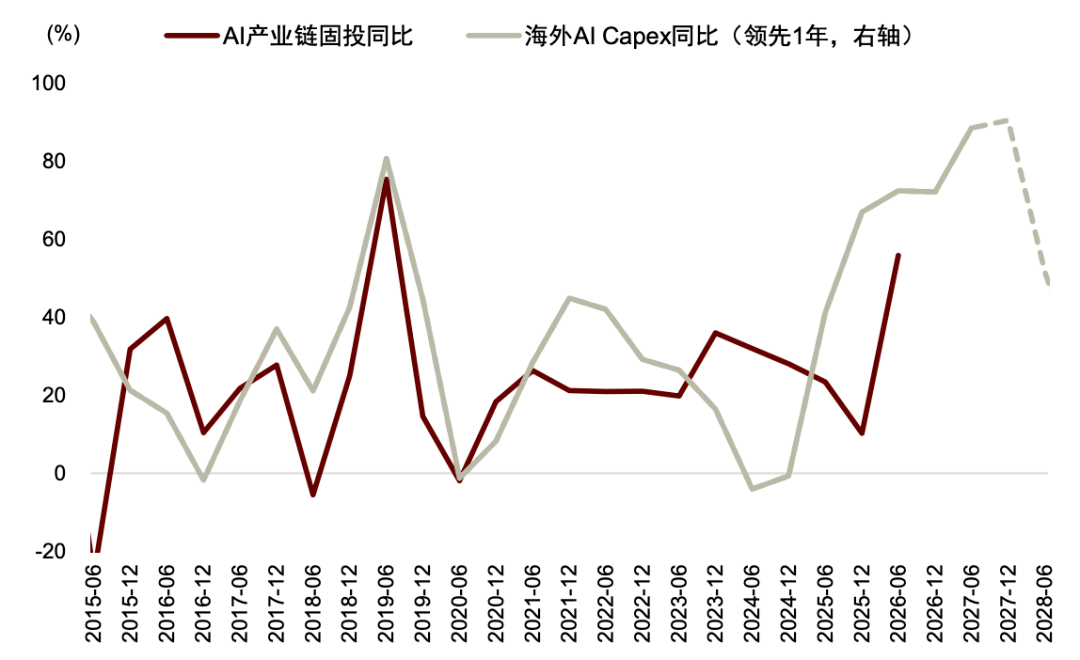
Based on data from A-share listed companies within the AI industry chain [4], we weighted corporate fixed asset investment by the proportion of overseas income to construct an AI industry chain investment indicator related to overseas demand. Our calculations show that changes in overseas AI capital expenditure have a longer transmission lag on domestic AI industry chain investment, with overseas AI capital expenditure leading AI industry chain investment by about one year (Chart 6), with a transmission coefficient of about 0.49. This also aligns with the economic logic that companies require a certain period of time from obtaining overseas orders and confirming capacity gaps to expanding facilities and purchasing equipment.
Chart 6: Overseas AI capital expenditure generally leads AI industry chain investment by about one year
Note: We weighted corporate fixed asset investment by the proportion of overseas income to construct the AI industry chain investment indicator related to overseas demand. Note: Overseas AI capital expenditure in Q3 2026 and beyond is FactSet's consensus forecast
Source: FactSet, Wind, CICC Research Department
From the perspective of marginal effects on economic growth, unlike the export channel, due to the longer lag in investment transmission, the high growth of overseas AI capital expenditure in 2026 may continue to support domestic investment until 2027. According to our current estimates, as the slowdown in overseas AI capital expenditure gradually transmits, the contribution to domestic investment may decline by 2028 compared to previous years.
In summary, from the impact channels, the slowdown in overseas AI capital expenditure's impact on the Chinese economy does not occur simultaneously: the export channel responds quickly, while the investment channel reacts with a lag. Therefore, we expect that the main impact in 2027 may first manifest as a weakening of export support, while the expansion investments driven by previous overseas orders still provide a certain buffer, and by 2028, the lagging impact on the investment channel may gradually become apparent.
Finally, it should be noted that our estimates represent a static local equilibrium analysis, primarily identifying the effects of changes in overseas AI demand. If domestic AI capital expenditure continues to grow rapidly, especially if domestic cloud service providers, computing power infrastructure construction, and domestic substitution-related investments continue to expand, it may form a certain hedge against the slowdown in overseas demand. Additionally, if AI penetration in enterprise operations increases, the estimation of domestic AI investment using cloud service providers may be underestimated, and the actual resilience of AI industry chain investments may also be stronger than the estimates derived solely from changes in overseas demand presented in this article.
Disclaimer: This article represents only the personal views of the author and does not represent the position and views of this platform. This article is for information sharing only and does not constitute any investment advice to anyone. Any disputes between users and authors are unrelated to this platform. If the articles or images on the webpage involve infringement, please provide relevant proof of rights and identity documents and send an email to support@aicoin.com. The relevant staff of this platform will conduct an investigation.