
Author: AiPlot Research Institute
Focus: RWA / Digital Assets / In-depth Analysis of Financial Infrastructure
1. Investment Conclusion: The Market is Shifting from "Narrative Competition" to "Financial Function Competition"
The current hot directions in the crypto market can be summarized into seven categories: Privacy, Tokenized Stocks/RWA, Launchpad, Pre-IPO/Private Market, AI and Revenue Reflow, Perp DEX and Protocol Cash Flow, as well as Stablecoins, Arc, and Agent Payments.
These seven narratives may seem dispersed; in reality, they can be compressed into a clearer industrial logic: Traditional assets need privacy and compliance when placed on-chain; once assets are on-chain, they require trading, settlement, and liquidity; trading activities generate protocol revenue; whether that protocol revenue can flow back to the token determines whether the token has fundamentals beyond attention trading.
From this perspective, the changes in the market have at least five levels.
First, RWA is moving from the phase of "putting assets on-chain" to "making assets tradable, redeemable, and combinable." Stocks, government bonds, money market funds, and equity in private markets can be tokenized, but the real challenges lie not in issuing tokens but in asset rights, custody, trading permissions, investor access, and redemption mechanisms.
Second, privacy has shifted from an early ideological narrative in the crypto industry to a necessary condition for institutional finance. If institutions make all positions, identities, counterparties, and fund flows public on-chain, RWA will struggle to meet compliance, commercial confidentiality, and risk management requirements. The future more valuable privacy infrastructure may not be "completely anonymous" but rather "verifiable to authorized parties, invisible to unrelated parties."
Third, the regulatory progress of Tokenized Stocks pushes RWA from concept to experimental trading systems. The U.S. Securities and Exchange Commission (SEC) issued the "Innovation Exemption" on September 17, 2026, granting conditional temporary exemptions for qualifying Tokenized Securities Venues to trade tokenized NMS stocks in a permitted environment through AMM liquidity pools. This is not a full liberalization, nor do all stock tokens gain legal trading qualifications; rather, it incorporates on-chain stock trading into a restricted, observable, and adjustable experimental framework.
Fourth, the market is beginning to demand that AI and protocol projects answer "the relationship between revenue and tokens." Just because AI products have paying customers does not automatically mean the associated tokens have value; fees generated by DEXs do not automatically imply cash flow for token holders. Only when revenue is returned to buyback, burn, staked earnings, or other holder rights through a clear, continuous, and auditable mechanism can tokens potentially transition from attention assets to cash flow assets.
Fifth, Stablecoins and Agent Payments are still in their early stages, but the industrial infrastructure has begun to take shape. The Circle Arc mainnet went live on September 16, 2026, positioned as a Layer 1 for financial markets, real-time fund flows, and the Agentic Economy, using USDC to pay gas and settlement fees. x402 attempts to allow AI Agents to use stablecoins directly to purchase APIs and digital services through an HTTP 402 mechanism. The industrial value of these directions may be significant, but the real commercial scale of Agent activity, payment frequency, and token value capture is yet to be fully validated.
2. Unified Framework for Seven Narratives
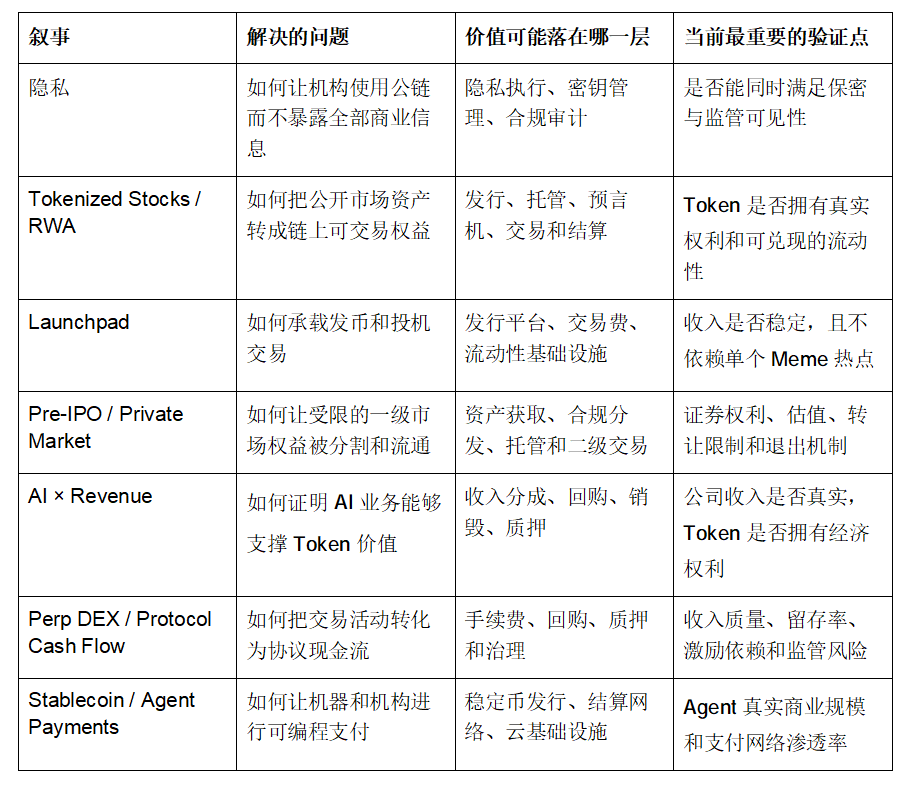
This table indicates that the seven narratives are not seven independent tracks. They can be linked in the order of financial activities: Privacy ensures transaction availability, RWA provides assets, Launchpad and trading protocols offer liquidity, stablecoins provide settlement, AI Agents create new trading demands, and protocol cash flow ultimately determines whether tokens have fundamentals.
3. Privacy: The Infrastructure Layer for RWA in Institutional Systems
1. Why RWA Needs Privacy
The transparency of public chains is an important feature of crypto assets, but financial institutions generally cannot accept exposing all positions, customer identities, transaction prices, and fund paths permanently. Asset management firms may need to protect client portfolios, banks need to conceal counterparty and funding arrangements, enterprises need to protect supply chains and financing terms, and market makers do not wish to expose all their strategies to competitors.
Therefore, the institutionalization of RWA does not mean simply copying traditional assets onto a completely transparent chain. A more likely structure is that asset ownership, trading status, and compliance certificates are verifiable on-chain, but specific commercial data is disclosed only to authorized participants.
2. From Anonymous Transfers to Confidential DeFi
ZEC, ZAMA, and NEAR form a narrative system of privacy: ZEC represents the early market recognition of privacy payments, ZAMA represents extending privacy computing to Confidential DeFi, and NEAR intersects with concepts such as Intent, Chain Abstraction, and Privacy Execution.
Three types of privacy need to be distinguished:
- Transaction Privacy: Hiding transaction amounts, asset quantities, or counterparties;
- Identity Privacy: Preventing external observers from directly associating addresses with real identities;
- Computational Privacy: Completing contracts or model computations without disclosing the raw data.
Institutional RWA may require all three types of capabilities but cannot completely reject regulatory access. Thus, a more realistic direction is "selective disclosure" or "authorized verifiable" privacy: ordinary market participants do not see sensitive data while audit firms, regulatory bodies, and counterparties can be granted proof under certain conditions.
3. Value Capture Issues in the Privacy Track
Privacy technology has strong industrial necessity, but technological necessity does not equate to token value. When researching privacy projects, it is essential to observe:
- Whether privacy computing is being used by real financial institutions or enterprises;
- Whether transaction privacy leads to larger capital scales and higher transaction retention;
- Whether privacy proof, key management, and compliance audits generate chargeable services;
- Whether tokens are used for paying for computation, staking security, network governance, or protocol income distribution;
- Whether regulators accept the system's auditing and tracking mechanisms.
If privacy is merely a marketing label, tokens may remain on the narrative trading layer; if it becomes a necessary component of RWA, bank settlements, and corporate data collaboration, its value could upgrade from "privacy coins" to "privacy infrastructure."
4. Tokenized Stocks: SEC's Innovation Exemption Opens a Restricted Experiment
1. What Exactly Did the SEC Do?
On September 17, 2026, the SEC announced the granting of temporary, conditional exemptions to qualifying Tokenized Securities Venues, allowing them to trade tokenized NMS stocks in a permitted environment through innovative AMMs and liquidity pools.
The key of this measure is not "allowing all stocks to go on-chain," but rather creating a trading environment constrained by conditions. The announcement includes the following requirements:
- The trading varieties and volumes of tokenized NMS stocks are limited;
- Trading venues must verify that holders of tokenized stocks enjoy the same rights and privileges as traditional similar stocks;
- If tokens are issued by a third party unconnected to the underlying stock issuer, the trading venue must notify the underlying issuer and provide an opportunity to oppose;
- The smart contracts used by trading venues must be auditable, public, and deployed on a public, permissionless distributed ledger;
- If the underlying stock ceases trading on major exchanges, the tokenized stock must also stop trading;
- The trading venue must disclose information about its operations, trading activities, and related party transactions;
- The exemption will expire five years after publication, during which time the SEC will collect opinions and assess subsequent rules.
This arrangement indicates that regulatory bodies do not see on-chain trading as completely different from traditional securities markets but are attempting to incorporate it within the existing frameworks for investor protection, trading transparency, and market order.
2. Why is "Retaining Shareholder Rights" Important?
If a stock token only has price exposure without dividends, voting rights, corporate actions, and underlying asset recourse, it is closer to synthetic derivatives or price tracking tools rather than the stock itself.
The SEC's conditions require tokenized NMS stocks to provide the same rights and privileges as traditional similar stocks, which enhances the asset authenticity of the products and increases the complexity of issuance and custody. Issuers must answer:
- Who holds the real stocks;
- Who records stock ownership;
- How dividends are distributed to token holders;
- How voting rights are exercised;
- How stock splits, buybacks, mergers, and suspensions are mapped to on-chain tokens;
- Whether token holders can directly recourse the underlying stocks if third-party issuers go bankrupt.
Therefore, the core innovation of Tokenized Stocks is not making stocks an ERC-20, but rather integrating securities registration, trading, custody, and corporate actions into on-chain systems.
3. Industry Beta vs. Meme Beta
Tokenized Stocks can be divided into two layers: Infrastructure projects like ONDO, LINK, UNI may achieve industry Beta, while meme stocks like AI, MARSCOIN, 4Stock obtain attention and high elasticity.
This distinction has some explanatory power, but not all projects should be placed in the same risk category.
The potential value of infrastructure projects comes from growth in issuance, oracle services, cross-chain transactions, liquidity, compliance, and settlement needs. Their upside potential generally relies more on trading volume, asset scale, and protocol revenue than on the fluctuations of individual meme stocks.
The value of meme stocks, however, is more derived from attention, trading volume, and community spread. They may exhibit higher elasticity during periods of market heat but are also more susceptible to liquidity withdrawals, underlying asset deviation, token unlocks, and regulatory restrictions.
These two layers can thrive simultaneously, but the research methods differ: infrastructure looks at asset scale and cash flow, while meme stocks consider liquidity, narrative lifecycle, and risk control.
5. Pre-IPO and Private Market: The Next Stage for RWA, but Also the Most Complex Stage
1. Why is Pre-IPO More Attractive than Public Stocks?
Placing public stocks on-chain mainly addresses issues of trading time, cross-border distribution, and settlement efficiency; Pre-IPO on-chain solves another kind of scarcity: ordinary investors cannot buy these assets at all.
Private companies or private market targets such as OpenAI, Anthropic, SpaceX, Stripe, Oura, and Polymarket may attract substantial funds due to their growth rates, brand influence, and listing expectations. If the primary market equity can be compliantly divided, custodied, and transferred in restricted markets, on-chain platforms may become a new distribution channel for private market assets.
2. "Available for Purchase" Does Not Equal "Freely Tradable"
Tokenization of Pre-IPO assets faces more legal and business constraints than public stocks:
- Are shares transferable;
- Do company bylaws and investment agreements restrict secondary trading;
- Does the issuer have buyback rights or rights of first refusal;
- Is the valuation from a real financing round, or a self-defined price by the platform;
- Is the asset direct equity, special purpose entity shares, or synthetic price exposure;
- Is exiting only possible through an IPO, merger, or issuer buyback.
Thus, the liquidity of Pre-IPO RWA might be "tradable but not redeemable at any time." An on-chain trading interface can expand visibility but cannot create an exit channel for the underlying assets out of thin air.
3. Why It Easily Becomes a "New Casino"
When assets are scarce, valuations are opaque, listing expectations are strong, and secondary market liquidity is limited, Pre-IPO tokens can easily shift from investment tools to sentiment trading tools. Traders may focus solely on the next funding round and listing rumors, rather than shareholder rights, lock-up periods, and asset custody.
Platforms like Binance, Coinbase, and Robinhood, if they continue to enter this space, may bring greater distribution capabilities and liquidity, but they will also bear heavier compliance responsibilities. Ultimately, whether a long-term market can be established depends on asset information disclosure, valuation updates, transfer restrictions, and redemption arrangements, rather than merely the number of tokens listed.
6. Launchpad and On-chain Trading Platforms: Memes May Change, Fee Models Might Be More Stable
1. Platform Revenue and Token Value Should Be Separated
PONS, STONK, STONKEX, and PUMP can be categorized as Launchpads or "on-chain casino infrastructure," suggesting that the more hotspots, the more tokens issued, and the more active the trading, the greater the likelihood that the platform will earn fee revenue.
This observation reveals an important business model: platforms do not necessarily need to predict which meme will ultimately succeed; as long as they can continuously support issuance, trading, and liquidity, they can potentially earn fees from the activity itself.
However, "high protocol revenue" does not directly equal "Token is worth buying." It is necessary to distinguish:
- Is the revenue protocol revenue or frontend platform revenue;
- Is the revenue net of liquidity incentives, rebates, and market-making costs;
- Is activity reliant on a single hotspot;
- Can revenue be returned to token holders through buybacks, burns, staking, or dividends;
- Is the platform facing risks related to security issuance, gambling, market manipulation, and consumer protection.
2. Boundaries of the "Selling Shovels in a Casino" Model
On-chain Launchpads may derive more stable fees from high-frequency token issuance and trading, but they are still affected by market cycles: in a bear market, reduced hotspots and declining trading volumes will lead to a rapid decrease in platform revenue; tightening regulations may also force the platform to restrict regions, asset types, and user qualifications.
What’s more noteworthy is whether the platform expands from purely meme issuance to RWA, stock tokens, private market assets, and compliant financial products. If the platform can establish a unified issuance, matching, and settlement system between speculative trades and compliant assets, its business model may upgrade from "on-chain casino" to "on-chain asset issuance and trading infrastructure."
7. AI × Revenue: The Next AI Token Must Explain How Revenue Flows Back
1. Why "AI + Token Issuance" Is Not Enough
Past AI token narratives typically suggest: The project has an AI concept, model, agent, or data network, hence the token may gain value. However, if AI products do not have real paying users or the product's revenue is completely disconnected from the token, the token primarily relies on attention trading.
The truly important question is:
How does the revenue generated by AI products increase the economic rights of token holders?
Possible connections include:
- Protocol revenue buys back tokens according to rules;
- Tokens are burned after buybacks, reducing circulating supply;
- Revenue is used for staking rewards or distributed to service providers;
- Tokens are a necessary payment medium for using AI services, data, or computing power;
- Holding tokens can provide product discounts, priority access, or revenue sharing of services;
- Tokens represent governance and economic rights over clearly defined on-chain treasury or protocol cash flow.
Here, buybacks and burns are just mechanisms, not sources of value. Only when revenues are real, continuous, and not offset by new issuance and unlocks can the rights of token holders potentially increase.
2. How to Analyze Revenue → Buyback/Burn
When researching an AI project, the following bridge should be established:
User payment → Company or protocol gains revenue → Deduct costs and incentives → Forms distributable cash flow → Buyback/burn/stake → Improvement in token circulation or holder rights.
If any link breaks, token value capture may merely be narrative.
For example, a project may announce high total revenue, but the revenue comes from one-off grants, token sales, or subsidies, rather than sustainable API, subscriptions, or usage fees. A project may also conduct buybacks, but funds come from financing or treasury tokens, rather than real operational profits. Even if buybacks genuinely exist, if new issuance and unlocks exceed them, circulating supply may still rise.
8. Perp DEX and Protocol Cash Flow: Transitioning from TVL Narratives to Revenue Quality
1. Past Valuation Metrics Are Failing
Previously, DeFi projects often used TVL, user numbers, trading volume, and airdrop expectations to measure growth. However, TVL may come from short-term incentives, users may be short-term addresses seeking rewards, and trading volumes may include low-quality wash trading.
As the market matures, investors are increasingly focused on:
- How much actual fees the protocol charges;
- How much of the fees belong to the protocol, rather than market makers or frontend;
- Whether the revenue derives from genuine trading and borrowing demands;
- Whether users continue to retain after incentives diminish;
- Whether revenues are used for buybacks, burns, or staking;
- Whether the protocol has sufficient risk reserves to cover bad debts and extreme market conditions.
2. Buyback is Not Equivalent to Dividends
Buybacks, burns, and staking rewards can increase token scarcity or yield, but their economic effects differ:
- Buyback and burn: Reduces circulating supply, and value relies on buyback scale and future revenue growth;
- Buyback retained in the treasury: May increase asset reserves but does not necessarily reduce circulating supply;
- Staking distribution: May allocate cash flow to specific holders while introducing inflation and lock-up;
- Direct dividends: May involve stricter securities and compliance issues.
Researchers cannot merely look for "buybacks" but must also assess whether token holders have net economic rights increasing in each cycle.
9. Stablecoin, Arc, and Agent Payments: Industry Alpha Precedes Token Alpha
1. What Does Arc Represent?
Circle announced the public launch of the Arc mainnet on September 16, 2026. Officially, Arc is positioned as an open Layer 1 for financial markets, real-time fund flows, and the Agentic Economy, emphasizing native integration with USDC, using USDC to pay gas fees, sub-second settlement finality, cross-border settlement, tokenized assets, and institutional validators.
Key design focuses of Arc include:
- Fees are paid in USDC, avoiding reliance on high-volatility native gas tokens;
- Reduces settlement wait time through fast finality;
- Supports USDC, EURC, and other stablecoins along with tokenized real assets;
- Targeted at institutional finance, payments, foreign exchange, trading, borrowing, and asset issuance;
- Meets enterprise confidentiality and compliance requirements through privacy and audit design;
- Reserves wallets, payment, and task execution infrastructure for AI Agents as economic participants.
The first-day ecosystem announced by Arc includes financial institutions, asset managers, payment networks, exchanges, custodians, RWA issuers, DeFi protocols, and AI infrastructure providers. Its significance lies in the stablecoin network beginning to attempt to place payments, asset issuance, trading, borrowing, and Agent activities on the same financial-specific track.
2. What Problem Does x402 Solve?
x402 is a payment protocol aimed at internet services. Its basic mechanism is: When an AI agent or client requests an API, the server returns an HTTP 402 Payment Required; after the client makes a payment with stablecoins, it reinitiates the request, and the server verifies the payment and returns the data.
This is different from traditional API payment models. Traditional models usually require users to register accounts, bind payment methods, purchase packages, manage API keys, and deal with prepayment, expiration, and permission configuration issues. x402 attempts to make payment part of the request itself, allowing machines to settle automatically by the instance, amount, or service.
Potential applications include:
- AI Agents purchasing weather, financial, and market data;
- Agents purchasing reasoning, search, and computing resources per instance;
- Software Agents calling services from other Agents;
- Automatic purchasing of APIs, content, risk management, and authentication services.
3. Why Can Only "Industry Alpha" Be Given Now, Not Directly "Token Alpha"?
The industrial direction of Arc and x402 is quite clear, but there remains a gap between industrial value and token value.
Arc can generate demands for stablecoin settlement, institutional services, network infrastructure, and asset issuance. If the network uses USDC to pay fees, ecological growth may initially favor Circle, payment service providers, custodians, applications, and infrastructure providers, not necessarily favoring a particular network token.
x402 enables Agents to pay for APIs, but the true commercial scale of Agents still needs observation. Machines being able to pay automatically does not mean they have sufficient revenue sources, nor does it imply that every payment will yield considerable protocol profit.
Thus, a more accurate judgment for this track is: Industry Alpha is strong, but Token Alpha has not fully emerged. Research focus should be on payment volumes, the number of paid APIs, Agent activity levels, stablecoin settlement scales, and service provider revenues, rather than merely seeking an "AI payment token."
10. Value Capture Ranking of Seven Narratives
If assessed based on the criteria of "real revenue, asset rights, and verifiable demand," the seven narratives can be ranked as follows.
First Layer: Assets and Cash Flow Fundamentals
This layer includes tokenized government bonds, money market funds, stock equity, private market equity, and true protocol income. They serve as valuation anchors. Without underlying assets or cash flow, other narratives may easily remain at the attention trading level.
Second Layer: Trading and Settlement Infrastructure
This layer includes stablecoins, RWA issuance platforms, oracles, custody, cross-chain, exchanges, Perp DEXs, Launchpads, and dedicated financial chains. They earn fees from asset issuance, trading, and settlement, but must demonstrate revenue quality and competitive barriers.
Third Layer: Privacy and Compliance Infrastructure
Privacy, identity, key management, compliance monitoring, and authorization systems determine whether institutions can utilize open networks. These may not easily form short-term hotspots but could be necessary conditions for large-scale RWA adoption.
Fourth Layer: Attention and High-Elasticity Assets
Meme stocks, AI narrative tokens, newly issued assets from Launchpads, and popular altcoins belong to this layer. They can provide high elasticity when liquidity is abundant but are highly sensitive to cash flows, unlocks, and sentiment reversals.
This is not a ranking of short-term prices but rather a ranking of mid- to long-term fundamental support. High-elasticity assets may perform excellently in the short term, but market attention should not be mistaken for asset value.
11. Major Risks and Follow-up Tracking Framework
1. Major Risks
Regulatory Path Risk. The SEC's Innovation Exemption is a temporary, conditional five-year exemption, not a permanent rule, nor does it imply that all on-chain stock trading is permitted.
Asset Rights Risk. Token names, stock codes, and price tracking do not equal underlying asset ownership. It is necessary to confirm how dividends, voting, corporate actions, and bankruptcy recourse are achieved.
Liquidity Risk. On-chain 24/7 trading may not align with the underlying market, custody, and redemption time frames, leading to price premiums, discounts, and liquidity gaps.
Cash Flow Quality Risk. Protocol income may derive from short-term incentives, wash trading, token issuance, or one-off activities. Buybacks may come from treasury financing instead of operational cash flow.
Supply Dilution Risk. If buybacks, burns, or staking rewards are offset by new issuance, unlocks, and inflation, the actual rights of token holders may not increase.
Insufficient Agent Demand Risk. There’s significant creative potential in x402 and Agent Payments, but the real Agent economy still needs users, enterprises, and service providers to form a complete loop.
Privacy Compliance Conflicts. Complete anonymity cannot satisfy institutional regulatory demands, while complete transparency may reduce institutional adoption willingness. Privacy infrastructure needs to strike a balance between confidentiality and auditability.
2. Suggested Data for Continuous Tracking
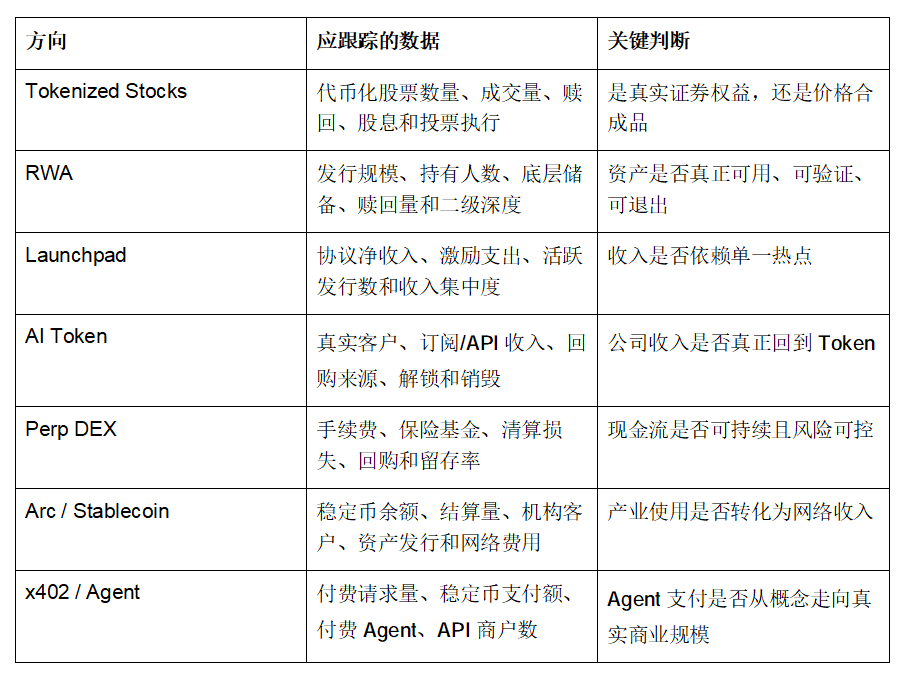
12. AiPlot's Research Value: Don’t Just Look at Narratives, Break Down the Value Chains
What needs to be done is to break down each narrative into four questions:
- What is the real demand? Is it institutions needing to protect positions, users wanting to purchase government bonds, or traders looking for higher volatility?
- Who is providing the service? Is it public chains, issuers, custodians, cloud vendors, exchanges, or frontend platforms?
- Where does the revenue come from? Is it from transaction fees, asset management fees, stablecoin reserve earnings, node service fees, or token incentives?
- What can token holders obtain? Is it governance rights, buybacks, burns, staking rewards, service discounts, or just price narratives?
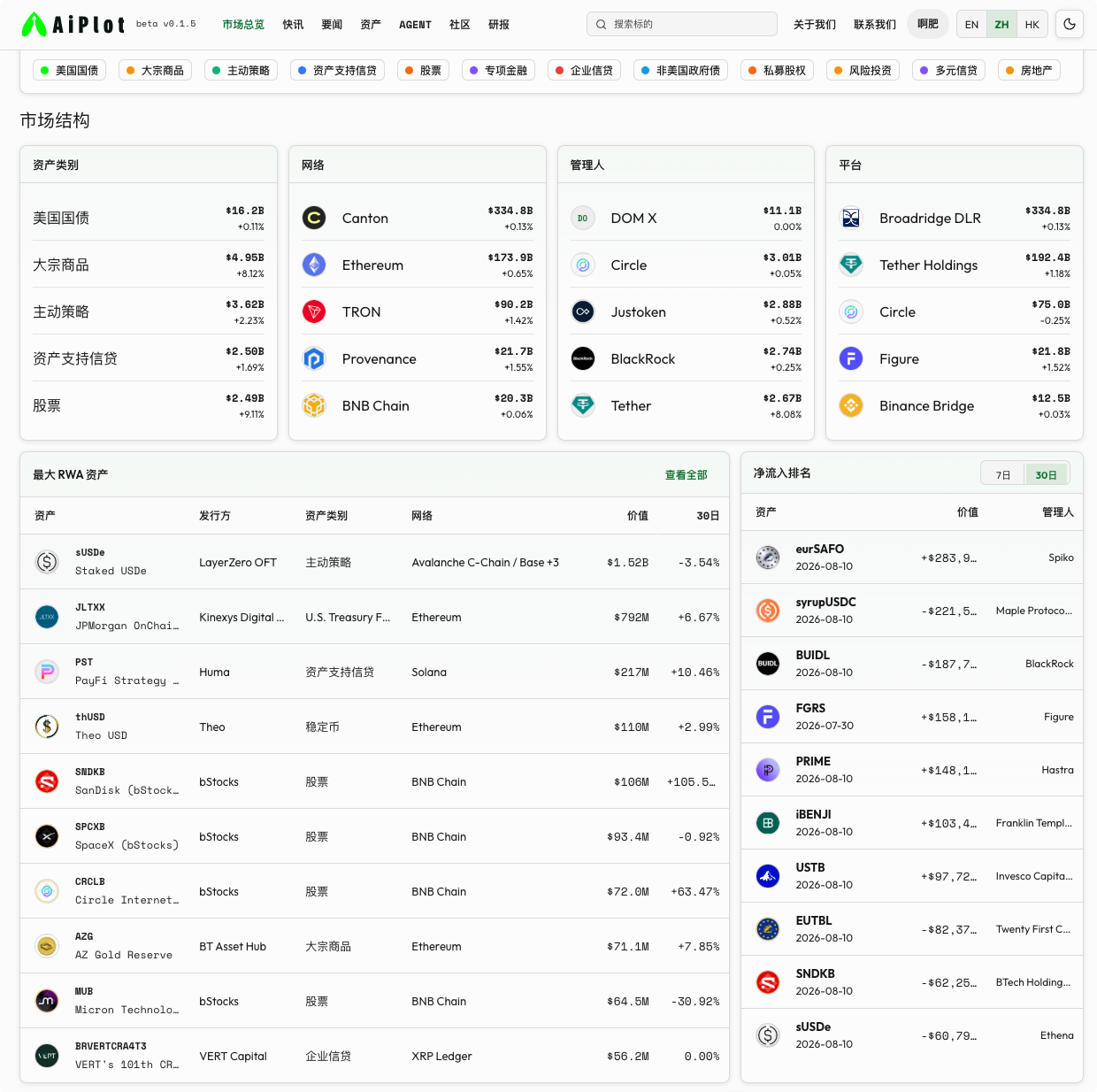
AiPlot's role can extend from asset market tools to cross-market research layers: observing RWA assets, tokenized stocks, stablecoin supply, protocol income, on-chain trading volume, token unlocks, and event information within the same framework. For the current market, the most important thing is not to discover more narratives but to assess which narratives have already generated sustainable assets, users, and cash flows.
13. Conclusion: The Next Round of Truly High-Quality Narratives Must Pass the Value Capture Test
The seven narratives provided by users can be summarized into three main lines.
The first main line is Asset On-chain: Tokenized Stocks, government bonds, money market funds, and Pre-IPO assets have expanded the range of on-chain investable assets. The SEC's Innovation Exemption for Tokenized NMS Stocks indicates that regulation is attempting to establish an observable institutional space for restricted on-chain securities trading, but the five-year term, permissioned trading, variety limitations, and shareholder rights requirements also indicate that this remains a cautious experiment rather than a full release.
The second main line is Financial Activities On-chain: Stablecoins, Arc, Launchpad, Perp DEX, and x402 enable payments, issuance, trading, borrowing, and Agent services to operate on-chain. Their value depends on real settlement scales, user retention, and institutional adoption, rather than the partnership lists promoted by the network.
The third main line is Value Returning to Tokens: AI projects and protocol projects must clarify the relationship between revenue and tokens. Buybacks, burns, and staking are not magic that automatically generates value; tokens can only form fundamental support when operational revenues are real, supply dilution is controlled, mechanisms are transparent, and the rights of holders are continuously increasing.
Ultimately, the next round of higher-quality crypto asset narratives will not just be "AI + Token," "RWA + Token," or "Stablecoin + New Chain." They must answer a more specific question:
Why do real users pay, who receives the revenue, how are asset rights realized, and what do token holders ultimately gain?
Projects that can answer these four questions have a chance to grow from short-term attention assets into financial infrastructure; those that cannot answer, even with popular track labels, are more likely to remain high-elastic trading tools in the next liquidity cycle.
For more data and analysis, please follow AiPlot:
📖 Community Communication:
Telegram:
https://t.me/+IIYMcJigBAo4Mjg1
The content of this article represents the author's personal view and does not reflect the stance of this platform. The viewpoints, conclusions, and suggestions in the text are provided for investors' reference only and do not constitute any investment advice related to this platform. The market has risks, and investment should be cautious.
Disclaimer: This article represents only the personal views of the author and does not represent the position and views of this platform. This article is for information sharing only and does not constitute any investment advice to anyone. Any disputes between users and authors are unrelated to this platform. If the articles or images on the webpage involve infringement, please provide relevant proof of rights and identity documents and send an email to support@aicoin.com. The relevant staff of this platform will conduct an investigation.