Original / Odaily Planet Daily (@OdailyChina)
In November, the prediction market experienced a moment of explosion: Kalshi's trading volume surged to $5.8 billion, and Polymarket reached $3.74 billion, both setting new records, with a combined trading volume approaching the $10 billion mark.
With capital enthusiasm soaring, Kalshi completed a $1 billion Series E financing at a valuation of $11 billion; Polymarket, after receiving a $2 billion investment from ICE, is seeking a new round of financing between $12 billion and $15 billion.
Amidst the heat, undercurrents are stirring. Kalshi faces dual pressures from regulatory scrutiny in Nevada and lawsuits from users; Polymarket has restarted its U.S. operations after settling with the CFTC, launching a local version of its app Launch of the U.S. APP. Meanwhile, major media outlets CNN and CNBC have reached cooperation agreements with Kalshi, pushing the integration of prediction markets and news into a new phase.
To the left is gambling, to the right is information. What lies before the prediction market is not only the embrace of capital but also the scrutiny of regulation and the ultimate questioning of its business model.
The Future Development of Prediction Markets: Kalshi Deeply Enmeshed in "Market Making," Polymarket Recruits Internal Trading Team
The future of prediction markets can be seen in the current competition between the two giants. Kalshi and Polymarket have been active recently, and their paths have clearly diverged:
Kalshi: Compliance and Outward Expansion Intertwined
- Regulatory Pressure: States like Nevada are tightening the qualification review for "sports betting," leading to a collective lawsuit due to its affiliated market maker Kalshi Trading, intensifying challenges on the path to compliance.
- Media Breakthrough: Kalshi has established deep cooperation with CNN and CNBC, integrating its real-time prediction data into mainstream news platforms, moving into the public eye.
- Product Chain Integration: Under regulatory pressure, Kalshi is actively collaborating with Solana, Sei Network, and others to promote tokenization and on-chain layout, exploring a balance between compliance and innovation.
Polymarket: On-Chain Transparency and Market Return
- Return to the U.S.: After three years, Polymarket has officially launched the U.S. APP, initially focusing on the sports sector and gradually opening up predictions across all categories.
- Ecosystem Expansion: By launching the MetaMask mobile app, Polymarket is leveraging its vast user base to broaden trading access and diversify channels.
- Building a Market Making System: Recent news shows that Polymarket is recruiting new members for its internal market-making team, which may trade against platform users. Sources indicate that it has recently engaged with several traders, including sports betting traders, to invite them to join this new department. It is evident that Polymarket, which currently operates with a "0 fee" strategy, is also seeking its own diversified revenue model, similar to the "market making" turmoil that Kalshi is deeply enmeshed in.
With capital support, both have rapidly risen to become industry giants with valuations in the tens of billions, thanks to their first-mover advantage and product strength. However, after becoming unicorns, they stand at a crossroads: one path leads to "casinos," relying on trading and gambling for expansion; the other path points to "news," integrating information decision-making and becoming the "probability sensor" for future events.
The Future Shape of Prediction Markets: Encouraging Competitive Trading to the Left, Becoming News Products to the Right
In the article “Why Prediction Markets Are Not Gambling Platforms”, we systematically argued the key proposition that prediction markets differ from gambling platforms, playing a unique and important role in price mechanisms, economic value, user structure, and regulatory authority.
After seven years of ups and downs, this once marginal field has become the focus of attention from both traditional finance and the crypto world. Currently, the industry giants and the capital behind them must answer four core questions:
- Where is the new incremental user market?
- How will new product forms evolve?
- How to create new profit models?
- How to define new regulatory boundaries?
Their recent actions are the preliminary answers to these questions. Their paths revolve around two main lines: trading and news.
Trading is the Main Line, from Liquidity Entry to Distribution Channels
For prediction markets, the most important aspect is that users place bets with their "real money," which involves multiple factors such as the direction of objective facts, personal subjective opinions, and market environment trends, resulting in price fluctuations in betting events of "Yes or No."
And fluctuations mean trading opportunities as well as the risks and benefits behind trading.
For Kalshi and Polymarket, the reason they attract numerous star capital institutions is primarily due to the increasing liquidity and attention on their platforms, which often overlap significantly. Like traditional internet tech companies and banks in traditional financial markets, Kalshi and Polymarket need to brainstorm ways to attract more liquidity.
In this regard, the on-chain liquidity of the crypto market is more efficient and enticing compared to traditional financial markets, as on-chain liquidity is not limited by geographical borders, lengthy chains of the Swift transfer system, or strict controls. For prediction market platforms, which currently have a total user scale of only tens of millions, the crypto market group of 600 million people undoubtedly represents at least a tenfold market increment.
Polymarket's launch of the MetaMask mobile application, the integration of the Ton ecosystem with Polymarket, and the integration of Solana and Sei ecosystems with Kalshi, all these events are essentially about seizing the "crypto entry" of prediction markets—just like Coca-Cola expanding its retail network channels in the U.S. market back in the day.
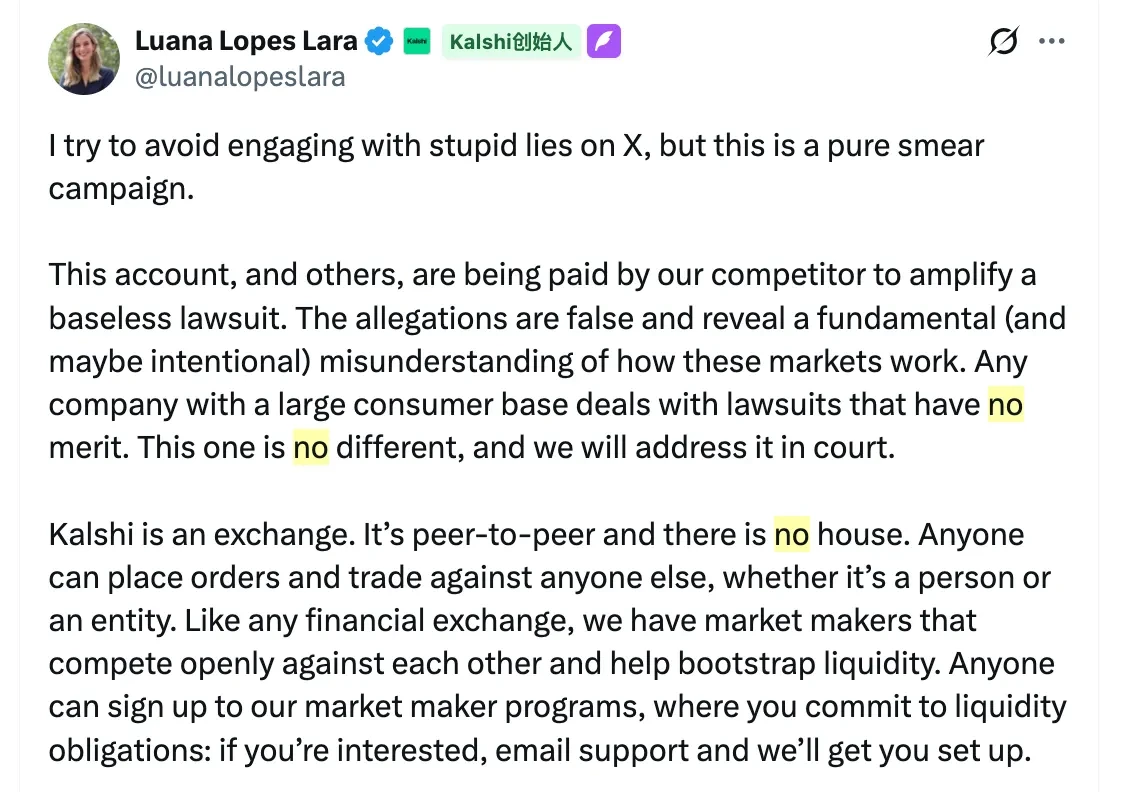
Additionally, the internal market-making teams that Kalshi and Polymarket have already formed or are in the process of forming are also a part of enriching the liquidity of betting events in prediction markets. As Kalshi co-founder Luana Lopes Lara stated, “Kalshi is an exchange. It's peer-to-peer and there is no house.”
However, regulatory agencies may not turn a blind eye to the various means employed during the wild expansion of prediction markets, as this involves the more critical proposition of "who will prediction markets pay taxes (or protection fees?) to." This is evident from the ban issued by Connecticut against Kalshi, Robinhood, Crypto.com, and other prediction market-related platforms.
This leads to another path that prediction markets must take—innovative news products.
News as Packaging, from Traditional Media to Institutional Information
As early as September 2024, Polymarket founder and CEO Shane Coplan officially announced the integration of Polymarket with Bloomberg terminals, which he regarded as a landmark event for prediction markets.
“(This means that prediction markets have) entered the mainstream news and finance field. What was once merely a marginal, sci-fi-like flow of information has now become the new normal, with thousands of people developing a habit of relying on Polymarket predictions as a source of truth to understand what is happening in the world. And it’s still early.”
Looking back a year later, this statement has indeed come true.
Moreover, Ethereum founder Vitalik Buterin has previously stated that prediction markets could greatly benefit the resolution of “public information accuracy”. After all, in the post-truth era, news often trails behind rumors and debunking messages, while the betting events in prediction markets provide real-time dynamic data feedback. This is the greatest driving force behind the deep integration of traditional media like CNN and CNBC, as well as institutional information platforms like Google Finance and Yahoo Finance, with prediction market platforms.
For prediction markets, they also need the "news product" packaging as a shell to respond to the pressure from regulatory agencies regarding "gambling industry accusations"; last year, Polymarket's prediction of Trump successfully winning the U.S. election also successfully validated the remarkable accuracy and greater reference value of prediction markets in news facts.
Moreover, as Kalshi's main market maker and the founder of U.S. options market maker [SIG, Jeff Yass, stated](https://youtu.be/qU9N75Fe1yU?si=VVHE4bganhGB9 USU), the value of prediction markets lies in preventing large-scale wars, quantifying decisions for policymakers, and innovating insurance, among other aspects, which is also the direction of news product innovation.
In the near future, prediction markets may permeate various aspects of social life, stimulating direct economic transactions while becoming an important consideration influencing global situations, sports events, political elections, and personal decisions.
Conclusion: The Future of Prediction Markets is Itself a Betting Event
Aside from the discussions above, the direction of prediction markets may itself be a very special and interesting betting event, just like the event of “Will Polymarket return to the U.S. market in 2025?” which has garnered over $46.48 million in bets on Polymarket. The prediction market platform and the prediction market betting events themselves form a conjugate loop, and in the not-so-distant future, prediction markets may combine with AI Agents, bringing us more trading methods and precise language about real-world trends.
At that time, no single person will be the prophet of the future; rather, the prophets exist in the trading votes of each of us participating in the bets.
Recommended Reading
Is Polymarket about to issue tokens? A look at 5 major crypto prediction markets
After making $4 million, assets went to zero: The mystery of Polymarket's "God of Sports Prediction"
Disclaimer: This article represents only the personal views of the author and does not represent the position and views of this platform. This article is for information sharing only and does not constitute any investment advice to anyone. Any disputes between users and authors are unrelated to this platform. If the articles or images on the webpage involve infringement, please provide relevant proof of rights and identity documents and send an email to support@aicoin.com. The relevant staff of this platform will conduct an investigation.