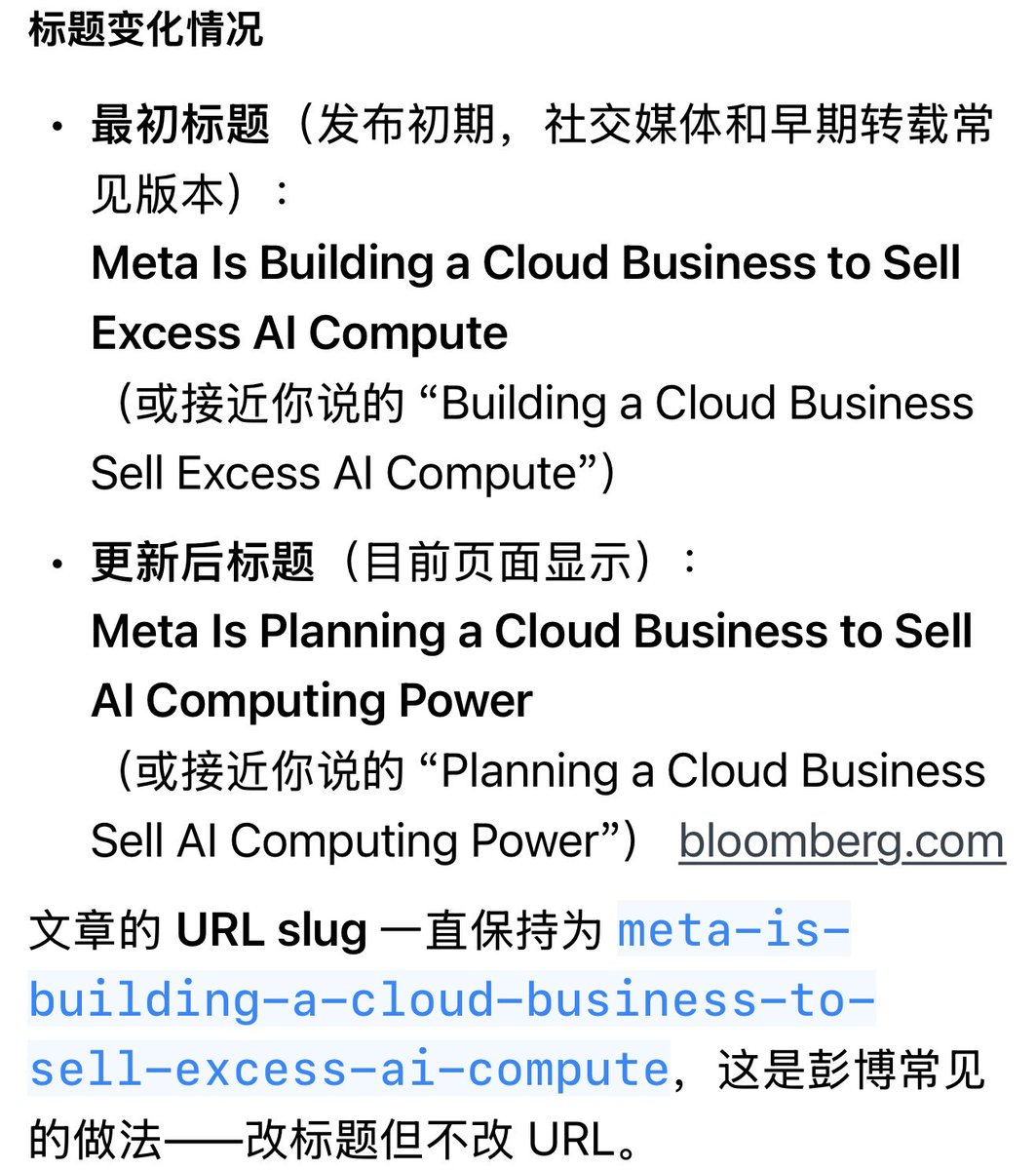
From Excess to Planning: How did the ghost story of Meta's excessive computing power spread? I don't know if you have paid attention to last night's Bloomberg news that crashed the market, but there was actually a headline change in the middle. 1. Last night at 8:35 am, Bloomberg posted a news article with the original title "Meta Is Building a Cloud Business to Sell Excess AI Compute". This title indeed expressed a sense of "Meta" computing power surplus After 10 pm last night, you went to read Bloomberg's report again, and the title has changed to 'Planning a Cloud Business Sell AI Computing Power'. The same article, the same link, the title has been changed .. The 'Excess' that everyone was concerned about has disappeared, and the building has been modified to' planning '. The funniest thing is Reuters, which quickly followed up and quoted this news, but the theme of Reuters' report is: Bloomberg reports that Meta may sell excess AI capacity, but the plan has not been finalized and Reuters has not independently verified it. 2. This brings up the most crucial question: why did Bloomberg change the title? I cannot answer this question for Bloomberg's editorial department, but from the results, this modification clearly and intuitively reduces the certainty and lethality of the original title. Last night's market trading was not just about Meta's cloud business, but also about the "Excess" in Bloomberg's original title that brought about the "excess computing power" association. Bloomberg later changed the title, but the excess Lenovo has already spread. That's also why this matter quickly went from a company news, because one word, combined with viral spread across the internet, turned into a ghost story of the semiconductor chain. Because if Meta has' excess computing power ', the market will immediately push down: Did Meta buy too many cards before? If you buy too much Meta, will Microsoft, Google, and Amazon also buy too much? If big companies buy too much, is AI capex overheating? If AI capex overheats, will GPU, HBM, advanced packaging, servers, power, liquid cooling, and optical modules all be under pressure together? This chain sounds smooth, but stories that are too smooth are often not logical, but rather emotional slides. And the most interesting thing is the market. If the market really understands this news as' AI demand collapsing 'and' Meta computing power running out ', then Meta itself should not be the strongest one last night. Meta in the US stock market rose nearly 10% during trading, while companies like CoreWeave and Nebius experienced double-digit declines, while Nvidia was slightly under pressure. So market trading is not about a collapse in demand (otherwise Meta wouldn't be able to rise), but about 'excess excess', where Meta comes to grab computing power orders and won't incur as much capital expenditure. CoreWeave and Nebius fell, trading 'because if Meta, the original big client, can also sell computing power in the future,' then Neocloud's narrative won't be as convincing to everyone. The entire semiconductor chain is falling, and the transaction is a possible slowdown in capital expenditures. 3. What should we do next? 1) Firstly, the issue with this meta computing power lies in the collapse of its own model, similar to the reason for SpaceX's rental computing power. As mentioned in last night's tweet, there are still some doubts about the issue of meta surplus. After all, we have been signing third-party computing contracts recently. 2) Meta's internal consumption of computing power is actually divided into two parts: one is its own model, and the other is related to AI advertising. The Financial Times reported that Gemini restricts access to Meta's computing power due to issues with its own model, and Meta's AI advertising uses Gemini's model. 3) Meta's stock price surged nearly 10% during the trading session and closed at 8%. It is estimated that Xiao Zha will not come out to refute the rumors, and finally has a sigh of relief. 4) The market rewards rental computing power, which means there is no problem with the demand for AI. What people question is whether there is an excess of computing power? The change in the rental price of AI computing power should give us the answer. Of course, the most crucial thing is that the market congestion is too high. We have discussed it here before https://(x.com)/qinbafrank/status/2067519756882833815? s=46&t=k6rimWsEbo2D2tXolYcM-A。 However, it is true that AI applications are worth paying attention to, and we have already seen several beginning to emerge. This article is sponsored by @ bitget_zh, titled 'Bitget Buying US Stocks: Instant Entry, Smooth Trading'