Loading...
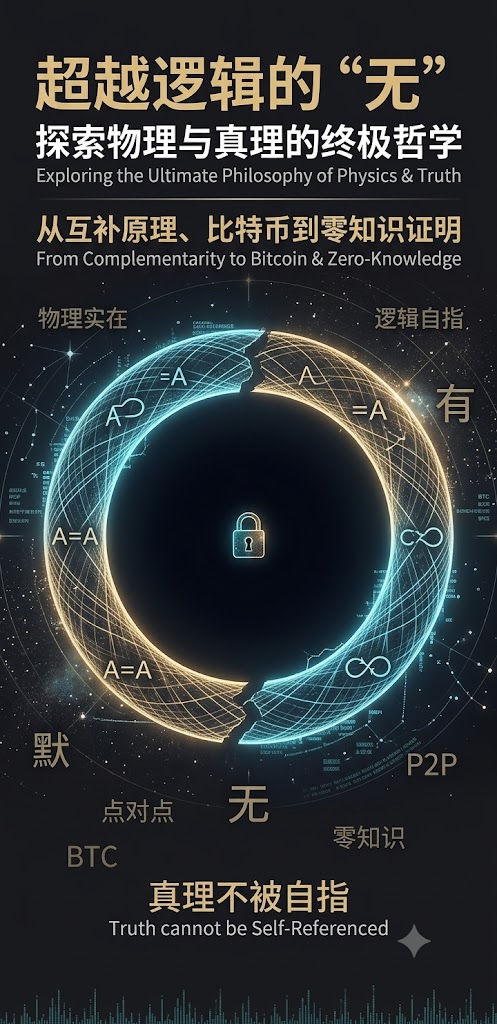
The Philosophy of "Nothingness": Transcending the Realm of Self-Referential Truth The essence of physical reality often lies hidden in depths beyond the reach of human logic. Any logical system attempting to exhaustively define truth will inevitably fall into the structural limitations of self-reference. Take Bohr's principle of complementarity, for instance—its philosophical foundation is built upon recognizing these limitations, striving to depict physical reality through the combination of multiple logics. However, physical reality is the genuine occurrence of the present moment, transcending all complete expressions of symbols and logic. Thus, whether it's the legacy of Bodhidharma or the state of true enlightenment, both are "incapable of being proven by logic." Only through "saying nothing and doing nothing" can one truly perceive this essence. In the constructs of human thought, any system based on "existence" is essentially an illusion embedded with self-referential logic. When a thought attempts to encompass everything (like Musk's philosophy of "X" aiming to include all), it touches the limits of "existence," and its inevitable logical flaws will ultimately leave behind a mess. Similarly, many societal constructs based on "existence" are often mere illusions. In contrast, the closest human thought comes to truth often arises from profound insights into "nothingness." Only "nothingness" can escape the constraints of self-referential logical structures. Throughout human civilization, the greatest foundations are built upon some form of negation or "nothingness": the basis of thermodynamics lies in "no perpetual motion machine"; the cornerstone of relativity is "no absolute motion"; and the revolutionary power of Satoshi Nakamoto's Bitcoin network stems precisely from its "decentralized" peer-to-peer architecture. This act of direct construction is rooted in the unprovable "power of negation." From this philosophy of "nothingness," cryptographic concepts like "Zero-Knowledge Proofs" emerge as profoundly accurate philosophical foundations. They demonstrate that truth can still be proven without revealing any specific "existence" of information. In summary, truth cannot be self-referential; it cannot be exhausted within the layers of logical nesting. True wisdom lies in seeing through the illusion of "existence." Truth can only reside in the realm of "nothingness," free from the constraints of self-reference.