Loading...
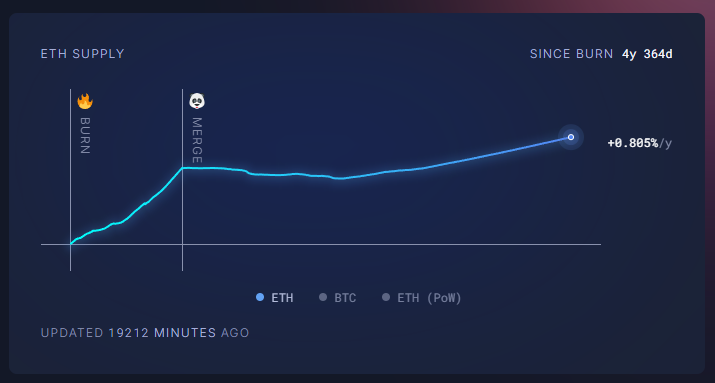
Shan's observations are incredibly insightful—every word hits home and cuts to the heart. I completely agree with the earlier points, but I’d like to add some perspectives from back then about ETH transitioning from PoW to PoS. If ETH hadn’t switched to PoS, just from a price perspective, it would’ve faced another kind of pressure. At the end of the PoW era, ETH miners were producing 13,000 ETH daily. At a price of $2,000 per ETH, that’s $26 million in daily sell pressure. After switching to PoS, the daily issuance dropped sharply to 3,000 ETH, equivalent to $6 million in sell pressure—just 1/4 of the PoW era. The foundation didn’t care at all about how much electricity Ethereum was wasting—after all, it was mostly surplus hydro and thermal power from southwestern and northwestern China. What the foundation really cared about was reducing issuance, so that all the ETH wouldn’t end up in the pockets of Shenzhen mining rig sellers and Sichuan miners. I’ve said before, this was an update that’s written as “consensus switch” but read as “massive issuance cut” . And this red button? It was already pressed back in 2013-2014 when Ethereum was being designed. Do you all still remember the “difficulty bomb”? Ethereum was worried it would succumb to inertia and not dare to switch to PoS, so it planted the difficulty bomb in early versions to make PoW mining so hard it would become unfeasible. Later, due to slow development, the difficulty bomb had to be delayed several times, which led to constant criticism from the community. Overcoming all the opposition to “halt the established plan” was an extremely, extremely tough decision to make. Just imagine—if someone had traveled back in time and punched Vitalik in the face , even he wouldn’t have dared to stop this red button. People back then had their own struggles, after all.