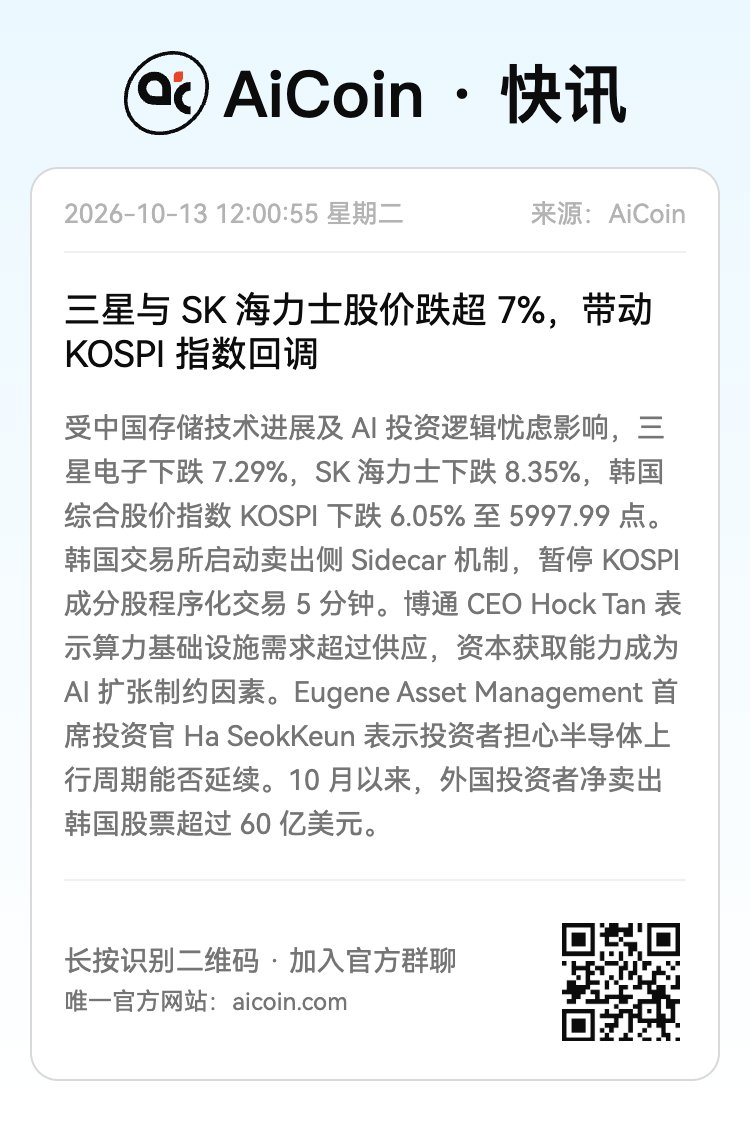
South Korean stocks plunged 6%, but BTC didn’t follow suit. The feared 'cross-market contagion' hasn’t materialized yet, and the underlying capital signals are worth paying attention to. Today, KOSPI dropped 6.05% to 5,997.99 points, Samsung Electronics fell 7.29%, and SK Hynix dropped 8.35%. The Korea Exchange activated the sell-side Sidecar mechanism, halting programmatic trading of KOSPI constituent stocks for 5 minutes. In this round of semiconductor stock adjustments, the market focus has shifted from AI growth expectations to AI return on investment and whether the semiconductor cycle can continue. Since October, foreign investors have net sold over $6 billion worth of South Korean stocks, amplifying market pressure due to capital outflows. The market is now asking one key question: Will this selling pressure in traditional markets spill over into the crypto market? South Korean investors are active in both stock and crypto asset markets. If stock accounts face margin pressure, some funds may need to sell other assets to supplement liquidity. However, judging by BTC’s price action, there hasn’t been any clear sign of synchronized declines so far. BTC hit a daily low of $80,985 before rebounding strongly, climbing back above $83,500 and successfully breaking through the previous key resistance zone. During the dip, liquidations of long positions increased significantly, but after the selling pressure was released, the price quickly recovered and continued upward. At the moment, this looks more like a rebound after leverage clearing rather than a broad retreat from risk assets. Next, keep an eye on two signals: 1. Whether selling pressure in South Korean stocks continues to expand and if risk sentiment spreads further; 2. Whether BTC can hold above $83,600 and challenge the previous highs of $84,000–$84,340 to confirm the strength of the rebound. This article is for market information sharing only and does not constitute any investment advice. #KOSPI #SamsungElectronics #SKHynix #BTC