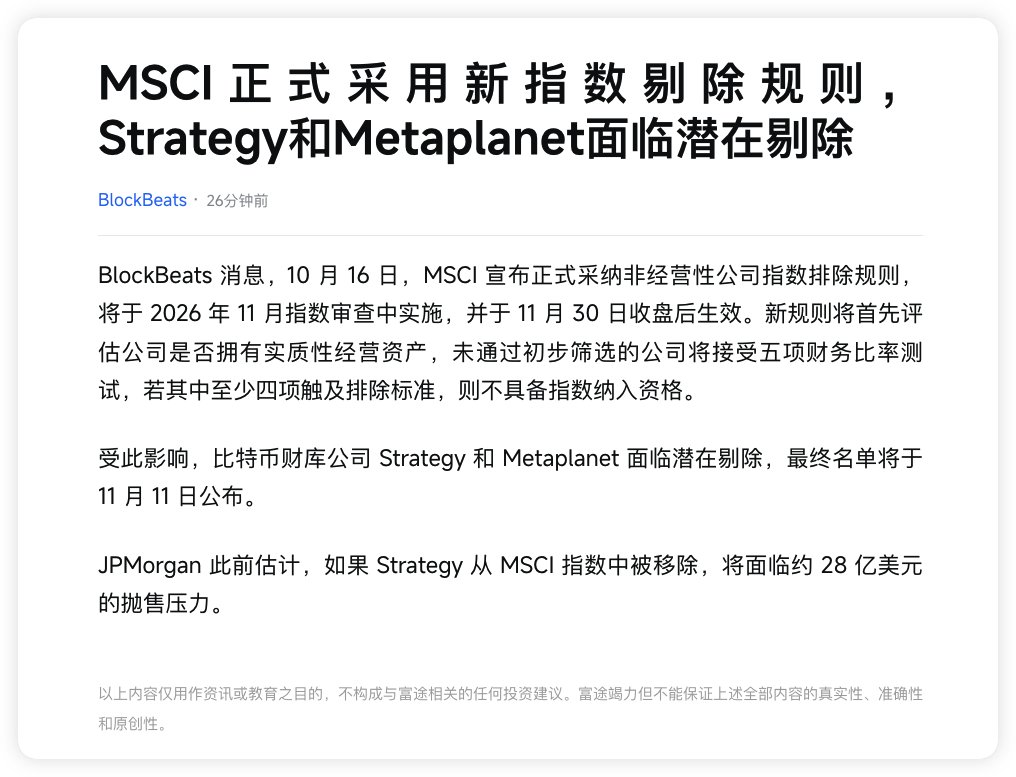
MSCI's new regulations aim to kick out listed companies that are more like investment tools and less like legitimate companies from the global index. Strategy MSTR and Japan's Metaplanet are both potential lists, and funds tracking MSCI hold approximately 13 million shares of MSTR, accounting for 3.1% of the total share capital. If they are kicked out, they may have to passively sell them. But MSCI's new regulations are not aimed at cryptocurrency treasury companies, but at companies that don't seem to be legitimate. On October 15th, MSCI officially finalized the framework for non operating companies, announced the final list on November 11th, and it will take effect from the close of trading on November 30th. Currently, Strategy (MSTR) and Japan's Metaplanet are both on the simulated deletion list. Firstly, it needs to be clarified that MSCI is not directly banning encrypted treasury this time. Instead, a new set of judgment rules has been adopted, which first checks whether the proportion of operating assets exceeds half, and then looks at five financial ratios (operating asset intensity, expense intensity, operating cash flow, fair value change intensity, and capital dependence). If four or more fail, they will be eliminated. The existing constituent stocks still need to fail for two consecutive periods before they can be truly deleted. After the implementation of this set of rules, almost all companies that turn their balance sheets into "encrypted treasury" will be affected. The essence of Strategy is a leveraged Bitcoin holding tool, and software business is no longer important. The same applies to Metaplanet. MSCI uses index rules to define that operating companies exclude treasury management companies. The impact is divided into three layers 1. The first layer is passive funding. 13 million shares are not a small number. JPMorgan has previously estimated that MSCI related funds alone could be invested in the order of $2.8 billion. But centralized selling and daily trading are completely different. Adding other indices to determine if they follow the trend will increase the pressure. 2. The second layer is the financing model. The core gameplay of Strategy is to continuously issue stocks, bonds, and buy coins, relying on stock price premiums to maintain the cycle. Once kicked out of the mainstream index, passive buying weakens, premium space is compressed, and financing costs rise. This is the real bone breaking point, as both financing costs and printing efficiency will be affected. 3. The third layer is narrative, and the market has always used MSTR as a Bitcoin leveraged ETF. The index being kicked is like officially telling everyone that this thing is more like an investment tool than a management company. The valuation anchor of narrative will shift from cryptocurrency treasury companies to non operational companies. There may be short-term impacts, but don't jump to conclusions. The existing constituent stocks have a buffer period, and the final list has not yet been released. The probability of being kicked is not low, but the time window has given the market digestion. More importantly, the price of Bitcoin itself is the true driving force behind MSTR. Index exclusion is a frictional cost, not value destruction. What should be asked now is: After being kicked, who is still using real money to give it a premium? The essence of this matter is that the power of index compilation is being redrawn. Who is qualified to stay in the establishment of a legitimate company, and who can only stay in the basket of alternative tools. MSCI uses rules to tell you that companies with a large market value cannot be included. I think the real variable is not the rules themselves, but whether the funds will re price such companies after the rules are implemented. However, for the current micro strategy, the market value of the company is still slightly smaller than the market value of the Bitcoin held. If this news has a significant impact during high premium periods, it will eliminate the premium. But now the market value of micro strategies itself comes from Bitcoin, and the impact is not as significant