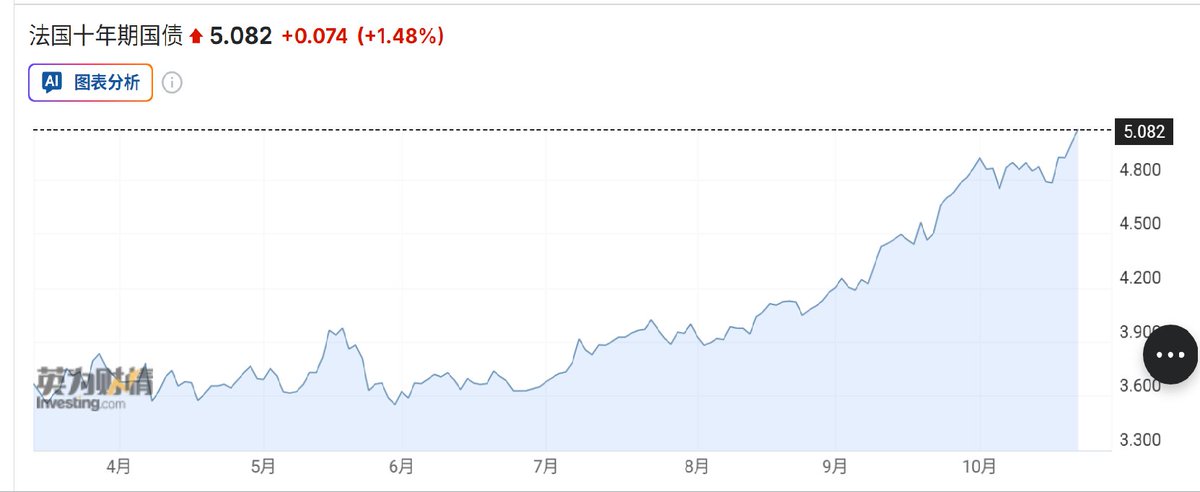
France owes 3.6 trillion euros, why is it bound to explode sooner or later? Because the lifeline is in someone else's hands. According to data from the Bank of France for the second quarter of 2026, the proportion of foreign investors holding long-term French government debt has risen to 58.4%. In the first quarter, it was still 55.9%, but in the second quarter, it jumped directly. This is not 'borrowing money for development', it is' borrowing money for survival '. And the money for extending one's life is in someone else's hands. The first thing to focus on is Japan. Bloomberg estimates that Japanese investors hold about 23 trillion yen of French treasury bond, equivalent to 145 billion dollars. In the eurozone, Japan's allocation of French bonds is the most severely over allocated. In the past, domestic interest rates in Japan were low, and money flowed to France, taking advantage of interest rate differentials. Now that the Bank of Japan is raising interest rates and the yen is flowing back, this batch of money may turn around at any time. Once Japanese institutions start selling, the buying demand for French bonds will be significantly reduced. The second wound is that France cannot afford to pay the interest on its own. In 2025, the interest expense on French debt will be 50.9 billion euros, expected to be 59 billion euros in 2026, and 91 billion euros in 2027. By 2030, the cost of debt repayment will increase by 59%, which may exceed defense spending. The Governor of the Bank of France refers to this as' gradual strangulation '. The more money consumed by interest, the less money can be used for growth and repayment. The vicious cycle has already begun. The third signal is that the market is already pricing. On October 21, the yield of French 10-year treasury bond exceeded 5%, the first time since 2002. The spread between France and Germany soared to 157 basis points, the widest since the 2011 European debt crisis. The most ironic thing is that the yield on French bonds is now higher than that of Italy. Italy's debt accounts for 138% of GDP, which is heavier than France's, but the market believes that Italy is safer than France. Why? Because most of Italy's debt is bought by Italians themselves. What about France? More than half are in the hands of foreigners. Foreigners run much faster than locals. So the logic behind France's bankruptcy is not only that the debt is too high, but also that the creditors are not its own people. This is very troublesome! When your creditors are Japanese pension funds, global hedge funds, or Luxembourg registered fund shells, they don't need to show you affection. When the interest rate spread widens and the rating drops, they follow the risk control model and sell out. France still has time. Moody's re evaluated the rating on October 23rd, and the outlook is already negative. Before the 2027 presidential election, no one dares to touch austerity. But time is being consumed day by day by interest. Who is next? Goldman Sachs has already named Italy. The deficit target has been raised to 3.4%, and the debt/GDP ratio may reach 137% by 2028, the highest in Europe. France is a warning, Italy is the main film. And the European Central Bank, this time there is no Draghi who is willing to do whatever it takes.