Loading...
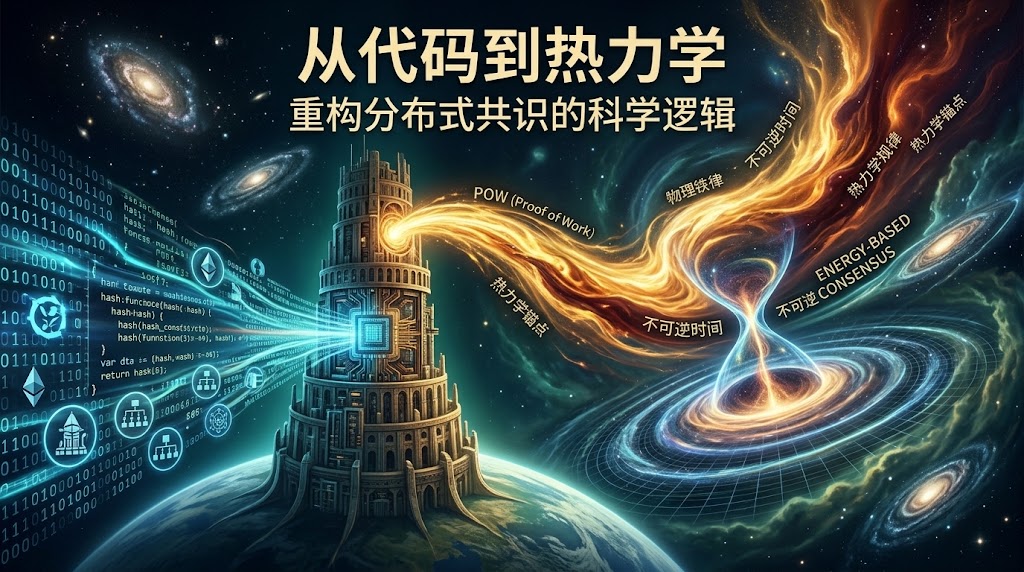
From Code to Thermodynamics: Reconstructing the Scientific Logic of Distributed Consensus All group organizations, social structures, and schools of thought throughout human history (whether early intellectual traditions or modern institutions) are essentially just temporary "stopping points" in the dynamic evolution of humanity. When we examine digital assets and distributed networks, we often fall into the misconception of regarding "code" as absolute authority. However, from a more rigorous scientific perspective, this perception requires a fundamental reconstruction. I. Examining the Limitations of "Code Supremacy" Traditional distributed networks (such as the Ethereum ecosystem) often adhere to the tenet of "trust code, not people." However, from the perspective of information science and systems theory, software code is essentially still an "artificial syntax rule" created by humans through logical symbols. Since code is written by humans, it carries the limitations of human cognition and possesses artificial attributes such as modifiability, forkability, and upgradeability. Entrusting complete trust to volatile code is tantamount to building a grand architecture on a fragile artificial beach. II. The Iron Laws of Physics and the Irreversible Arrow of Time As natural science reveals, man-made laws, contracts, and even ideologies change with the evolution of history. Only objective physical laws are the unshakeable iron laws of the universe. Within the framework of thermodynamics and computational theory, the core constraints of the universe are **irreversible physical time** and **energy consumption**. Time has a unidirectional flow; once information is given a real physical cost, it cannot be easily erased. Any attempt to tamper with historical records must pay a price commensurate with real physical energy. III. The Physical Anchoring of the Nakamoto Consensus Re-examining from this scientific perspective, the profundity of the Nakamoto Consensus lies not merely in writing a few lines of ingenious cryptographic algorithms, but in its clever anchoring of the distributed ledger of the digital world **to the energy and time of the physical world through Proof-of-Work (PoW)**. The code itself may fail, but the computational process, which consumes real physical energy and follows the laws of thermodynamics, is honest. This trust structure, which binds consensus to irreversible physical time, is independent of the free will of any individual, group, or government. It transcends the realm of traditional "man-made laws," becoming a spontaneously emerging, point-to-point order akin to natural laws. Conclusion Humanity's exploration of future social organization and governance has only just begun, and this entirely new path is still in its infancy. The deepest mode of coexistence between people and between people and nature will always follow objective laws. Code may iterate, and ideas may change, but the point-to-point essence rooted in the ironclad laws of physics and irreversible time will forever continue in the dynamic evolution of the universe.