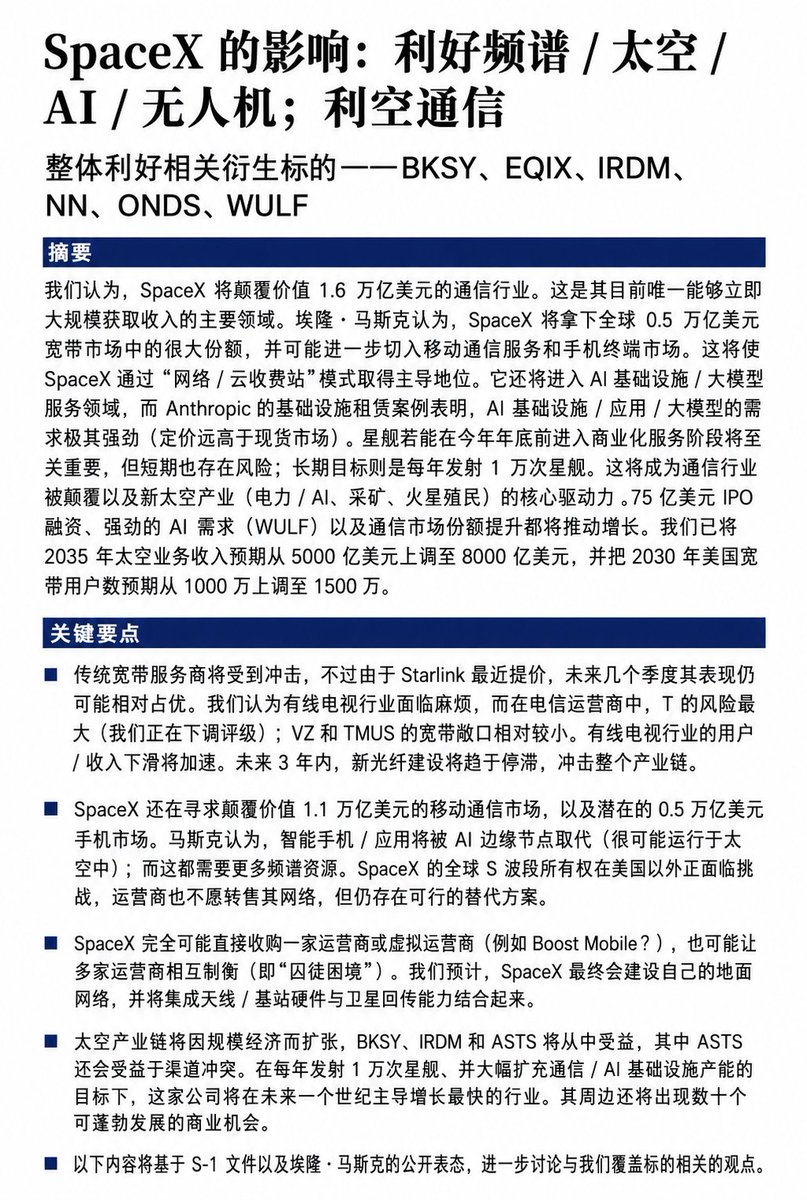
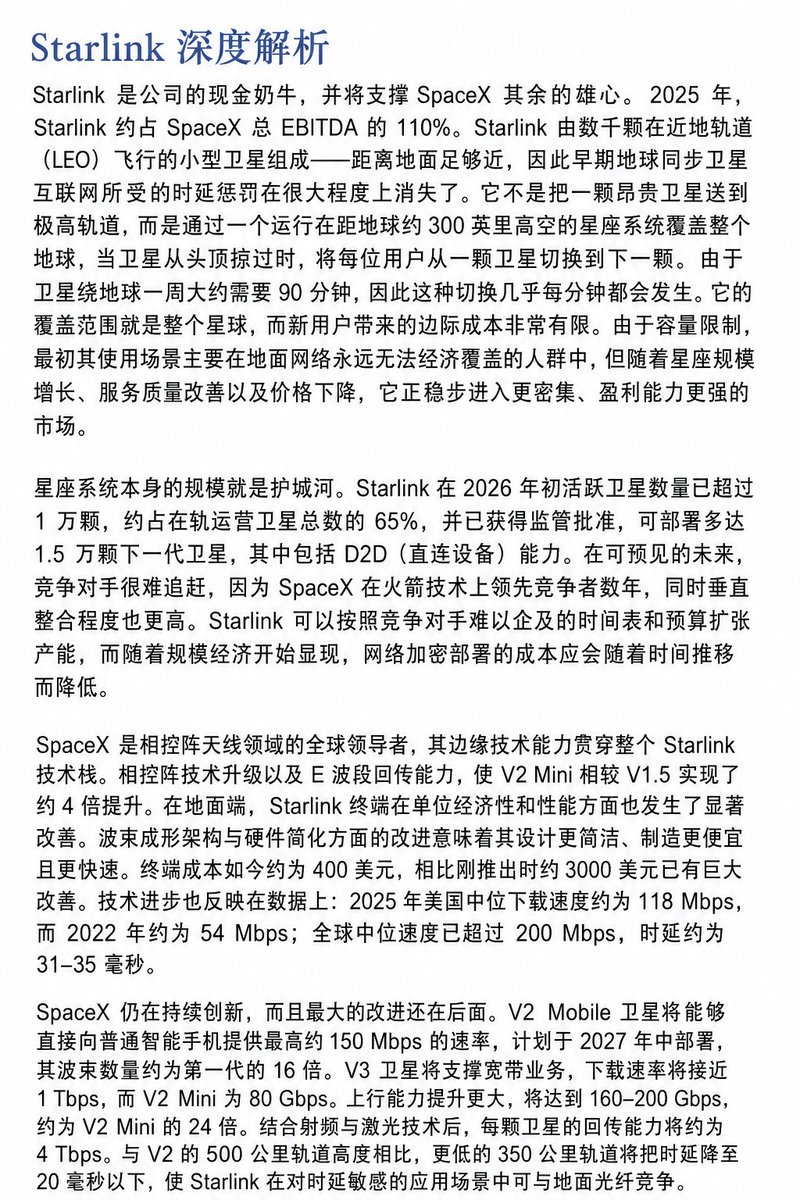
SpaceX is accelerating the cleaning of the global $1.6 trillion traditional telecommunications and network infrastructure industry through its highly vertically integrated Starlink constellation and Starship launch system. According to research reports on market leaks and financial model analysis, Starlink has officially become SpaceX's core cash cow, contributing approximately 110% of the company's EBITDA (earnings before tax, interest, depreciation, and amortization) in 2025, perfectly bearing Musk's funding expenses for deep space exploration and AI computing infrastructure expansion. As of early 2026, the number of active Starlink satellites in orbit has officially exceeded 10000, accounting for about 65% of the total number of operating satellites in orbit worldwide, and has obtained regulatory approval for up to 15000 next-generation satellites. On the hardware side, SpaceX has completed a brutal cost reduction and reshaping. By upgrading phased array antennas, improving beamforming architecture, and eliminating hardware redundancy, the production cost of ground user terminals, which originally cost up to $3000 in the early stages of release, has been forcibly reduced to $400. On the performance side, by 2025, the median actual download speed of Starlink for US users has reached~118 Mbps, and the global median has exceeded 200 Mbps, with latency reduced to~31-35 milliseconds. With the deployment of V2 Mobile satellite with direct to mobile (D2D) capability in mid-2027, which can directly distribute~150 Mbps bandwidth to standard smartphones, traditional smartphones and application ecosystems are even facing intergenerational dimensionality reduction caused by the direct replacement of AI edge nodes deployed in space. This commercial trend, which relies purely on economies of scale and technological lag, is causing devastating pressure on global terrestrial fiber optic construction, cable television networks, and some cross-border telecommunications gateways. The report directly downgraded the rating of American telecommunications giant AT&T (T) and predicted that in the next three years, due to Starlink's penetration into high net worth and high-density markets worldwide, the laying process of new terrestrial fiber optic cables will come to a standstill, leading to widespread bad debts in the entire traditional communication supply chain. Even more ironic is that due to the heavy assets of ground base stations, traditional operators have shown strong resistance to reselling Starlink networks, while SpaceX is evaluating establishing a fully autonomous ground and satellite fusion network by directly acquiring mobile virtual network operators (such as Boost Mobile) or using the "prisoner's dilemma" to differentiate competitors. While traditional big companies are mired in the quagmire of heavy asset transformation, Musk's true ambitions have long transcended simple broadband distribution. SpaceX has officially entered the AI infrastructure and Large Language Model (LLM) computing hosting service. According to the report, the underlying infrastructure lease agreement previously signed by AI unicorn Anthropic indicates an extremely strong demand in the market for space grade/new AI infrastructure provided by SpaceX, with its opaque pricing far exceeding the spot market on the ground. With SpaceX's long-term goal of an average of 10000 starship launches per year, and the capital action of significantly raising the 2035 long-term space industry revenue forecast from $500 billion to $800 billion, the essence of this efficiency war has become very clear. This is no longer an ordinary satellite communication upgrade, but a low-cost monopoly of global information distribution access, spectrum resources, and intelligent node ownership by super computing power and space asset holders represented by SpaceX.