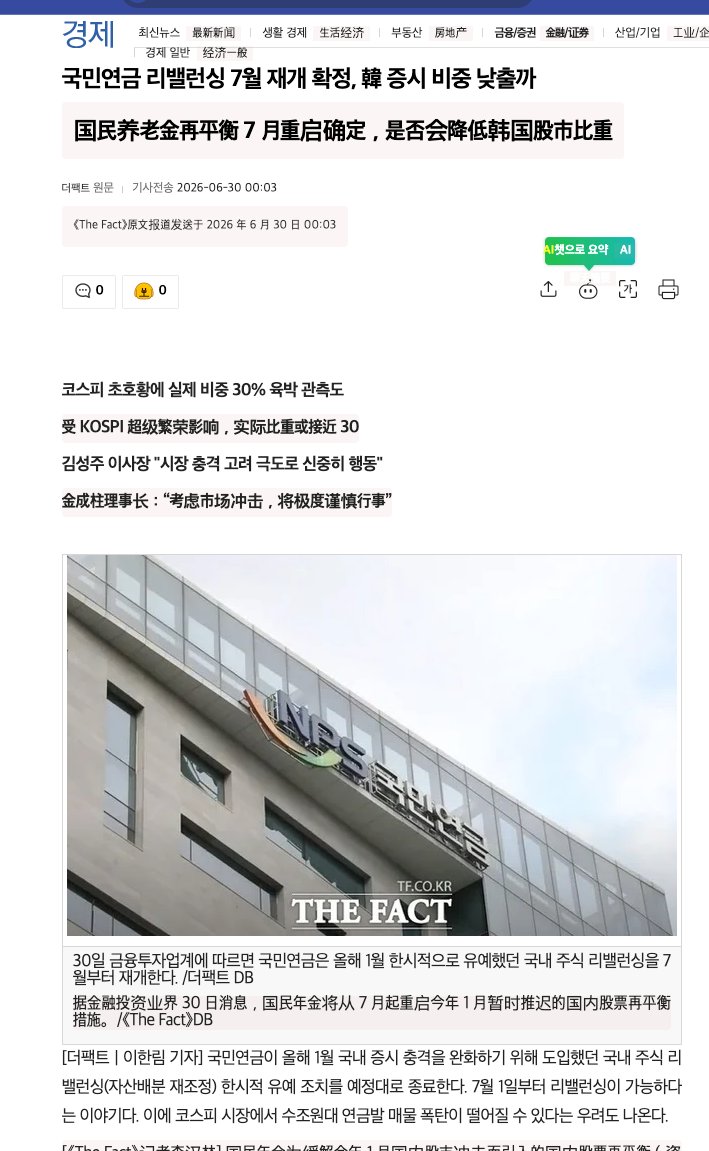
Can SK Hynix still be obtained? How to translate In the past period, the volatility of Hynix has been significant, especially dropping from nearly $2000 to $1600 twice, and the holding experience has not been very good. The reason lies in Part of the reason is the outflow of profits from foreign-funded institutions. On June 29th, foreign investors sold approximately 7.7 trillion Korean won (about 4.9 billion US dollars) worth of stocks in the KOSPI market, setting a record for the highest daily net sales in history, mainly concentrated in semiconductor large cap stocks such as Samsung Electronics and SK Hynix. Another part of the statement from South Korean bloggers is that South Korean pension funds such as the National Pension Fund have recently started to net sell South Korean stocks. I searched for news in South Korea and found that the domestic stock rebalancing that was temporarily suspended in January will resume in July. At the same time, the target proportion will be significantly increased to 20.8%, and measures such as temporarily expanding the scope of strategic asset allocation (SAA) and reducing the daily selling scale will be taken to minimize market impact. But this is not selling Korean stocks due to a bearish outlook, but a normal rebalancing operation caused by the natural increase in the proportion of holdings due to the rise in stock prices. So there will be some pressure on South Korean stocks in July. ~~~~~~~~~~~~ Should we run? After careful consideration, I have decided not to make any changes to the Hynix that I have been holding for a long time, as I believe a portion of this foreign investment will be sold and repurchased after the Hynix ADR in the United States. I asked AI, and it agrees with my judgment that there is a high probability of similar reallocation behavior, especially in active funds. as a result of: Configure credit limit: Many foreign investors, especially emerging market funds in Asia, have reached the upper limit of their "Asian equity" allocation after the surge in Korean stocks. Selling local Korean stocks can release quota, and then buying the same company's stocks through US ADR will be converted to "US equity" allocation, no longer occupying the Asian quota. Valuation arbitrage and 'Korean discount': Korean stocks often have a "Korean discount" (relatively lower valuation compared to their peers in the US stock market). After ADR goes public, it may enjoy a high valuation of US semiconductor stocks (similar to the premium of Micron MU). After foreign investors sell local Korean stocks, if there is a discount on the initial pricing or trading of ADR, they can buy at a low price (relatively) and make a profit. Practical operation convenience: ADR trades in US dollars, does not require handling of Korean won exchange rates/foreign exchange controls, is more easily included in US stock ETFs/passive funds, and has better liquidity. After listing, there may be arbitrage flows where Korean local stocks are converted into ADRs. ~~~~~~~~~· Since the listing of stocks in the US stock market to obtain the world's largest liquidity is a positive news (you can refer to the spot trading of altcoins on Binance), and the expected Q2 financial report of Hynix is expected to be released on July 29th (referring to Micron, it may only be more explosive). No matter how the funds flow out and copy the collateral targets, the shortage of memory is still the core of the AI mainline in the short term, which is a bit like the funds that speculated on ETH in the previous wave of counterfeit bull market may move to speculate on other public chains after a round of speculation, but ultimately return to ETH in terms of exposure and weight. Hold it for another month, and when the market starts to copy Hynix's financial report, attention will increase again. Then consider whether to leave, let alone the grid is still playing.