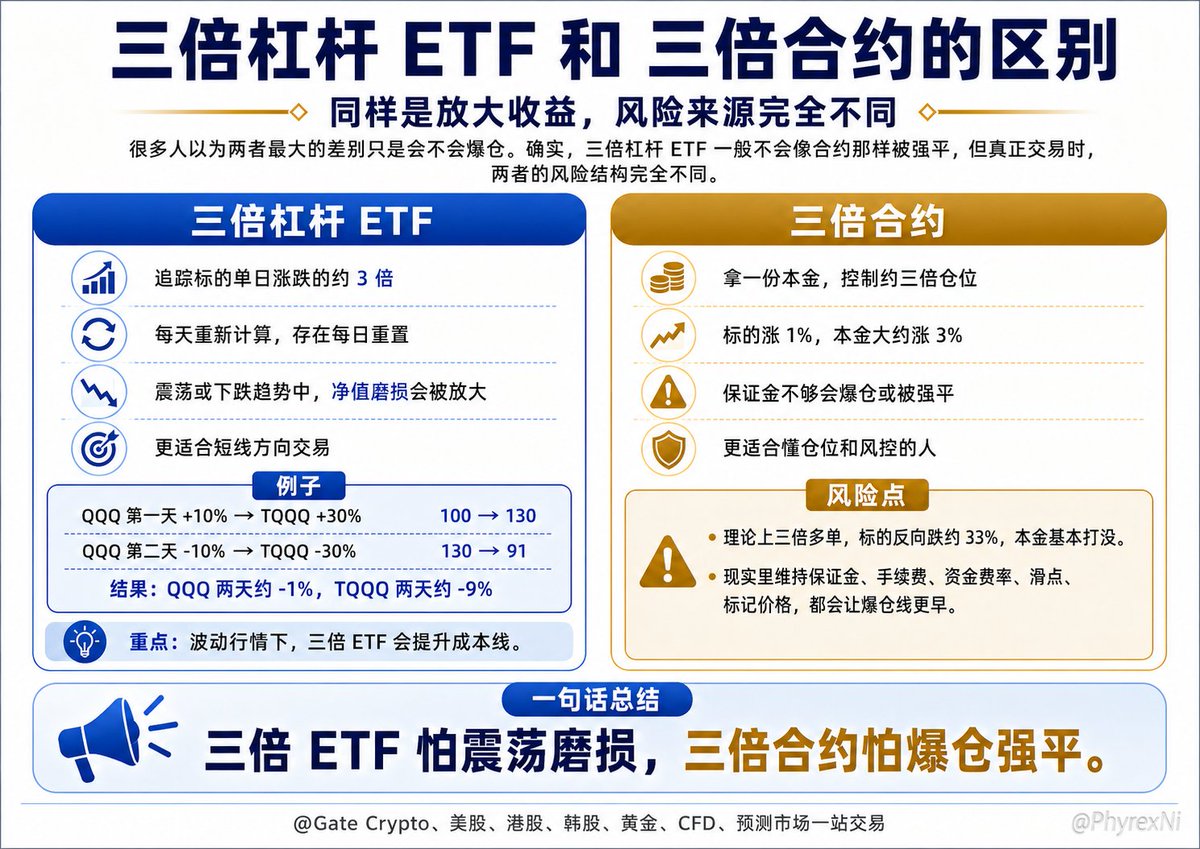
The difference between triple leveraged ETFs and triple contracts - both aim to amplify returns, but the sources of risk are completely different As mentioned earlier about triple leverage ETFs and triple contracts, many people think it's just a matter of liquidation. Triple leverage ETFs won't explode, but triple contracts will explode. Yes, that's the biggest difference. But there are actually more detailed differences. Triple leverage ETF refers to the fund striving to achieve three times the daily rise and fall of the underlying asset. For example, the Nasdaq rose 1% today, TQQQ theoretically rose 3%, the semiconductor index fell 2% today, and SOXL theoretically fell 6%. This triple is recalculated daily, so the core issue with triple ETFs is the cost loss caused by daily resets. Of course, a unilateral upward trend is definitely the best, but if it is a volatile or downward trend, the wear and tear of a triple ETF will be magnified. For example, on the first day, QQ increased by 10%, TQQQ increased by 30%, and 100 became 130. The next day, QQ fell by 10%, TQQQ fell by 30%, and 130 became 91. QQ only fell 1% in two days, while TQQQ lost 9%. Simply put, using a triple leverage ETF in a volatile market can actually raise the cost line. This is why many investors who hold triple ETFs tend to overlook the fact that they simply multiply the long-term fluctuations of the underlying asset by three, but recalculating every day is more important. Triple contract is really simple. Taking a share of capital and opening a triple position essentially means controlling a $30000 position with $10000. If the target rises by 1%, the principal will earn approximately 3%. If the target falls by 1%, the principal will lose approximately 3%. The contract is simpler and more brutal, and if the margin is not enough, the position will be liquidated. In theory, if the target price drops by one-third in the opposite direction after three times the order, the principal is basically gone. In reality, due to maintaining margin, handling fees, funding rates, and slippage points, and even marking prices, the liquidation line is usually earlier. So triple ETFs are more suitable for short-term direction, such as looking at the trends of the Nasdaq, semiconductor, gold, and crude oil for one or two days or a short period of time. The advantage is that trading is convenient, there is no need to monitor margin, and there will be no sudden liquidation problems like contracts. But if a triple ETF is taken as a long-term investment, especially in high volatility markets, it is easy to end up with the index not falling too much and the ETF already falling a lot. Many investors lose money on TQQQ and SOXL not because they see the wrong direction, but because the fluctuations in the middle are too large, which erodes the net value and increases costs. @Gate Crypto、 US stocks, Hong Kong stocks, South Korean stocks, gold CFD、 Predicting one-stop trading in the market