Loading...
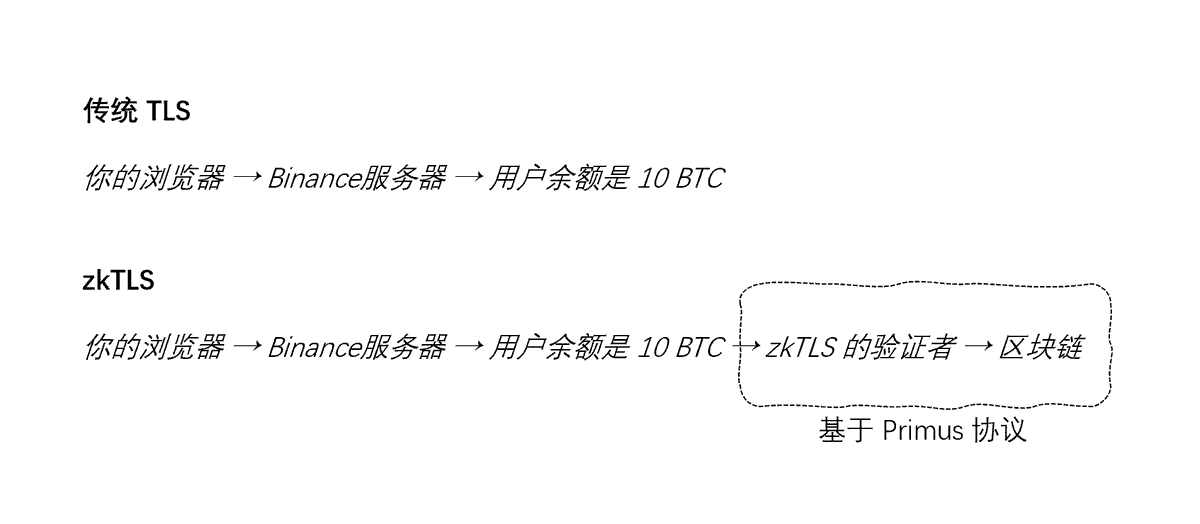
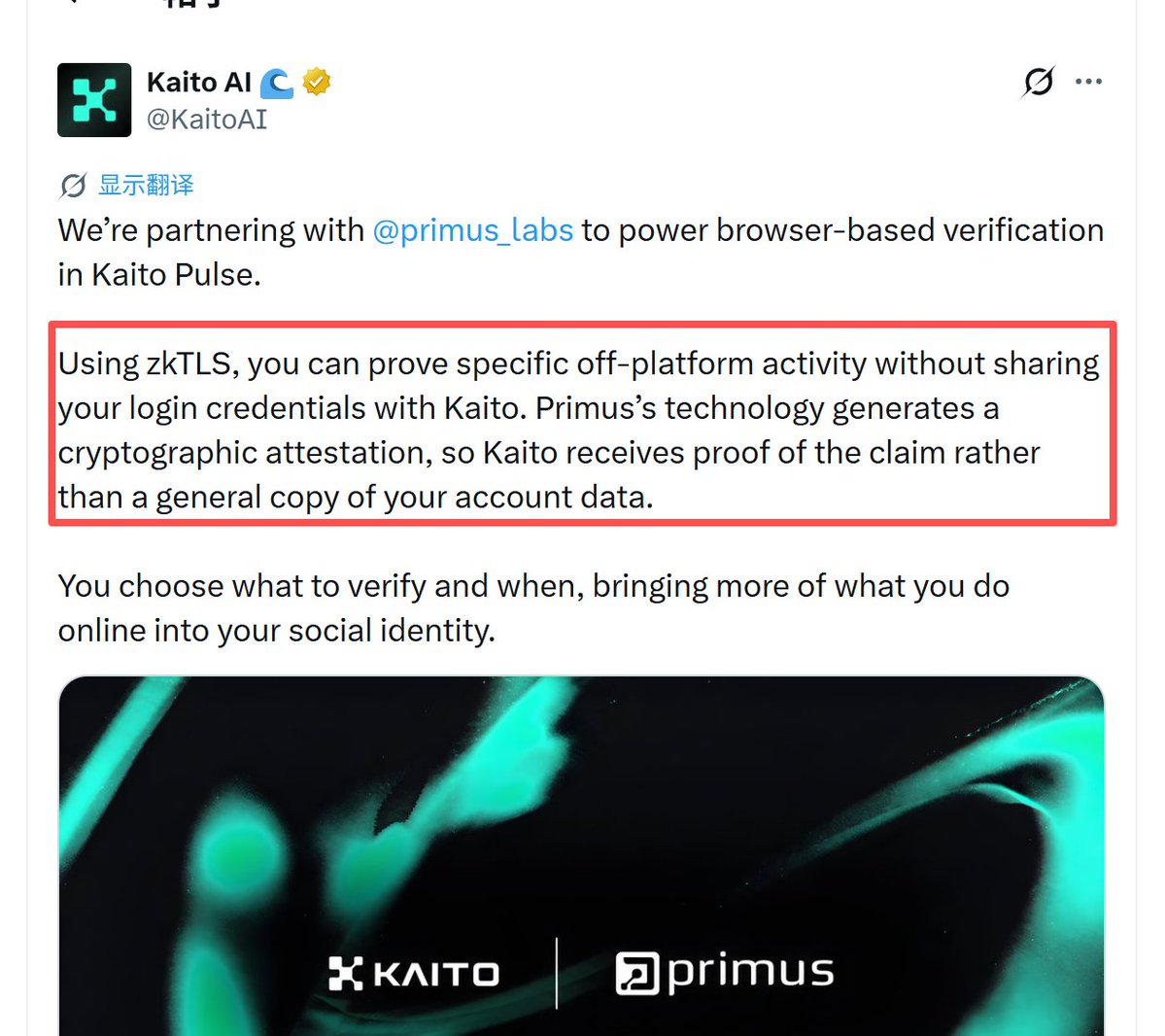
Kaito’s original expertise is something everyone knows—quantitatively scoring social media accounts on Twitter. However, the scoring used to focus mainly on tweet data, which led many people to try boosting their scores by posting excessively. Back then, many people suggested: why not evaluate the actual value of these accounts based on their real trading activity? For example, if a big influencer claims to love BTC, has he really bought a lot of Bitcoin on an exchange? Well, guess what? Kaito has now launched a feature that’s pretty much like that. I dug into some documents and here’s a breakdown for everyone—how does this real trading verification actually work? First off, this verification mechanism is called zkTLS, a cryptographic technology developed by Primus @primus_labs. You probably don’t need much introduction to zk—zero-knowledge proofs are already quite familiar. But TLS is worth mentioning; it’s the transport layer security protocol (also used in HTTPS). Let’s explain with an example. In the past, if someone wanted to prove they had 10 BTC in Binance, there were basically four ways to do it—two official methods and two more informal ones: 1. Binance provides an API; 2. OAuth login authorization; 3. Providing screenshots; 4. Friends in a group chat: “I’ve seen his account offline .” But each of these methods has its own issues: 1. Binance likely can’t cooperate with you anytime, anywhere; 2. Too much privacy exposure; 3. Screenshots could be photoshopped to brag; 4. Both privacy exposure and potential bragging . That’s where zkTLS comes in. So, how does Primus’s zkTLS technology solve this problem? Traditionally, when you access an exchange’s webpage (via TLS), the process looks like this: Your browser → Binance server → User balance is 10 BTC This data can almost be considered authentic because, obviously, Binance wouldn’t collaborate with an influencer to fake screenshots. Now, with zkTLS, the process adds two more steps and becomes: Your browser → Binance server → User balance is 10 BTC → zkTLS verifier → Blockchain This essentially allows Primus’s verifier to replace the “group chat friends” and perform a fair and impartial asset verification. At the same time, thanks to zk, you can selectively reveal only the data you want to share. In other words, you can prove you have a 10 BTC holding (with solid evidence) while keeping private the fact that you once secretly snagged a 0.1 USDT exchange red packet from a group chat . And the whole process doesn’t require cooperation from the exchange—the exchange might not even know someone accessed this data. This is what’s called “proof with privacy,” and it’s one of the real-world applications of zk. I dug a bit deeper into the Primus project—it used to be called PADO and has been working in cryptography for 4 years. They were behind the U→eU feature on BSC. Recently, they secured investment from YZI Labs and are part of YZI EASY S4. This brings us back to the original question—Kaito partnered with Primus to enable asset verification for Twitter accounts without needing cooperation from exchanges. Pretty interesting stuff.