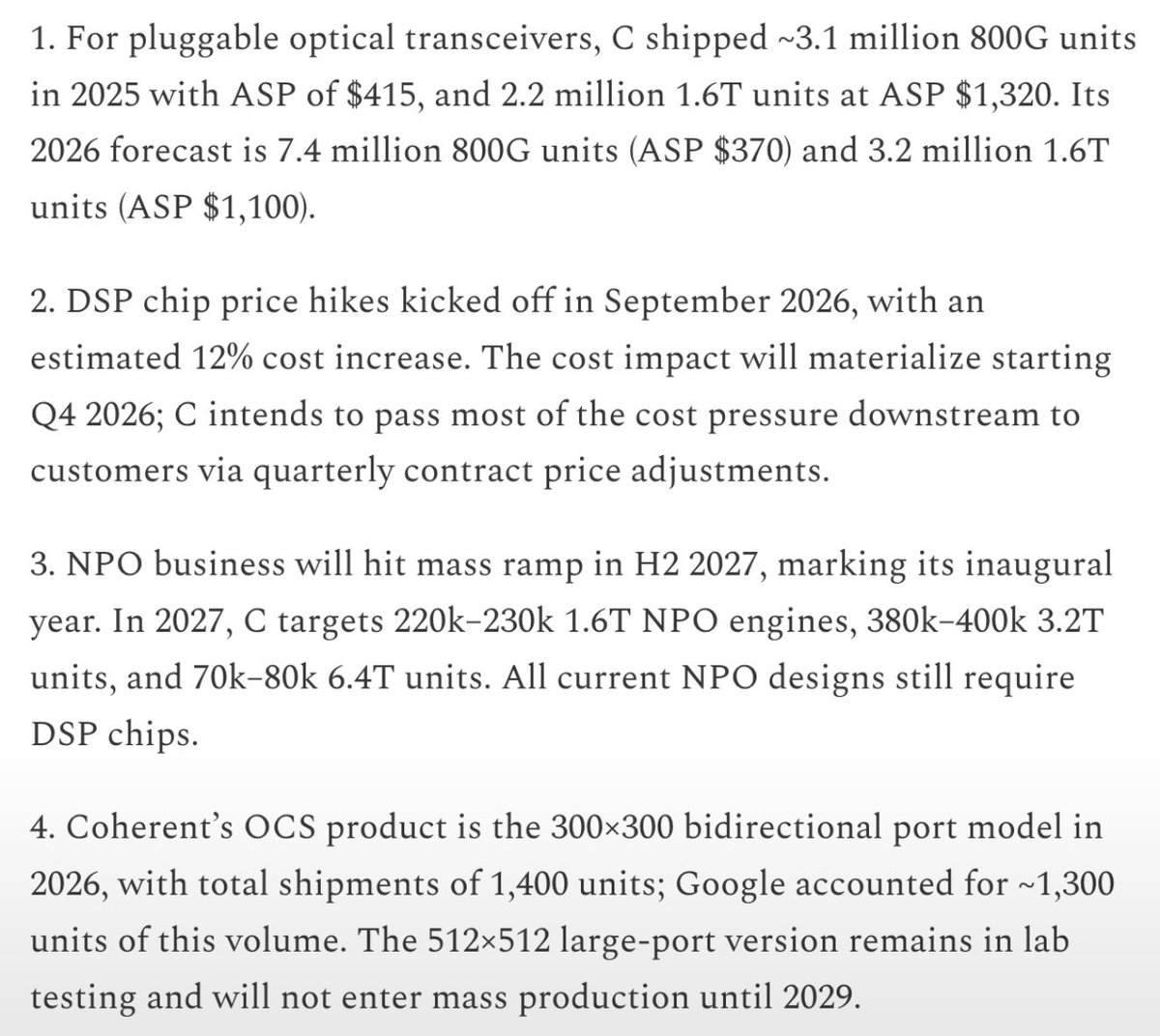
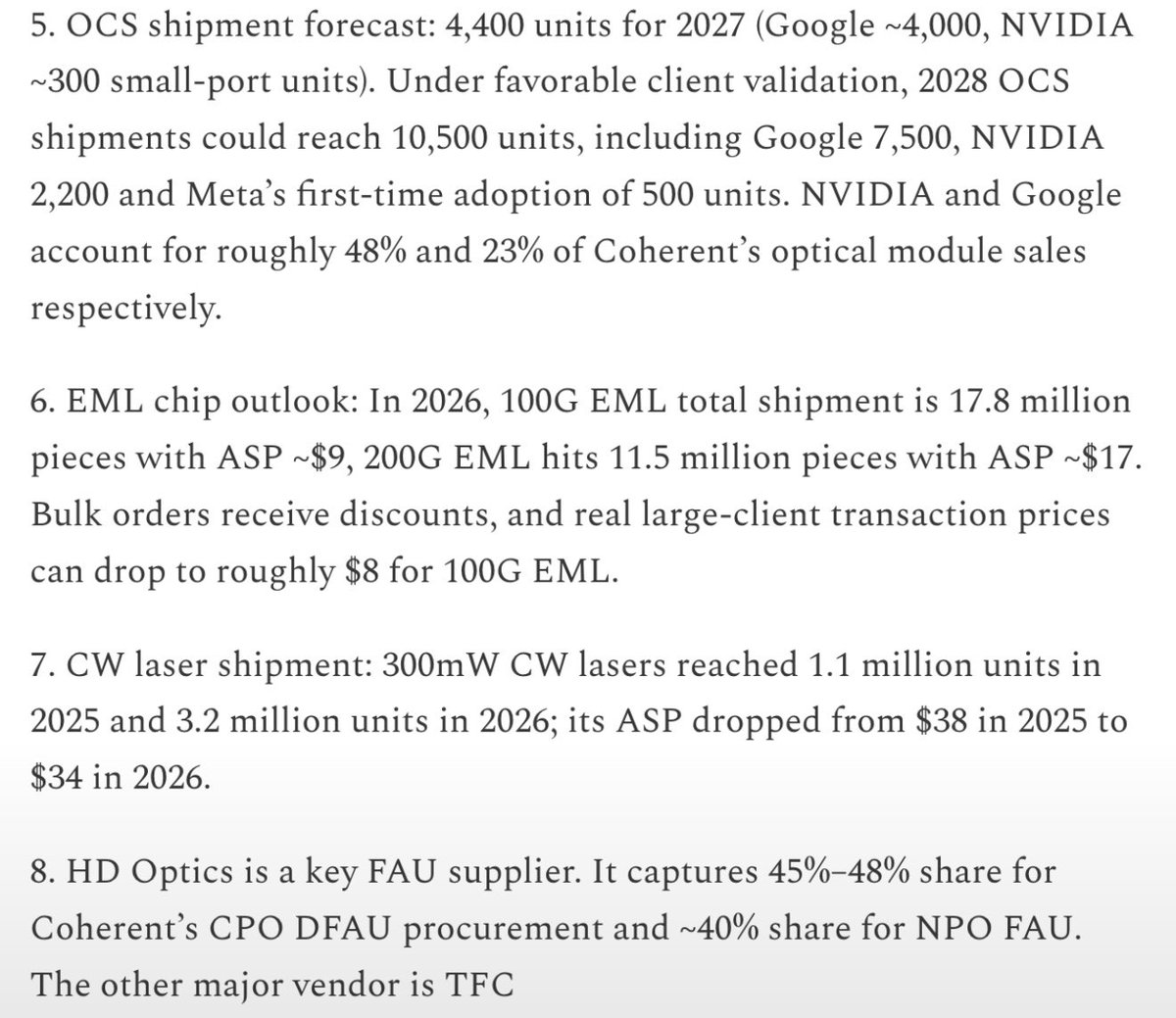
Based on Coherenr's expert interview content, estimate the performance of COHR. 1. Pluggable optical module (quantity and ASP given in the interview): 800G product By 2025, 3.1 million units x $415=$129 million 2026E 7.4 million x $370=$2.74 billion 1.6T product By 2025, 2.2 million units x $1320=$2.9 billion 2026E 3.2 million x $1100=$35.2 billion total By 2025, it is expected to reach $4.19 billion, while 2026E is projected to reach $6.26 billion (+49% year-on-year growth). The quantity is increasing, the unit price is decreasing, and the increase in revenue is almost entirely dependent on shipments. Please note that this is a calendar year, with a difference of two quarters in COHR's financial report (FY2027, July 26 to the end of June 27). 2. Industrial business The interview content directly gave income: $221 million (2025) → $232 million (2026) → $248 million (2027) → $2.7 billion (2028), with a gross profit margin reference to 34.2% in 2025. This is a slow variable. 3. Add the two parts together and do not double calculate the laser: 2025: Module $4.19 billion+Industrial $2.21 billion ≈ $6.4 billion 2026: Module $6.26 billion+Industrial $2.32 billion ≈ $8.6 billion This is not even the total revenue of the company. Lack of telecommunications coherence, stock of low-speed modules, laser/chip for takeaway, and OCS. Cohr's actual revenue for FY2026 (as of June 2026) is approximately $7.1 billion, which is in line with the chassis revenue of $6.4 billion for 2025. 4. The component appears small when viewed individually, and it is highly likely to be an internal component: In 2026 100G EML 17.8 million x approximately $9 ≈ $160 million 200G EML 11.5 million x approximately $17 ≈ $200 million 300mW CW laser 3.2 million x $34 ≈ $110 million. The transaction price for major clients can be even lower (the post states that 100G EML can reach about $8). These support module gross profit and production capacity bottlenecks, not another revenue that can be added up. 5. How to achieve EPS performance in 2026 The profit margin path given in the post is: a net profit margin of about 17.8% in 2026, about 19% in 2027, and a long-term target of 22% -25% from 2028 to 2030. This is closer to non GAAP, not GAAP. The company's non GAAP EPS for FY2026 is $5.61, corresponding to a net profit margin of around 15%, with an upward slope of 17.8%. After filling the gap, the more reasonable range for the total revenue in 2026 is $9.5-10.5 billion ($8.6 billion chassis+telecommunications/other/OCS about $1-2 billion). Based on a net profit margin of 17.8% and diluted share capital of approximately 200-210 million shares: 1) Revenue of $10 billion → Net profit of approximately $1.78 billion → EPS of approximately $8.5-9.0 2) Revenue is only $9 billion → EPS is approximately $7.6-8.0 3) Revenue to $10.5 billion → EPS approximately $9.0-9.4 This is on par with Wall Street's consensus on expected revenue of approximately $10.6 billion and EPS of $8.6-9.4 for FY2027 (July 2026 June 2027). Of course, it is also important to note that the calendar and fiscal year are one quarter off and cannot be directly compared. 6. Cohr's own statement for August is: FY2027 Q1 revenue of $2.2-2.4 billion non-GAAP EPS $1.85–2.05, And it is expected to generate a single quarter revenue of over $3 billion for the first time before the end of FY2027 (June 2027 quarter). If it has already reached $3 billion per season in mid-2027, it makes sense for FY2027 to fall between $10.5 billion and $11.5 billion for the whole year. 8. In 2027 The post did not provide module size, only structure push can be used Industrial $2.48 billion can almost be locked in. Elasticity is in three blocks, and the posts do not have ASP: 1)OCS: 1400 units by 2026 (approximately 1300 by Google); 4400 units by 2027 (approximately 4000 for Google and 300 for NVIDIA with small ports); If the verification goes smoothly in 2028, it can reach 10500 units (Google 7500, NVIDIA 2200, Meta's first batch of 500). If the unit price of a 300 × 300 switch is in the hundreds of thousands of dollars, it will only generate a few hundred million dollars in revenue by 2026; It will not begin to affect the overall market until it more than triples in 2027. The production of 512 × 512 will not begin until 2029. 2)NPO In the second half of 2027, there will be a surge in volume, with targets of 220000-230000 for 1.6T engines, 380000-40000 for 3.2T engines, and 70000-80000 for 6.4T engines, and existing solutions still require DSP. This is the increment after the second half of 2027, not the number for 2026. 3)InP The 6-inch production capacity has doubled in the first half of 2026 and will double again in 2027, corresponding to CW, EML, NPO, and CPO. If the revenue reaches $1.15-12.5 billion and the net profit margin is 19% in 2027, the net profit will be approximately $2.2-2.4 billion, and the EPS will be approximately $11-12. This requires the module to continue to increase in volume, and NPO/OCS to start contributing. Interview data cannot be directly added yet. 9. Several points to note 1) Customers are concentrated: NVIDIA accounts for approximately 48% of optical module sales, while Google accounts for approximately 23%. OCS 2026-2027 is almost like Google. 2) DSP prices will increase from September 2026, with a cost of approximately+12%, and will be reflected from the fourth quarter of 2026; The company plans to transfer the majority of the contract on a quarterly basis. If the transfer is delayed by one quarter, the gross profit margin will be suppressed first. To be clear, these numbers are expert interview notes, not company guidelines. Consistent with the disclosed FY2026 revenue of approximately $7.1 billion and Q4 revenue of $20.5 billion ($1.62 billion for data communication and $430 million for industry), but the calendar year and fiscal year are misaligned, resulting in a direct year-on-year bias. Original content of Cohr expert interview: https://(x.com)/equity research/status/2106353585273569591? s=46&t=k6rimWsEbo2D2tXolYcM-A