Loading...
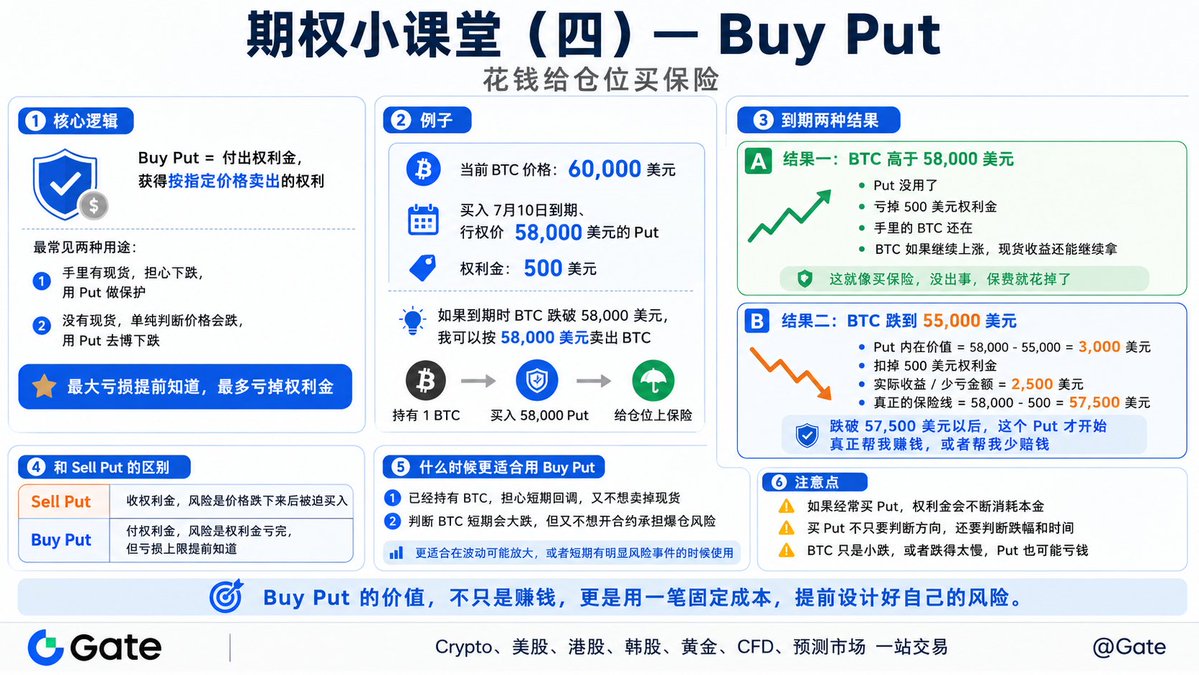
Option Classroom (4) - Buy Put Spending Money to Buy Insurance for Positions The Wheel strategy of Sell Put+Sell Call was discussed earlier, with the core being willingness to buy at low levels and sell at high levels, while continuously collecting royalties in the middle. Today we will talk about Buy Put. Simply put, Buy Put means short selling, because the most common uses of Buy Put are twofold: one is to protect oneself from a price drop when there is a spot in hand, and the other is to simply judge that the price will fall even if there is no spot, and use Put to speculate on the decline. Let's take a simple example, assuming the current price of Bitcoin: native is $60000. I have 1 BTC in my hand, but I am worried that it will fall below $58000 in the next few days, and I do not want to sell BTC now, fearing that BTC may continue to rise. At this point, you can buy a Put. For example, when I buy a Put with an exercise price of $58000 due on July 10th, the premium is $500. The right given to me by this Put is that when it expires, if BTC falls below $58000, I can sell BTC at $58000. Please note that this is for buying Put, so I am the one paying. The $500 royalty is my cost, and the maximum loss is this $500. At 16:00 Beijing time on July 10th, there will be two outcomes. Result 1: BTC is above $58000. For example, if BTC rises to $62000 or is still around $60000, then this put is useless. Although I lost $500 in royalties, I still have BTC in my hand, and I can continue to take the profits from BTC's rise. It's like buying insurance, when nothing happens, the premium is spent. For example, car insurance is like this. Everyone will buy insurance when driving, but no one really wants to get into trouble (insurance fraud is not counted). Result 2: BTC falls below $58000. For example, BTC fell to $55000, but I still have the right to sell BTC at $58000. So the intrinsic value of this Put at this point is: 58000-55000=3000 USD After deducting the $500 royalty I previously spent, I actually earned $2500. Or rather, I lost $2500 less. Because I already have BTC in my hands, this $2500 can offset the losses caused by BTC's decline. I am still selling BTC at $58000. And in fact, I still spent $500 on the cost, so the real insurance price is: 58000-500=57500 USD After BTC fell below $57500, this Put began to truly help me make money, or in other words, help me lose less money. Of course, many times losing less money is making money because I can still buy back this BTC at $55000. At this point, I still have a Bitcoin and $2500 in my hand. It's still profitable. Of course, if BTC only falls from $60000 to $58500, although the direction is correct and BTC has indeed fallen, it still loses money because it has not fallen below the exercise price Put. In general, Sell Put is a premium, and the risk is being forced to buy after the price drops. Buy Put means paying a premium, the risk is that the premium will be lost, but the benefit is knowing the upper limit of the loss in advance. Buy Put is like buying a downside opportunity with fixed costs. For example, if you buy Put for $500, you can only lose up to $500 and won't explode due to BTC's rise. But the problem is also very obvious. If you frequently buy put and don't drop every time, the premium will continue to consume the principal. So Buy Put is more suitable for use when there are suspected fluctuations that may amplify, or when there are obvious short-term risk events, such as macroeconomic data such as CPI, Federal Reserve interest rate meetings, stock financial reports, etc., which are the best insurance periods. @Gate Crypto、 US stocks, Hong Kong stocks, South Korean stocks, gold CFD、 Predicting one-stop trading in the market