Loading...
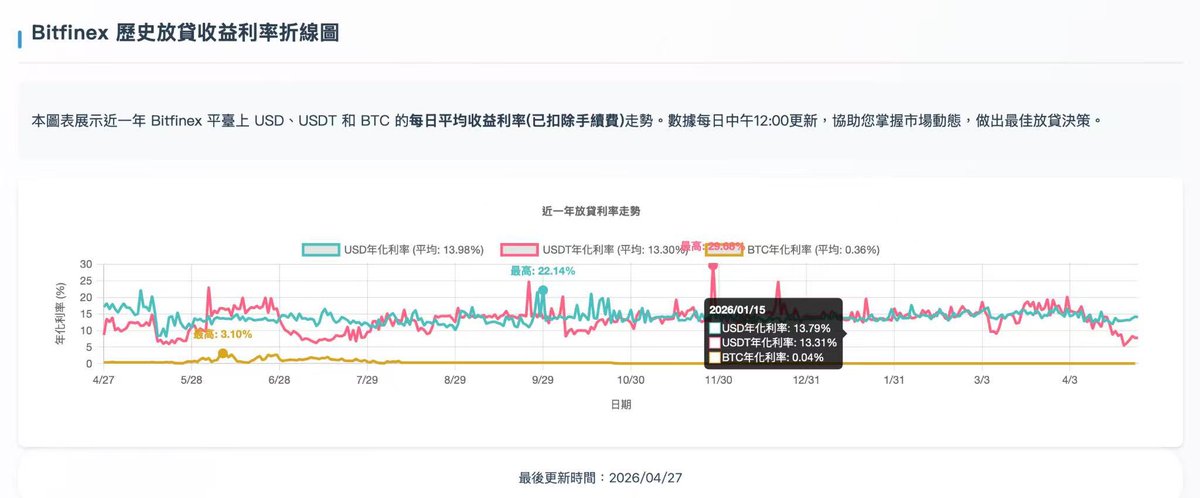
Tell me an insider about an industry. Over the past year, USDT wealth management has been annualized at 13-20% A large number of so-called wealth management products are collected from everyone Then put U back into the 13-20% total lending pool with a scale of 1 billion US dollars 3-5% for everyone Intermediary anger earns 8-15% Why do middlemen make money with this money Come on, I'll teach everyone and smash the jobs of middlemen speaking of Tether, the issuing company of USDT, belongs to the iFinex system, and there is an exchange called Bitfinex under the iFinex system Established in 2012, this veteran cryptocurrency exchange is one of the earliest Bitcoin trading platforms in the world. Its positioning has long been biased towards professional traders, institutional users, and large funds This annualized rate is 13-20% A loan pool with a scale of 1 billion US dollars Bitfinex was established based on its unique advantages 1/Bitfinex lending is not a wealth management tool The essence of Bitfinex lending is a real money lending market. You put money in and the profits come from the financing costs of leveraged traders, not platform subsidies. They borrow USD, USDT, BTC to go long, short, and leverage. You provide funds, they pay interest, and the platform is responsible for matching, custody, risk control, and strong leveling So the 3-5% seen outside and the 13-20% here are not the same level of things, one is the result of being allocated, and the other is the underlying market itself How does this market operate Bitfinex Funding is a P2P lending market that matches order books. You can set your own interest rate and term, such as a daily interest rate of 0.047% for 100000 USD with a term of 30 days. If someone accepts, the transaction will be made, and interest will be calculated per second after the transaction. If no one borrows, the loan will continue to be held What really affects returns is not how high you set the interest rate, but whether the funds can continue to be lent out For the same amount of 100000 US dollars, some people can achieve 10% -12% for the whole year, while others can achieve 16% -18%. The difference lies in whether the interest rate is higher or not Finding a balance between long loan periods, keeping funds in working condition at all times The simplest way is to stick the FRR all the time and hang it FRR stands for Flash Return Rate, which is the weighted average interest rate of all executed loans in the current market Updated every hour, it can be understood as the current real transaction price in the market The meaning of sticking FRR is to continuously place orders at a price close to this, so that they will not be empty for a long time. Interest rates will fluctuate up and down with the market, but most of the time the funds are in a lending state If deliberately raised, such as FRR at 13% and 18%, transactions will only be made when the market suddenly lacks funds, and the funds will be empty for the rest of the time Who to lend money to and how to protect the principal The person borrowing your money is a margin trader who borrows USD or USDT to open leveraged positions, but the funds cannot be withdrawn and can only be used internally within the exchange. Once the position loses money and triggers risk control, the system will automatically force liquidation and prioritize the repayment of financing funds For example, borrowing 90000 with 10000 principal to open a 100000 position, if the market fluctuates in the opposite direction to the risk line, the system will directly close the position and return the borrowed funds to the lender first. This mechanism has already run through multiple extreme market conditions Why is the more chaotic the market, the higher the interest rate Interest rates are essentially the price of leveraged funds. The more intense the market, the more people borrowing money, and the tighter the funds, the higher the interest rate will be When BTC experiences a rapid rise, sharp drop, and burst chain, the lending rates of USD and USDT can jump directly from single digits to 13%, 17%, 20%, or even higher During periods of high volatility in history, the USD lending rate approached 30% APR, which is not the norm but can occur periodically 5/How to set the most convenient After the funds come in, transfer them to the Funding wallet and directly place an FRR order with a term of 7 or 30 days. Turn on automatic renewal to keep the funds in a borrowed state This method will not reach the highest point, but it will basically not idle, and in the long run, it will approach the real market return range 6/Want to eat a little more interest rate You can take out a portion of the funds separately and set a higher interest rate when the market fluctuates, such as setting it at 18% or 20% when the market is clearly short of money, specifically for short-term high demand The remaining majority of funds will continue to stick to FRR, so that overall returns will not be dragged down due to idle trading What is the approximate level of return for 7/ Calculated at an annualized rate of 17%, the gross profit of 100000 US dollars per year is approximately 17000 US dollars. After deducting about 15% of platform service fees from the gross profit, the net profit is approximately 14450 US dollars, which translates to nearly 40 US dollars per day and around 1200 US dollars per month Similarly, if 100000 US dollars are invested in 3% wealth management, it is 3000 US dollars per year, and if invested in 5% wealth management, it is 5000 US dollars per year The difference is between 9000 and 11000, and after scaling up, this difference will be very significant The same amount of money, outside it is the income after distribution, here it is the price of underlying funds. With one more step in the path, the income will differ significantly Here, Bitfinex entrance: https://www. (bitfinex.com)/sign-up? refcode=EZr71Ede5